Evangelicalism and Injustice Part I

Evangelicalism has been very good at preaching the good news, but falls a bit short on doing justice.


I am taking a break from considering the difference between “the righteous” and “the wicked” in Scripture to return to a related topic that erupted publicly in recent weeks: racial injustice. It is related because God’s character is righteousness and justice at His core.

As an attorney, I have had the privilege (and sacred duty) to devote some time to a local organization known as Administer Justice that serves the poor, vulnerable and under-privileged in communities around the country. A great many of “those people” are minorities, immigrants and “the working poor”. I’ve had the honor of getting know some real servants of the Gospel in the process, like Bruce Strom, the founder and executive director of this organization.

I am reading through his book, Gospel Justice. I’ve owned the book for a long time, probably years. I started it a long time ago, and I am still not through it yet because ( I admit) that other, more “interesting” subjects and diversions have distracted me from the seemingly mundane subject of justice.

If I truly want to know God’s heart, to follow Jesus and to work out my salvation as God works within me to will and to act according to His good purpose, though, I need to be concerned about justice – because it’s at the foundation of God’s throne. (Psalm 89:14)

We can’t talk about justice in the United States in the 21st century without talking about racial disparities resulting from centuries of racial injustice. The recent events following the killing of George Floyd (and others) have focused national attention on the issue. As the national dialogue continues, we in the Body of Christ need to engage.

There is a great need for the Body of Christ collective to participate as God would have us get involved in the discussion, action and changes necessary to address racial injustice. My own neighborhood in the Body of Christ is the American evangelical church. Thus, I write this with my evangelical brothers and sisters in mind.

The following passage in Bruce Strom’s book inspires my thoughts today:

“The division between Jews and Gentiles was the great divide of the first century.
“In America that great divide is race, and it remains a leading contributor to injustice. In their book, Divided by Faith, Michael Emerson and Christian Smith examine the role of white evangelicalism in race relations. Based on extensive interviews and study, they conclude that the evangelical church, with its focus on individual salvation, not only misses the opportunity to break down the great divide between the races, but also contributes to it.
“This view is shared by my friend Ed Gilbreath, who wrote Reconciliation Blues. ‘A sad tendency of evangelical faith is to elevate the act of evangelism over the humanity of the people we want to reach…. Apparently, any time an ethnic minority speaks out against race-related injustice, he risks being branded a malcontent in need of therapy.’
“Racial injustice is real….
“We must not walk on by [like the priest and Levite in the parable of the Good Samaritan] as if racial injustice does not exist. We should listen to our neighbors of color who understand well the injustices in their community. And our friends of race should not give up, but seek opportunity to lead by example.”

I am reminded that the evangelical tradition is informed by people like Luther and Wycliffe. They championed the principal that salvation is by faith in the grace of God, not by works that we can do. That and the primacy of Scripture and the need for individual members of the Body of Christ to read Scripture for themselves and to pray to God our Father – not through some intermediary, but directly – one on one.

These things have driven the evangelical church to seek and save the lost, proclaiming the Gospel with the message of salvation to individuals who believe, repent of their sins and put their faith in the lordship and salvation wrought by Jesus on the cross. These are hallmarks of evangelicalism. They are indeed central to the purposes of God.

I am reminded further that, when Jesus stood up in the Temple to announce the beginning of his ministry in Luke 4, he read this from the Isaiah scroll:

The Spirit of the Lord is upon Me,
Because He anointed Me to preach the gospel…. (v.18)

When the evangelical church considers the Great Commission –  “[G]o and make disciples of all nations….” (Matt. 28:19-20) – preaching the Gospel comes primarily to mind.  Evangelicalism has been a champion of preaching the Gospel. 

But, I think that sometimes we forget that Jesus didn’t stop there. The passage in Isaiah from which Jesus read continues on well past preaching the good news (quoting from Isaiah 61:1):

He anointed Me to preach the gospel to the poor.
He has sent Me to proclaim release to the captives,
And recovery of sight to the blind,
To set free those who are oppressed,
To proclaim the favorable year of the Lord.

Continue reading “Evangelicalism and Injustice Part I”

Who Are the Righteous and the Wicked? Part II

Righteousness and justice are what they are because God is who He is.


Who are the righteous? Who are the wicked?

This was the question prompted in my heart recently as I read Psalm 1, which begins with a warning not to walk in step with the wicked, stand in the way of sinners or sit in the company of mockers. I describe how that question was prompted in Part 1 of this blog series.

Beyond equating the wicked with “sinners” and “mockers” (and speaking to the company we keep), Psalm 1 doesn’t go into much detail on the characteristics of the wicked (or the righteous). I realized as I responded to the prompting in my heart that I had some old assumptions about those things that might not be true, or at least not completely true, so I set out to dig a little deeper.

As Christians, we know that no one is righteous; we have all sinned and fallen short. We know that righteousness is credited to those who believe God and have faith (trust) in Him. We might assume, then, that there isn’t much more to it – that believing God, and the Bible and going to church is all it takes to make a person righteous; and, of course, that these things distinguish the righteous from the wicked.

This view, though, is only partly right. Even demons believe (Jam. 2:19), but that doesn’t make them righteous! We need to dig a bit deeper to develop a more complete understanding of what it means to be righteous. God, of course, is righteous, and our righteousness is gained only in relation to Him – by believing in Him – by what does that mean for us?

Continue reading “Who Are the Righteous and the Wicked? Part II”

Who Are the Righteous and the Wicked? Part I


I am on a year-long plan to read through the Bible chronologically (which is not exactly the way the Bible reads if you start in Genesis and read straight through to Revelations). I also read a “verse of the day” in the Bible app (YouVersion) that I use. I begin most mornings with reading the passages of the day in the year-long plan I am following and the Scripture of the day.

Today’s chronological reading begins with Psalm 1[i]. The verse of the day is Psalm 1:1-2:

Blessed is the one
who does not walk in step with the wicked
or stand in the way that sinners take
or sit in the company of mockers,
but whose delight is in the law of the Lord,
and who meditates on his law day and night.

I almost glossed over the fact that the chronological reading of the day and the verse of the day converged on the same text – Psalm 1. I kept reading out of force of habit, but that still, small voice was whispering in my ear.

“Maybe”, I thought, “God wants me to focus on Psalm 1 today. Maybe He has something to say to me.”

It would take too long for me to explain where I am in my journey of praying, reading and meditating on Scripture and what God has been laying on my heart or how I got here. Suffice it to say that my attention was drawn to the contrast of the righteous and the wicked in Psalm 1.

I realized as I read Psalm 1 a second time, more carefully, that I have some assumptions about those two categories of people – the wicked and the righteous – that I have carried a long time and which may not be completely accurate.

As I have been reading chronologically through the Bible, I have been focusing on the theme of righteousness and justice. I realized this morning that what I have been learning about righteousness and justice reveals that my assumptions about righteousness and wickedness may be a bit shallow and, therefore, a bit off center.

Who are the righteous and the wicked?

That is the question that I believe God prompted in my heart.

Continue reading “Who Are the Righteous and the Wicked? Part I”

Comments on Freedom and the Clash of Ideas

If any speech or expression is deemed unworthy of protection on the basis of its content, no speech or expression is safe.


“The clash of ideas is the sound of freedom.”  (Lady Bird Johnson)

I grew up in the 1960’s and 1970’s, bring born at the very end of 1959. My young, impressionable mind recalls the assassination of JFK, Robert Kennedy and Dr. Martin Luther King, Jr. I remember watching the riots during the Democratic National Convention in Chicago, the Kent State protest and shooting, the footage of the Vietnam War and the Nixon impeachment on the nightly news.

The world seemed a chaotic place, no less than it does today, on this 4th day of July, 2020.

In the 1960’s, the dissident voice championed First Amendment rights that included the freedom of assembly and freedom of speech. I remember that freedom cry as a child superimposed over news footage of a burning US flag. The patriot in my young heart was equally shocked by the flag burning and impressed by the necessity of the freedom that allowed that flag to burn.

In law school, I learned the nuances of the jurisprudence that grows out of our US Constitution in which the First Amendment is enshrined. The clash of ideas is so sacred in our constitutional framework that it allows even the idea of abolishing that very framework to be heard.

In the 21st Century, many things have changed, while somethings have remained the same. Many of the dissident ideas from the 1960’s have become mainstream, and more “conservative” voices have become dissident. I am no longer shocked by the burning of the flag (and, perhaps, the point of burning a flag is no longer poignant for the same reason).

The angst of the 1960’s of my youth has been replaced by the angst of the 21st Century of my middle age. The reasons for my angst are much different, yet very much the same at their core. I have grown and changed in my views, but the emotional strain of the human condition remains.

I fear, at times, that the framework that protected the freedom to burn US flags in the 1960’s might, itself, be destroyed in my lifetime, or the lifetime of my children, by the fire of ideas that are antithetical to that freedom.


The ideas in colleges and universities around the country that seem to dominate those institutions promote the silencing of dissident voices. Speaker engagements are canceled as the loudest voices want not even a whisper to be heard in opposition.


One theme of the dominant social, philosophical and political ideologies that thrive on college campuses today is that certain voices should be silenced, while other voices should be magnified – a kind of totalitarianism of ideas. This worldview would destroy the foundation of the First Amendment if the First Amendment is not held firm.

I am shocked by this new predominant view as I was once shocked by the burning of a US flag. The shock stems not from the evils in society this ideological view aims to address, as I find some common ground in those concerns. I am shocked that the proposed remedy involves weakening the most fundamental freedom that protects freedom itself – the freedom of ideas and the right to express them.

The idea of “hate speech”, as well-intentioned as it sounds, is inimical to a framework of freedom that protects the clash of ideas. Nowhere is freedom more necessary to be protected, than at the intersection of ideas and the right to express them. One person’s hate speech is another person’s freedom of expression.

If we allow the idea of hate speech into the fabric of First Amendment jurisprudence, we threaten its very foundation. What we characterize as “hate” today is subject to change with changing societal norms tomorrow. No speech is safe from the label of “hate” if labels are allowed to silence speech.

While such a worldview has some appeal and laudable goals, it cannot be advanced by the abolition of freedom of speech. Yet, I realize at the same time, that freedom, real freedom, protects even those ideas that are antithetical to freedom and demands that they be heard.


As shocked as I was in my naïve youth to watch the US flag burn in the streets of America, I understood the importance of allowing that expression to be heard. That I am no longer shocked by that expression is of no consequence.


In fact, freedom of speech is nowhere more vital than the protection of speech that is offensive. Favored speech doesn’t need protection.  If any speech or expression is deemed unworthy of protection on the basis of its content, no speech or expression is safe.

Continue reading “Comments on Freedom and the Clash of Ideas”

The Redemption of Korah: the Sons of Korah

I would rather be a doorkeeper in the house of my God than dwell in the tents of the wicked.


Have you ever heard of the rebellion of Korah? How about the Sons of Korah? The rebellion of Korah and the Sons of Korah have a connection with each other, and the connection is fascinating.

The rebellion of Korah occurred during the 40 years Moses led the nation of Israel in the wilderness following God’s miraculous deliverance of the people out of captivity in Egypt. Korah rose up during their time of desert wandering and rallied a group of people to oppose Moses.

Korah was a grandson of one of Levi’s three sons (Kohath). He was a Levite, which meant that he was involved in the Levitical duties of caring for the tent of meeting and the tabernacle where God’s “presence” resided in the midst of the people. The Levitical duties were sacred and honorific.

The Kohathites were specifically in charge of caring for the Ark of the Covenant, the table, lamp stand, altars, articles of the sanctuary and the curtain behind which the priests performed the sacred rituals God passed down to Moses. (Numbers 3) Unlike the other Levites who were allowed to transport their items in carts, the Kohathites were required to hand carry their items.

The Ark of the Covenant was particularly sacred, of course, but the Kohathites may have been jealous of the ease enjoyed by the other priests who didn’t have to hand carry the items for which they were responsible. We don’t know. The text doesn’t tell us.

The text does tell us that Korah and several others rallied 250 other men in public opposition to the authority of Moses. They claimed that all the people of Israel are holy, and they questioned why Moses and Aaron “exalted themselves” above everyone else. (Numbers 16:3) They might as well have said more pointedly, “Who put you in charge?!”

Moses responded by challenging Korah and his followers to put the issue before God. He said, “This is how you will know that the LORD has sent me to do all these things and that it was not my idea.” (Num. 16:28)

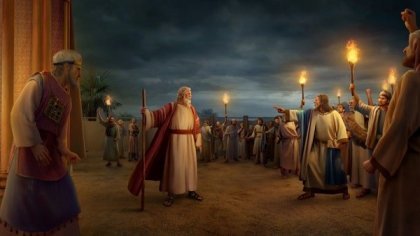
As the story goes, they gathered publicly before all the people in front of the Tent of Meeting, each man with incense burning in censors. This is how Moses and Aaron faced off with the contentious lot led by Korah. I am really not sure of the point of this faceoff. If anyone has any insight, post in the comments below.

In any event, God warned Moses, and Moses warned the crowd to stand back. When he finished talking, the ground opened up and “swallowed” up the 250 men rebels that supported Korah in his opposition to Moses. (Numbers 16)

The story stands as a warning to those who are not content with their place in the world and people who get jealous of others to whom God has given greater responsibility and authority. God chose Moses and Aaron to lead the people. By opposing God’s chosen leaders, Korah and his band of rebels were ultimately opposing God and God’s authority.

From this story, I assumed that Korah and his clan were wiped out. The text seemed to imply that all his family were included in the 250 agitators. It turns out that my assumption was wrong, however, because the “sons of Korah” appear many generations later, and their place in the history of God’s people is truly intriguing.

Now, for the “rest of the story”, as Paul Harvey used to say.

Continue reading “The Redemption of Korah: the Sons of Korah”