Another Look at God in Light of the Evil in the World (Part 1)

Love is a key component to understanding the problem of evil.


I introduced the problem of evil in a previous blog post, looking at God in light of the evil in the world. My writing is prompted by the discussion series being conducted by over 800 churches in the Chicago, explore God, taking on some of the big questions about faith.

I have tackled various aspects of the problem of pain before, but getting to a place of understanding is an ongoing process. I write as a way of working through issues to gain understanding. My understanding continues to grow and sometimes to change.

In the previous post, I suggested that we should approach the problem of evil in a similar fashion to the way we approach science,. Not that faith questions are susceptible of scientific inquiry, per se, but the answers aren’t always obvious. Sometimes they take considerable work on our part. We shouldn’t be lazy and give up simply because the work is hard.

As with science, we need to start with a premise. For the theist, the premise is that God exists. For the Christian, the God who exists is revealed in Scripture. He is a maximal being – maximally great, maximally good and maximally powerful. Of course, this is where the problem of evil arises for the Christian.

The problem of evil takes on different form, depending on the way each religion describes God. Not all religions describe God as a maximal, personal and volitional Being. For the Christian, therefore, the problem of evil leads to the question:

How can a good and all-powerful God allow evil, pain and suffering to exist in the world?

The skeptic would say: 1) either God isn’t all powerful, or 2) God isn’t good; or 3) God doesn’t exist at all (at least not as Christians conceive God).

I am not going to argue for the existence of God in this article. I am going to assume God exists as Scripture reveals Him. The proofs are satisfying to me, and I believe intellectually and experientially in the God of the Bible.

If God is God, then, how do we reconcile the issues posed in the problem of evil?

As with any complex problem, we need to hold to the premises we are given. Is there a way to do that? Can we harmonize these things? I think we can.

Continue reading “Another Look at God in Light of the Evil in the World (Part 1)” →

Another Look at God in Light of the Evil in the World (Intro)

We live in a complex world, and sometimes the answers in theology, as in science, are complex.


Over 800 churches in the Chicago area have been carrying on a discussion under the heading, Explore God. The discussion is prompted by a series of seven questions. A couple of weeks ago, the question was this: Why Does God Allow Pain and Suffering?

This is “the” hard question. It’s a question with which most believers struggle to reconcile with the idea of a loving and all-powerful God. It is the stated reason why men such as Darwin and Einstein were not believers in the God of the Bible.  It’s a question we should take seriously, though the answers may not be easy or simple to understand.

As with the natural world, answers to very difficult questions like the problem of evil may be complex. We live in a complex world in which the theory of relatively seems to be contradicted by quantum theory. Sometimes answers aren’t readily seen and require careful study and reflection to determine. Sometimes we have to dig, and engage our minds and work through the details.

How long have we been studying the stars and galaxies and the tiniest particles of the world? And we haven’t yet begun to fathom all the mysteries. Little by little we make progress. Since the days of Job (from the oldest book in the Bible), the problem of evil has been a mystery to be fathomed. As with science, we have made a great deal of progress, but to begin with, we need a good understanding of the problem.

In a nutshell, it is this: If God is all-knowing, all-powerful and all good, there should be no evil in the world.

I have written about and around this issue for years. There are answers. There are explanations and ways of understanding why a good, all-powerful God puts up with evil in the world. For some, the answers may be intellectually viable, but they fall short emotionally. I would not pretend that the issue is an easy one to grapple with.

As in science, though, we have to start with a premise. For this issue, we start with the premise that God exists, that God is good, and God is all-powerful. How do these things fit together in harmony (if they can be fit together in harmony)?

Continue reading “Another Look at God in Light of the Evil in the World (Intro)” →

Doubts About the Viability of Darwinian Theory Increase

sad chimpanzee


I am reblogging this post as I have the distinct impression that most of the world, including most of the academic world, don’t realize that the Theory of Evolution, which seems to be accepted more like a fact in modern society, is still not completely settled. While the official face of the scientific world continues to bow in homage to Darwinian Theory, doubts of its ultimate viability and explanatory scope are increasing.

This is not to say that doubts about evolution, generically, are increasing. Evolution can mean any number of things, including the adaption of species over long periods of time. Garden variety evolution is not seriously in question (to put a layman’s spin on it).

Rather, evolution as an explanation of the origin of life and which defines the entirety of the biological process, from beginning to end, is still in some flux. If you don’t believe me, listen to Stephen Meyer and Perry Marshall debrief the Royal Society meeting of eminent biologists last November. (See Unbelievable? What happened to evolution at the Royal Society? Stephen Meyer & Perry Marshall)

Their report (as well as others) reveals a Neo-Darwinian theory in crisis. Many scientists are finding it increasingly difficult to maintain the old paradigm, even with a face lift, in light of ongoing research and discovery. The old model is straining under the pressure.

It isn’t any wonder, then, I suppose, that the number of scientists willing to sign a petition expressing skepticism about the contemporary theory of Darwinian evolution has risen ten times since 2001.

Skepticism About Darwinian Evolution Grows as Over 1000 Scientists From Around the World Declare Their Doubts About Darwinism WASHINGTON, Feb. 5, 2019 /PRNewswire/ — Over 1000 doctoral scientists from around the world have signed a statement publicly expressing their skepticism about the contemporary theory of Darwinian evolution, according to Discovery Institute. The statement, located online at http://www.dissentfromdarwin.org, reads: “We are […]

via Doubting Darwin — God does not believe in atheists

Commitment to a Worldview

The commitment to atheism can be as dogmatic as any other belief.

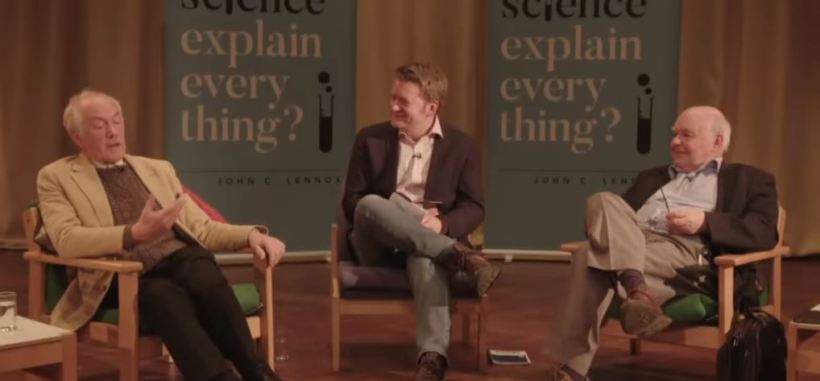
From the Unbelievable! discussion involving John Lennox vs Peter Atkins – Can science explain everything?

In a recent discussion on theism and atheism with the Oxford professors, John Lennox and Peter Atkins representing both ends of the spectrum, the dialogue stopped, and a time of questions and answers began. One person, a scientist, wrote in saying that he is an atheist, but his commitment as a scientist to follow the evidence suggested to him that God does exist. For him, the issue isn’t the evidence, but his own feelings, instincts and emotions.

When this question was put to the two guests to respond, the answers were very intriguing. John Lennox, the Christian, suggested that the man should continue to question and research and to test the position (that God exists) personally, not from afar. The response of the atheist, Peter Atkins, was simple: stick to your “commitment to rationality” (which to him presupposes atheism).


Think about it. Would you suppose the answer, to stick to your commitment, would more likely come from the Christian or the atheist? I would. I think most people would expect that answer to come from the Christian, but it doesn’t in this case. It’s the atheist sticking dogmatically to a presupposition.

Continue reading “Commitment to a Worldview” →

The Plurality of One God


I have explored the question, Is Jesus God?, by looking first at the claims Jesus made about himself. After all, if Jesus didn’t really claim he was God, we would have to wonder about others who make that claim. Among other things, the religious authorities or his time understood what Jesus was saying – that he was equivalent to God – and they condemned him for it. If his detractors thought he was making that claim, that’s pretty good evidence that he di, indeed, claim to be God.

I also explored what people in the time of Jesus said about him. Some people claim that the early followers of Jesus didn’t really think he was God, that the God-claim arose generations later in the way of a legend. Unless the Gospels and letters collected in the New Testament were written generations later, clearly, his early followers, and even people opposed to him, believed that he was God (or at least claimed to be God).

One puzzle that remains, though, is how the claims made by Jesus and his Jewish followers fit into their theological framework. Judaism was built on the foundation of one true God. Jesus, himself, quoted the sacred text handed down from Moses: “You shall worship the Lord your God and serve him only.” (Luke 4:8, quoting Moses Deut. 6:13) So how do we square affirmation of the monotheistic theology of Judaism with his claims that put him on a par with God?

There is no dearth of Christian commentary on the Trinity, but I turn to a former Muslim for help. Muslims have a robustly monotheistic view of God (Allah). In Islamic theology, Allah is not a father and does not beget sons. He is single, undivided, and unequivocally one God.

For that reason, I turn to Nabeel Qureshi as my source for an explanation of the Trinity. Nabeel was a devout Muslim turned Christian after his college years, and he went on to become a Christian apologist.

Nabeel recalls that one of the most recited passages of the Qur’an is Surat-al-Ikhlaas, 112:2 – “God is not a Father, and He is not a Son.” He says this “doctrine above all doctrines” in Islam is known as Tawhid – God is absolutely one and cannot be father or son.

The question that troubled Nabeel when he was comparing the two religions is the same question I seek to answer today: How can the Trinity be harmonious with a monotheistic doctrine?

Continue reading “The Plurality of One God” →