Ravi Zacharias: The Isolation, Insulation and Danger of Greatness

The tendency to put gifted people with strong and charismatic personalities on a pedestal is a weakness in the church.

Anyone who pays any attention to apologetics has probably heard of Ravi Zacharias. Before his death last year, he traveled the world for decades as an evangelist and apologist. He spoke at secular universities and challenged non-Christian thinkers and leaders to consider Christian claims and the gospel worldview.

He was a winsome and charming speaker, erudite and polished. He toured the greatest institutions of higher learned on multiple continents and engaged people of all religions and atheists alike in deep conversations on the truth of the Gospel.

His organization, RZIM, boasted top notch Christian thinkers who contributed to the worldwide apologetics ministry. Sam Allberry, Amy Orr-Ewing, Abdu Murray, Nabeel Qureshi, and others were a formidable group of Christian apologists. Ravi Zacharias was greatly loved and much admired for his debonair, sharp-witted oratory and ability to answer people who challenged Christian thinking in public arenas.

I listened to him often and enjoyed his approach and insight. Thus, when a scandal erupted about the credentials on which he identified himself as “doctor”, I was quick to dismiss it. The accusation came from Steve Baughman, an atheist, charging Ravi Zacharias with falsely using the title, “Dr.”, and embellishing his connections to Oxford and Cambridge universities.[i]

Baughman seemed to “have it out” for Ravi Zacharias. He created a website, Ravi Watch[ii], in which he doggedly investigated the apologist and purported to document a number of false claims made by Ravi Zacharias. He was an atheist, so it was easy for Christians to dismiss his claims. Ravi Zacharias did have three honorary degrees, so the confusion about whether he earned a Ph.D seemed overblown.

Around the same time, though, some other allegations were emerging. A woman in Canada, who was a large donor to RZIM, went public with accusations that Ravi Zacharias developed a long-distance relationship with her, requesting nude photos from her and “sexting” with her. Ravi Zacharias strongly denied the claims, but he settled a lawsuit with the accuser for which the parties signed a non-disclosure agreement.[iii]

Most of the Christian world, including me, believed that Ravi Zacharias was being unfairly targeted by people who opposed his worldview and had an axe to grind. The allegations seemed out of character to the man we “knew” from his public ministry. The charges seemed wholly incongruent.

The charges, however, were true.

Sometime after his death on May 19, 2020, additional allegations began to emerge. They came from other sources, other women.

To its credit, RZIM hired an independent firm to investigate the charges. On February 9, 2021, a 12-page report was released from the investigation by RZIM.[iv]

The investigation confirmed allegations and disclosed many more. The report ends with these words:

“Our investigation was limited to Mr. Zacharias’s sexual misconduct, and even as to that issue it was not exhaustive. We acknowledge that we have not spoken to all individuals who may have relevant information to provide. We strived to balance the need for completeness with the need for expediency, and we are confident that we uncovered sufficient evidence to conclude that Mr. Zacharias engaged in sexual misconduct.” (emphasis added)

The release of the report was followed by an apology from the leaders at RZIM and shock from the rest of the Christian world.[v]

In the weeks that followed, the world of Christian apologists and the church have been wrestling with these disclosures. Everyone is talking about it. People are asking: How did it happen? What can we learn about it? What can we do to prevent this from happening again?

Like most shocking events or discoveries, the furor will die down, and we will go back to our daily lives after we have exhausted our initial angst.

We won’t really know the longstanding effects of this scandal for years. Even then, the ripples of this scandal in the Christian world will largely merge into the ether of all the happenings in the world, good and bad, that affect the way people see things and respond to them.  

It will be remembered by many as a reason why they no longer believe, or never believed in the first place. The hopes and faith of many people have been affected. Some will find a way to move on, but others will be dogged by it and a million other doubts.  Many will be tempted to categorize it as an aberration, and for many nothing will change.

I didn’t plan on writing about the Ravi Zacharias scandal. I wasn’t sure I had anything to add to what has already been said. I am skeptical of the real, long-term benefits of the hand-wringing exercises we do when these things occur. We go through the exercises, but we go back to our regular routines as quickly as we are done, and the change we think we are accomplishing isn’t realized.

Not that I have the answers. I have a hard enough time with long-term change in myself from the besetting sins of my youth that haunt me in middle age, and I am in no place of influence.

Yet, we must try. The Christian life is nothing if not a continual posture of repentance, turning to God to receive forgiveness, and desiring to do better. We would truly be doomed if not for a God who forgives us more than seventy times seven. So, we must turn to the Author and Perfecter of our faith – again, and again – for our answers.

Continue reading “Ravi Zacharias: The Isolation, Insulation and Danger of Greatness”

There Is Now No Condemnation, but Go and Sin No More.

When Jesus said, “Neither do I condemn you,” it isn’t the end of the story.

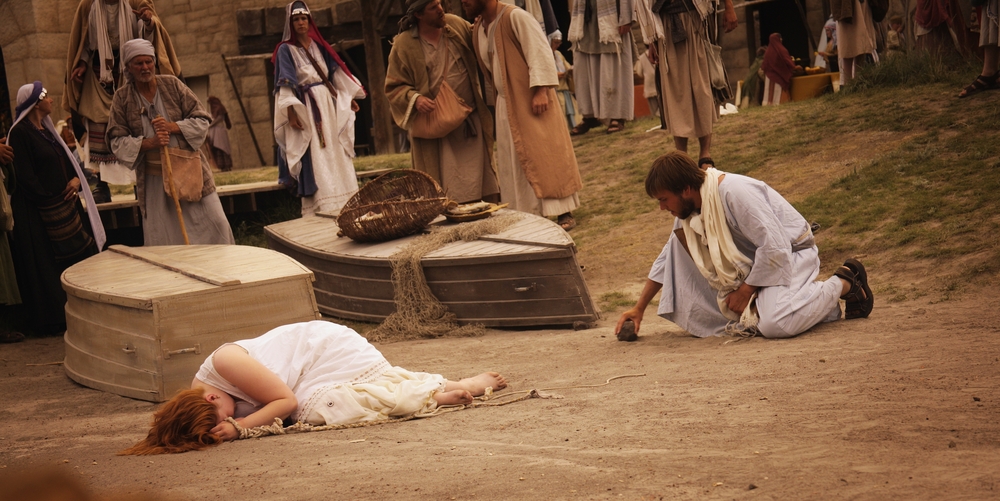
I have been thinking lately about the phrase, “Do not go on sinning.” These were the words Jesus spoke to the woman caught in adultery after he rescued her from her accusers. We forget about them, perhaps, because of the force of the rest of the story.

The Pharisees brought her to Jesus one day and challenged him: “’Teacher,’ they said to Jesus [with a hint of affected deference, I imagine], ‘this woman was caught in the act of adultery. The law of Moses says to stone her. What do you say?’”

They were trying to trap Jesus into saying something they could use against him, but Jesus was not shaken or disturbed by the dilemma they posed him. He stooped to write in the dust with his finger.

The awkward silence was broken finally by a demand for an answer. Jesus obliged,

“Alright, but let the one who has never sinned throw the first stone!”

John 8:7

Significantly, Jesus didn’t deny what the Law says. His answer implied agreement with the judgment of the Law, but his answer turned the table on the accusers and focused attention on them.

His answer is reminiscent of apportion of the prayer that Jesus taught his followers to pray and of a segment of the Sermon on the Mount:

“And forgive us as we forgive those who trespass against us.”

Matt. 6:12

“[I]n the same way you judge others, you will be judged….”

Matt. 7:2

The pregnant silence continued again, as Jesus returned to writing in the dust with this finger. This time, the demands for an answer slipped away with the accusers, one by one, leaving alone with the accused woman.

The focus of the encounter had shifted dramatically from the adulterous woman to her accusers. Their self-righteous smugness turned to bitter disappointment and shame as Jesus put them in their place.

Now alone with the woman, Jesus asked her, “Where are your accusers? Didn’t even one of them condemn you?”; “No, Lord,” she replied. “Then, “Neither do I,” Jesus said.

This seems to be the perfect way for Jesus to end the story. The accusers of the adulterous woman were sinners too. When Jesus said, “Let the one who is without sin cast the first stone”, none of them could do it. They knew they would be condemning themselves. What Jesus wrote in the sand must have hit home with them.

The story would be perfect if it ended there, right? Jesus, the Lord and Savior of the world, says he doesn’t condemn the adulteress woman either!

But that isn’t the end of the story. The story ends with Jesus adding, “Go and sin no more.” (John 8:11)

Those words hang there now for me, as I imagine they did for the woman.

What wisdom and command of the situation Jesus had shown! The pompous self-righteousness of the religious leaders who used this poor woman as a ploy to back Jesus into a corner was deflated. The public humiliation and shame she must have felt was heaped back on her accusers in divine vindication. The gentleness with which he treated her and affirmed her value is beautiful.

But, when the men had left, and she was alone with Jesus, he left her with the instruction, “Go and sin no more.”

Jesus didn’t condemn her, but Jesus didn’t release her to go back to the lifestyle and choices she had made to that point. Why not?

The words, “go and sin no more”, haunt me as I think about myself and how easily I fall into sinful attitudes and stumble. It would so much easier if Jesus hadn’t tagged those five words on to the end of this story!

Continue reading “There Is Now No Condemnation, but Go and Sin No More.”

Rainbow Seekers Passing Through


Gently, autumnal breezes

Whisper over brown grasses

Through summer greens

Yielding now yellow and orange.

Like the caress of sweet Chernobyl air

Is life in surrender to death

Forboding a familiar numbness

Opaquely covering the soft nuance

Of a summer day giving way

To the inexorable coming of winter.

Longing, memories already fading

Into dreams and Paper Castles.

We are Rainbow Seekers passing through.

The Counter Culture of Gentleness in an Angry World


The Bible verse of the day today in the YouVersion app is from Proverbs 15:1:

“A soft [gentle] answer turns away wrath.[1]

I try to read Scripture every day. I have a reading plan (reading through the Bible chronologically this year), and I usually read the Scripture of the day. Every once in a while, the Scripture I am reading for the day comes up that day in another context.

Today is Sunday, and the sermon I listened to today by Jeff Frazier at Chapelstreet Church in Batavia, IL was about the misconception that we should not judge. I would post the message (because it’s a good one), but it isn’t on the Internet yet for viewing. The message was somewhat along the lines of an article I wrote, 8 Important Points About Judging and Judgment.

Keys points are that God didn’t tell us to judge; he told us to judge others with the same measure we judge ourselves; we need to take the logs out of our own eyes before we can take the specks out of our brothers’ eyes; we are not instructed to judge the world (God is their judge), but we are to judge those in the church; we need each other’s righteous judgment and gentle help in dealing with sin (speaking the truth in love to one another).

Jeff said something about removing specks from brothers’ eyes that I hadn’t thought about before. I note that we must be close to our brothers to remove specks from their eyes, and that requires close, intimate relationship. He added that we don’t go about removing objects in our loved ones’ eyes with a screwdriver and a pliers! We do it gently, carefully with a delicate touch.

The real take away for me in his message, and the reason that I write is not about relationships in the body of Christ among the brothers and sisters in the faith, but our relationship to the world with people who do not subscribe to the faith. This is where he used the statement in proverbs – a gentle answer turns away wrath – and it couldn’t be more relevant to the times.

Continue reading “The Counter Culture of Gentleness in an Angry World”

The Deceitfulness of Sin


I woke up the other night with a nagging thought. It gripped me. I was instantly awake. It was urgent and insistent, and the weight of it remained with me when I woke up again to get up and go to work.

I will get back to the thought that woke me from my sleep in the middle of the night, but first I need to explain the backstory.

We have established protocols and precautions for COVID in my office based on the consensus of advice from the experts. We decided that we would only set appointments according to the protocols that are designed to keep our staff and the people who meet with us safe from the risk of exposure to COVID.

We don’t allow walk-in appointments. We encourage “meetings” over the phone or video conferencing. Certain meetings, though, have to be in person, such as meetings to sign documents. I do a lot of estate planning, especially lately, and we must have two witnesses and a notary to sign Wills and Powers of Attorney. Everyone must be together in the room at the same time to satisfy the statutory requirements for those documents.

The protocol includes advising clients when the appointment is scheduled to wear masks, to bring their own pens (or use one of ours and take it with them) and to answer a list of questions. The questions include the following: have you tested positive for COVID; do you have a fever; do you have symptoms, like a dry cough, fever, loss of taste of smell, etc.; have you traveled out of the area in the last 14 days (and, if so, where); have you come into contact with anyone who has tested positive for COVID in the last 14 days; etc.

Our staff is instructed to call people who are scheduled to come in to the office the night before the appointment to ask all the questions, and to explain the protocol in detail. When people come in, we make sure they are wearing masks, we take their temperature, ask them to wash their hands and use hand sanitizer, and we have have them sign off on the same list of questions.

We have been taking the threat of COVID seriously and doing what is in our power to protect people and ourselves from possible exposure. The battle of the experts and expert opinions in the media and conflicting “facts” about COVID, including reports of intentional embellishment of the number of cases reported, raise many questions, but the protocols are the least we can do to love and protect the people who work for us and our clients from the potential risks.

Our staff and I developed the protocols. All the attorneys in the office agreed that we should follow these procedures, and we have been following them.

I have some very long term clients. It isn’t unusual for me to meet with staff at their offices or for them to meet with me at my office. Most of my appointments are set up by my legal assistants, but I work very directly with our bigger, long-term clients on an ongoing basis, as I try to be as responsive to their ongoing needs as possible. We have represented one entity continuously since the 1960’s, so our diligence and conscientious work has been rewarded.

One staff member I work with often asked for a meeting with me sometime last week. He suggested meeting with me at my office to review the documents we were going to discuss. He set up the meeting through an Outlook calendar invitation, and I accepted it.

I didn’t think anything of it. This is how I have done things with them for years, and I didn’t follow the protocols we set up. I didn’t think about it.

You can probably see where this is going.

Continue reading “The Deceitfulness of Sin”