Is Your Faith Determined by Where You Live, Your Parents and Your Culture?

People do tend to adopt the faith perspective that is predominant where they live, that their parents had, and in the society in which they were raised, but….


Richard Dawkins famously claims that religion and faith are a product of where people live and the influence of their parents and the culture in which they live. A quick look at data on religious faith might suggest Dawkins is right.

On other hand, Richard Dawkins was raised in the Anglican faith and was confirmed at the age of 13. He didn’t remain a Christian, though. In his later teens, he rejected the God and religion he was raised to believe in and the religion he was confirmed in.

Dawkins, himself, proves the falsehood of his own claims – unless, of course, Dawkins is the extremely rare outlier.

Dawkins’ assertion is generally true if we take a quick look at the data, but even the data reveals it isn’t so simple. People who live in areas in which religious belief is enforced by law and social custom tend to remain (at least) nominally loyal to that religious belief, but there are significant outliers in the data.

Iran, for instance, had 100,000-300,000 Christians in 1979, comprised of ethnic Armenians, Assyrians, and Chaldeans who had lived there for centuries. Organizations like ELAM Ministries and Transform Iran reported only 300-500 Muslim converts to Christianity in 1979.

In 1979, revolution dethroned the Shah formed an Islamic state. Since that time, Islam has been enforced by law and strong social mores. Onerous legal and social penalties are imposed on people who convert from Islam to other religions, including physical punishment, social exile, imprisonment, and even death.

For the past 44 years, Iranians who decided to become Christians have been persecuted with religious zeal and governmental force. (The World’s Fastest Growing Church, July, 20, 2023 (International Christian Concern)) “All missionaries were kicked out, evangelism was outlawed, Bibles in the Persian or Farsi language were banned and several pastors killed.” (A spiritual revolution in Iran?, September 16, 2020) Global Christian Relief))

Some people report that the number of Armenian, Assyrian, and Chaldean Christians has slowly dwindled to around 100,000. (See The World’s Fastest Growing Church) This kind of outcome is to be expected in a country like Iran in which one religion is not only predominant; it is enforced by legal decree and social coercion.

Unexpectedly, though, the number of Muslim converts has risen exponentially since 1979 according to faith-based groups that support them. Until recently, the claims of exponential growth in Muslim conversions to Christianity in Iran were largely anecdotal reports from faith-based organization.

Those claims have recently been affirmed by the secular, Netherlands-based research group, GAMAAN. A 2020 poll of 50,000 Iranians aged 20+ Iranians shows that 1.5 percent of then identify as Christian. (Survey supports claims of nearly 1 million Christians in Iran, Aug, 27, 2020, (Article 18)) With a population of 80M+, that works out to 1,200,000 Islamic converts to Christianity in 2020. (See A spiritual revolution in Iran?)

Continue reading “Is Your Faith Determined by Where You Live, Your Parents and Your Culture?”

The Errors of Our Ways: Science, Religion, and Racism

That Christians should have known better seems self-evident to us today. But, what of science?


Most people know well the checkered history of Christianity on racism, especially in the United States. Much less is said (and therefore known) on the checkered history of science on racism in the west. One reason for that difference in our collective memories is the Enlightenment narrative: that science rescued the world from Christianity. More on that below.

I am not writing today to criticize Christianity less or science more for the moral failing of the history of racism in America. I am writing to bring some clarity where a popular narrative muddies the waters.

I think most people can agree that American (and British) Christianity has a racist past, but we have short (and biased) memories on this score. History is replete with dominant people groups subjecting other people groups to slavery, genocide, and other atrocities. It wasn’t just Americans, or western civilization, or Christians that perpetuated the evil of slavery.

That we even call those things atrocities today is a credit to Christianity. The story of Jesus voluntarily dying at the hands of the dominant power of his day, urging his followers to live lives of self-sacrifice, and looking after the benefit of others as he did changed everything.

It took three centuries, but the cross eventually became the symbol of this religious movement characterized by self-sacrificial love.

Prior to the death of Jesus, the cross was the ultimate symbol of the exultant might of the dominant state over its subjects. Those in power determined the values of the society they ruled, and those values were imposed with Draconian force on those who lived under that power.  “Might makes right” was just the way the world was for most of history.

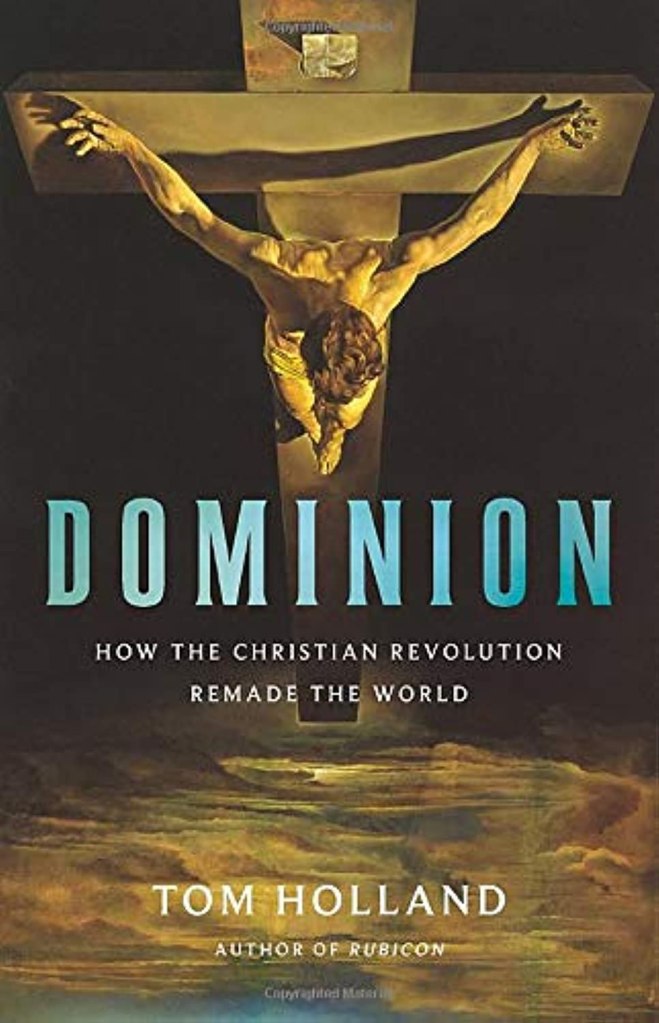
Tom Holland, in his seminal book, Dominion: How the Christian Revolution Remade the World, found the nexus for a radical change in the west in the crucifixion of Jesus. That event and the movement it inspired changed forever how the west (and now the rest of the world) views power and morality.


Tom Holland was an atheist When he did the research for this book. His area of expertise is Greco-Roman history. He was steeped in the brutish nature of the Roman world that championed power and elite, male dominance over all that was weak.

When he set out to trace his secular humanist values in western civilization, he knew there was some discontinuity between the Greco-Roman values he knew so well and his own, modern notions of basic human rights, so he was curious to locate the origin of that seismic shift.

His book, Dominion, traces our modern values from the roots where he found them in the history of western civilization. He found they go back to Jesus of Nazareth and the people who gave their lives to follow him.

The death of Jesus on the cross radically subverted the assumptions that ruled the world to that point. The Greco-Roman world that valued and honored power above all things gave way over time to the man who is claimed to be the Savior of the world who let himself be led like a lamb to his own slaughter. His life and message of self-sacrificial love became the bedrock for modern civil rights, human dignity, and the assumption that the powerful should shelter and care for the weak.

The criticism of Christians for racism and its worst manifestation – slavery – is deserved. Mostly because Christians “should’ve known better”. Of all people, Christians should have known better!

The water gets murky, though, in our modern memory because it has been influenced by a narrative that obscures the truth. The narrative that exposes the failing of Christianity often does so by directing attention away from the nonreligious world of reason and science, as if there is “nothing to see here.”

This view that rose to prominence during the Enlightenment is prevalent still today. It puts the full weight of condemnation for our failings on religion (and Christianity in particular). This is a false narrative, and, it obscures the truth and warps our perceptions that still persist.

There is nothing inherently wrong with science and reason. It is people who are flawed, and the flaws of people are not confined to science, or religion, or to any particular ideology or worldview. No ideology or worldview is immune.

Continue reading “The Errors of Our Ways: Science, Religion, and Racism”

Still Influenced by the Flesh? Division in Christ

What is your litmus test for who is in Christ? If you have a litmus test that is different than God’s standard, you need to put yours down!


I keep coming back to the theme of unity that Paul addressed in most of his letters. Christ tore down the dividing wall between Jews and Gentiles (Ephesians 2:14), and there is no longer any divisions in Christ: “There is neither Jew nor Gentile, neither slave nor free, nor is there male and female, for you are all one in Christ Jesus.” Galatians 3:28 (Emphasis added) Elsewhere Paul says,

“[T]here is no Gentile or Jew, circumcised or uncircumcised, barbarian, Scythian, slave or free, but Christ is all, and is in all.”

Colossians 3:11

We might add the major divisions we have today, like black or white, Republican or Democrat, liberal or conservative, capitalist or socialist, Palestinian or Israeli, American or Russian….

Did I lose anyone there?

Do you have a hard job believing that certain types of people can be considered Christians?

Are we not “all one in Christ”?

Of course, we need to define what is meant by “in Christ.”

According to John Piper, to be in Christ means to receive and embrace grace (1 Timothy 3:9) to be chosen by God (Ephesians 1:4), to be loved by God’s inseparable love (Romans 8:39), to be redeemed and forgiven (Eph. 1:7), to be justified and considered righteous (2 Corinthians 5:21), and to be a new creation. (2 Cor. 5:17) It means to be in relationship with God in Christ as sons and daughters, marked by God’s Holy Spirit.

“In Christ” means that we have a saving relationship with Christ in union with him:

Being one with Christ, means that those in Christ should be one with each other also. The one thing that binds us together is Christ Jesus. We may be very different from each other in many ways, but we are one if we are, indeed, in Christ.

It doesn’t matter how many differences we have with each other. If we are (indeed) in Christ, we are unified in Christ. Thus, it should not be surprising that Paul urged the Corinthians to be unified:

“I appeal to you, brothers and sisters, in the name of our Lord Jesus Christ, that all of you agree with one another in what you say and that there be no divisions among you, but that you be perfectly united in mind and thought.”

1 Corinthians 1:10

No divisions among you! Be united in mind and thought.

How do we do that? What keeps us from being united?

Continue reading “Still Influenced by the Flesh? Division in Christ”

In Response to the State of Our Culture, Do We Carry the Cross or the Sword?

Jesus told us to follow him by picking up our crosses, but many of us today are picking up our swords.


I recently heard Tim Alberta say that some modern evangelicals have picked up a sword, and that sword is Donald Trump. Such a sword is needed for success in a culture war, and a culture war mentality drives the politics of many, if not most, of evangelicals today.

Many evangelicals are concerned, if not fearful, of current cultural trends. People are pulling away from and rejecting traditional Christian values in the US. The change has been rapid (as far as cultural trends go). American society is going the way of Europe and Canada in letting go (and outright rejecting) Christian labels, overtly Christian thinking, and church attendance.

Perhaps, nothing demonstrates the cultural movement away from Christianity in the United States like the book, The Nones: Where They Came From, Who They Are, and Where They Are Going, by Ryan P. Burge. The author says that only five percent (5%) of Americans claimed “no religion” in a 1972 poll. That number rose to over twenty three percent (23%) by 2018. This made “nones” as numerous as Catholics or evangelicals in the US in 2018.

Nones are predominantly young Americans, but this trend does not just affect the nation’s youth, and it has picked up momentum since COVID. Robb Redman reports from various sources on community trends and culture for worshipleader.com, including the following:

  • 70% of Americans were church members in 1999 (Gallup);
  • Less than 50% of Americans were church members in 2023 (Id.);
  • 45 million Americans have stopped going to church in that time;
  • 41% of Americans 39-57 went to church regularly in 2020 (Barna);
  • 28% of Americans 39-57 went to church regularly in 2023 (Id.).

Ryan Burge partnered with Jim Davis and Michael Graham to explore the reasons for this precipitous decline in church membership and attendance and the rise in self-described nones in their recent book, The Great Dechurching. This book has become the topic of much conversation in the short time since it was published. I haven’t read the book yet, so I posed the question, “What are the top five reasons people have stopped going to church, listed from most common to least common”, to two different AI platforms. The results from Bing Co-Pilot are as follows:

  1. Judgmental attitudes (87%)
  2. Distrust of organized religion (74%)
  3. Too focused on Money (70%)
  4. Busy schedules (67%)
  5. Loss of Habit (58%)

The Co-Pilot response summarized studies done by the Pew Research Center, Gallup Polls, the Barna Group, the Public Religion Research Institute and various academic studies to generate this list. I note that the first three reasons people have given for not attending church are issues with the Church I am referring to the Church (capital C) because I don’t know how this breaks down among denominations. The other two main reasons are unrelated to the Church; they reflect personal and societal lifestyle issues.

Chat GPT reported different results, citing some of the same sources (Pew and Barna) and some different sources (General Social Survey and books and articles, generally, including Sociology of Religion by Diana Butler Bass, an academic book). The Chat GPT list is not as straight forward:

  • “A growing disconnection with church teachings or religious beliefs” (about 60%-70%);
  • “Negative experiences, such as feeling judged or encountering hypocrisy” (about 30%-40%);
  • “A perceived irrelevance of church” and disconnectedness of the church to modern issues (about 25%-35%);
  • Busyness, lifestyle, time constraints, and changing priorities (about 20%-30%); and
  • Exploring alternative spirituality and religious practices (about 15%-25%).

Again, the first three (3) (and the most prominent) reasons for not attending church deal with the Church, itself. Worldviews are shifting away from the views held by the Church (which seems to indicate we are losing this “culture war”). The Church is perceived as disconnected from modern life and the modern world and not relevant to it, and the Church is perceived as overly negative and hypocritical.

The one area of overlap is the high percentage of people who list judgmental attitudes, including negative experiences and hypocrisy) as major reasons of not attending church. This is obviously a key issue (ranking 1st and 2nd respectively).

I find this to be highly problematic for the Church because the Paul plainly said the Church should not be (presently) judging the world (according to Paul (See What Business Do We Have Judging the World?)) And, Jesus said we should be known by the love we have for each other.

It seems pretty obvious to me in my own anecdotal experience that the American Church, generally, has some significant issues in this regard. We are not following Paul’s instruction not to judge the world, and we are failing to love each other well.

I recently watched a Gavin Ortlund critique of fundamentalism in the Church today that focuses on these issues. He says it well when he describes a segment of the Church that is focused more on what followers of Christ should against, rather than than what we should be for. When our focus is on the negative, our positive message is likely to be eclipsed and obscured and it lost in the noise.

I realize, of course, that this “indictment” of the Church generally, is a very broad brush. The church I attend does not fit this mold. Most of the Christians I have close relationships with do not fit this mold. We don’t have to look very far or deep on social media, however, to see evidence of judgmental attitudes, hypocrisy, and negativity.

It’s interesting to me that resources Co-Pilot pulled from identify more negatives (distrust of organized religion and too focused on money) in the top three reasons for not going to church, while the Chat GPT sources identified “growing disconnection with church teachings or religious beliefs” and perceived irrelevance of church” and disconnectedness of the church with modern issues. Distrust and money-focused have nothing to do with message, but disconnection with church teachings and a perceived irrelevance with modern issues has everything to do with message (theology).

Exploring alternative spirituality and religious practices (the 5th reason noted by the Chapt GPT response is related to the disconnection responses. I don’t know whether these things are causal or just symptomatic. If people were finding what they were looking for in church, they wouldn’t disconnect and look elsewhere. If their church experience wasn’t negative, they might still be connected.

On the other hand, both sources identify other things that are going on. Busyness, lifestyle, time constraints, and changing priorities are “neutral” pressures that are affecting not just churches, but service organizations, fraternal organizations, and other traditional ways people have gathered together.

We see a spike in this trend of disconnection from Church membership and attendance after COVID (pun intended). COVID seemed to supercharge changes that were already in the works in many areas of life. People were already disconnecting from face-to-face contact with other people with the proliferation of hand-held devices and social media going back at least to 2012. COVID isolated people even further.

Sociologist, Jean Twenge, finds sharp changes in teen behavior and mental health starting in 2012, which she attributes to teen use of smartphones and other hand-held devices. Her findings about the changes in the behavior of teens is a yardstick to measure the pulse of society.


A published interview with Twenge as Time Magazine’s Person of the Week, reports that “Gen Z is in the grips of a historic mental health crisis, with teenagers struggling with record levels of depression, anxiety, and loneliness.” Twenge, who has studied many generations of teens, discovered “big and sudden” changes in Gen Z starting around 2012, when hand-held devices became normalized among teens.

Those changes included, among other things, a doubling in the diagnosis of clinical depression among 12-17 year-olds from 2011 to 2019. At the same time, teens reported significantly less face time with other people corresponding significantly with more screen time. I have heard her say that teen pregnancy is down (which seems to be a good thing) because teens spend more time on their phones in their bedrooms alone than spending time with each other (which is problematic).

So, what does this have to do with Donald Trump and Christians fighting a culture war to try to preserve their power and influence in a society that seems to be pulling away from us? I seem to have wandered far afield, but now I am going to pull it in and get to the point.


It seems our culture needs Jesus more than ever. At the same time, people are do not see the benefits of knowing Jesus. At the very time when people need the grace and love of Christ most, people are being pushed away by judgmental attitudes and negative experiences. As people are struggling with isolation, polarization, and mental health issues, the Church is becoming more irrelevant, disconnected, and inaccessible to them.

Ironically, it seems to me, we are not only losing this culture war, the culture war seems to be the very thing that is pushing people away and isolating them from us. As we are circling our wagons defending ourselves against these “outsiders”, and attacking them from behind our theological walls, we have lost sight of the fact that Jesus sent us out into the world to bring the Gospel to the lost.

We are failing in our most critical mission.

Continue reading “In Response to the State of Our Culture, Do We Carry the Cross or the Sword?”

A Tale of Two Processions, Two Kingdoms, and the Triumph of God

Two processions, two kingdoms clashing, and God’s triumph in the death of God incarnate on the cross


Episode 124 – Statement of Triumph – from the BEMA Podcast, with Marty Solomon and Brent Billings, inspires my writing today. It was the subject of discussion for the Saturday morning Bible study I have attended off and on with an exceptional group of men for several years.

The subject was Matthew 21:1-11. The chapter heading in the NIV translation (which would not have appeared in the original text, because there were no chapter headings in the original text) is “Jesus Comes to Jerusalem as King”.

This is usually how we read it: a “triumphal entry”. We celebrate it as a triumph, and it was. But not perhaps in the way we tend to think about it. Certainly, not in the way the erstwhile followers of Jesus perceived it when it happened.

Marty Solomon sets the stage in the podcast, noting that Jesus rode into Jerusalem on a donkey during the week of Passover, an unusually tense time in this region of the Roman world. The uneasy tension arose in that time in that region because it was home to the only group of people in the Roman Empire who refused to worship the Emperor.

The Jewish people were stubbornly true to their God. Even so, Rome allowed the Jews to have their own ruler, Herod the Great. Herod was Jewish and powerful in his own right, but he was happy to be propped up by the Romans, and the Romans accommodated him to maintain stability in the region.

Even so, this small piece of real estate was problematic for Rome. It sat at the crossroads of the earth. The Hebrew people long inhabited it, but they were a headache for the Romans because of their entrenched religious traditions and unabated worship of their God.

When Herod the Great died, three of sons took over different areas of this land that Herod ruled as a vassal of the Romans. Herod Phillip ruled the north (Caesaria Phillippi). Herod Antipas ruled the middle region, and Herod Archelaus ruled in the south (Judea).

Archelaus only lasted two years, so Rome brought in its own ruler, Pontius Pilate (the Roman Bulldog), to maintain Rome’s control over the region. Pilate didn’t live in Jerusalem. Pilate lived in Caesarea Maritime (Caesarea, By the Sea), a city built by Herod to honor Caesar.

The week of Passover would have been a particularly tense time in Jerusalem, the Jewish holy city. Jews from all over were in town to celebrate the feast that remembered their great deliverance and triumph over the superpower of an earlier time, Egypt. The last thing that Rome wanted was for this celebration to get out of hand after rebel Jews got all fueled up with wine and remembrance of their former deliverance.

If there was any holiday that might make the Romans nervous in Judea, it was Passover. Zealots were always stirring up trouble, and Passover would be the most opportune time for a Jewish revolt against the Roman rule of this territory that the Jews long held out as their own. After all, the Jews still believed this land was to be theirs again through based on their understanding of prophecies about a military coup to be led by a messiah (savior) in the line of their once great King, David.

Every year at this time Pontius Pilate would head south from Caesarea down the coastal road to Joppa. He would head east from Joppa to make his way into Jerusalem. Pilate would enter Jerusalem from the west. He traveled with great pomp and a show of force, with an army of soldiers, trumpeters, heralds, banners, and pronouncements. Pilate would lead the way on a white stallion symbolizing Roman conquest and rule.


This show of power, of course, was intentional. I found the article, In Through the Back Door, September 24, 2022, by Terry Gau that describes these yearly processions made by Pilate into Jerusalem at the beginning of Passover week. He cites historians, John Dominic Crossen and Marcus Borg, in their book, Last Week, memorializing the historical and political context for the final chapter of Jesus’ ministry on earth. the procession is described this way:

“Traditionally, Pilate paraded into Jerusalem on the first day of Passover Week, entering the west gate – the front gate – with legions of chariots, horses, and foot soldiers, dressed for battle and armed with swords and spears.  Rome’s authority would not be questioned.  The majesty with which Pilate enters the front door of the city was meant to inspire awe and fear, respect and obedience.”

Marty Solomon says,

“You could have heard him coming from miles away. The message he wanted to send to the Jews was clear. ‘Don’t even think about it! Keep everything under control, or Rome will crush you!’”

BEMA Podcast, Episode 124

Pilate would stay in Herod’s palace in Jerusalem for the week until the festivities ended. Then he would go back to Caesarea. He wasn’t there to celebrate, though. He was there to ensure things didn’t get out of hand and to keep the peace.

During one Passover week under the rule of Pontius Pilate in Judea another procession took place. It may have even happened on the same day at the same time that Pilate was entering the City from the west. This procession took place on the east side of Jerusalem where Jesus, riding on a lowly young donkey with a small, rag tag bunch of unarmed disciples entered through the east gate – the back door to Jerusalem.

“This parade was just as carefully staged as Pilate’s entry into Jerusalem. It was a counter-procession, a different vision of what a Kingdom should be, a subversive action against the powers that ruled Jerusalem. Jesus’ humble, yet triumphal, entry into Jerusalem stood in contrast to the magnificence and brutality on display at the opposite end of the city. Jesus brings peace, while Pilate brings a sword.”

In Through the Back Door

This was the backdrop for episode 124 of the BEMA Podcast and of our discussion. I sit writing at a temporary table with one chair left in my house that is all but cleaned out and being readied for sale. My future is uncertain as I recount one of the most pivotal times in human history and the dealings of God with man and what it means for us, today.

Continue reading “A Tale of Two Processions, Two Kingdoms, and the Triumph of God”