Thinking Outside the Circle and Focusing on the Center: What Direction are You Moving?

If we are not challenged to rethink what we think we know from time to time, we are not likely coming into close enough contact with Jesus.

I watched the Chapelstreet church service today and listened to the sermon by Jeff Frazier in Batavia, IL. It was just what I needed to hear. Not that it tills new ground; it covers familiar ground from a new angle. It avoids the ruts of old, tired ways of thinking and finds fresh new ground (for me) from which to approach how we see Jesus.

The sermon today was inspired by Matthew 9:9-13.[i] You can read it in full at the endnote below. In summary, Jesus called Matthew from the tax booth where he was sitting to follow him, and Matthew responded by following him. That was the extent of the initial story

Then Scripture jumps to another scene: Jesus reclining at a table with “many tax collectors and sinners”. We are left to draw our own conclusions about what happened in the interim. It could be that Matthew invited all his friends, who were naturally other tax collectors and “sinners”, to met Jesus who had just connected with him.

The focus of the new scene, though, isn’t on Matthew anymore. The focus shifts to the Pharisees who ask the disciples why Jesus eats with “tax collectors and sinners”.

Before I describe how Jesus responded to them, I want to focus on the fact that the people who had a problem with Jesus were the religious people. Jesus was hanging around with all the wrong people according to the religious insiders of his day.

This is nothing new. I have written often about the Pharisees, Jesus and tax collectors and sinners. In fact, I wrote on the same subject just two weeks ago. (The Danger that Good, Upstanding, Religious People Face Today)

It isn’t a new thing to realize Jesus defied categorization; he shattered expectations and common ways of thinking. He challenged everyone he met to see the world differently, but we sometimes forget the radicalness of Jesus in our routine orthodoxy.

I dare say, if we are not challenged to rethink what we think we know from time to time, we are not likely coming into close enough contact with Jesus!

Back to the story: in First Century Judea, tax collectors were traitors and sell-outs. They were Hebrews who collected taxes for the Romans and used the authority of the Roman occupiers of the Hebrew Promised Land to accumulate wealth for themselves. They were hated by good Jews. They were outsiders in their own community.

As outsiders, they naturally associated with other outsiders (“sinners”). Thus, for Jesus to establish a relationship with Matthew – and worse than that: to “hang out” with other tax collectors and “sinners” – was scandalous. It was unthinkable!

When Jesus heard the Pharisees challenge the disciples to explain why Jesus was associating with “such people”, Jesus famously responded:

“Those who are well have no need of a physician, but those who are sick. Go and learn what this means: ‘I desire mercy, and not sacrifice.’ For I came not to call the righteous, but sinners.”

Matthew 9:12-13

This is a familiar passage to us, but I think the application of the message is sometimes lost on us today. I think we can fall into the trap of the Pharisees in our thinking without even realizing it. Thus, we need to be challenged to see things from a different angle, just as Jesus challenged the Pharisees in the first century.

Again, these are not new thoughts, but the the change of perspective (for me) comes courtesy of Paul G. Hiebert. Born to missionary parents in India, he became “arguably, the world’s leading missiological anthropologist”.[ii]

When he moved back to the west, he wrestled with questions like these: What does it mean for an illiterate, Hindu peasant to know Jesus? How much of their old life and traditions must be left behind?

Having observed missionaries in India, he concluded that the western mission movement was importing too many western traditions and thoughts. He saw the need for thinking outside the western box – like Jesus encouraged the followers of his day to think outside the box…. or rather, outside the circle, as we will see.

Continue reading “Thinking Outside the Circle and Focusing on the Center: What Direction are You Moving?”

Postscript to the Sons of Issachar Who Understood the Times

We receive the Holy Spirit, not so that we will know the times, but so that we can be effective as His witnesses!

I wrote a piece on the Sons of Issachar recently. They are referenced in 1 Chronicles 12:32. The Sons of Issachar were 200 “chiefs” of the descendants of Issachar, one of the sons of Jacob. These men joined David with a multitude from the other tribes of Israel when David was hiding in the wilderness from the murderous rage of King Saul.

Saul was Israel’s first king. He was the king the people demanded. He was the king God gave them, despite the fact that His people were rejecting God as their king in the process of demanding a human king, like the other nations.

Saul got caught up in his own power and position. Saul began to lose touch with reality as he stopped obeying God and became paranoid of losing a grip on the power God gave him. He became jealous of David. and suspected David was out to get him. Though David could not have been more loyal, King Saul sought to kill David to eliminate his perceived threat.

Indeed, God was about to reject Saul as king because Saul ceased to listen to and follow God’s instruction given through the prophet, Samuel. God had chosen David to succeed Saul, because David was a man after God’s own heart.

David, for his part, loved and honored Saul because God had made him king. David had multiple opportunities to kill Saul, but he refused to do it, leaving Saul’s fate (and his own fate) completely in God’s hands.

Still, men from every tribe of Israel began to gather where David was hiding, including men from Saul’s own tribe (Benjamin). The Benjamites were some of the first men to join David. The 200 chiefs of the Sons of Issachar joined David later. Scripture says of them, specifically, that they were men “who understood the times and knew what Israel should do.”

That phrase has been invoked by people who style themselves modern prophets who support the presidency of Donald Trump. They claim, of course, that they are men who understand the times. They claim to know what Christian in the United States should do, particularly in regard to support Donald Trump.

I don’t dismiss what they say out of hand. God has spoken at various times through people considered to be prophets. One of the hallmarks of “the last days” is prophecy, visions, and dreams. Peter announced the last days were starting when he stood up on the Day of Pentecost and quoted the prophet, Joel:

And in the last days it shall be, God declares,
that I will pour out my Spirit on all flesh,
and your sons and your daughters shall prophesy,
    and your young men shall see visions,
    and your old men shall dream dreams;
even on my male servants and female servants
    in those days I will pour out my Spirit, and they shall prophesy.

Acts 2:17-18 (quoting Joel 2:28-32)

Some people believe that these displays of God’s power and authority were only for a dispensation in time long enough for the Holy Spirit to lead the disciples into truth and preserve it in what we now call the New Testament. I don’t see evidence of that in the New Testament itself. I think we should expect God to work through people today through prophecy, visions, and dreams, and I believe He does.

We, in the west, are not very open to God working in that way. We have staked out our position on the embankment of reason, logic, and “sound doctrine”. We are quite uncomfortable with the “messiness” of experiential phenomena like prophecy, visions, and dreams.

Yet, outside our western sanctuaries and cloistered halls of learning, these phenomena are regular experiences of Christian life. People who have done short-term or long-term missions often encounter these phenomena in places where people are not presumptively skeptical of what God can do.

Visions and dreams are ubiquitous in the stories of recent Muslims coming to faith in Christ. I once spoke with a Muslim woman who described for me a vision of Jesus coming to her in the midst of a near death experience she lived through. She described a subsequent “waking vision” of Jesus gaining her attention in the nick of time to save her son from being hit by a bus. She became a believer in Jesus because of these visions, though no one preached a word to her.

Her supernatural visions, though, didn’t lead her to a place of sound understanding of God and His word. They caused her to believe in God and Jesus, but she gravitated toward extremes in biblical understanding. This is just an anecdote, but I think there is a lesson to take away from it.

It would be a mistake to dismiss out of hand the prophecies, visions, and dreams that people claim to have today, but we also need to be careful. Paul admonished the Thessalonians, “Do not despise prophecies…!” (1 Thess. 5:20) But he added an important qualifier:

“…. test everything; hold fast what is good.”

1 Thess. 5:21

Continue reading “Postscript to the Sons of Issachar Who Understood the Times”

The 2020 Election: Daylight Had Spoken

I woke yesterday to these words:

Daylight had spoken 
So clear and so plain 
I’m the keeper of nothing 
But an old flame 
Consuming the shadows 
Caught in the light 
Blinded by hunger 
And fed to the night 

I went to bed with the presidential election in the balance, teetering on the brink of madness – madness that we are so divided as a country over, perhaps, the two most unpopular candidates in our country’s long history.

We have gotten used to the “lesser of two evils’ voting mantra. Not that each candidate doesn’t have their crazy fans. And, that’s part of the madness too.

But daylight broke once again. Like Groundhog’s Day the movie, its constancy is inimitable. So, it is fitting that the Book of Lamentations states thus (3:22-23):

The steadfast love of the Lord never ceases;
    his mercies never come to an end;
they are new every morning;
    great is your faithfulness.

In my daily Scripture reading, the passages were no less apropos:

As evening approached, there came a rich man from Arimathea, named Joseph, who had himself become a disciple of Jesus. Going to Pilate, he asked for Jesus’ body, and Pilate ordered that it be given to him. Joseph took the body, wrapped it in a clean linen cloth, and placed it in his own new tomb that he had cut out of the rock. He rolled a big stone in front of the entrance to the tomb and went away. Matthew 27:57-60

So, it was the night Jesus was crucified.

The passages for the day also included the description of a small entourage of women waking in the morning to bring spices to the tomb. When they got there they found the tomb empty. (Mark 16:1; Luke 24:1-3)

Finally, the passages for the day included the appearance of Jesus to Mary Magdalene, the woman from whom he had cast out seven demons. (Mark 16:9) Mary was the first person to whom Jesus appeared. That significance can not be understated.

The men back were still hunkered down where they had been since darkness draped over the world the night Jesus died. They didn’t believe her when she told them she saw Jesus. (Mark 16:11)

So it is that we arrive quickly at assumptions and hold on to them. Jesus died before them and the onlooking world. Jesus was dead. Who would believe otherwise?

Of course, he had been telling them since they met him that his body would be destroyed, and he would raise it up three days later, but they never quite got what he was saying.

I left for the office pondering these things.

The votes are still being counted today. The outcome is less than certain. There is talk of fraud, injunctions and refusing to step down, and I can’t bear to think of four years of Biden… or Trump.

But the new day has dawned. God’s mercies are new every morning. Great is His faithfulness. Jesus defied sin and death, rose again and ascended into heaven. He sits, now, at the right hand of the Father. He will come again to judge the living and the dead – so the creed goes that was canonized over three centuries after Jesus died.

Pontius Pilate, the leader who presided over the death of Jesus, is nothing but a footnote to the world’s greatest event – the death of God at the hands of His creation, for the sins of His creation, to provide His creation a real hope that cannot not be eliminated by an election, injunction or even crucifixion – and the resurrection!

So, Donald Trump or Joe Biden will become their own footnotes in history as the purposes of God unfold. The world may seem to be teetering out of control at every turn, but the only thing teetering is our illusion that we are in control. God’s word goes out, and it does not come back void. Jesus is still on the throne.

The song that woke me yesterday morning ends like this:

My search was unending 
And my soul was bare 
And Darling, you came to me like a midnight flare 
Out of the ocean 
The stars had all gone 
My heart was broken 
Lost and alone 

[Outro] 
Darling, you came to me like a beacon, leading me home

Substitute Jesus, for Darling, and it’s just about perfect.

~~~~~~~~~~~~~~~~~~~~~

Job poetically says of God that He gives orders to the morning and shows the dawn its place. (Job 38:12) Because of the tender mercy of God, the “Dayspring” [Dawn/Jesus] came to us from heaven to shine on us who live in darkness – in the shadow of death – to guide our path into peace. (Luke 1:78-80)

Contemplating the Influence of Power and Wealth on The Church

It is “a supreme paradox” that ‘the church in freeing itself from the secular itself became a state”, says Tom Holland.

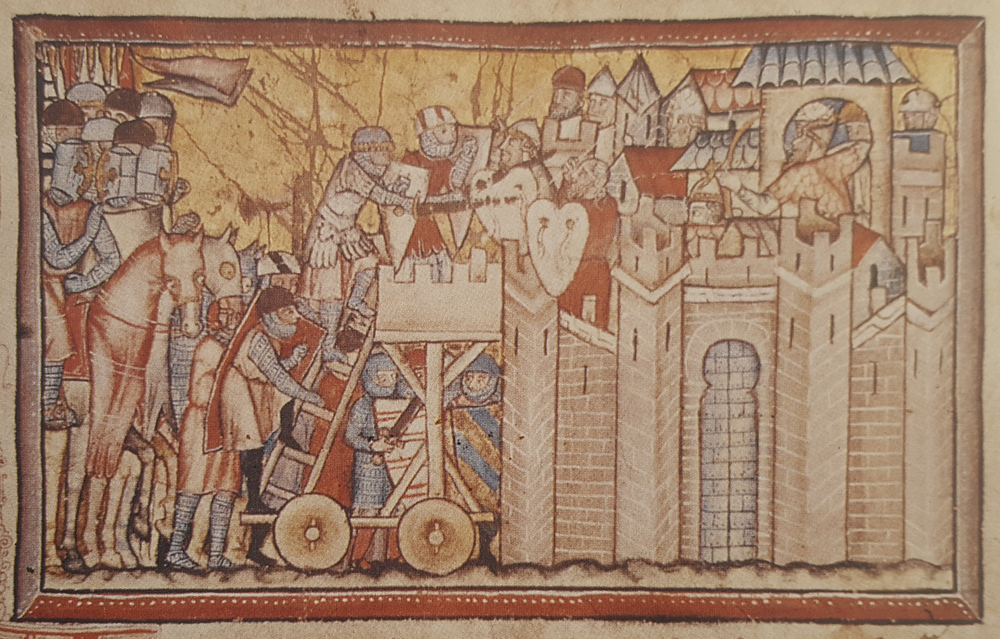
Miniature showing siege scene of conquest of Jerusalem, 1099. Nunez de Balboa House-Museum, Jerez de los Caballeros, Spain

I am working my way through Tom Holland’s book, Dominion: The Making of the Western Mind. I have just finished the segment on Pope Gregory VII and Pope Urban II at the turn of the first millennium since the birth of Jesus Christ.

Since Jesus first told an antagonistic group of religious leaders that people should “render unto Caesar that which is Caesar’s, and render unto God that which is God’s”, and for centuries afterward, the church was at the mercy of the state. Not even a generation after Jesus died, the Roman government, which controlled Judea where Jesus lived and his following sprung up, ransacked Jerusalem, scattering Jews and Christians into the countryside and beyond.

Through the first three centuries, the best the followers of Jesus could hope for was an indifferent Caesar or provincial ruler. At various times, they suffered at the hands of a Nero or more local prefects of local Roman rule in places like Lyons, Vienne or Carthage. The powerful Roman government was to be suffered and obeyed.

Christianity was illegal until Constantine decreed the prohibition lifted. Within a generation or two, Christianity was not just legal in the Roman Empire; it became the favored religion. Christian rulers became part of the governing structure of Rome, serving by the appointment and the pleasure of ruling authorities from mid-way through the 4th Century on.  

Over the centuries, the Roman Church became a player in the ebbs and flows of power and influence in western and central Europe. When Gregory VII was made Pope by acclamation of the people, however, he hid himself, not having been chosen through the usual protocols. When he was affirmed, nevertheless – his affirmation having as much to do with popular will as with political protocols, it marked the beginning of a change.

Gregory and Henry IV, the Roman Emperor, had a fitful relationship. Gregory excommunicated him three times, each time undoing it, the last time on his death bed in a remote outpost to which he been banished by the powers that be. Henry IV, for his part, declared antipopes in opposition to the papacy of Gregory, but his antipopes never rose to the position of acceptance by the people. The tide was turning.  

When Pope Urban II gathered and commissioned a vast army in the sacred duty of marching on Jerusalem to reclaim it from the Saracens who had overrun it a couple centuries earlier, the victory they attained in 1099 AD (the First Crusade) marked the completion of a transition. Carrying forward the efforts of Pope Gregory to divorce the church from the state, the goal was accomplished by the military victories won for Christendom – not by any Caesar or secular emperor, but by people marching under the banner of The Church.

Holland described the irony that, in obtaining freedom from the state, the church became a state. Holland calls it is “a supreme paradox” that ‘the church in freeing itself from the secular itself became a state”.

Continue reading “Contemplating the Influence of Power and Wealth on The Church”

God Will Not Be Mocked; His Purpose Will Be Accomplished Among Us

I have no doubt God is accomplishing His purpose, but what role we play may surprise us

21 February 2016: Republican Presidential candidate Donald Trump speaks to several thousand supporters at a rally in Atlanta, Georgia.

The Washington Examiner reported that Republican senator, Ben Sasse, said in a “campaign telephone town hall call that went to about 17,000 Nebraskans”, among other things, that President Donald Trump trash-talks evangelicals behind their backs”. After briefly citing some points of agreement with Trump, Sasse “began to unload” on the President.

Sasse identified a litany of issues he has with Trump – careening “from curb to curb” on COVID (first ignoring it, then going “into full economic shutdown mode”), selling out allies, “the way he treats women”, spending “like a drunken sailor” and flirting with white supremacists – but the issue I want to focus on is the charge that Trump “mocks evangelicals behind closed doors”.

Sasse commented, “I think the overwhelming reason that President Trump won in 2016 was simply because Hillary Clinton was literally the most unpopular candidate in the history of polling.” It’s true, and most evangelicals I know said they were voting “only” for Trump as “the lesser of two evils”. They couldn’t stomach another Clinton presidency, perpetuating that inbred political machine in Washington that is openly hostile to concerns of evangelicals.

So, where along the timeline did Donald Trump become our champion? When did he stop being an evil? (Albeit an “lesser” one)

A little googling reveals (for those who’s memory is short) that “long before” Donald Trump ran for President of the United States, he was a Democrat. Donald was registered as a Democrat from 2001-2009. Have we forgotten the criticism leveled against The Donald by Jeb Bush? “He was a Democrat longer than he was a Republican. He’s given more money to Democrats [including Hillary Clinton] than he has to Republicans.”

To be completely accurate, Donald Trump changed his party affiliation at least five times since 1987, when he registered as a Republican. He changed to Independent in 1999, to Democrat in 2001, to Republican in 2009, to Independent in 2011, to Republican again in 2012. (See Political positions of Donald Trump at Wikipedia) But should that give Republicans comfort?

On the issue that has been historically most influential on the Evangelical vote, abortion, Donald Trump has been described as shifting “from pro-choice to pro-life only as he planned a presidential run”. Robb Ryerse, a pastor at Vintage Fellowship in Fayetteville, AR, said earlier this year, “I personally believe that the President is cynically using pro-life voters for his own electoral purposes and doesn’t actually care about protecting innocent life at all.”

The LA Times was less skeptical in its description of Trump’s turnabout recently, calling him “a late convert” to the pro-life cause. Noting Trump’s position in 1999 (“pro-choice in every respect”), Trump told the March For Life crowd in Washington this year that “every life is worth protecting”.

The Times added: “Trump is counting on the support of his base of conservative activists to help bring him across the finish line.” While I don’t share the Times’ anti-pro-life stance, that’s what concerns me – that Trump is saying simply what a large block of his constituents want to hear. (To be fair, my skepticism runs deep with all politicians, especially when they are in campaign mode.)

After all, politicians seem to think that moderates are not tolerated by voters anymore. Both political parties have “taken harder-line positions for and against abortion rights”. Trump had to choose sides. As former White House Press Secretary, Ari Fleischer, said recently, “There used to be a middle”, but now candidates must choose sides in an increasingly polarizing political environment.

Digging deeper, Trump’s political views have shifted from moderate populist (2003) to liberal-leaning populist to moderate populist (2003-2011) to moderate populist conservative (2011-12), to Libertarian leaning conservative (2012-15) to “hard-core conservative” just before the 2016 election. Interestingly, he back-stepped to Libertarian-leaning conservative, then moderate conservative after the election, but he may (again) be described as “hard-core conservative” … now that he campaigns for re-election. (See Political positions of Donald Trump ibid.)

I can’t help noticing that his hard-core conservativism seems to be timed with election campaigning, and that’s one of the things that troubles me about him. So, I began wondering today: what are his long-standing convictions? From my reading, I would say populism, authoritarianism, and nationalism, so let’s take a closer look at those threads of Donald Trump’s political life.

Continue reading “God Will Not Be Mocked; His Purpose Will Be Accomplished Among Us”