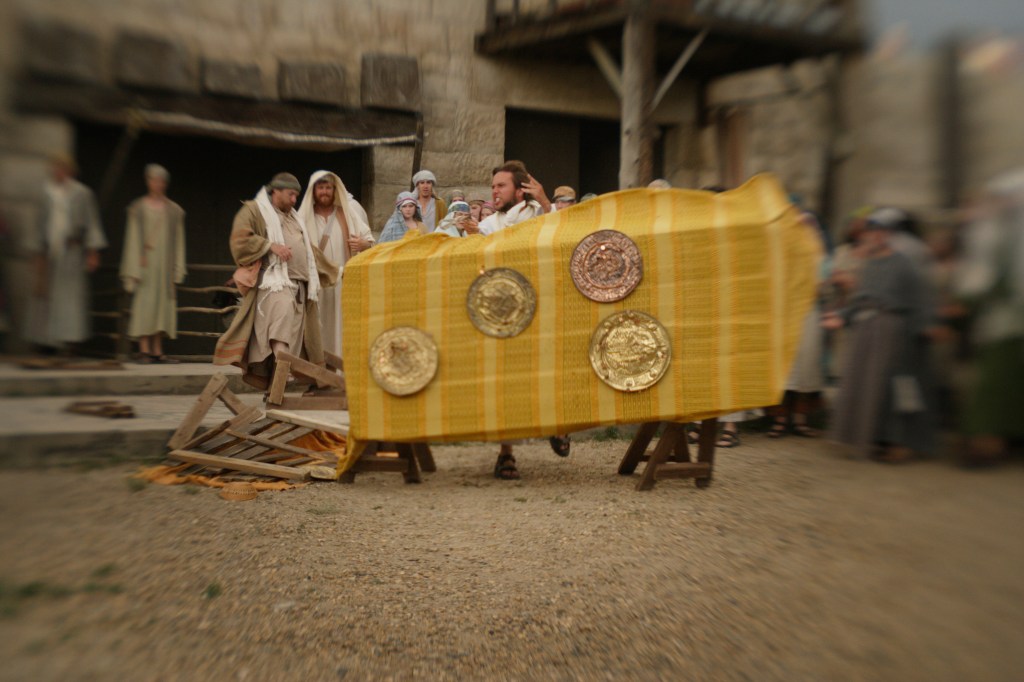
You Might Be A Pharisee If ….

Just when we become proud of our own spiritual advancement we are most in danger of spiritual catastrophe!


[29] “Woe to you, experts in the law and you Pharisees, hypocrites! You build tombs for the prophets and decorate the graves of the righteous. [30] And you say, ‘If we had lived in the days of our ancestors, we would not have participated with them in shedding the blood of the prophets.’

Matthew 23:29-30

Reading this passage in Matthew today reminded of the old bit by the comic, Jeff Foxworthy. If Jeff Foxworthy was a comic in 1st Century Judea, he might have said, “You might be a Pharisee if ____________________ (fill in the blank).”

In a similar vein, we could say, “You might be a Pharisee if you think you would not have opposed Jesus if you lived in Judea in the 1st Century.”

Of course, Jesus wasn’t being funny when he confronted the Pharisees, and this wouldn’t be a comedic schtick.

I don’t think Jesus was saying it was wrong for people to build tombs to the prophets or decorate them with flowers. Jesus was saying it was wrong to say (and think) they would have treated the prophets any differently.

The Pharisees are to us what the prophets were to the Pharisees. We may be tempted to think that we would embraced Jesus if we lived in 1st Century Judea, and would not have opposed him or called for his crucifixion if we we were in the crowd that shouted, “Crucify him!”.

But, that is no different than how the Pharisees thought and what the Pharisees claimed about the prophets that were resisted, derided, and sometimes killed by the “religious” people of their day. Jesus was clearly implying that the religious people of his day (the Pharisees), were no different than the religious people in the days of the prophets.

Can we say, then, that we are different than they?

Only if we adopt the same thinking as the Pharisees! (If I am understanding Jesus accurately.)

The Pharisees thought of themselves more highly than they should have. John came preaching repentance, for the Kingdom of God is near! But, the Pharisees didn’t repent. They didn’t think they needed to repent.

When Jesus – who was God in the flesh – came into the world, the Pharisees didn’t recognize Him or receive Him. (John 1:9-11) They did not prepare themselves for his coming by repenting, as John the Baptist exhorted. They adopted the wrong attitude about what God was doing in their time, and they didn’t hear and respond to what God God’s messenger was saying.

Pharisees say the right things, and they do the right things, but they fool themselves. What the Pharisees said and did was a façade. Their hearts were not aligned with their actions. They claimed to be experts in the Law, but Jesus called them blind guides leading blind followers. (Matt. 15:14)

Pharisees were concerned with appearances and the way people saw them. Pharisees were not as concerned with their heart attitudes. Jesus called them “white-washed tombs” that were empty inside (full of dead people’s bones and uncleanness). (Matt. 23:27-28) We need to be careful that we do become like the Pharisees.

Continue reading “You Might Be A Pharisee If ….”

Who Were the Wolves Jesus Warned the Disciples About?

When Jesus said, “Be wise as serpents and innocent as doves”, who was he speaking about?


I am reading in Mathew right now in my year long reading plan, focusing this year on the New Testament. I have read the whole sweep of the Bible, from the Old Testament through the New Testament, each year for a number of years. I am not sure how many, because I have not kept track.

The words, “be wise as serpents and innocent as doves”, came up in conversation with my son a few days ago, so these words caught my attention in my daily reading this morning. I had not paid much attention to the context in which Jesus spoke these words before:

“I am sending you out like sheep surrounded by wolves, so be wise as serpents and innocent as doves. Beware of people, because they will hand you over to councils and flog you in their synagogues.” ‬

Matthew‬ ‭10:16‭-‬17‬ ‭NET

These are the instructions Jesus gave the disciples when he sent them to “the lost sheep of the house of Israel”. Jesus was very specific in his instructions, telling them what to do and what not to do, what to wear, how to conduct themselves, and Jesus pointedly included the following instructions:

“Do not go among the Gentiles or enter any town of the Samaritans. Go rather to the lost sheep of Israel.”

Matthew 10:5-6

I realized this morning for the first time the significance of the warning that Jesus was giving to his disciples when he sent them “out like sheep surrounded by wolves”. (Matt. 10:16) That instruction takes on a different color for me, now, considering that the “wolves” surrounding the disciples would be the religious people in their world – their fellow Jews.

Jesus was not sending the disciples among the Romans, or the Greeks, or even the Samaritans. Jesus was sending his disciples to the lost sheep of the house of Israel.

Jesus told the disciples to go only to the lost sheep of the house of Israel, and Jesus warned them they would be surrounded by wolves. This means Jesus was sending the disciples to the sheep in the house of Israel, and the disciples would be surrounded by wolves in the house of Israel.

The conclusion seems clear that the sheep in the house of Israel to whom Jesus was sending his disciples were going to be among wolves, who were also in the house of Israel.

These words of Jesus provide us the time worn adages about wolves among the sheep and wolves in sheep’s clothing. Jesus repeats this theme of the lostness of religious people and the wolfishness of religious leaders over and over again throughout the Gospels. So much, that this theme has stuck out like a sore thumb to me in recent years. (I have written about it in articles like, Why Did Jesus Pick on the Pharisees so Much?)

I have been recently pondering about the many criticisms Jesus leveled against the religious leaders of his day. Do these criticisms have any warrant today? How should we view what Jesus said to the religious leaders of his day? Is the significance historical, only? Or does it have application today in our Christian world?

Continue reading “Who Were the Wolves Jesus Warned the Disciples About?”

The Curious Upside Down Kingdom of God Revealed in the First Prophetic Utterance in the Bible

The imagery in Genesis 3:15 is confusing in light of Isaiah 53, but that is a clue to our understanding


In my last blog article, I focused on the way that Genesis 3:15 anticipates and foreshadows the coming of a Messiah, generally, and how it was specifically fulfilled in the virgin birth of Jesus. Not only that, but it introduces a thread in Scripture (the elevation of women) at the very beginning that runs through the entire Bible.

That the Bible uniquely elevates the stature of women despite the distinctly male dominated history of mankind should be noted. That this thread is embedded in the earliest biblical texts despite the ancient, backwards culture of the time speaks to a creator God who is able to influence the course of history even when people have a tendency to go their own ways.

I am constantly amazed how many hidden threads are woven into the great tapestry that is the Bible. I see new ones all the time, and I am going to highlight another thread in this article that I see in Genesis 3:15. In fact, I only noticed it as I was writing the last blog.

Genesis 3:15 reads as follows:

“And I will put enmity between you and the woman, and between your offspring and hers; he will crush your head, and you will strike his heel.”

In the last article I focused on the woman’s (Eve’s) offspring (seed) as a foreshadowing of the virgin birth. In this article, I will focus back on the second half of God’s statement to the serpent: “he [the woman’s offspring] will crush your head, and you will strike his heel.”

In my contemplation of the prophetic quality of this verse for the last article, I was drawn to Isaiah 53, which is (perhaps) the clearest prophetic passage anticipating and foreshadowing Jesus in all of the Old Testament:

  • 2 – “He grew up before him like a tender shoot”;
  • 3 – “He was despised and rejected by mankind, a man of suffering, and familiar with pain…., and we held him in low esteem;
  • 4 – Surely he took up our pain and bore our suffering, yet we considered him punished by God, stricken by him, and afflicted”;
  • 5 – “But he was pierced for our transgressions, he was crushed for our iniquities; the punishment that brought us peace was on him, and by his wounds we are healed”;
  • 6 – “We all, like sheep, have gone astray, each of us has turned to our own way; and the Lord has laid on him the iniquity of us all”
  • 7 – “He was oppressed and afflicted, yet he did not open his mouth; he was led like a lamb to the slaughter, and as a sheep before its shearers is silent, so he did not open his mouth”; and
  • 8 – “By oppression and judgment he was taken away. Yet who of his generation protested? For he was cut off from the land of the living; for the transgression of my people he was punished”;
  • 9 – “He was assigned a grave with the wicked, and with the rich in his death, though he had done no violence, nor was any deceit in his mouth”;
  • 10 – “Yet it was the Lord’s will to crush him and cause him to suffer, and though the Lord makes his life an offering for sin, he will see his offspring and prolong his days, and the will of he Lord will prosper in his hand”
  • 11 – “After he has suffered, he will see the light of life and be satisfied; by his knowledge my righteous servant will justify many, and he will bear their iniquities”; and
  • 12 – “Therefore I will give him a portion among the great, and he will divide the spoils with the strong, because he poured out his life unto death, and was numbered with the transgressors. For he bore the sin of many, and made intercession for the transgressors”.

In reading through this passage again, I noticed multiple uses of the word “crush”. The Hebrew word, דָּכָא, (daka), found in Isaiah 53:5 and 53:10, is the same Hebrew word used in Genesis 3:15. It means, literally, “to crush” in English. It can also mean, figurately, to oppress (and it can mean contrite of heart for those who “are crushed”).

The appearance of the same word in both passages caught me eye. What are the odds of that? The imagery, however, is confusing.

Genesis 3 says that the offspring of the woman will crush the serpent. Whereas, Isaiah 53 says that God will cause the crushing and “cause him [the suffering servant] to suffer” as an “offering for sin”.

On the one hand, God will crush the suffering servant as an offering for sin (Isaiah), and on the other hand the woman’s offspring will crush the head of the serpent. (Genesis) These verses seem to describe very different things, but the very particular use of the same word in both passages is cause for further consideration.

Continue reading “The Curious Upside Down Kingdom of God Revealed in the First Prophetic Utterance in the Bible”

The Significance of Eve’s Seed in the Plan of God

The description of the virgin birth of Jesus harkens back to Genesis 3:15.


I am constantly amazed at the “new” things I see in reading the Bible year after year. I read the Bible for the first time in a World Religion class in college in 1978, and I have been reading it ever since. In the last 5 years (6, or 7, I don’t know), I have read the through the Bible from beginning to end – from Genesis to Revelation – in chronological order and in other ways.

At the beginning of this New Year, I am going to try writing some shorter articles, as I have noticed my articles are getting progressively more wordy and lengthy. The Bible is a rich tapestry, but some threads are longer than others, so I am going to try to pull on some shorter threads from time to time.

In this article, I am focusing on Genesis 3:15 inspired by a brief comment in a sermon I heard during the Christmas season. People often credit the following verse in Genesis as a foreshadowing of the coming of Jesus. God speaking to Eve after the fall said:

“And I will put enmity between you and the woman, and between your offspring and hers; he will crush your head, and you will strike his heel.”

Genesis 3:15 niv

I confess that this foreshadowing never seemed crystal clear to me. Jesus is the offspring of Eve, but so are billions of people. Thus, that connection didn’t seem obvious to me. I saw nothing in that verse that seemed to be specifically about Jesus.

I always figured that theologians connect the second phrase of Genesis 3:15 to Jesus: Eve’s “offspring” (Jesus) will “crush” the serpent’s (Satan’s) head, and the serpent will “strike” his heel. Crushing the head and striking the heel is imagery that doesn’t seem to tie in specifically to what happened with Jesus, except in a very general way. It isn’t completely inappropriate (Jesus certainly had the victory!), but the imagery doesn’t closely fit the details of the crucifixion (like Isaiah 53 does, for instance).

Crushing a head is a fatal blow. Striking a heel is not fatal. Satan’s blow wasn’t fatal, though it seemed to be the dramatic end to Jesus. The crucifixion turns out to be more like the striking of a heal, because Jesus rose from the dead! And that “blow” was crushing to Satan and his purposes.

The end!

Mic drop….

While this is generally accurate, the imagery doesn’t remind us of Jesus in the same way that other Old Testament passages clearly foreshadow him, like Isaiah 53 (by his stripes we are healed).

Hindsight helps us see Jesus in these words spoken by Isaiah hundreds of years earlier. Jews before the time of Jesus knew that many passages in the Psalms, the Prophets, and other places spoke of a Messiah to come. Scholars also go back to Genesis 3:15 to see the foreshadowing of the Messiah (an offspring of Eve crushing the serpent that fooled Adam and Eve into sin).

But, there is more in Genesis 3:15 than the crushing of the serpent’s head that may point to Jesus, and it points to Jesus uniquely and poignantly. It also reveals another thread that runs throughout Scripture.

To see the thread I want to pull on today, we need to focus on the first part of the verse:

And I will put enmity between you and the woman, and between your offspring and hers….

Genesis 3:15a
Continue reading “The Significance of Eve’s Seed in the Plan of God”

The Minimalest, Non-Factual, Argument for the Resurrection

Perhaps, the minimalest, non-factual argument in favor of the resurrection isn’t a factual argument at all, but a philosophical one.

Thought to be the place of the resurrection of Jesus Christ in Jerusalem Israel

The title of this piece is tongue-in-cheek, a play on the “minimal facts” evidence for the resurrection made famous by Gary Habermas. I don’t really have a killer piece of evidence that uses fewer facts (or no facts) that trumps all other arguments. But, maybe I got your attention!

As often is the case, my inspiration comes from what someone said or wrote. In the podcast interview linked below, Mason Jones describes how he he decided to read through the Gospel accounts as an atheist who knew next to nothing about Christianity. He quickly caught on that the resurrection is the centerpiece of Christianity, so he focused his attention on that.

He researched the evidence for the resurrection. He googled arguments for the resurrection and arguments against the resurrection. Though he was an atheist at that time, he was willing to give the evidence that exists a chance. (Whether there was any, he didn’t know.)

As he considered the arguments and counterarguments, he found that the arguments against the resurrection didn’t address very well the arguments for the resurrection. They didn’t take them seriously.

Then he realized that the arguments against the resurrection only work if you start with the presupposition that the resurrection didn’t happen. Because it is impossible. Because people don’t come back to life. Ever.

If you take that presupposition out of the equation, thought Jones, the evidence favors the conclusion that the resurrection occurred, and the arguments against the resurrection loose their luster. If you want to hear the rest of Mason Jones’s thought journey from atheism to theism to Christianity in his own words, you can listen here.

Meanwhile, I want to spend a little time considering the presuppositions people make about the resurrection.

Continue reading “The Minimalest, Non-Factual, Argument for the Resurrection”