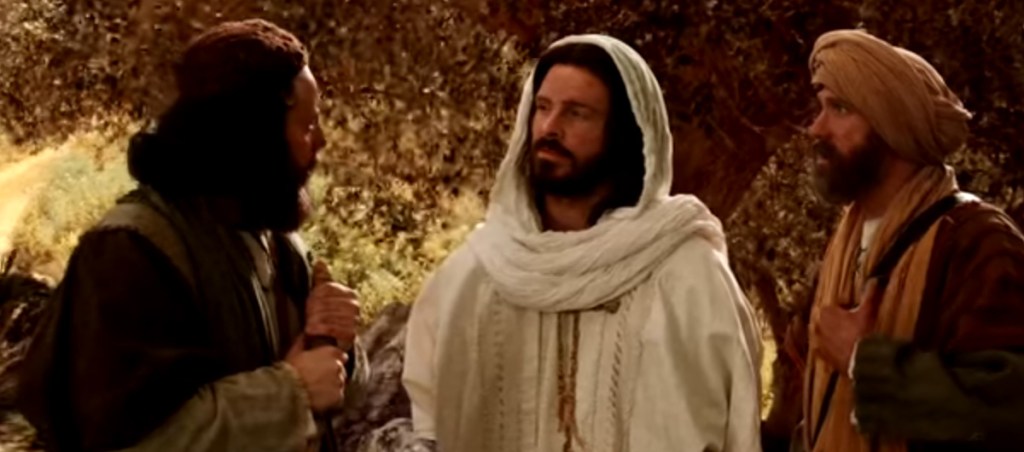
How We Miss Jesus in the Dust of Our Own Hopes and Expectations

Reading from Luke 24:13-21.

"That very day two [men] were going to a village named Emmaus, about seven miles from Jerusalem, and they were talking with each other about all these things that had happened. While they were talking and discussing together, Jesus himself drew near and went with them. But their eyes were kept from recognizing him. And he said to them, “What is this conversation that you are holding with each other as you walk?” And they stood still, looking sad. Then one of them, named Cleopas, answered him, “Are you the only visitor to Jerusalem who does not know the things that have happened there in these days?” And he said to them, “What things?” And they said to him, “Concerning Jesus of Nazareth, a man who was a prophet mighty in deed and word before God and all the people, and how our chief priests and rulers delivered him up to be condemned to death, and crucified him. But we had hoped that he was the one to redeem Israel."

This encounter took place after Jesus was publicly seized, tried and crucified. These men were discussing those events. Everyone was talking about it. Jesus had stirred up the hopes and dreams of the people, including these two men, but those hopes and dreams ended shockingly and abruptly just few couple of days ago.

Everything changed. Expectations deflated Hopes crashed. The shameful and humiliating death of Jesus, the man in whom so much hope had been placed, was overwhelming. It’s all they could talk about.

When Jesus, himself, came and joined them, walked with them, and and spoke with them, they didn’t recognize him. It wasn’t the first time Jesus wasn’t recognized by his people.

Jesus was born into a world that was ripe for his coming. The last of the Hebrew scriptures was written about 300 years prior, and the thrust of those writings, the prophets, anticipated the coming of a Messiah.

The first century Jews believed this Messiah would be a king that would rescue them from Roman rule and reestablish God’s Kingdom in their promised land, rekindling the glory of their heritage. The air was virtually electric with that hope and expectation.

Jesus didn’t deliver what they expected and hoped for. He was a controversial figure from the start. He offered them hints of the promise they hoped for, but he didn’t deliver on their expectations.

Jesus was controversial because he seemed to stand in opposition to the existing Jewish leadership. He seemed to be more critical of the contemporary religious leaders than the secular Roman imposters that governed their homeland.

The orientation of Jesus in opposition to the contemporary religious leaders was not lost on them. They saw Jesus as a threat. Jesus seemed to provoke them with violations of the laws they handed down. He appeared to say blasphemous things like, “Before Abraham was I am”, and claiming to have the authority to forgive sins.

The Jewish leaders were aware of the miracles Jesus performed and the following Jesus had with the poor, the weak, the vulnerable and the downtrodden people. They loved him and who flocked to him, but he gained no trust or respect from the leaders and learned men.

The men with the religious credentials characterized his miracles as magic, sorcery. They called him a hypocrite for hanging out with prostitutes, tax collectors and sinners. That their protestations failed to detract from his popularity was worrisome.

The Zealot movement that predated the birth of Jesus was driven by people had gotten tired of waiting for a Messianic figure to come. They determined to take the course of history into their own hands, to overthrow the Roman government by their own force and to reestablish the Kingdom of Israel in the present time.

Many zealous leaders rose promisingly in in opposition to Roman rule. They quickly generated a following. Just as quickly their followings fell away as those leaders were caught, tried and executed. Jesus seemed no different than they.

This was the atmosphere of First Century Judea. It was a tumultuous time, but a time filled with an air of expectation. Jesus was the closest thing to the promised Messiah that had come along. He had just been welcomed by throngs of adoring people as he entered Jerusalem. They public spectacle they caused stood, now, in contrast to disappointing end to their hopeful Messiah.

Continue reading “How We Miss Jesus in the Dust of Our Own Hopes and Expectations”

Who is My Neighbor? And Who is a Neighbor to Me? The Discomfort of Grace.

Grace is exercised among people who are not like you, who challenge you, who are uncomfortable to be around.

I have often touted the Unbelievable Podcast on Christian Premiere Radio in the UK, and I do it again here. I recommended the episode on Philip Yancey live Q&A on faith, doubt and the future of the US church: Saturday 19 March 2022. Much was discussed in the episode that I could write about, but one thing stands out above the rest to me this morning. Philip Yancey said,

“It’s easy to find a church, to gravitate toward a church, where people look like you, and smell like you, and vote like you.”

Most of us go to churches like that. It’s a human tendency to gravitate toward people with whom we have the most connections, to settle in with people with whom we have the most in common, to spend time with people most like us, but Yancey says,

“That’s not the way to exercise grace. Grace is exercised among people who are not like you, who challenge you, who are uncomfortable to be around, people who are immoral. That’s where to exercise grace.”

Such a radical statement challenges most of us, I think. I am guilty of settling into churches where I feel most comfortable, but what if God wants me to engage in a church, or in groups, or with people with whom I feel uncomfortable? Would I be open to that possibility?

Jesus often urged people to love their neighbors. When I think of my neighbors, I think of the people in my neighborhood who I know and spend time with. If you are like me, you probably think immediately of your neighbors you know, but what about your neighbors you don’t know?

Jesus knew that people tend to favor those who are like them when he told the parable of the Good Samaritan. (Luke 25:30-35) In the parable, an unidentified man is attacked by robbers, stripped of his clothes, beaten and left for dead. (Luke 25:30) Three people come along and see him lying there: a priest, a Levite, and a Samaritan.

The priest and the Levite were the people most like the man who asked the question that prompted the parable. He was an expert in the Law of Moses, a Jewish leader.

He actually began with a more esoteric question: “What must I do to inherit eternal life?” Jesus turned the question on him, asking “What is written in the Law?” (Luke 25:25-26)

When the man responded, “‘Love the Lord your God with all your heart and with all your soul and with all your strength and with all your mind’; and, ‘Love your neighbor as yourself,'”, Jesus answered anti-climatically, “You have answered correctly…. Do this and you will live.”

That might have been the end of the conversation, but the expert in the law “wanted to justify himself”. Perhaps, he wanted affirmation that he was reading the law correctly. Perhaps, he wanted Jesus to acknowledge his deep moral thinking. Perhaps, he wanted to prove his expertise in the Law. Whatever he was thinking, he asked, “[W]ho is my neighbor?” (Luke 25:29)

The man may have wanted Jesus to engage him in a deep theological discussion, but Jesus deflected the attempt with the parable. The expert in the Law wanted to make it difficult and complicated, but Jesus kept it simple.

The man is specifically identified as an “expert in the Law”, and the initial question and follow up question read to me like he was wanting a deeper, philosophical conversation with Jesus. He didn’t really want a simple, straightforward answer. He wanted to debate, but Jesus wouldn’t go there with him.

I am also relatively certain that the answer Jesus gave him was not at all what he expected. It likely cut him to the quick – both he and and the wider audience who was listening in.

Continue reading “Who is My Neighbor? And Who is a Neighbor to Me? The Discomfort of Grace.”

The Danger of Religiosity, Political Expediency and the Weight of the Cultural Moment

We can be so caught up in our own lives and the world around us that we fail to recognize the God who gave us life and created the world.

I have been reading through the Gospel narratives leading up to the death and resurrection of Jesus during Lent. My reading included the following passage that jumped out at me:

“Then they led Jesus from the house of Caiaphas to the governor’s headquarters. It was early morning. They themselves did not enter the governor’s headquarters, so that they would not be defiled, but could eat the Passover.” 

John 18:28 ESV

I will get the point, but first we need to build in a little context. This passage describes a passing moment leading up to the crucifixion after Judas betrayed Jesus in the garden. Jesus was taken, first, to the palace of Annas (John 18:13) and then to Caiaphas, the Jewish High Priest. (John 18:14)

After Caiaphas questioned Jesus, Jesus was taken to the Roman governor, Pontius Pilate. The High Priest wanted Jesus put to death for blasphemy, but only the Roman state had authority to impose capital punishment.

Caiaphas was the High Priest who presided over the Sanhedrin, the official religious body recognized by the Romans. Caiaphas was made the High Priest by the Roman procurator Valerius Gratus. Annas, the father-in-law of Caiaphas, had presided over the Sanhedrin before Caiaphas.

They were the official heads of the ruling group of religious leaders in First Century Judea in the time of Jesus, the Sanhedrin. They stood between the Romans, who conquered and controlled the region, and the Jewish people on matters of the Jewish religion.

During this tumultuous time, a group of violent men, the Zealots, who were opposed to Roman rule threatened to upset the political balance and peace. Similarly, the growing, unpredictable following of Jesus posed a threat to the Sanhedrin’s position as trusted middlemen trying to preserve peace and the status quo.

Potential disruption threatened the delicate balance. The Sanhedrin tried to walk the line between the threat of the Roman Empire on the one side and the Zealots and others who might provoke the Romans to tighten their grip on Judea, dismiss the Sanhedrin from their power position, and clamp down on the freedoms of the Jewish people they ruled.

Tensions were not just a threat to the Sanhedrin, who were officially given some overlapping authority the Romans; they were legitimately a threat to the well-being of all the Jews in Judea. Thus, we read in John that Caiaphas advised “advised the Jewish leaders that it would be good if one man died for the people”. (John 18:14)

The suggestion was based on practical expediency. Though Jesus wasn’t a Zealot, he was very popular among the people, likely including the Zealots who hoped Jesus would spell the end of the Roman occupation.

The concerns of the religious leaders were no doubt heightened to a critical level when Jesus came riding into Jerusalem on a donkey in triumphant celebration greeted by a “great crowd” that lined the streets, waiving palm branches and shouting,

“Hosanna!…. Blessed is the king of Israel!”

John 12:12

I am going to get to the danger of religiosity, political expediency and the weight of the cultural moment as the title to this article promises. First, however, I want to develop the backstory a bit further. To do this, we need to jump forward several months in time.

Continue reading “The Danger of Religiosity, Political Expediency and the Weight of the Cultural Moment”

The Group Affiliations the Apostles Had and What It Might Mean for Us

When I look at American expressions of Christianity today, I wonder if we demonstrate the right way to follow Jesus.

Oil painting illustrating Jesus Christ and his disciples on a meadow

I have spent some time lately considering the various influential groups of people in the time of Jesus and the orientation of those groups toward Jesus. I have wondered why Jesus seemed to pick on the Pharisees more than the other groups, especially since they seemed most aligned with him and had the most in common with him.

As I researched and thought about the various groups of Jewish influencers in the First Century in relation to Jesus, I began to think about the apostles, and their connections to these groups. I am always mining for insight as I read Scripture, and today my mind turns toward the relationship of the twelve apostles to those same groups of First Century, Jewish influencers.

We don’t know much about the background of the twelve disciples, except that most of them were “common” men of generally humble means. One disciple was identified with the Zealots (Simon, the Zealot, also known as Simon the Canaanite). Matthew, the tax collector, might have been Herodian (or may have been viewed as one).

We really don’t know about the group affiliation of the other disciples, at least not from the explicit text. They seem to have been ordinary people with no distinct association with particular groups. They did not seem to be closely associated with any of the five groups Jewish leadership groups in First Century Judea.

Even Simon, who is known as the Zealot, probably left his group behind to follow Jesus. Just as Matthew left behind his livelihood (tax collection) to follow Jesus. Of course, Simon (Peter) and Andrew dropped their fishing nets to follow Jesus, as did the brothers, James and John. It’s no stretch, therefore, to imagine that Simon, the Zealot, would have similarly “dropped” or left behind his affiliation with the Zealots to follow Jesus.

In fact, the theme of leaving behind your group seems to run throughout the teaching and example of Jesus. Jesus said, “[E]veryone who has left houses or brothers or sisters or father or mother or children or lands, for my name’s sake, will receive a hundredfold and will inherit eternal life.” (Matt. 19:29)

He called Peter and Andrew and James and John away from their profession of fishing. He called Matthew, the tax collector, away from his profession of tax collecting. I think it’s fair to assume that Jesus called Simon, the Zealot, away from the Zealots to follow him.

The theme of leaving behind family, livelihood and group identity runs deep in Scripture, all the way back to Abram (as Abraham was originally known) when God called Abram to leave his country, his people, and his father’s household and go to the land God would show him. (Gen. 12:1)

Hebrews 11 commends Abraham for the example of faith demonstrated in responding to God’s call and leaving behind the familiarity of all the things that typically identify people and their place in the world. Abraham and all the people of faith commended in Hebrews 11 demonstrated a kind of faith that made them “aliens and strangers on earth”.

Jesus called the rich young ruler to walk away from his wealth. (Matt. 19:16-30) Jesus told Nicodemus, the Pharisee, that he would have to be born again to see the kingdom of God. (John 3:3) Nicodemus was born into an enviable position in his community and may have winced at the thought of needing to be “born again”.

The kingdom of God is something I have been mulling over for many weeks, and months. It’s a theme I have written about often lately, and it has occupied a prominent place in my meditations lately.

The five main groups of Jewish influencers in the First Century had one thing in common – they were operating on a spectrum of influential relationship to the political structures and religious structures in their world. They were invested and embedded into their positions, and identities, with the people with whom they affiliated – like the partisanship and critical group affiliations we have today.

Along came Jesus, however, and he called people “out of the world”. (John 15:18-19) Jesus called people to leave their lives, and identities, and associations behind to follow him. I believe he is still calling people to the same allegiance today.

We don’t know much about the backgrounds and affiliations of the twelve disciples, perhaps, because they did just that. They left those things behind to follow Jesus. They became known, simply, as disciples of Jesus. They were, simply, Christ followers.

I am interested in these things because of what it means for us. If we would be disciples of Jesus and Christ followers, how do these things translate to our lives in the 21s Century?

Continue reading “The Group Affiliations the Apostles Had and What It Might Mean for Us”

Jesus Among the Religious and Political Groups of His Time

This is a companion piece to the last article I wrote and published: Why Did Jesus Pick on the Pharisees So Much? The former article was inspired by 40 years of observation that Jesus was harshly critical of the Pharisees. His treatment of them virtually jumped off the pages at me when I first read the Gospels in college.

The Pharisees, though, were only one of the influential groups of Jews in First Century Judea. We see some evidence of Jesus rubbing shoulders with the other groups, but not nearly as much as Jesus engaged the Pharisees.

We might be tempted to assume that the Pharisees were particularly wicked and sinful – far more than the other groups Jesus encountered – but that isn’t so. Jesus was most like the Pharisees, and they were most like him in their theological leanings and in the social circles in which they operated.

For that reason, I focused in my last article on the question: why was he so harsh towards them? I could have asked: why didn’t he pick on the other groups more?

In this article, I will explore the other groups and the difference between them and the Pharisees. I will spend a little time pondering how Jesus and the twelve apostles related to these groups in the Gospel accounts and provide my own thoughts as they occur to me.

First Century Judea was broadly possessed by two groups: the Jews, of course, and the Romans. The Jews had long lived in this land that God promised their ancestor, Abraham, but the Romans were newcomers. they were recent conquerors, following the Greeks, in a long line of challengers to the Jewish occupation of the land.

The five Jewish groups represent a spectrum of relational attitudes towards the Romans and each other in their religious and not-so-religious observances, lifestyles and attitudes. I will tackle them in order of their relationship to the Romans and their religious orientation.

Continue reading “Jesus Among the Religious and Political Groups of His Time”