Looking at Both Sides of the Wall

Walls can provide peace and security, but they can also be used to oppress and to prevent us from accomplishing God’s purposes.

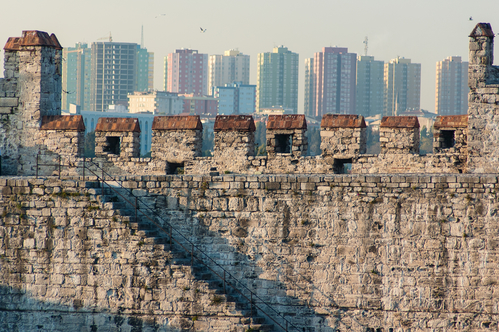
Ancient city walls and modern buildings in Istanbul, Turkey

Wayne Gruden, a Christian ethicist, makes a case for building a wall. He cites to biblical passages that reinforce the idea that walls provide protection, peace and security to those inside the walls. These are good things, he says, and he cites to support for this proposition in the Scriptures.

The Psalmist prays (for Jerusalem) for “peace within your walls and security within your towers” (Psalm 122:7) and praises God for strengthening the bars of Jerusalem’s gates, making peace within its borders. (Psalm 147:12-14) David prayed to God to build up the walls of Jerusalem. (Psalm 51:18) King David built walls around Jerusalem, and King Solomon strengthened those walls after him. (1 Kings 3:1)

God used the Babylonians to visit judgment on the people of Israel by breaking down the walls of Jerusalem and burning down the temple and the palaces. (2 Chronicles 36:19. See also Jeremiah 52:14) The first thing the remnant did when they returned to Jerusalem was to rebuild the wall. (Nehemiah 2:17)

Indeed, walls and gates and towers are all pictures that convey the peace and security that the ancients hoped and prayed for from God. These symbols stand for the peace and protection for which ancient people longed in the harsh world of their time.

Proverbs says, “A man without self-control is like a city broken into and left without walls.” (Proverbs 25:28) Thus, walls around cities are symbols of self-control and self-defense.

Certainly, building walls in a hostile world is a prudent thing to do. On different levels, we do this (provide peace and security) for our families, our communities and our nations. Basic decency demands it. Therefore, Wayne Grudem concludes that “the Bible views border walls as a morally good thing”.

I agree with him, but that isn’t necessarily the end of the story. Like many things, walls can be good, and they can be bad. Few people, for instance, believe the Berlin Wall was a morally good thing. Whether building a wall is a morally good or appropriate thing depends on the circumstances and the purposes for which it is built.

Moral goodness can’t be determined in a vacuum. Morality, or righteousness and justice, to use more biblical terms, is a matter of relationship with God and other people. The determination of what is righteous and just begins with a determination of God what God desires and purposes We must have to apply what we know about God’s heart for righteousness and justice in a given situation by considering specific circumstances in light of the big picture.

Walls are not good or evil in themselves. They can protect and maintain peace and security for the people within the walls. They were a critical and necessary component of safe community in most centuries gone by. People who were not protected by walls were exposed to the vagaries of every vagabond with bad intent.

But walls that are designed to keep people captive to an oppressive regime are not good. Walls that were necessary and appropriate for the safety and security of people in ancient times may not be as necessary of appropriate in modern times.

Walls can be used to provide peace and security, but they can also be used for evil purposes like oppression. The issue isn’t walls, but purpose and intent. For Christians that means God’s ultimate purposes and intent.

Continue reading “Looking at Both Sides of the Wall”

Following Jesus on Immigration

Jesus told us to give to Caesar what is Caesar’s, but we are Caesar in a democracy in which we all participate through the right of freedom of speech.


“If you really fulfill the royal law according to the scripture, ‘You shall love your neighbor as yourself,’ you are doing well. But if you show partiality, you are committing sin and are convicted by the law is transgressors. For whoever keeps the whole law but fails in one point he has become guilty of all of it…. So speak and so act as those who are to be judged under the law of liberty. For judgment is without mercy to one who has shown no mercy. Mercy triumphs over judgment.” (James 2:8-10, 12-13)

The immigration issues in the United States are much on everyone’s mind, if for no other reason than Donald Trump and the media are making a big to do about it. Most thinking and empathetic people, however, have watched with some angst as the treatment of families and children crossing the border has brought a moral crisis to our daily awareness.

What should we do with these illegal immigrants and asylum seekers? How should we be treating them and handling the situation? As the videos, photos, stories and reports stream in day after day, we can’t help but notice what is going on and react to it.

How does a Christian respond to the immigration issues that face our country?

Continue reading “Following Jesus on Immigration”

Hearing the Voice of God for Today

Our focus should be on God, and our direction should be inspired by scripture with the help of the Holy Spirit to discern God’s heart, intention and direction for us in these modern times.


I recall a sermon preached back in the 1980’s in the church I attended at the time in New Hampshire. I don’t remember the scriptural passage or references, but I remember the gist of the message, and it has stuck with me ever since.

The gist goes something like this: As God’s people, we need to be informed and take our direction primarily from God and God’s will as revealed to us in the Bible with the help of the Holy Spirit. We are in the world, but we are not of the world, and we should be careful not to be influenced by the world in our thinking.

The key point that I remember, however, is that we can focus so much on trying not to be influenced by the world that we become reactionary to it. If the world goes right, we go left. If the world goes left, we go right. If all we are doing is being reactionary to the world, we lose our focus on God. In the process of trying not to be like the world, we allow ourselves to be defined by the world nevertheless.

If our direction is dictated by nothing more than going in the opposite direction of the world, we are no more directed by God than if we are going in exactly the same direction as the world. Either way, we are focusing on the world and allowing the world to influence our direction, rather than God.

Continue reading “Hearing the Voice of God for Today”

America’s Changing Melting Pot

The population of America is a changing landscape. What are the implications of that for us? What are the implications of that changing landscape on the immigration controversy that is going on?

kevingdrendel's avatarPerspective


So here’s a thought, but first, consider these statistics:

In 2016, in 26 states, the number of non-Hispanic whites who died was greater than the number of non-Hispanic whites who were born in those states, according to an analysis by the U.S. Census Bureau that was released last week. The 26 states were a diverse group in terms of geography and demographics, from Maine to Alabama to California. Nationwide in 2016, there were 0.98 births for every death among non-Hispanic whites, a rate lower than that of blacks (1.71), Asians (3.87) and Latinos (4.88).

I have seen numbers like these before on a national scale. We are tottering on the edge of population regression. People get married less, marry later, have fewer children, and these factors contribute to our population decline – at least among white Americans. Most European countries are well beyond us in this population regression cycle.

View original post 295 more words

What the Studies Say on Immigration and Crime

A common perception going back into the 1800’s is that immigrants bring criminal behaviors with them into the country.


Much of the positioning and politicking about immigration focuses on crime and fears that immigration brings crime into the country. Donald Trump famously said of Mexican immigrants, “When Mexico sends its people, they’re not sending their best. They’re not sending you. They’re not sending you. They’re sending people that have lots of problems, and they’re bringing those problems with us. They’re bringing drugs. They’re bringing crime. They’re rapists.” (Remarks from the speech by Donald Trump when announced his run for the Republican nomination for president at Trump Tower Atrium in Manhattan on June 16, 2015)

Crime is obviously a very big societal concern, and one we shouldn’t take lightly. Most Americans are in agreement on that point. Protecting law abiding citizens from criminal behaviors is a top priority, one that often justifies using a significant percentage of local tax dollars in support of law enforcement. If immigration increases crime in our communities, tightening up the immigration laws makes sense from the standpoint of protecting citizens from crime. But does it?

Does immigration increase the crime rate in our communities? Are immigrants more likely to commit crimes than citizens?

I wasn’t at all sure what the studies show so I set out to determine for myself the answer to the questions. These are important questions because our immigration policies should be informed by the facts. As Christians, especially, we should be guided by truth.

Continue reading “What the Studies Say on Immigration and Crime”