Be Careful Lest You Fail to Take What God Is Doing to Heart

Pharaoh did not take to heart a movement of God in his time.


In Exodus 7, we read that God moved in visible and compelling ways to convince Pharaoh to listen to the request by Moses to let the people go into the wilderness and be with God. Pharaoh was given demonstrative signs that God was behind the request, but Pharaoh was not swayed.

“Instead, he turned and went into his palace, and did not take even this to heart.”

Exodus 7:23 NIV

Pharaoh’s magicians answered Moses and Aaron with their own divination, and Pharaoh did not take the demonstration of the movement of God to heart. This is the character of hardness of heart. We see God move, but we have an answer to explain it away, and we do not take it to heart.

Pharaoh and Egypt are considered to be analogous to the world that does not know God, a world that has set itself against God. We don’t consider ourselves to be like Pharaoh or like Egypt.

When we do the same thing, however, we are no different. When we see God move, and we explain it away and do not take it to heart, we are no different.

The Pharisees, the religious leaders of God’s people, did the same thing. When Jesus performed miracles right in front of them, they explained it away. They said it was of the devil, and they did not take it to heart.

Be careful that you are not quick with an answer to explain away what God is doing and fail to take it to heart.

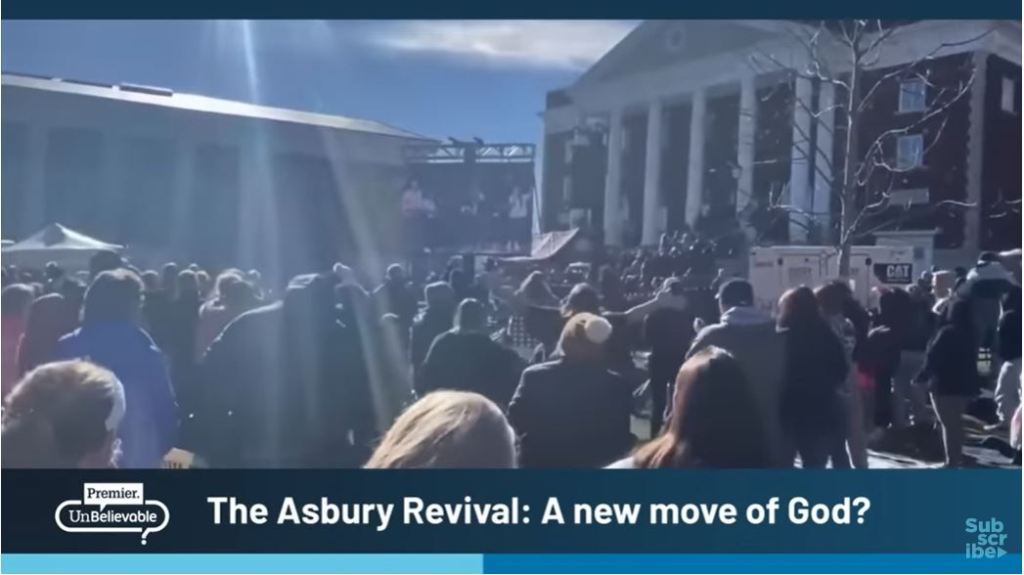
Do not be quick to explain away what is happening at Asbury University (and reportedly at other universities now, too). Do not be quick to dismiss it and miss what God is doing.

Take it to heart. Ponder it like Mary pondered what the angel told her: that she would give birth to Jesus. Be open to what God is doing, and what God wants to do in you.

The Pharaoh that didn’t take to heart what God was doing in his time lies entombed today like a stone. The God of Israel lives! Jesus, who was also entombed, rose from the dead and lives! The grave could not hold him, and he offers that same life to you!

Taste and See that God is Good: The Asbury Revival

We spend far more time praying for renewal of our strength than soaring on wings like eagles.


I have noticed with some mild interest at what is going on at the chapel on the Asbury University campus in Kentucky. Posts show up in my Facebook feed daily, as I am connected to many Christians (and many other people too) on Facebook. One post today, shared from someone who has been there from the beginning, described it succinctly as follows:

“A chapel service that didn’t stop but continued spontaneously for 8 days now.”

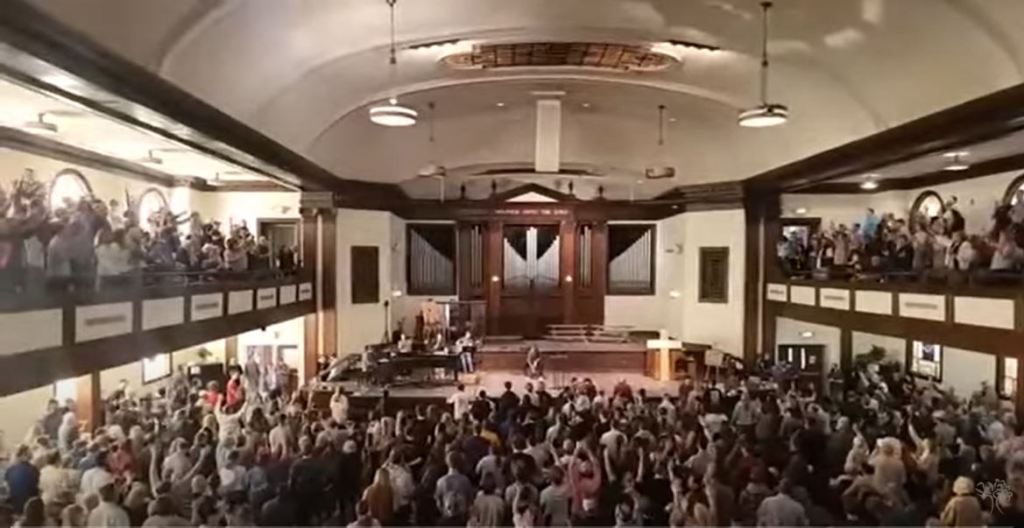
Today has been ten (10) days since that spontaneous beginning, and I have been watching various live streams of the February 8th chapel service that is still going on. This is how it started:

How the Asbury University chapel started on February 8, 2023

I have seen doubters and critics, I have seen posts from people who jumped in their cars and traveled hundreds of miles to see it for themselves: this chapel service that started and has not stopped. It has continued around the clock for 10 days now.

I have seen hype. I have seen caution. Critics caution about emotionalism. Critics want to de-emphasize experience and double down on the Bible and doctrine. Critics say that an omnipresent God should not require a person to travel to a particular location to experience Him.

I have been cautious myself. I am also aware that a sovereign God does what He wants to do despite our understanding of scripture, and theology and the way things ought to be. I have experienced “moves of the Holy spirit”, myself.

I have experienced that people cannot dictate how, when, or whether the Holy Spirit moves. “The wind blows where it will.” We don’t put the Holy Spirit in our pocket like a rabbit foot. We don’t command or possess Him.

People have described what is going on at Asbury University as a revival. That term may conjure up images of a “tent revival” and flamboyantly crass preachers, artificially slick hair, words that drip like honey, and ecstatic chaos.

The Asbury Revival is characterized by a different atmosphere. The person’s post from today who has been there from the beginning said this:

“To quote Professor McCall, a theology professor at Asbury Seminary, ‘what we are experiencing now—this inexpressibly deep sense of peace, wholeness, holiness, belonging, and love—is only the smallest of windows into the life for which we are made.’”

As a child of the 60’s and 70’s, I am reminded of the hippies who wanted “Peace and love. Not war!” I think of John Lennon who imagined a world without war – and without religion – with only peace. Hippies, however, were a contentious bunch, and John Lennon was no saint.

Not that I blame them for dreaming or trying. It’s just that people are completely incapable of making these kinds of dreams come true. Just when we think we have created our utopia, it is already disintegrating and slipping through our fingers like a mirage we feel we can grab hold of.

I lived for several years in a communal house. It was a leftover from the flower children of the 1960’s who became the Jesus people of the 1970’s. I loved it, but it was no utopia. The reality is that people have rough edges. So, “iron sharpens iron,” but the sharpening isn’t always a pleasant process.

Yet, when people get together to devout themselves to following God together, to worship and pray together, to do life together, God is in their midst. These words of Jesus are as true today as the day he spoke them:

“Where two or three gather in my name, there am I with them.”

Matthew 18:20

These words are true when our rough edges are rubbing against each other as much as when we “feel the love” (which may not be as often as we like). Even then, I have never experienced the intimacy with another human being as I have experienced when I have experienced the Holy Spirit “moving” in me, usually during times of group worship..

I have experienced the “inexpressibly deep sense of peace, wholeness, holiness, belonging, and love” described by the Asbury professor. It cannot be manufactured or trumped up. When it “happens”, words are difficult to describe it; the experience is life changing.

The experience is only truly life changing, however, if we recognize that the experience is not the point. The experience is a brush with God, who is the source of peace, wholeness, holiness, belonging and love.

If we walk away from the experience longing for another experience, we have missed the important thing. It isn’t ultimately the experience that we long for at all; we long for God, and relationship with Him.

If we chase the experience, it becomes ever more elusive. In our desperation and desire to repeat it, we may resort to emotionalism. We may even resort to trumping up experiences that are artificial.

We desperately need connection to our Creator and the lover of our souls.

Continue reading “Taste and See that God is Good: The Asbury Revival”

Taking the Hand of God, Literally; How We Read the Bible


Heaven is my throne, and the earth my footstool. What sort of house will you build for me? says the Lord, or what will be my resting place? Did not my hand make all these things?

Acts 7:49‭-‬50 CSB

I have thought and written about the fundamentalists and the atheists of the world who, ironically, approach the Bible in the same way. Both groups of people read the Bible in a wooden, inflexible, literal kind of way. (See Sam Harris Podcast with Bart Ehrman – Part 2 – Wooden Fundamentalism)

This passage above gets me thinking about these things again. The passage quoted above is from Steven’s address to the Jewish leaders who had him stoned after calling them stiff-necked like their ancestors in the desert (among other things).

Steven recited the Jewish history to them, including the Ark of the Covenant that was created to hold the Ten Commandments and the Tent of Meeting that was carried through the desert and set up where they stopped as a place for God’s “presence” to “dwell” among them. The Tabernacle with the Ark of the Covenant became the inner sanctum of the Tent of Meeting. These structures the people carried with them became the place they would meet with God.

David desired to build God a home, a permanent place for the Ark of the Covenant and Tabernacle, and Solomon accomplished David’s dream. David knew, however, that God does not live in a temple made by human hands. Solomon, David’s son who built the Temple, acknowledged the same thing when he dedicated the Temple:

“But will God really dwell on earth? The heavens, even the highest heaven, cannot contain you. How much less this temple I have built!

1 Kings 8:27

They understood that the Tabernacle, the Tent of Meeting, and the Temple were symbolic. These physical structures and the activity organized around them and in them were meant to point to a metaphysical reality of much greater substance.

It’s ironic that David, a man after God’s own heart, knew these things, but the people of God generally often did not. David was a man after God’s own heart, but the Israelites on the whole were often stiff-necked, as Stephen said.

I find it ironic that people who try to interpret and apply the Bible in the most literal way fall on opposite ends of the spectrum. Fundamentalists and atheists both tend to interpret the Bible literally. They are the two sides of the same interpretive coin. The only difference is that one side believes every part of it, and the other side believes none of it.

At the end of the passage quoted above, the Lord poses the rhetorical question, “Did not my hand make all of these things?”

Does anyone literally believe that God’s hand made the universe? I suppose we should ask, also, “Does God have only one hand?”

I would venture to guess that everyone understands this phrase to be allegorical. Yet, there are so many things in the Bible that people try to take and apply literally that are, perhaps, not as obviously allegorical.

I’ve heard the counter statement that we cannot pick and choose the things we believe out of the Bible. We must believe every word of it, or reject all of it. This is the fundamentalist/literalist approach – all or nothing. Never mind that a verse like the one quoted above is clearly not intended to be taken literally!

Not to pick on “fundamentalists” (whatever that term might mean), but those people we tend to label with that term tend to push a very literal interpretation of Scripture. They, in a sense, double-down on the “facts” stated in the Bible and attempt to believe “everything”. Many atheists dig in on the same literal way of interpreting the Bible, but they believe none of it. They both approach the Bible the same way, but one believes 100% and the other believes 0%.

Continue reading “Taking the Hand of God, Literally; How We Read the Bible”

Digging into the Accuracy and Inspiration of the Bible

I wrote recently on the character of Scripture, prompted by a statement made by Marty Solomon in Episode #82 of the BEMA Podcast, picking up on a statement he made that inspiration doesn’t necessarily mean accuracy. (See Does inspiration mean accuracy?) This topic gets into what it means that Scripture is the inspired word (or revelation) of God.

The idea that Scripture is inspired by God comes from 2 Timothy 3:16:

“All Scripture is inspired by God and beneficial for teaching, for rebuke, for correction, for training in righteousness….” 

2 Timothy 3:16 (NASB)

Paul’s statement in his second letter to young Timothy is one of the few comments on the character of Scripture in the Bible. In this article, I want to focus on other comments on Scripture that can be found in the New Testament.

You might be surprised to know that Peter references Paul authoritatively, expressly characterizing Paul’s letters as “scripture” (sacred writings). (2 Peter 3:15-16 ESV) The recognition by Peter that Paul’s writings are scripture is highly significant because Jesus said Peter was the “rock” on which Jesus would build his church. (Matt. 16:18) If Peter considered Paul’s writings “scripture”, we should too.

Paul, likewise, references Luke in his first letter to Timothy. Paul quotes from “the Scripture”, saying: “’Do not keep an ox from eating as it treads out the grain.’ And in another place, ‘Those who work deserve their pay!’” (1 Timothy 5:18 NLT) The first quotation is from Deuteronomy 25:4. The second is from Luke 10:7 (NRSV). Thus, Paul quotes Luke’s Gospel, as scripture in the same vein as the Torah.

This discussion, though, begs the question: what is scripture? Obviously Peter thought Paul’s letters were scripture, and Paul thought Luke was scripture. Most of scripture in that time would have been what we call the Old Testament. There was no “New Testament”, so what else is scripture?

Many misconceptions abound. People claim that books were removed from the Bible. People claim that a group of “church fathers” got together and determined what should be in the New Testament.

These claims are false. They have no basis in the historical record.

The truth is more complicated, and the NT canon developed more organically than what is popularly believed. The writings of the NT developed from the texts that were considered authoritative throughout the scattered regions of the early church, long before the Christianity became the official religion of Rome in the late 4th century and the Holy Roman Empire emerged in the 9th Century (See Encyclopedia Britannica).

We may think of Christianity being controlled centrally from Rome, but that didn’t happen until after the 4th Century. Before that, churches were scattered all over the Roman Empire and beyond. Various centers of influence existed, including Rome, Alexandria (Northern Africa), Jerusalem and Caesarea (the Levant), Antioch (Syria), Lyons (France) and other places. The top down authority of Rome (and Constantinople) developed much later.

The writings that make up the existing New Testament were shared and circulated throughout a wide area, wherever churches took root. Opinions were shared, and a consensus grew based primarily on the authorship (apostolic connection) and message (consistency with the teachings of Jesus).

Many of those writings were accepted very early by a majority of people, and others gained acceptance later by the same organic method of consensus. (See The Formation of the New Testament Canon) Many other writings were considered helpful, but not scriptural, and some writings were considered heretical. Late writings generated after the apostles had all died were categorically excluded. These writings date from the second century and later.

Eusebius of Caesarea was one of the first people to attempt a summary of authoritative writings. The 22 “books” he identified in the 3rd Century are nearly identical to the canon we have today, minus a few and plus a few. The consensus was close to settled at that time.

The first person to name all 27 writings exactly as they are known today was Athanasius in Northern Africa in his Festal Letter written A.D. 367. The same canon was accepted by the rest of Christendom at the African synods of Hippo Regius (A.D. 393) and Carthage (A.D. 397 and 419). (Not the Council of Nicaea as the popular myth goes!)

In between the 1st Century and the early 5th Century when the canon was officially settled, other lists were offered by various sources. Bruce Metzger, the Princeton Theologian, says, “The slowness of determining the final limits of the canon is testimony to the care and vigilance of early Christians in receiving books purporting to be apostolic.”

Metzger notes that “the chief criterion for acceptance of particular writings as sacred, authoritative, and worthy of being read in services of worship was apostolic authorship”. The early church focused on the source or authority – connection to the apostles who knew Jesus. They also measured them by the known message of Jesus, as preserved by those same apostles.

Keep in mind that the apostles lived on after Jesus. Peter died in 64 AD during the reign of Nero in Rome according to contemporary, extra-biblical sources. John, the Apostle, died in approximately 100 AD according to reports preserved from multiple sources.

Thus, the apostles, the closest people to Jesus, lived on 30 to 70 years after Jesus died. They were the standard by which the authority of contemporary writings were judged.

Determining (or accepting) what is Scripture is only a beginning, though. How we view Scripture and interact with it is where the real rubber meets the road. In my last article, I wrestled with what it means that Scripture is inspired, suggesting that accuracy is not necessarily the key component. I will dig a little deeper into that vein in the rest of this article.

Continue reading “Digging into the Accuracy and Inspiration of the Bible”

Does God Throw Wildflowers into a Furnace?

The title to this piece seems like a silly question, right? But Jesus said,

“Consider how the wildflowers grow: They don’t labor or spin thread. Yet I tell you, not even Solomon in all his splendor was adorned like one of these. If that’s how God clothes the grass, which is in the field today and is thrown into the furnace tomorrow, how much more will he do for you — you of little faith?”
 
Luke 12:27‭-‬28 CSB

So, we need to ask again, “Does God throw wildflowers into a furnace?” I think it’s pretty safe to say that He doesn’t, right? Jesus is speaking allegorically here.

Jesus is saying in flowery terms that flowers are here today and gone tomorrow. They are beautiful, but only for a short time. No one reads this passage to mean that has a furnace where He throws all the wildflowers in the world. A wildflower furnace.

In the context of this little parable, Jesus is saying that wildflowers are magnificent in their splendor, though they last only a short time. The fact that God makes such temporary things as wildflowers beautiful in splendor is meant to give us hope and faith that He has much more splendor in store for us, the creatures He made in His own image!

These words give us great hope when life seems to be taking us down. No one interprets what Jesus says here as a lesson in the way God disposes of wildflowers. It’s a lesson about putting our faith in God.

Continue reading “Does God Throw Wildflowers into a Furnace?”