An Exercise in Looking at ‘White Privilege’ through Marxist and Gospel Filters

The inspiration for this article comes from an attempt by a black person to explain to a white friend what she means by white privilege. Much of the evangelical world resists the term, fearing its Marxist roots will poison the vine if we let it grow.

Before I get to the article explaining white privilege from anecdotal examples, I did a little research and found an article written by a Marxist critiquing of the concept, “white privilege”. Critique as I use it here means a critical (as in negative) view. (I found the article when searching for the origin of the term, thinking I would find its Marxist roots.)

I found the idea of white privilege can be traced back to a pamphlet, White Blindspot, generated by Noel Ignatin and Ted Allen in 1967 in which they presented arguments for “white-skinned privilege theory”. They argued that the white working class conspired with their exploiters against the non-white working class to achieve certain privileges that the non-white working class were denied. They called on the white working class to repudiate those privileges and stand with their non-white comrades.[i]

The 2020 article from which I take this narrative is critical of the “privilege theory” that developed. It identified the “privileges” that had been gained by largely white working class people included better access to medical care, better educational opportunities, and so on. The article took umbrage with the call for those workers to forgo those hard fought “privileges” to stand with their comrades of color against the capitalist elite.

“The problem with this conception is that these measures, rather than representing undeserved ‘privileges’, were in fact reforms won by the working class through bitter struggle. These class gains represented the return of a small part of the great wealth held by capitalists that workers had produced. Privilege theory – on the basis of unequal access to these gains under racist American capitalism – converted hard-won class victories, reforms and rights into “undeserved” workers’ ‘privileges’.”

The article says that “privilege theory” is “totally flawed” because it pits the white working class against the black working class. The article blames “privilege theory” on “divisive propaganda of the capitalist class” – a kind of divide and conquer strategy that served the interests of the capitalist class by creating tension in the working class on the basis of race. (Perhaps, the fact that “liberal elites” in cloistered universities developed “privilege theory” was another strike against “privilege theory” to a true Marxist.)

This article is not even a year old. Interesting, is it not? Just as the church is leery of white privilege, so are actual Marxists!

To a certain extent, this article exposes the weakness of Marxist theory which thrives on conflict. When conflict is part of the creed, it undermines itself; conflict conflicts with itself. Perpetual conflict begets perpetual conflict. “Privilege theory” is just one example of how Marxism pits factions against each other, even among factions with common interests.

On the other hand, I can argue that the idea of white privilege is actually more gospel than Marxist. I don’t necessarily believe that, but stay with me for a second. Paul urged the Philippians to have the same attitude as Christ Jesus, saying:

Though he was God,
    he did not think of equality with God
    as something to cling to.
Instead, he gave up his divine privileges….

Philippians 2:6-7 (NLT)

Most translations say that God “emptied Himself”. The Greek word, kenoó, literally means “to empty” and is translated empty, deprive of content or make unreal.[ii] The HELPS word study adds, to be “perceived as valueless”.

The idea that God “gave up His divine privileges” captures the essence of the meaning of the Greek word in a very modern way. I think about this often when I consider the concept of white privilege.

This is the example of Jesus – that he had the attitude of emptying himself and giving up his privilege. Jesus calls us to be like him, to deny ourselves, take up our crosses and follow him. Thus, if we have any privilege (white or otherwise), our attitude should be the same as Jesus. We should be willing to give up our privileges, literally or figuratively, and empty ourselves (consider those things valueless) for the sake of the gospel and others.

In the next chapter of Philippians, Paul says,

“I count everything as loss because of the surpassing worth of knowing Christ Jesus my Lord. For his sake I have suffered the loss of all things and count them as rubbish, in order that I may gain Christ ….” 

Philippians 3:8

Thus, the idea of recognizing the privileges we have, whether they are on account of being white, or American or whatever, actually has some biblical roots. Our willingness to recognize that privilege and to be willing to empty ourselves of it for others is consistent with Christian values and faith


The idea of recognizing privilege and being willing to empty ourselves of it may be more biblical than Marxist! (I am not completely jesting to suggest it.)

But this really isn’t the ultimate point I want to make today. I am not here to argue for the concept of white privilege in our interpretation or application of the gospel. I agree that foreign concepts, such as the notion of white privilege, should not be brought into the gospel message. The gospel message has integrity in itself and stands alone in its ability to transform lives and bear the fruit God intended of it.

I do want to argue, though, that Christians should not reflexively recoil from and demonize the notion of white privilege. It’s the language of the modern world, so demonizing it creates a divide between us and those God desires to save.

Rather, I think we can use the term to the advantage of the Gospel. If Paul used quotations from pagan poets and philosophers to bridge the gap to his Greco-Roman audience at Mars Hill (Acts 17), we can do the same with the notion of white privilege (and other words that are used in modern parlance).

Continue reading “An Exercise in Looking at ‘White Privilege’ through Marxist and Gospel Filters”
Looking at Some of the Oldest Extant Examples of Ancient Biblical Text

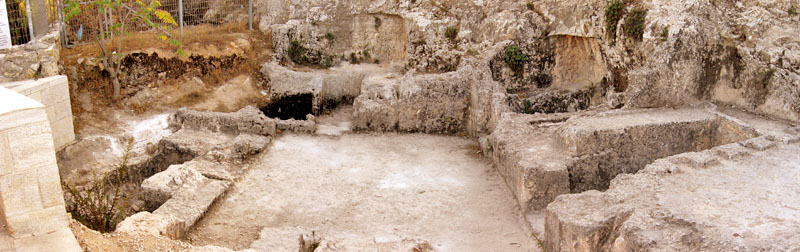
By Tamar Hayardeni, Attribution, https://commons.wikimedia.org/w/index.php?curid=23802552
Ketef Hinnom burial caves

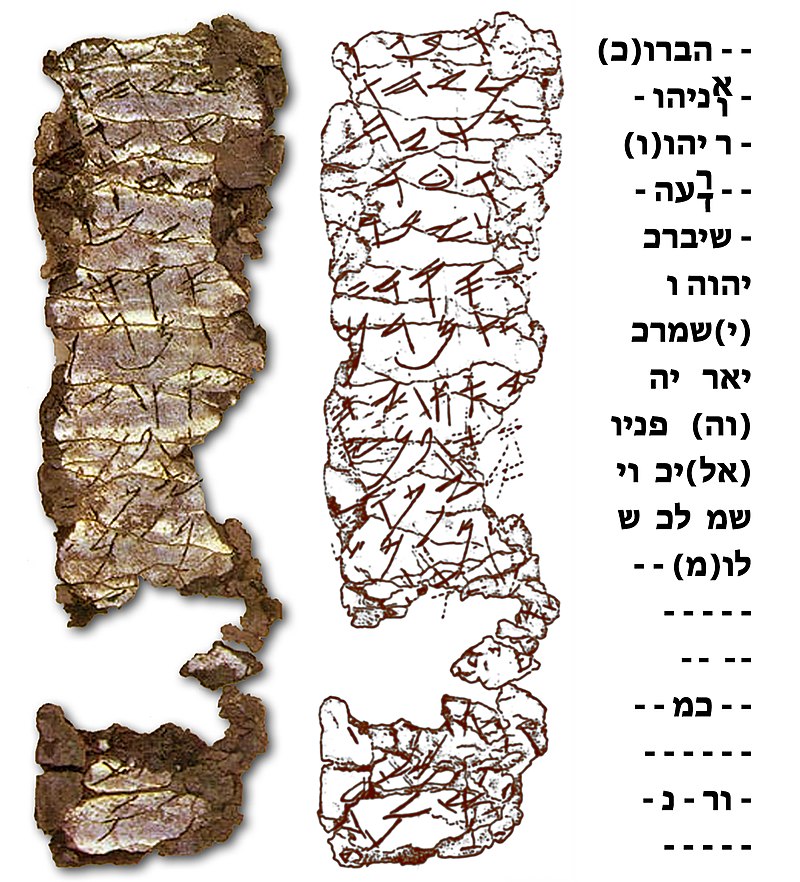
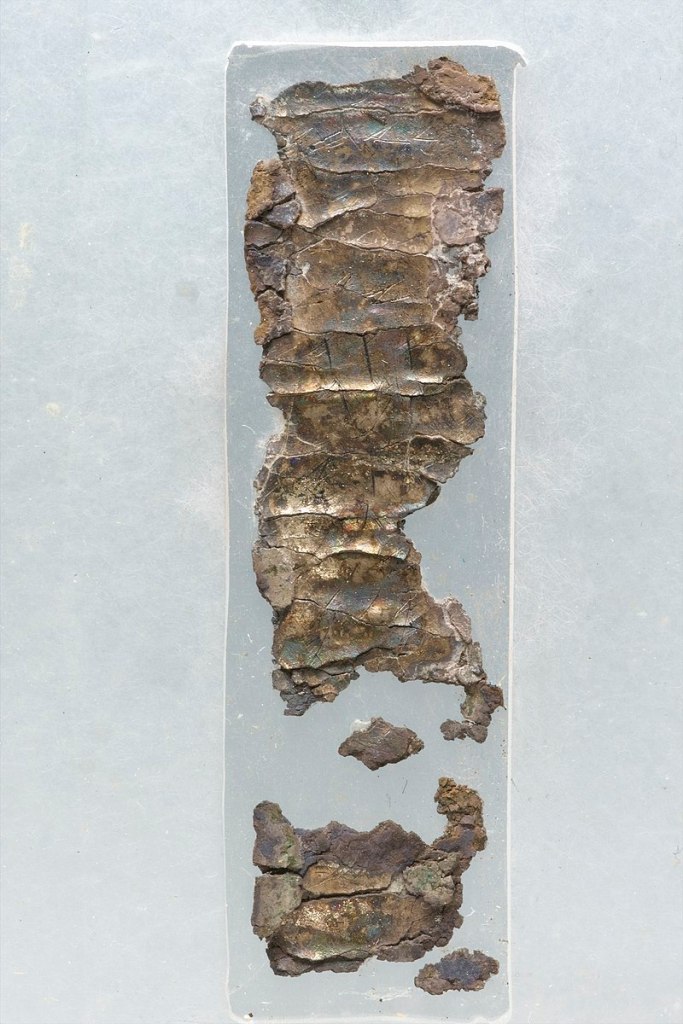
Some of the oldest extant examples of ancient biblical text are the Ketef Hinnom amulets.[i] The silver amulets meant to be worn around the neck are very small. They are actually tiny scrolls made of rolled silver with inscriptions on them. They were found at the First Temple funerary site of Ketef Himmom southwest of Jerusalem.[ii]

Discovered in 1979, the inscriptions on the amulets were not detected until the scrolls were painstakingly unrolled in 1994 by the West Semitic Research Project at the University of Southern California. The inscriptions on one scroll contain text similar to the blessings found in the Tora[iii]h at Numbers 6:24-26[iv]:

6:24 Yahweh bless you and keep you;
6:25 Yahweh make his face shine upon youand be gracious to you;
6:26 Yahweh lift up his countenance upon you, and give you peace.

(The italicized words are not found on the scroll but may have appeared in the area where the scroll has disintegrated.)

The other scroll contained language similar to the parallel passages in the Torah of Exodus 20:6; Deuteronomy 5:10 and 7:9, and the Prophets, Daniel 9:4 and Nehemiah 1:5.[v]


These amulets with the biblical inscriptions date to the First Temple period before the Babylonian exile. Conservative sources date them to the eighth–sixth centuries B.C.E.[vi] More liberal sources date them to the period immediately prior to the destruction of Jerusalem by the Babylonians in 586/7 BCE.[vii] No one dates them after the destruction of the First Temple.

This is significant because the consensus of scholars date the Torah post exile to the Persian Period (539-333 BCE, and probably 450-350 BCE).[viii] While classic rabbinic views hold that the entire Torah was written by Moses during his life in the second millennium BCE, the consensus of modern scholars is that the Torah was written by a number of authors post exile.

The confirmed dating of the Ketef Hinnom amulets doesn’t necessarily prove that the Torah was written and in existence at the time those amulets were created. They could have been produced from oral tradition. It does establish, though, that pre-exilic Jews were familiar with the sayings in the Torah.


It’s also consistent (or not inconsistent) with the view that the Torah was written down before the exile – perhaps, even by Moses.

All five books of the Torah, and every book of the Christian Old Testament, except for Esther, was found among the Dead Sea Scrolls. The earliest Dead Sea Scroll texts date to 300 BCE. The remarkable similarity of the versions of the Hebrew text in the Dead Sea Scrolls to the texts preserved from a millennium or more later amazed scholars. While most of the books of the Old Testament found at Qumran were fragmentary, a complete scroll of Isaiah was found dating to no earlier than the first century BCE.[ix] The Ketef Hinnom amulets, though are much older still.

I have referenced mostly sources that are secular or liberal in their leaning. I did that on purpose, as even these sources attest to a certain factual baseline that is consistent with the biblical narrative, and not contradictory to it. They don’t rule out earlier dates and facts that are not just consistent, but which match the biblical record. Thus, archaeology continues to reveal artifacts consistent with a view of the historical reliability of the Old Testament.


~~~~~~~~~~~~~~~

[i] See Ketef Hinnom at Wikipedia

[ii] See Miniature Writing on Ancient Amulets, by Robin Ngo for Bible History Daily at the Biblical Archaeology Society website March 5, 2021.

[iii] The first five books of the Christian New Testament known as Genesis, Exodus, Leviticus, Numbers and Deuteronomy.

[iv] See Wikipedia

[v] Ibid.

[vi] See Miniature Writing on Ancient Amulets

[vii] Wikipedia.

[viii] See Torah at Wikipedia

See Who Wrote the Dead Sea Scrolls? By Andrew Lawler for Smithsonian Magazine January 2010

[ix] See 6 Things You May Not Know About the Dead Sea Scrolls by Jennie Cohen at History.com

Opening Our Eyes and Ears to the Global Church to Gain Perspective

American evangelicals can gain perspective from other believers

I recently read an article by Ed Stetzer and Andrew MacDonald, Waking Up After QAnon: How Can the Church Respond, posted by Christianity Today. The secondary headline is: Evangelicals disproportionately believed conspiracy theories in 2020. How do we recover?

I do not agree completely with everything in this article, but I think it is more “right” than wrong. The following assertion, for instance, certainly rings true to me:

“For years a segment of Christianity has sought to reclaim the United States of America as a Christian nation—or at the very least a nation founded upon Judeo-Christian values. However, they have, at the same time, witnessed the American culture (and, yes, what they see as American elites—media giants, big tech, politicians, and Hollywood) adopt a more secular and progressive agenda.”

I am familiar with the thinking of patriotic Christians because I “grew up” in Christianity in an atmosphere influenced by the Moral Majority and efforts to reclaim the Christian heritage of this country. It was a patriotic movement made “sacred” with Christian reference and fervor.

The community in which I was engaged out of college joined the effort. It seemed that some momentum was being generated in the direction of reclaiming the United States as a Christian nation…. at least while I remained in that community. When I left to go to law school, my perspective changed.

Looking back, I see that patriotic Christianity appeals to a certain narrative of faith and a desire to protect what is familiar and comfortable. It affirms a sense of place in the world as an American Christian who believes fully that the United States was blessed by God more than other nations in the world and stands like a city set on a hill for the world to see.

While I think there may be some truth to that blessing from God, we shouldn’t confuse His blessing for a time (and for His greater purpose) with our own desires for prosperity, influence, protection of lifestyle, culture and familiar life. God raises kings, and he takes them down.

The patriotic movement in the church going back in time was influenced, in part, by the “prosperity gospel”. The focus was on faith. A certain exhilaration accompanies the thinking that we are part of a sacred movement of God’s people uniquely blessed with faith. It was a kind of manifest destiny for the church.

I imagine the 1st Century Jews saw the world similarly, though they didn’t have the prosperity or power of American Christians in 21st Century. Their sense of being God’s people and being culturally “right”, however, made it difficult for them to accept that God loved Gentiles. That tribalism caused the first schism in the early church.

The American exceptionalism that is part of the allure of this politically-charged faith embraces modern Israel and the Jewish state. They see a kinship there, and I believe we are prone to the same kind of error that the early church fell into.

Moving on from that community of my early walk in Christ and seeing faith and the world from different angles changed my perspective. I loved my time in the community of my early Christian years. They did many things right, and they were eager and earnest in their faith in refreshing ways, but I have come to see that patriotic element differently. God is bigger than our patriotic ideas of Him.

(Not that all the people in the church I attended wandered down that road. I know many of them still, and many of them did not get swept up in the patriotic fervor. They have adjusted and adapted, and their perspectives have changed also.)

The real point here is that God has a global and universal purpose. We are as much a part of that purpose as our brothers and sisters in China, or India or in the African American churches in the US.

That is not to say that everyone is right about the way they view the world. We all have our own unique vantage points and perspectives, and for that reason I need to listen to others because they offer perspective that I have trouble seeing from my own, limited position.

Perhaps, if we can all come together in the shared experience of Christ who died for all mankind and learn to set aside the things that divide us, we can catch a more global and universal glimpse of what God is doing in the world. The Stetzer and MacDonald article makes the following statement regarding the headlong embrace of Donald Trump:

“Christians need to understand how this foolishness not only hurts relationships in the local church and community but diminishes our witness. In such situations, our gospel witness is at stake and we cannot afford to be passive.”

This is a major concern. We may have trouble seeing the ways in which we have wandered off the narrow path unless we take time to listen to what other believes are saying.

Continue reading “Opening Our Eyes and Ears to the Global Church to Gain Perspective”

How Core Identity and Lived Experience Affects Our Views on Immigration in the Church

People of faith live as aliens and strangers on this earth because we look forward to a better country

What is your identity? Are you just a name? A member of a family? A citizen of a country?

We might give different answers in different contexts, to the question, depending on who is asking “Who are you”? To a certain extent, our identity flows out of our lived experiences.

I identify as a son, a member of a larger family with ancestors who settled in Naperville, IL after emigrating from the Alsace region of France/Germany. I identify as a father and a husband. I identify as the son of a father, who is a lawyer, and I identify as a lawyer myself.

I also identify as a born-again Christian, oen who was once lost and is now found, a follower of Jesus Christ in the process of being renewed in my mind conformed to the image of God.

How we identify ourselves in an ultimate sense reflects our core values and what is ultimately most important to us. Thus, if someone is asking me about my highest identity, or the basis of all identities, or what is my central identify out of which all other identities now flow, I would say I identity as a child of God and follower of Jesus.

Such is the effect of being born again: born into the family of God – born of the Spirit. (John 3:7-8) It means that we now cry to God, “Abba! Father!” Romans 8:15) “Because you are his sons, God sent the Spirit of his Son into our hearts, the Spirit who calls out, ‘Abba, Father.’” (Gal. 4:6)

Our identity as children of God flows out of our experience of being born again. This identity is first and foremost. It is the identity that qualifies all other identities.

Or, at least it should….

Other identities flow from being born again. We no longer identify as being of the world, though we continue to live in the world. (John 17:16) We identify as citizens of heaven (Phil. 3:20), and we identify as “aliens and strangers” in this world. (1 Pet. 2:11)

We know these things, but we might ask, “How much has this identify taken ahold of me?” And, “How much do I identify as a child of God, a citizen of heaven, no longer of this world, but an alien and stranger here?”

“Is this my experience? Do I live this out as my fundamental identity?”


The pull of the world is great. I have to be honest, myself: I experience long stretches of time in which I could not say with integrity that I am living as an alien and stranger in this world. I find myself identifying more closely than I should, perhaps, with things of this world. My experience doesn’t always reveal close alignment with my citizenship in heaven.

The following story really brought the reality of the effect of experience on personal identity home to me. It showed me that how we identify at the core of our being is tied into lived experience, and our lived experience reveals our hearts.

Continue reading “How Core Identity and Lived Experience Affects Our Views on Immigration in the Church”

The Story of Abraham and God’s Redemption of all Mankind – Part 3

God works through the hot mess of our choices to accomplish His purposes.

I am covering some ground in the story of God’s redemption of mankind through Abraham and his progeny. This is a story of God redeeming people because of their faith (trust in God), not for their morality. It’s also a story of God accomplishing His purposes through people despite their messiness.

Abraham and Sarah were childless for 25 years after God gave Abraham promises that He would give Abraham a land for his descendants who would be numerous and that God would bless all the nations through them. On the basis of those promises, Abraham left his ancestral home and journeyed to “a land God would show him”. 

Through those 25 years, Abraham and Sarah continued to live their lives. The moved many times over those years, in and out of the land of Canaan, which is the land God promised to them.

Abraham wavered at times. At one point, when God visited Abraham, Abraham questioned God, saying, “[Y]ou have given me no offspring….”, and telling God (as if He didn’t know), “[T]he heir of my house is Eliezer of Damascus.” (Gen. 15:2-3)

God God didn’t waiver, though. He renewed the promise, saying, “This man shall not be your heir; your very own son [out of your loins] shall be your heir.” (Gen. 15:4)

Years went by. Abraham and Sarah had been in Canaan for 10 years already (Gen. 16:3), and Abraham was 86 years old. (Gen. 16:16), Sarah got impatient and offered her Egyptian servant, Hagar to Abraham, they conceived, and Hagar gave birth to Ishmael. (Gen. 16:1-4)

We find out that this wasn’t God’s plan either, but He let 13 more years go by before letting Abraham know. Abraham was 99 years old when God visited again!

God said again, “I will make you very fruitful; I will make nations of you, and kings will come from you” (Gen. 17:6); and, “The whole land of Canaan, where you now reside as a foreigner, I will give as an everlasting possession to you and your descendants after you.” (Gen.17:8)

How would Abraham have taken that?

God had made this same promise since Abraham stood in Haran imagining the land God was promising him and the descendants he would have, but that was 25 years ago! Abraham was now 99, and Sara was 90. The likelihood that the two of them would have a child together was slim to none.

Thirteen years prior, Abraham had a son. His name was Ishmael. Surely, Abraham thought by that point that Ishmael was the fulfillment of God’s promise, but it wasn’t so.

After almost 25 years, God finally gave Abraham some missing details:

“As for Sarai your wife, you are no longer to call her Sarai; her name will be Sarah. I will bless her and will surely give you a son by her. I will bless her so that she will be the mother of nations; kings of peoples will come from her.” (Gen. 17:15-16)

Abraham’s response isn’t surprising:

“If only Ishmael might live under your blessing!” (Gen. 17:18)

Abraham had not only come to accept that Ishmael was the fulfillment of God’s promise; Abraham had embraced it. Abraham undoubtedly loved Ishmael, despite his abrasiveness. Thus, his response to God’s new direction was, “What about Ishmael?!”

Why did God wait 25 years from the time He first promised to fill the land with Abraham’s descendants to give Abraham all the details? Why did God let Abraham sleep with Sarah’s servant and have another son first? Why did God wait 13 more years before letting Abraham in on the additional details?

I’m not sure I know the answers. It was obviously God’s plan, though, to fulfill the promise to Abraham through Sarah, his half-sister, the daughter of Abraham’s father, Terah. God also wasn’t done with using the line of Terah in this story.

Continue reading “The Story of Abraham and God’s Redemption of all Mankind – Part 3”