I am going to do something unusual (for me) today. I have listened to long podcasts and summarized them or focused on particular aspects of them. I have also read books and done the same.
Today, I am going to link to a long podcast without much comment. the podcast is the Joe Rogan Experience, the most poplar podcast available today. I am not really a Joe Rogan fan. I don’t often listen to his podcast. I am not sure I have ever listened to an entire episode, so this is a first for me.
Joe Rogan is unquestionably a curious and surprisingly intelligent interviewer. He can say some stupid things, but then (I have to confess) so can I. I suppose that combination of “common guy” persona, willingness to ask the “stupid” questions and challenge the status quo, and a modicum of intelligence is why he is so popular.
In the episode I am embedding below, Joe Rogan interviews Stephen C. Meyer, a “proponent” of “intelligent design”. The interview is particularly interesting because Joe Rogan tends toward people like Sam Harris, and Bart Erhman, and other materialists, atheists, and skeptics of religion.
Rogan isn’t just a Cretan (to use an old biblical word) as his popular persona might suggest. Though he clearly favors materialist explanations of the world, he asks good questions and gives his guests opportunity to explore contrary points of view. This is the case in the embedded interview that lasts for over 3 hours.
I am still working my way through it, but I have heard enough at the 50 minute mark to consider it worthy of putting it out there. Maybe I will come back to summarize or focus on particular aspects of the conversation. If you have listened to it (or are listening to it as I am), feel free to post your own comments.
Stephen Meyer is the author of the New York Times bestseller Darwin’s Doubt: The Explosive Origin of Animal Life and the Case for Intelligent Design and Times (of London) Literary Supplement Book of the Year Signature in the Cell: DNA and the Evidence for Intelligent Design. His many other publications include contributions to, and the editing of, the peer-reviewed volume Darwinism, Design and Public Education (Michigan State University Press, 2004) and the innovative textbook Explore Evolution (Hill House Publishers, 2007). His most recent book, Return of the God Hypothesis: Three Scientific Discoveries That Reveal the Mind Behind the Universe, is generating much discussion, like the interview embedded in this blog.
Meyer graduated from Whitworth College in Spokane, Washington, in 1981 with a degree in physics and earth science. He worked as a geophysicist before returning to academia at Cambridge University, to earn an M.Phil. in 1987 and a Ph.D. in 1991 in the Philosophy of Science. His doctoral thesis was titled “Of Clues and Causes: A Methodological Interpretation of Origin-of-Life Research.”
I am reading through Kings and Chronicles right now in my annual trek through the Bible, and the Prophet, Elijah, has been the “star” these last few days. Elijah means “Yahweh is my God” in Hebrew. He is known for his great faith and is one of the most prominent and revered prophets in the Old Testament.
Elijah is known for his fierce faith in the face of difficult circumstances when Ahab, the King of Israel, and his domineering, foreign wife, Jezebel killed off most of the faithful Hebrew prophets and instituted the worship of Baal and Asherah for the nation of Israel.
Elijah stood defiantly against Ahab and Jezebel who sought to kill him for his defiance Elijah is, perhaps, most known for his public challenge to the prophets of Baal and Asherah that culminated in a powerful demonstration of Yahweh’s superiority to those foreign gods.
This story and another story in a similar vein to it are the backdrop for this article. If Elijah is an exemplary man of faith, to what extent should we follow his example today in the expression of our faith in the face of governmental and cultural opposition?
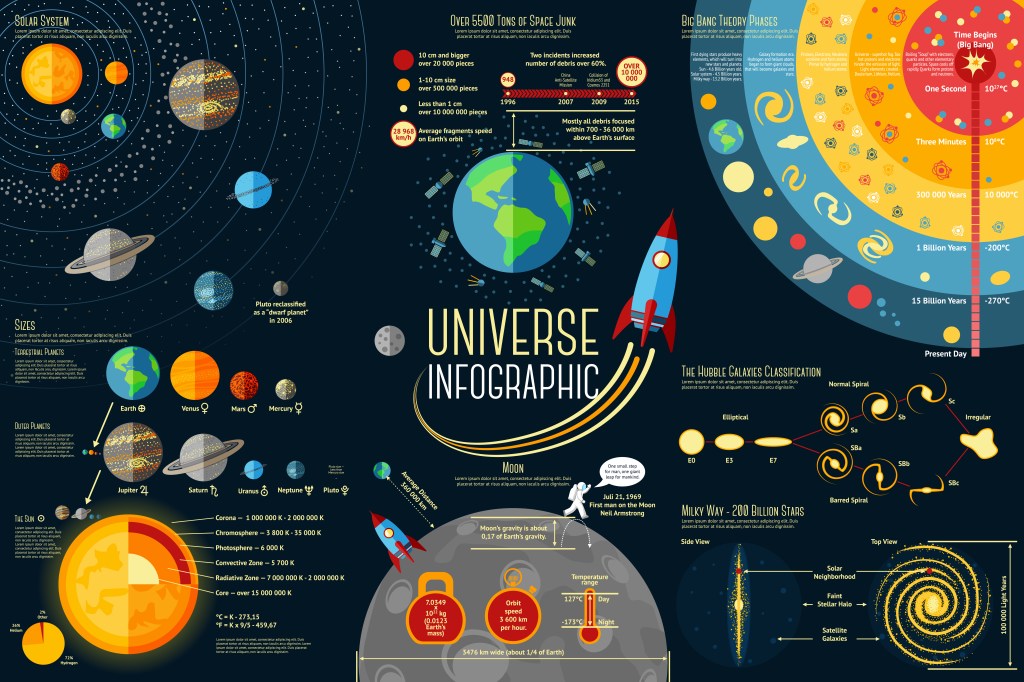
Set of Universe Infographics – Solar system, Planets comparison, Sun and Moon Facts, Space Junk made by man, Big Bang Theory, Galaxies Classification, Milky Way description. Vector illustration
The question that forms the title of this blog article is the subject of a recent video on YoutTube. I am embedding the video here so you can watch and listen for yourself. The suggestion, however, that the James Webb Telescope is disproving the “Big Bang”, is overstated. You might even call it clickbait!
Before launching into my thoughts on this, however, what is meant by the “Big Bang” needs to be defined. The terminology is credited to Fred Hoyle. When Hoyle coined the phrase in a 1949 a talk on BBC Radio, he was probably speaking tongue in cheek.
Hoyle (like most scientists of his age) had long believed in a steady state universe. The new evidence indicating that the universe is expanding was like a big bang to them. It rocked the long-held view that our universe is static and unchanging.
The laws of physics seemed immutable. Why wouldn’t scientists believe the universe was equally immutable?
That the evidence that the universe is expanding was unsettling to the accepted “science” at the time is an understatement. As Hoyle was describing the then recent discoveries and the theories that derived from that evidence, he said:
“These theories were based on the hypothesis that all the matter in the universe was created in one big bang at a particular time in the remote past.”
Because these discoveries came as a shock wave to scientists in the first half of the 20th Century. the term, “big bang”, may have been used to characterize how those discoveries were received!
The evidence that the universe is actually expanding raised the specter that the universe isn’t static, and it might even have had an origination “point”. This realization that the universe may have had a beginning wasn’t lost on scientists at the time, and it wasn’t eagerly received.
The term didn’t really “stick” until the 1970’s, and it isn’t really a good descriptor for what we (think we) know happened. It probably wasn’t a “bang” for instance, because no sound was likely generated. The history of the development of this evidence is interesting and can be found on Wikipedia.
The Big Bang does suggest a beginning to the Universe (to put it bluntly). This possibility, of course, has theological implications, another realization that wasn’t lost on scientists who largely viewed the universe through a materialistic lens. That possibility was largely downplayed then, and many scientists have continued to downplay that possibility.
We still don’t have evidence that reveals how the universe was formed. We can’t see back that far, and doubt exists whether we ever will be able to see back that far. As the Wikipedia article states: “[T]he Big Bang model does not describe how energy, time, and space were caused, but rather it describes the emergence of the present universe from an ultra-dense and high-temperature initial state.”
The current suggestion that the James Webb Telescope is disproving the “Big Bang” (the implication of an expanding universe with a “beginning”) comes from people who would like to downplay the implication of an expanding universe with a beginning, and it seems to be more wishful thinking than reality.
The James Webb discoveries fueling this resurgence in old thinking include images of old stars and galaxies that are more formed than they should be on our standard (Big Bang expansion) model of the Universe. The standard Big Bang expansion model is similar to the concept of evolution. If the universe expanded, it must have progressed from a simpler state to a more complex state.
Just as life began with a simple, self-replicating molecule and progressed to ever increasing complexity over a long span of time, the thinking has been that the universe must have developed in the same progressive sort of way. This is the paradigm that has driven much of modern science: that natural processes developed from the bottom up.
The new James Webb images reveal more highly developed stars and galaxies than we imagined would exist in the earliest stage of the universe on the standard model. The mature development of ancient galactic stars and star formations is surprising on the progressive view.
These images do not contradict the fact that the universe is expanding, however, and they don’t disprove the appearance of a “beginning”.
People are “surprised that things grew so quickly”. People are perplexed that stars and galaxies are so well-formed at such an early stage, when they would expect to find “fledgling” galaxies in more undeveloped states.
People are scratching their heads at the appearance of extremely small and extremely large galaxies in the early Universe because it does not comport with the progression of the expansion of the Universe as modern scientists have modeled it before the advent of the James Webb Telescope.
These observations have nothing to do with the evidence that the universe is expanding. A more accurate statement is that models for how that expansion occurred are being called into question: not the fact of expansion from “a point of beginning”.
The James Webb findings do not negate the evidence we have that our universe is expanding from some very dense “point”. If anything, the findings evoke even more theological implications, perhaps, than the standard Big Bang model.
The idea that the universe developed from simple to complex over time is difficult to maintain when stars, galaxies, and other formations in the farthest (and earliest) regions of the universe that we can see are so well-formed and “mature”. These things conjure up the specter that this evidence is more consistent with the idea of the universe being created than we previously thought.
Of course, we had clues that this should be not surprising to us: the standard expansion inflation model incorporates the assumption that an early, extremely rapid and short “burst” of expansion occurred, and this assumption was necessary to accommodate the short time frame in which the Universe appeared to have “developed” based on what we could see before the James Webb telescope. Perhaps, then, we shouldn’t be surprised to find even greater “development” at earlier stages.
We shouldn’t be surprised either that modern scientists who are committed to a materialistic worldview are struggling with these things. A materialistic worldview has colored modern science for a couple hundred years, at least.
A materialistic worldview was perfectly at home with the old static state view of the universe. It took a hit with the evidence that the universe is actually not static, but expanding from a point of beginning, though materialist thinking held firm, and most scientists have continued to hold to a strictly materialist position.
Stephen Hawking and Roger Penrose famously calculated “singularity” that “proved” the so-called Big Bang (that expansion necessitates a “beginning”). Vilenkin (and some other guy who I can’t remember, lol) determined that even a multiverse that is expanding would have to have a “singularity” (a euphemism, it seems, for a beginning).
So far, modern discoveries have continued to negate good reason to believe in a static universe (which theory was discarded after centuries of use when we found that our universe is expanding) or an oscillating or cyclic universe. Multiverse(s) seem to make sense theoretically, but we will likely never be able to prove it/them anymore than we are likely to see back before the “beginning” of this universe.
Scientists like Neil de Grasse Tyson, Hawking, and Penrose who are committed to finding explanations for these things that do not implicate a Beginner (a/k/a God), will likely continue to try to prove their point. Hawking spent much of the rest of his life after mathematically proving the “singularity” trying to get around “singularity” and its theological implications. Penrose (and Vilenkin) do not concede any theological implications either.
Nothing (much) has changed on that score, but the new james Webb images are certainly is producing some head scratching! Some scientists, like Hoyle, who were once very antagonistic about people drawing theological implications from cosmology have backed off their dogmatic stances. Penrose seems to concede the possibility of a legitimate “metaphysical” component to reality, though he “doesn’t go there” in his own thinking.
There certainly is a lot of head scratching going on, and these are interesting times. We may all be at the edges of our seats to learn where all of this will take us, though I strongly doubt that we will get definitive answers to our most fundamental questions, like the origin of the Universe in my lifetime – if ever.
The new discoveries do call into question the expansion models that scientists have developed, but they do not call into question the evidence that the universe is, indeed, expanding. The new discoveries do not align with they way scientists have believed the universe expanded, but the evidence that the universe expanded from a “point” of singularity remains solid.
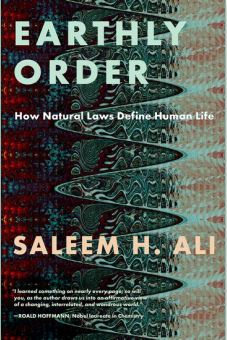
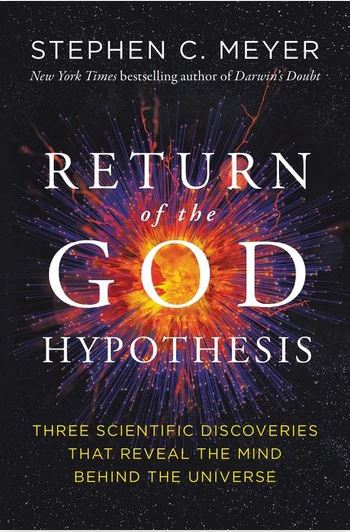
Where does order in nature and the cosmos come from? Stephen Meyer & Saleem Ali recently met up with Justin Brierly on the Unbelievable? podcast to discuss the nature of order in the universe. Saleem Ali’s focus on the comparison between natural order and human social systems in his book, Earthly, Order, is the backdrop for the discussion with Stephen Meyer, who wrote Return of the God Hypothesis.
Saleem Ali’s book, Earthly Order: How Natural Laws Define Human Life, explores the linkage between natural order and societal order. He ultimately argues that mankind should synthesize social structures to match the order found in the natural world for the benefit of mankind and the environment in which we live. In reaching this conclusion, Ali devotes attentions to the beauty of natural order, which he sometimes calls design.
Saleem takes the consensus, scientific approach to the natural order. He assumes that natural order developed from the bottom up: that stars and planetary systems formed from initial cosmological constants present in the fabric of the universe at the instant after the “Big Bang” and that life formed spontaneously from inert matter into self-replicating molecules that grew exponentially more complex over time.
Saleem Ali is the Blue and Gold Distinguished Professor of Energy and the Environment at the University of Delaware. He has a B.S. degree in Chemistry and Environmental Studies from Tufts University, 1994, and M.S. degree in Environmental Studies from Yale University, 1996, and a Ph.D. in Environmental Planning, Department of Urban Studies and Planning from Massachusetts Institute of Technology, 2000. Stephen Meyer, who also wrote Signature in a Cell and Darwin’s Doubt, has degrees in physics and earth science from Whitworth College, 1981, and an M.Phil. in history and Ph.D. in philosophy of science from Cambridge University, 1987 and 1991.
In Return of the God Hypothesis, Meyer attempts to show that what we see in nature is better explained by a top down model of order. He argues that “specified complexity” defies a bottom up explanation, and begs for a top down approach. He claims that this is a not a “god of the gaps” argument. Rather, it is the natural conclusion to be drawn from what we observe: that the specified complexity we observe in the world always comes from a mind.
Meyer doesn’t necessarily chart new ground in the evidence or the methods he uses to reach his conclusions. He using principals consistent with good science and the evidence revealed by modern science to argue that they point in a different direction than the modern scientific consensus. He argues that the evidence we see in science is better explained by the conception of top down order and it points to a particular kind of top down order.
I am not going to attempt to describe either book more than what I know, most of which can be gleaned from the descriptions of those books and the descriptions provided by both gentlemen. I am also not going to attempt to get too deep into the conversation between Ali and Meyer. You can watch their interaction yourself if it piques your interest. (Linked in the photo below.)
Saleel Ali’s perspective is the one you have heard. It is the perspective that is included in every textbook (by law). It is grounded in the predominant view: that the universe is self-organizing, and life is self-replicating. His responses to Meyer reflect a carefully guarded reluctance to allow for intelligent agency in the design we see in the natural world.
Stephen Meyer and other people, some religious and some not at all, are questioning the propriety of that reluctance to allow for intelligent agency, or what we might simply call “mind”, in or behind the processes that created the universe and life in the universe. One argument in favor of that view is derived from the scientific experiments intended to show how life evolved on earth, says Meyer:
“I love these new approaches in the origin of life and the simulation experiments that are done to test them. I think that they are telling us something, though, about the importance of, as Thomas Nagel put it in Mind and Cosmos[i], that in addition to physical order there is a reality of consciousness and mind, and, we can see hints of that in life…. You see this actually in the origin of life simulation experiments that are conducted to test these new models, because the logic of simulation experiment is to try to reconstruct conditions that we think might have been present on the early earth, and then see what happens in the present. So our knowledge of those cause and effect processes that we see ensuing will help us reconstruct what might have caused life to arise on planet earth.”
These experiments are a kind of “reverse engineering” of the conditions that might have given rise to life from the inert chemistry of the primordial earth, assuming that life developed in that way. Reverse engineering requires an enormous amount of intentional effort and creative design. It also suggests that our efforts at reverse engineering proves an initial engineering that was also the product of intentional effort and creative design. Meyer continues:
“There is something that has emerged invariably from these experiments, and that is to get the chemistry to move in a life relevant direction, the chemist repeatedly has to impose constraints on what the chemical reactions would naturally do. If you have got reagent A and reagent B, and they are combined, they will make A/B, but they will make a whole slew of versions of A/B…. The chemist has to fish the A/B version three out of that gamesh of possibilities…. What the chemist is doing at that point is excluding some options, electing another…. [Often]what they will do is just buy the reagent that they want off the shelf that has already been purified by an intelligent agent. At each step along the way there is an impartation of information. If you exclude some options and elect others, you are imparting information into your simulation, and that information is invariably coming from the experimenter.”
The impartation of information, of influence, of direction is the activity of a “mind” – a causal agent. By agent, I don’t mean a compound that is, itself, a product of inert matter that always reacts according to its properties; I mean a “will” that is directed by “mind”. A billiard ball is inert until it is stricken by a person with a cue, and then it acts according to its properties and the laws of motion until friction causes it to slow and to stop. Meyer says:
“So, I think nature is actually telling us something. These simulations invariably require the imposition of intelligence to proceed in a life relevant direction. You have to ask, ‘What are they simulating?’ If this is something that is consistently arising in all simulation experiments, maybe they are pointing to a need for a top down explanation (explaining the origin of life) because all of the simulations require top down imposition of intelligence and information into the systems.”
These experiments intended to show the possibility that life might arise spontaneously, given the right conditions, are demonstrations of the importance of outside influence to cause it to happen – if indeed it can happen that way.
The famous Miller-Ulrey experiment still referenced in high school textbooks was heralded as proof of the concept. It comes woefully short, however, in demonstrating that life might have arisen out of a primordial soup. (I explored the limits of that famous experiment in What’s in Your primordial Soup?) In the Miller-Ulrey experiment, the experiment was done with elements that were not known to have existed in the early “primordial soup” of the earth at the time in which we know that life arose.
To be fair, though, they were just trying to show that it’s possible: that life can form on its own, given the right environment. On the other hand, it is a good example of the way in which an intelligent agent (the scientist) must jury-rig an experiment to try to produce the intended result he is trying to achieve.
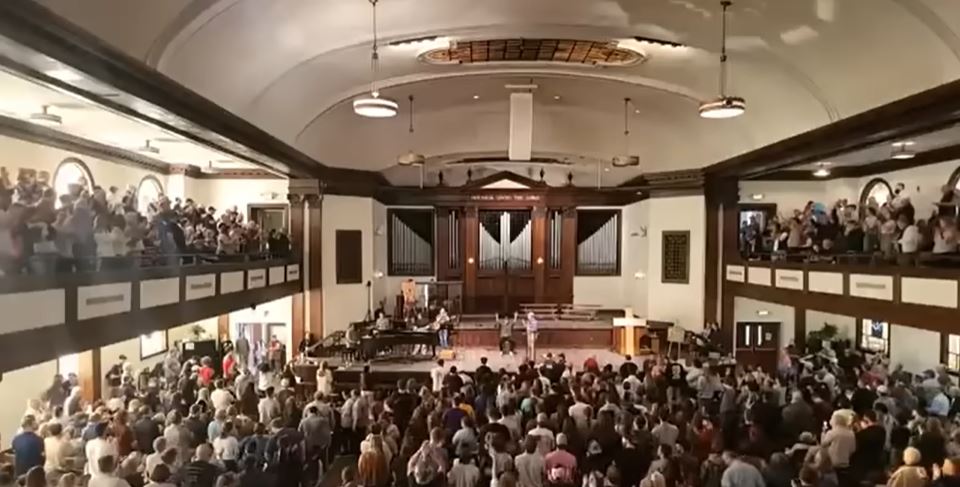
I listened to Voddie Bauchaum summarize what is wrong at Asbury recently. The video title is (Wow) The Asbury Revival is NOT of God. His summary is similar to other skeptical takes I have heard, so I will summarize his summary here. (You can also watch the video and hear what he says for yourself.)
Bauchaum said he listened to four testimonies of students who attended the “revival”, and they “confirmed exactly what I figured was going on.” It’s a small sampling size, but I have no reason to believe he didn’t hear what he heard.
His conclusions were more in number than his sampling size. First, he said, “This event is nothing more than strange fire.” (The whole event.) For proof, he offered what the students said in their testimonies: One student admitted said he experienced a “fit of laughter”; another student claimed his mother began speaking in “unknown tongues”. (If Bauchaum supplied a summary of the other two testimonies he heard, I missed it.)
The phrase, “strange fire”, is a reference to Leviticus 10:1-3 an incident in which two priests put incense into censors and offered “strange fire before the Lord, which he commanded them not.” (KJV) Those men were consumed by fire from the Lord, the passage says. Therefore, Bauchaum is comparing the people at Asbury to the two rogue priests who presented offerings to God they were not instructed to give and were killed for it.
Clearly, Bauchaum is suggesting that “this event” is not of God; it is “unauthorized” worship; and God views it like He viewed the priests who offered strange fire and were killed for it.
As further proof that this event could not be from God, he said, “A lot of this took place out of the church!” He added that “the university ordains women for ministry, so there is a lot wrong here.”
He went on to explain to say that he was looking for a man of God taking the pulpit to open the Bible and preach the word of God, “and it never happened.” Though he didn’t say it, I am left to assume that revivals must happen only inside church buildings, and then only when a man of God preaches the word of God from a proper pulpit.
I note that he didn’t do much research if he only heard four testimonies, as I found testimonies all over the Internet, including many statements by professors and school administrators. The happenings at Asbury took place over roughly a two-week period, so there was a lot of footage to see and many people who were there talking about it.
I also note that the chapel service began with someone preaching, but, then, I don’t know if he was “a men of God”, and I don’t recall whether he used a pulpit. (Sarcasm alert.)
Bauchaum warned that Satan tricks people with music. As anecdotal proof, he recounted his own experience attending a Pentecostal church a few times when he was a new believer. He recalled feeling emotional, on the verge of tears, because he felt like God was moving, but he determined it was “nonsense” after reading the Bible for himself for several weeks.
To his credit, he said that he “matured really fast” during during those few weeks. (I am not being sarcastic now. These were his words, not mine.) He said he desired to hear someone preach the Word of God because he was hungry for preaching.
To be fair, I can appreciate. I have been in his shoes before when all I wanted was to hear a meaty sermon that dug deep into God’s word.
Bauchaum recalled an old Paul Washer sermon in which people were moved by the preaching of the word, not by the music. As proof that this is the way it should be done, he quoted Romans 10:17: “Faith comes by hearing, and hearing by the word of God.” (No issue there.)
I don’t know if Bauchaum is a cessationist (someone who believes the “gifts of the Holy spirit” have ceased), so I don’t want to make any assumptions. If he is a cessationist, then it would not matter if people had limbs grow back: a cessationist has already determined God doesn’t do those things anymore.
To give him the benefit of the doubt, I can admit that his concerns might be just as validly expressed by someone who is not a cessationist. His concerns do suggest a need for some circumspection, but I have greater concern over his conclusions than any of the spectacle he described that took place on the Asbury University campus for over two weeks in February of 2023.









 Navigating by Faith