The Danger of Triumphalism in the Church


Marcelo Gleiser, a Brazilian physicist and astronomer who is currently Professor of Physics and Astronomy at Dartmouth College, won the Templeton Prize for his outstanding contributions for “affirming life’s spiritual dimension”.[1] He is an agnostic, but he isn’t hostile to religion or faith. He maintains an open mind, stating:

“Atheism is inconsistent with the scientific method….

“Atheism is a belief in non-belief. So you categorically deny something you have no evidence against.

“I’ll keep an open mind because I understand that human knowledge is limited.”[2]

In listening to Gleiser recently on a podcast[3], I was reminded of another gentleman I listened to recently. Dr. Soong Chan-Rah, an evangelical professor of church growth and evangelism at North Park Theological Seminary in Chicago. On first glance, these two gentlemen might seem like odd companions in my thoughts, but together they inspire this blog piece.

Gleiser grew up in Brazil. His mother died when he was 6. He described how her death led him into a dark time in his life. He was Jewish and lived in a conservative Jewish community, but Judaism didn’t led him out of that darkness. He says it was science.

Gleiser was drawn by the wonder of science and scientific discovery. His interest in science was sparked by the gift of an autographed photograph of Albert Einstein from his uncle. It became his “altar”, and it led him to become fascinated with the “exploration of the mysterious”. He left the darkness of his teenage years with a purposeful decision to engage the mysteries of the world and find answers.

We might be quick to label his reverence for science idolatry. He even speaks of it in religious terms, but he tempers his enthusiasm, unlike many people who have placed their trust in science. He is humble enough to make room for the possibility of God and spiritual reality.

Hearing Gleiser talk about the limits of science and possibilities of faith from “outside the fold” can be instructive. Humility is more than just a winsome quality.

Dr. Soon Chan-Rah doesn’t come from outside the fold, but he also has a perspective that was formed outside the framework of American evangelicalism. Dr. Chan-Rah didn’t tell his story in the talk I listened to, but he is obviously Asian by descent. I bring that up only because it suggests he has a perspective that isn’t colored wholly by the fabric of western civilization.

We need to hear from outside perspectives, lest we never question the assumptions we take for granted – the extra-biblical (and maybe unbiblical) influences that creep in with our culture, tradition and familiarity that go unquestioned.

I have heard Dr. Chan-Rah speak about lamentations in the Old Testament and the conspicuous lack of lamentations exhibited in American evangelical culture. He says that about forty percent (40%) of the Psalms might be characterized as lamentations. Whereas, only about twenty percent (20%) of the songs in modern American hymnals contain some form of lament, and those songs often go unsung in our church services. As for contemporary Christian music, we might be hard pressed to find more than five (5) songs out of the top one hundred (100) containing any form of lament.

Whether the math is exactly right, the point is clear. We don’t engage in lament in our American evangelical culture to the same degree as reflected in Scripture. Chan-Rah attributed that cultural characteristic with several things, including the sense of triumphalism that has permeated American culture. That observation is what brings me to write this blog piece. Please allow me to explain.

Continue reading “The Danger of Triumphalism in the Church”

For the Shame of the Gospel

We have gotten away from the pure and simple message of the cross, that Jesus came to die for sinners and give them salvation.


We live in interesting times. We have taken for granted for a long time in the United States that we are a Christian nation. Christians are fighting through political means and social media to convince this country of those origins and to hold on to them. This is a fight that began in my memory back in the 80’s, and maybe even before that.

In my opinion, we have moved past those Christian origins. Perhaps, the minute we had to start fighting to preserve that legacy we had already lost the fight. I am not sure we will ever go back, short of a revival orchestrated by the Holy Spirit.

Current attitudes in popular culture and among the intellectual elite in the US view the Christian heritage negatively, to the extent that people admit we have a Christian heritage. People view Christians as privileged, wielding power and oppressors. This is the cultural Marxist dialectic that has been playing out since at least the 70’s and maybe before that. We are losing the cultural war.

The positive connotation that went with the word, Christian, in our past has been replaced with a negative. This has largely happened in my lifetime.

Christians have not always deserved the positive connotation that unquestioningly followed the reference, Christian, in the past. Neither do Christians deserve the negative assumption that is evident today. While people may have previously distinguished the errors and failures as departures from the actual message of Christianity, that “nuance” (not that it is very nuanced) is largely lost today. Moderns increasingly equate Christians with those errors and failures. The exceptions have swallowed the rule.

We (Christians) need to be mindful in this realization that we can be guilty of the same failure to recognize the distinctions and nuances in “others” as well. Most Muslims, for instance, are not terrorists. Most feminists, gays, transgender people and others who do not see the world as we do are just trying to find meaning and purpose, healing from their pain and happiness in life. They aren’t the enemy. They are people Jesus died for.

But, I digress.

Christians are the most oppressed religious group in the world today, but you wouldn’t know it in the United States. It isn’t the kind of news that gets published (often) or that anyone wants to hear. It doesn’t fit the current narrative on Christianity that has developed in the west.

It may be that people don’t want to hear it because Christians have had it pretty easy. Christians in the US are viewed as the reigning social oligarchy. The consensus that has building for some time is that Christianity needs to be toppled from it privileged position.

Indeed, Christianity has enjoyed a long and enduring influence in the west, and especially in the US, unlike most other areas of the world, but Christians are now on the defensive as the “others” renounce allegiance and demand recompense. It seems to defy common understanding in the United States to consider Christians an oppressed group.

That privilege doesn’t exist in most other parts of the world where, ironically, Christianity is now growing fastest. While the Church in the US is losing ground rapidly to “the nones”, Christianity is growing fastest and gaining ground most in countries in which the environment is harshest and most hostile to the message of Jesus.

Maybe this is a reflection of the difference between the Gospel of Jesus and the institution of the Church – the difference between the simple message of the Gospel and the burdensome structure of religion. Just as “others” no longer understand the difference between the Gospel message and the errors and failures of the Church, equating and conflating the two, the Church in the US has largely lost its way, no longer shining like a bright light on the hill Jesus intended.

The vestiges of Christian power and influence are evident everywhere, but it is a blighted and obsolescent infrastructure that is crumbling and washing away. The cultural momentum that is gaining steam threatens to displace it altogether from its place of position in the social commonwealth. The current oligarchs in that marketplace of ideas threaten to oust the Christian voice and banish it from the public square.

As I survey the voices I hear, what I see that is being opposed is the voice of Christian power and influence. It isn’t so much the Gospel, but all the infrastructure that has been built up around it, that people are opposing. People don’t (very often) object to the simple message of the Gospel, They don’t even know or appreciate what it is! The message of the Gospel is effectively hidden behind the more public scaffolding of the Church.

Continue reading “For the Shame of the Gospel”

Thoughts on Christian Persecution


The blasts that rocked Sri Lanka on Easter Sunday 2019 sent shockwaves all over the world that reached the United Stated. Finally, the targeted persecution of Christians was reported in the mainstream news. The tsunami of reaction, if we can call that, even led to a Newsweek article acknowledging that Christians are the most persecuted religious group in the world today, and the targeted hostility is on the rise.

The news is not that persecution of Christians around the world is on the rise. The news is that mainstream news reported it. Not that it could be ignored. The numbers were too big. They were too big to ignore, unlike the ongoing killings in Nigeria, and India, and Pakistan and arrests in China and burning and demolition of churches that occur increments that are easier to let slip by.

But, let’s be real here. Christian pleas for recognition and sympathy, as was shown for the killing of Muslims at Christchurch or institutionally marginalized people in our own culture who are rising on the shoulders of the Christian notion of the exaltation of the weak and oppressed is largely falling on deaf ears. And Christians aren’t happy about it.

Let’s be even more real here. Christians are not persecuted in the United States and never have been. That the tide of popular opinion about Christians and Christianity is turning, has turned, is not the same as persecution. That Christians are seen as the oppressors, the privileged and the keepers of the gates to be stormed by the cultural elite who have secured themselves in the cultural command center does not equate to persecution… yet.

But, we need to be careful here. We need to keep our eyes on Jesus. We need to follow His lead, and not react out of our flesh. We need to maintain the right perspective. The perspective of people for whom Jesus has made a place with Him.

Continue reading “Thoughts on Christian Persecution”

Of Church Heretics and Heroes

Who are the William Tyndale’s in modern culture?

The Tyndale Monument, Gloucestershire, UK was built in honor of William Tyndale, a translator of the Bible, who was born nearby.

I listened recently to the Unbelievable podcast on the subject of William Tyndale. (Unbelievable? Why William Tyndale’s Bible changed the world: Melvyn Bragg and Ben Virgo) Tyndale lived from 1494-1536, during a time in which illiteracy was the rule, not the exception. The Bible was read only by the educated elite.

The 1600’s was also a time of great corruption in the church itself. The church was the largest employer in the land. It had great power, and it was corrupt. The vast majority of people, including clergy, were ignorant of Scripture. According to the experts on the Unbelievable podcast, many clergymen didn’t even know the 10 commandments. This was a very dark period in church history, the culmination of centuries of church/state alliance that twisted the Gospel to serve the power of kings and popes who lived like kings.

Tyndale was influenced by Martin Luther who also a rebel that opposed the church consensus and power structure of the day. Tyndale was influenced by John Wycliffe who a century before had translated the Bible into middle English, but the church opposed the “unauthorized” translation and rejected it. The church even declared Wycliffe a heretic after his death, and many of the Wycliffe Bibles were burned and not widely distributed.

Tyndale made it his life’s mission to translate the Bible into English for the common man. Though Wycliffe had already done that, the Bible was still virtually inaccessible to the vast majority of people, and even clergy were ignorant of it. He suffered exile for his efforts and was eventually arrested, jailed, convicted of heresy, executed by strangulation, and his body was burned at the stake.

We celebrate Tyndale now as a martyr for the faith who took up his cross and followed Christ even unto death, a leader of the reformation that led believers out of the corruption of the organized religion of his day.

He and other “rebels” paved the way for the Bible to be made available worldwide in every language spoken on earth. Tyndale now is the name of a major Christian publishing company. Luther is the namesake of a major church denomination. Wycliffe is the name of the organization that translates the Bible into the rarest languages of the farthest flung tribes of the world.

Just as Jesus opposed the Pharisees and Sadducees in the 1st Century, Tyndale opposed the popes and bishops in the 16th Century. Just as the Pharisees and Sadducees sought to stop Jesus and had him arrested, tried, convicted and executed for spreading the Gospel, the popes and bishops tried to stop Tyndale, had him arrested, tried, convicted and executed for translating the Bible including the words Jesus preached into English.

The main opposition to Jesus, and Tyndale, came from the religious leaders. Those religious leaders employed the power of the state to oppose the spread of the Gospel (in Jesus’s case) and the spread of the translation of the Bible into English (in Tyndale’s case).

When Pilate asked, “Shall I crucify [Jesus]?”, the chief priests said, “We have no king but Caesar!” (John 19:15) I think about these things in light of the current religious and cultural climate.

Tyndale was viewed as a rebel and, a renegade, a heretic. He opposed the status quo, including the status quo within the church. He was despised. He was opposed by the church. He could not even return to his homeland, England, for fear of his life, and he eventually lost his life to the church and state authorities of his day

Today, the church and state are no longer joined in power as in Tyndale’s day. Many modern Christians in the United States rue the loss of power and advantage, while modern secularists would like to negate completely all influence of religion on society. If Hilary Clinton had been elected, instead of Trump, most Christians feared an incremental loss of power and influence in the affairs of our nation. Christians have embraced Trump as the man to fight the tide of growing secularism and maintain Christianity in that position of power and influence.

But is that a good thing? We all know of the challenges, difficulties and even persecution of the church that result from state government that is opposed to the church, but history suggests that the confluence of state power with church governance leads to corruption of the church. Would we rather accept corruption in the church to avoid challenge, difficulty and persecution?

Listening to Tyndale’s story, makes me wonder, “What about the church today is like the church in Tyndale’s time?” What influence lingers or has crept in to modern Christianity that will cause future believers to look back and wonder at the corruption of the 21st Century church?

Who are the heretics of our time who will be hailed as heroes in future generations?

The Roots of Modern Ethics in the Ancient Near East

Of the origins of monotheistic religion and ethics.

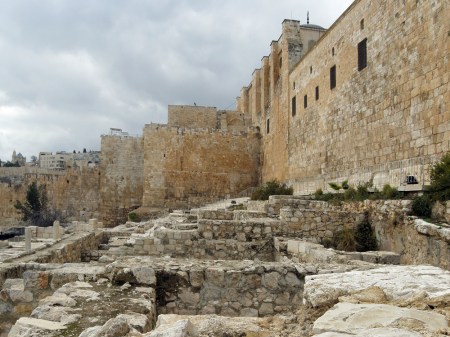
Jerusalem: The Temple Mount from the time of the Second Temple

When I was in college, the first class I took was World Religions. Though I graduated with an English Literature major, I also had enough credits to be a Religion major. I didn’t need the dual major. I only took the religion classes because they interested me.

I also became a believing Christian during my college years. It was a transition that took place between that World Religion class and the summer between Sophomore and Junior years. It’s a long story that I might tell in detail some time, but the point for now is that I did a lot of reading and thinking about these things in those years and in the decades since. It doesn’t make me a theologian, but I have more than a passing interest.

Early on I learned that the creation story and flood story in Genesis, among other things, have counterparts in other religions, including other religions in the same area of the world – the Ancient Near East. Phoenicians, Assyrians, Persians, and other people groups had similar myths that have been uncovered from that general time period.

I learned that Zoroastrianism shared attributes similar to the ancient Hebraic view of the world, including the idea a singular creator God, a dualistic cosmology of good and evil, the ultimate destruction of evil, judgment after death, etc. The scholarly understanding when I was in college was that Zoroastrianism predated Hebraic thought and influenced it.

It occurred to me at the time, not having any reason to doubt what I was taught, that Abraham may have been particularly open to his encounter with God if, indeed, he had lived in an area of the world and in a time in which there was this kind of influence. It made some sense. He was the right guy in the right place with the right influences setting the table for an encounter with God, the Creator of the world. Perhaps, Abraham brought the influence of monotheistic Zoroastrians into the pagan, polytheistic world of Canaan.

Recently I did some research on Zoroastrianism. Wikipedia acknowledges that Zoroastrianism has “possible roots dating back to the second millennium BC”, though the “recorded history” of Zoroastrianism dates back only to the 5th Century BC. (Wikipedia). The conjecture that Zoroastrianism dates back further to the second millennium BC is has no present support in the historical record.

If we date the accounts of Abraham and his descendants according the biblical chronology and references, that history goes far back into the second millennium BC, but the consensus of modern archaeologists and theologians reject that dating in favor of first millennium BC dating. (See Wikipedia, for example) Modern scholars don’t take the Bible at face value. In fact, they presumptively dismiss the Bible as historical record.

Scholarly views are not universal on this issue, of course. Not by a long shot. Modern archaeological and written evidence exists to suggest that the modern consensus is wrong about the timeline for the life of Moses, the Exodus and other things. (See for instance Patterns of Evidence: The Moses Controversy) The Patterns of Evidence theory is that historians and archaeologists who assume a particular timeline for certain events are not apt to see the evidence for those events if they occurred in a different timeline.

The Patterns of Evidence thesis is that evidence for the events described in the biblical narrative is there if we use the right timeline and look for them in the right time periods. Specifically, the biblical accounts of Moses, the Exodus, and entry into the land of Canaan are apparent in the archaeological record and historical data on the biblical timeline (second millennium BC), but they are not evident in the first millennium timeline applied by modern, skeptical scholars.

Certain archaeological finds, like the Ebla Tablets, also raise questions about the modern scholarly consensus. The importance of “looking” in the right places according to the right timelines is explored in Timing the Walls of Jericho.

Back to Abraham, though. He was reportedly from the area of Ur (in modern southwest Iraq), which is quite a distance from the area of Canaan (later Judea) where he ended up – about 1600 miles in fact. In Ur, he may have come in contact with Zoroastrians and similar influences. That idea intrigued me in college, and it still does. So I revisit that thought journey again today.

Continue reading “The Roots of Modern Ethics in the Ancient Near East”