Immigration Policy, Declining Population Growth, the Economy and the Sheep and the Goats

As Christians, should we be more motivated by what Immigrants can do for us? Or what can do for them?

The article, Why U.S. Population Growth Is Collapsing, by Derek Thompson in a recent issue of the Atlantic reminds me of a trend I have been following for quite a few years, now, of declining population growth in Europe and the United States. I first became aware of the trend maybe 8 years ago, and most European countries were already (at that time) at unsustainable growth levels. The US wasn’t far behind.

The article linked above picks up the story as it has advanced in the last two years with COVID. Changing societal norms and expectations have led to significant declines in population growth as younger generations are getting married later in life, having children later in life and having fewer children or no children at all. COVID has rapidly accelerated the decline.

One interesting note from this article is the statement that “America’s bias against immigration is self-defeating in almost every dimension.” The article asserts (with no citation to authority) that immigrants are vital to our national economy, but I have read the studies and know the beneficial affects of immigration on an economy.

Anecdotally, I know a young woman who is a “Dreamer”. I will call her Sofia. She is the daughter of two undocumented immigrants who found themselves on the “wrong” side of the border with an infant (Sofia) after 911. They figured things would go back to pre-911 conditions when people came and went with no documentation required. That never happened, of course.

She shared with me that her father is a businessman. He has multiple businesses. He employs many people, and he teaches other people to be entrepreneurial. He pays taxes. He pays into Social Security, but he will never reap any benefit from it.

He doesn’t qualify for Social Security, and he never will. If he overpays his taxes he gets no refund. He is always afraid of being found out and deported to a country that he no longer considers his home.

Sofia grew up with the same fear. She grew up with the burden of having to be a perfect citizen. Any negative attention could expose her to to deportation to a country she has never known. She told me she knew from an early age that she would never qualify for student aid or student loans, so she would have to earn way to obtain the education she aspired to.

I didn’t realize this, but I have since learned that the IRS will assign a number to anyone, with or without a Social Security number. The IRS doesn’t care, as long as people pay taxes.

When I met Sofia, she had graduated from high school in three years with a perfect GPA, and she was on pace to finish college in three years. She had a perfect 4.0 GPA, and she planned to go to law school. She was exceptional in every way. (Since then she went to law school where she currently is.)

This story is anecdotal, but it’s indicative of the data that shows that undocumented immigrants are not a drain on our economy. Undocumented immigrants pay into the system, but they don’t qualify (in most ways) to take from the system they pay into. The statistical difference (on average) is $80,000 per person paid into the system more than what is taken out.

We actually make money off of undocumented immigrants. They shop at our stores, eat at our restaurants, pay real estate taxes, pay income taxes, pay into Social Security, provide labor for our employers (who are happy to pay them minimal wages), and more. (The popular assumption that immigrants commit more crime turns out to be false also.)

Not only are we turning our backs on the boost to our economy that more generous immigration policies would provide, but we are entering a “population danger zone” according to the author of the article cited above

All of this is to bring me to the point in writing this article, which is a little different than the points made in the article. I borrow these things from the article and from my research to get to a different point.

How should Christians generally view the issue of immigration?

Continue reading “Immigration Policy, Declining Population Growth, the Economy and the Sheep and the Goats”
Caste Systems, Nationalism, and True Christian Faith

The thing about a speck in someone’s eye is that it seems like a plank to the one with the speck.

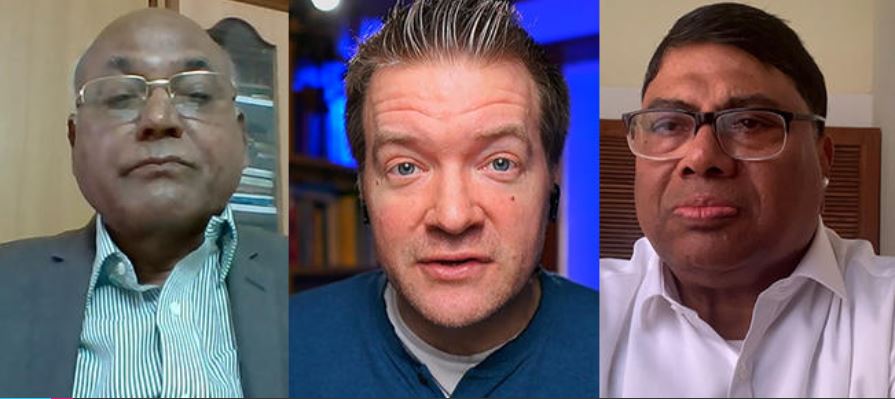
I’m listening to Unbelievable? | Hinduism, Caste & Christianity: Joseph D’Souza and Kancha Ilaiah Shepherd. The following statement by Anglican, Joseph D’Souza, caught me up: “The caste system in India has poisoned the church in India just as racism poisoned the church in the West.”

Joseph D’Souza is an Indian Christian, but he stands as an outsider in India, which is increasingly being driven by a right wing movement to preserve India’s Hindu heritage and power against the threat of Christianity, in particular. Thus, I find it ironic, and convicting, that he finds a parallel between India’s caste system and racial disparity in “the west.”

Kancha Iliah Shepherd, the other participant on the podcast, was born of the Dalit class in India – one step above the untouchable caste/class. Against all odds, and the rules of the caste system, he became educated, and he wrote a book, Why I am not a Hindu, critiquing the caste system.

On the podcast, he questioned what Hinduism has to offer the lower castes who can not receive the education of the Braham caste, cannot learn to read and write the language of the Hindu gods (Sanskrit) and cannot serve in Hindu temples? Why be a Hindu unless one is born a Braham?

D’Souza observed that many Dalit and untouchables in India are becoming Christian because of Christian doctrines, such as the doctrine that all men and women are made in the image of God; God is Creator of all people; and there is no distinction among people (no Jew or Gentile, no slave or free, no man or woman) in Christ.

Though the Hindu nationals have succeeded in passing a law against “forced conversion”, D’Souza says that no one in India is forced to convert to Christianity. People convert because they want to. The church, in fact, stands against the idea of forced conversion.

The present Hindu nationalist movement seems to be partly to blame for Christian conversions because of its adherence to the caste system. The lower castes find in Christianity a God who does not perpetuate a caste system, who made all people equally in His image, and who makes no distinction between people on the basis of caste, birth rights or nationality.

Shepherd adds that God cannot be a nationalist. If there is one true God, He is God of all people in all places, nations and stations in the Earth. Shepherd said this as an Indian of the Dalit caste in India speaking against the Hindu conservative resurgence that forbids lower castes from becoming priests while maintaining a strong Hindu nationalist position.

If we look at the world through the eyes of these Indian men, we can gain some understanding and insight to be applied to our Christian walk in the United States. We can begin to understand why Christian nationalism is heresy and why Christian tolerance, ambivalence, and apathy for racial disparity in the US is poison in the church.

Continue reading “Caste Systems, Nationalism, and True Christian Faith”

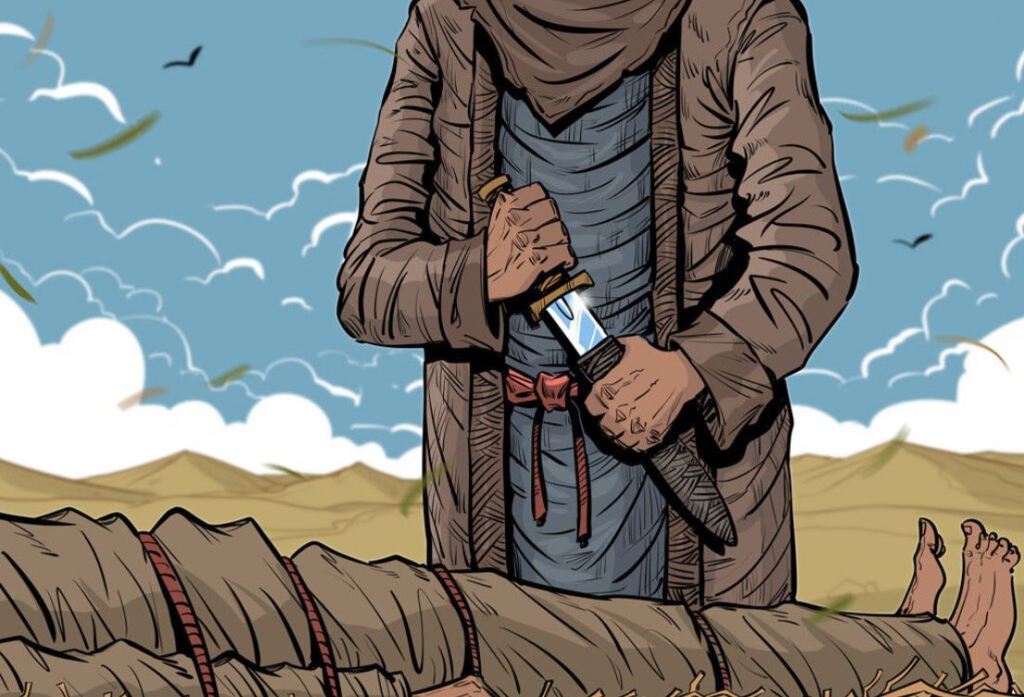
The Story of Abraham and Isaac Revisited: Here I am!

I set the stage for digging deeper into the story of Abraham and Isaac in The Story of Abraham and Isaac Revisited: Introduction. Abraham’s faith is the lesson we all learned in Sunday school. Faith is the basic place we start, but Abraham’s faith is only scratching the surface of the story.

We often view this story as simply a test of Abraham’s faith, which it is, but it’s much more than that. This story is not simply about Abraham’s faith, because what we learn through Abraham’s faith may be just as important, if not more important.

Think about it: Does God need to test Abraham to know who he is? God already knows what kind of man Abraham is. He knows our thoughts from afar and the words we speak even before we say them! (See Psalm 139) That should give us a clue that there is more to this story, so let’s go back and see what else there is to see.

Many decades before, we are told that Abraham believed God, and his faith was credited to him as righteousness. When God called Abraham to leave his country, his people, and his father’s household – which was his legacy – and God said He would make a great nation of Abraham’s descendants, Abraham left – though he didn’t even knowing where he was going! Though he was 75, Abraham responded with faith and went. (Gen. 12:1-4)

Many years and adventures later, Abraham was still childless, living in the land God showed him, and Abraham still believed the promise God made to him, though he had nothing to show for it. Abraham’s faith was already counted to Abraham as righteousness, but the promise Abraham believed was not yet realized. (Gen. 15:1-6)

Isaac was not born to Abraham and Sarah until Abraham was 100 years old, a quarter century after the initial promise was made. (Gen. 21:1-7) All the while, Abraham had faith. The story of Abraham and Isaac is not just a story about Abraham’s faith, but about how God is revealed through Abraham’s faith.


Though the story begins with the statement that God was testing Abraham, it doesn’t say God was testing Abraham’s faith. (Gen. 22:1) Perhaps, God tested Abraham, at least in part, to show Abraham (and us) who God is!

I will explain, but first we need to understand something of the Ancient Near East culture Abraham lived in. A key element of this story is the fact that child sacrifice was a common and universal practice in the Ancient Near East.

Abraham would have been intimately familiar with how people understood the gods of his culture. They were considered unpredictable, arbitrary, and capricious, demanding allegiance and sometimes even child sacrifice to be appeased.

What Abraham may have sensed, but didn’t fully understand, was that his God was not like the other Ancient Near East gods. The character of God, as revealed to Abraham, would have been a complete paradigm shift from what he and his culture believed about gods.

In our western mindset, we might expect God to announce at the outset who He is: we might expect Him simply to tell us. In a more eastern mindset, we they expected to discover truth through their lived experience and the lived experiences (stories) of other people.

Similarly, it seems, God doesn’t simply tell us who He is; God desires to show us. To “know” God is not simply an intellectual exercise; it is a lived experience. Thus, all of Abraham’s life is an example for us, and we learn who God is through Abraham’s lived experience (and our own).

God reveals Himself to Abraham experientially through Abraham’s faith, and He reveals Himself to us through Abraham’s story and our own faith. If you haven’t read the introductory article yet, I encourage you to do it now at the link above.

With this basic understanding, I encourage you to read Genesis 22:1-14. Then, we get into the details of the story.

Continue reading “The Story of Abraham and Isaac Revisited: Here I am!”

The Story of Abraham and Isaac Revisited: Introduction

God tests Abraham’s faith by asking him to sacrifice his son. Abraham in faith goes ahead but God intervenes to provide a ram for sacrifice instead.
Genesis 22.

Everyone in the western world has heard of the story of Abraham and Isaac. It is iconic. Even people who didn’t hear the story in Sunday school as a child have heard the story somewhere along the way in their lives. The story is a commonly referenced in literature and art, and often with negative connotations in our modern world.

Dare I say that most people have a shallow understanding of the story – even Christians? I would include myself in that category for most of my life, though I had the fortune of hearing the story and considering it for the first time, not in Sunday school, but in a college World Religion class.

The “fortune” of hearing the story for the first time in the context of an academic environment is that that I approached it first intellectually with an open mind. I approached it critically – not as in being critical of it, but as in being thoughtful about it.

Those discussions have stuck with me. We learned about the Mesopotamian world in which the story arose, including the theory that monotheism was born in that time and region (not necessarily of Hebrew origin).

I have since spent many hours thinking and writing about those things I first learned in that class about the Ancient Near Eastern world in which Abraham would have lived. I have learned other things as well, such as the apparently universal practice of child sacrifice to the gods that dominated the religious thought in that culture.

The story of Abraham and Isaac must be read in that context to understand how it fits in. We learn through the story that the God of Abraham was radically different from the gods of the Ancient Near East culture in which Abraham lived.

In Abraham’s world, every people group and community had their own gods. While each community of people had their own gods, and each god was different from the next, one thing those gods all had in common: they were unpredictable, arbitrary and capricious.

Everyone Abraham knew assumed that the gods had to be appeased, and appeasing the gods often meant sacrificing your own children to them if necessary. Abraham would not have recoiled in moral horror at the thought that God was insisting he sacrifice his son. As difficult as it might be, you didn’t argue with the gods.

We tend to focus only on Abraham’s faith, as if that is the sum and substance of the story. Faith is the Sunday school lesson, but it’s only a shallow understanding if we see nothing else in the story. Faith is merely the beginning of understanding:

“And without faith it is impossible to please him, for whoever would draw near to God must believe that he exists and that he rewards those who seek him.”

Hebrews 11:6

Without Abraham’s faith in God, he would not have learned that God was different than other gods. Abraham’s faith was the key to learning that God was different, and Abraham’s discovery of the unique character of God is the real gem of this story – that He is not unpredictable, arbitrary and capricious like the other gods.

Abraham was a man of faith. He believed God exists, and he believed that his God was the God of gods. He believed that God could be approached; God could be trusted; and God rewards those who seek Him. Abraham was a man who sought to draw near to God, but that is only the beginning.

In the story, we see that Abraham expected God to be like the other gods he knew, but we also see that Abraham sensed something different about God. God used Abraham’s cultural understanding of the gods to show Abraham that He was different.

God is not arbitrary and capricious. He has plans for His creation. He desires to bless His creation. He desires relationship with His creation, and we (like Abraham) can engage God in that purpose by faith – by trust in God’s benevolence and good intentions toward us.

This understanding of the story will become more evident as we dig deeper in the next article: The Story of Abraham and Isaac Revisited: Here I Am. While the Sunday School version is all about Abraham’s faith, and the secular, cynical version fixates of the savage notion that a god might demand child sacrifice, the real gem of the story is that God is not like the other gods Abraham knew.


How Will the World Know You?

How will the world know you?

Will the world know you by your family, your ancestors and the legacy that comes after you?

Will the world know you by your wealth, your fiscal responsibility and ability to turn a profit?

Will the world know you by your great intellect, by the diplomas on your wall, the articles you have written? and the collection of books on your shelf you have read?

Will the world know you by your creativity, your command of a color palette, graceful and unique strokes of the brush and eye for design?

Will the world know you by your fame, by the number of people who know your name?

Will the world know you by your physical prowess, your ability to come through in the clutch, and your wins?

Will the world know you by your command of the English language, your artful turn of a phrase and your ability to move people with the written word?

Will the world know you by the instrument you play, the finesse of notes and rhythms, and the virtuosity with which you play your instrument?

Will the world know you by your professionalism, by your reputation for excellence in your field, and the accomplishments you have achieved?

Will the world know you by your stunning good looks, your impeccable fashion taste, and the company of beautiful people you keep?

Will the world know you by your eloquence, the depth and richness of your voice and your ability to command the attention of a crowd?

Will the world know you by your scientific mind, your understanding of technical details, and ability to apply scientific method and sound logic?

Will the world know you by your leadership, the number of people who follow you and your influence?

Will the world know you by the music you compose, the divine harmonies and intricate melodies you weave together in symphonic wonder?

Will the world know you by your politics, the platforms you have championed, and the dedication to your party allegiances?

Will the world know you by the roles you have played, the tears you have coaxed from fawning audiences, and the adoring fans you have?

Will the world know you by your architecture, by your complex end subtle designs, by the magnificence of the structures created from your drawings?

Will the world know you by your dedication, reliability and number of sick days you did not take?

How will the world know you?

In the end, we all go down to the grave, and the world is passing away. When an Ode to a Grecian Urn fades from collective memory, Jesus said we will be known as his disciples simply by our love for each other.

“Love one another. As I have loved you, so you must love one another. By this everyone will know that you are my disciples, if you love one another.

John 13:34-35

“We know that we have passed from death to life,  because we love each other.  Anyone who does not love remains in death.”

1 John 3:14

“Be devoted to one another in brotherly love.  Outdo yourselves in honoring one another.”

Romans 12:10

“Love never fails. But where there are prophecies, they will cease; where there are tongues, they will be stilled; where there is knowledge, it will pass away….” And now these three remain: faith, hope and love. But the greatest of these is love. “

1 Corinthians 13:8,13