From a presentation by Francis Collins at the Veritas Forum at the California Institute of Technology
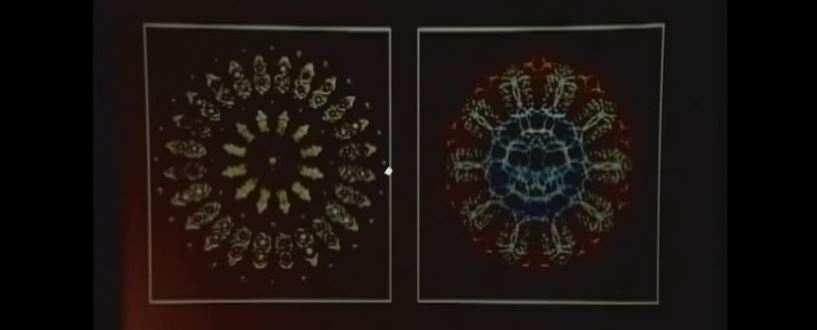
Take a close look at the two images. What do they represent? We might say that one image represents science and the other represents religion (or faith). But which is which?
The images are similar, but one of them is manmade, and the other is something we find in nature. Do you know which is which? Is the manmade image the scientific one or the spiritual one?
I will answer these questions; at least I will answer them as they were described in a presentation given by Francis Collins, the manager of the Human Genome Project, at a Veritas Forum at Caltech University in 2009. In the process, we will explore the chief question examined by this eminent scientist: whether science and faith are compatible.
I am reading a book by Clay Jones called Why Does God Allow Evil? I highly recommend it. The “problem of evil” is one of the more challenging questions that we face in life, and difficulties struggling with that question have led many people to abandon or refuse to embrace faith in God.
Why does God allow pain and suffering? If God is good, how can He allow people to suffer? Why doesn’t God stop evil? If God exists, why does He allow evil to exist? These are just some of the variations of the problem of evil.
The problem of evil is a challenge for every worldview. Responses include that there is no God, and that’s just the way it is (a naturalistic world view); evil is just an illusion of unenlightened souls (a Buddhist or eastern view); evil is result of bad karma (Hindu); or evil is the result of rebellsion against God – sin (Christian). We all struggle with the conviction that things simply aren’t the way they ought to be. That Utopian disconnect urges us to ask, “Why not?”
I think, personally, that the Christian worldview makes the most sense of this question. It begins with the story of God and Adam and Eve. Whether the story is allegorical or historical, the answer involves God’s purpose in creating man, man’s finite, corruptible character (compared to God’s infinite, pure character) and a plan to develop this corruptible creature (man) who is created in God’s own image into a pure, loving relationship with God that is defined by God’s pure character, and not the corruptible nature of man.
I’m not a scientist, and I am not even “a science person”, though I have become much more interested in science as an adult than I was as a child. I am more of a philosophical and theological person. My background is English literature, world religions, and American jurisprudence (law).
We give scientists quite a bit of deference in our modern society, and so we should. They are peeling back the layers of this universal onion in which we live. Scientific discoveries are fascinating, life-changing and significantly valuable.
I would be quickly lost in the weeds in a discussion of science among scientists, but scientists are human. They have flaws, and they usually are not schooled in philosophy or theology.
For instance, Stephen Hawking is one of the most brilliant scientists of our age. In his book, The Grand Design, he says, “In a world in which a law like gravity exists, the universe can and will create itself out of nothing.”
This isn’t a statement of science; it’s a philosophical statement with theological impact. The question is: does it make sense?
One of the “show stopping” questions posed by atheists is this one: If God created the universe, who created God?
It is a clever question, and has stumped many a person who believes in God, but the question, itself, is flawed. Let me explain.
In my response, I am indebted to John Lennox who’s answer to this very question is embedded at the end of this blog article. John Lennox, is a Professor of Mathematics at Oxford University and a frequent speaker on topics of science, philosophy and religion. He has twice debated the vocal atheist, and Oxford professor, Richard Dawkins, who wrote a book, The God Delusion, using this question as a centerpiece.
The flaw of the question is that it is loaded with the assumption that God was created. The response of the Christian (or theist generally) is that such a notion (that God was created) is not a notion about God at all, but a notion about a god – a created thing. Another word for such a thing is an idol.
Francis Bacon, the father of modern science, used to say there are two books of God: the book of Scripture (the word of God) and the book of nature (the work of God). He believed, as did many people who came before him and after him, that all truth is God’s truth. He believed that there is no contradiction at the end of the day between those two “books”. Any apparent discrepancy or conflict is in the interpretation of one or the other of those two sources of the revelation of God. There is no discrepancy or conflict at the level of the facts themselves; the only discrepancy or conflict is in our understanding of Scripture (theology) or nature (science).
Theology and science are, at best, interpretations of the data. Theology and science are not the facts, but interpretations of the facts. Scientists and theologians have disputes and disagreement among themselves and between the disciplines. We all have preconceived ideas on ultimate and intermediate issues, but following the evidence where it leads is the approach most surely to result in the most accurate understanding.
People who identify in both camps of science and theology promote the misconception that science and theology (or science and faith if you will) are incompatible. That is unfortunate, because there shouldn’t be any tension between the two. While science is the study of the natural world and theology is the study of the super-natural world (so to speak), the two should be in perfect harmony if, indeed, a Causal Agent (who we might call God ) exists who caused the universe to begin.





 Navigating by Faith