“This is what the Lord says to me with his strong hand upon me, warning me not to follow the way of this people: ‘Do not call conspiracy everything this people calls a conspiracy; do not fear what they fear….'” (Isaiah 8:11-12 NIV)
“When someone tells you to consult mediums and spiritists, who whisper and mutter, should not a people inquire of their God? Why consult the dead on behalf of the living?” (Isaiah 8:19 NIV)
These verses from Isaiah hit home with me today. Some people might call me a believer. I am a believer, but I’m also a skeptic. I am skeptical of the world and the various pressures and ways in which it “gets in my face” and “urges” me to conform.
Of course, I am being inappropriately anthropomorphic. The world doesn’t do these things. Or does it? Paul says,
“[W]e do not wrestle against flesh and blood, but against the rulers, against the authorities, against the cosmic powers over this present darkness, against the spiritual forces of evil in the heavenly places.” (Ephesians 6:12)
If there are forces pressing upon us to conform, they aren’t always human forces. Being anthropomorphic isn’t entirely accurate, but it’s the best we can do, perhaps. We are the unwitting pawns in the battle. Some of us play our parts with gusto.
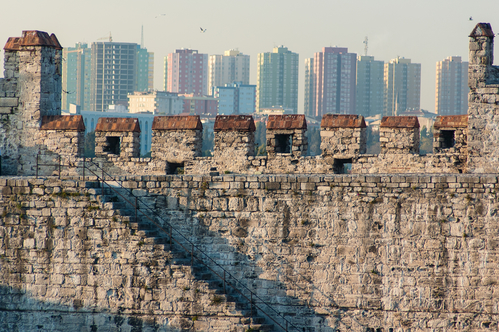
Ancient city walls and modern buildings in Istanbul, Turkey
Wayne Gruden, a Christian ethicist, makes a case for building a wall. He cites to biblical passages that reinforce the idea that walls provide protection, peace and security to those inside the walls. These are good things, he says, and he cites to support for this proposition in the Scriptures.
The Psalmist prays (for Jerusalem) for “peace within your walls and security within your towers” (Psalm 122:7) and praises God for strengthening the bars of Jerusalem’s gates, making peace within its borders. (Psalm 147:12-14) David prayed to God to build up the walls of Jerusalem. (Psalm 51:18) King David built walls around Jerusalem, and King Solomon strengthened those walls after him. (1 Kings 3:1)
God used the Babylonians to visit judgment on the people of Israel by breaking down the walls of Jerusalem and burning down the temple and the palaces. (2 Chronicles 36:19. See also Jeremiah 52:14) The first thing the remnant did when they returned to Jerusalem was to rebuild the wall. (Nehemiah 2:17)
Indeed, walls and gates and towers are all pictures that convey the peace and security that the ancients hoped and prayed for from God. These symbols stand for the peace and protection for which ancient people longed in the harsh world of their time.
Proverbs says, “A man without self-control is like a city broken into and left without walls.” (Proverbs 25:28) Thus, walls around cities are symbols of self-control and self-defense.
Certainly, building walls in a hostile world is a prudent thing to do. On different levels, we do this (provide peace and security) for our families, our communities and our nations. Basic decency demands it. Therefore, Wayne Grudem concludes that “the Bible views border walls as a morally good thing”.
I agree with him, but that isn’t necessarily the end of the story. Like many things, walls can be good, and they can be bad. Few people, for instance, believe the Berlin Wall was a morally good thing. Whether building a wall is a morally good or appropriate thing depends on the circumstances and the purposes for which it is built.
Moral goodness can’t be determined in a vacuum. Morality, or righteousness and justice, to use more biblical terms, is a matter of relationship with God and other people. The determination of what is righteous and just begins with a determination of God what God desires and purposes We must have to apply what we know about God’s heart for righteousness and justice in a given situation by considering specific circumstances in light of the big picture.
Walls are not good or evil in themselves. They can protect and maintain peace and security for the people within the walls. They were a critical and necessary component of safe community in most centuries gone by. People who were not protected by walls were exposed to the vagaries of every vagabond with bad intent.
But walls that are designed to keep people captive to an oppressive regime are not good. Walls that were necessary and appropriate for the safety and security of people in ancient times may not be as necessary of appropriate in modern times.
Walls can be used to provide peace and security, but they can also be used for evil purposes like oppression. The issue isn’t walls, but purpose and intent. For Christians that means God’s ultimate purposes and intent.
I am on the Board of Directors of Administer Justice, a faith-based legal aid clinic. Bruce Strom, the founder of Administer Justice moved on five years ago to form the Gospel Justice Initiative that has established 75 other faith-based legal aid clinics around the country. The tagline for GJI is “communicating the truth of the gospel through justice.” That tagline inspires this blog.
We have no better example of God’s heart than Jesus: God who become flesh and lived among us, being obedient to the purposes of God the Father, even to the point of dying on the cross for us. His life is the Gospel incarnate. This Jesus will ultimately mete out justice to all mankind.
“When the Son of Man comes in his glory and all his angels are with him, he will sit on his glorious throne. The people of every nation will be gathered in front of him. He will separate them as a shepherd separates the sheep from the goats. He will put the sheep on his right but the goats on his left.” (Matthew 25:31-33)
Do you know the basis of the justice that Jesus will mete out?
It will be based on what people did when they saw the hungry, the thirsty, the strangers, the needing clothes, the sick and the imprisoned. (Matthew 25:34-46)
Why? …. Because Jesus said,
“Whatever you did for one of my brothers or sisters, no matter how unimportant they seemed, you did for me.” (Matthew 25:40)
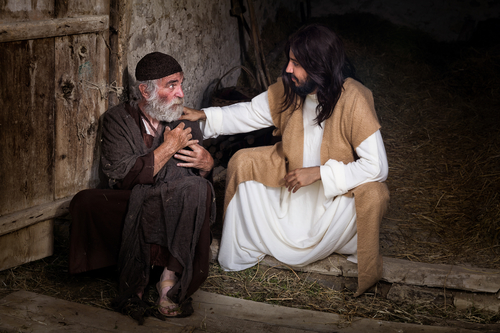
When John the Baptist was in prison and wanted some assurance of who Jesus was, before Jesus answered him, “[Jesus] healed many people of diseases and plagues and evil spirits, and on many who were blind he bestowed sight.” (Luke 7:21) Then Jesus said:
“Go and tell John what you have seen and heard: the blind receive their sight, the lame walk, lepers are cleansed, and the deaf hear, the dead are raised up, the poor have good news preached to them.” (Luke 7:22 alluding to Isaiah 61:1-2)
I spend some Saturday mornings meeting with people at a low-income, legal aid clinic. Many people come with “one” big issue, but the conversations often reveal a myriad of things they are dealing with.
The one big issue brought them to the desperate point of reaching out, but that one big issue often belies many little things that plague them. The little things they tolerate in their lives, often lead to the big thing that brought them to the point of desperation.
The circumstances aren’t always the result of bad decisions, bad behaviors or other failures, but often they are. We can be our own worst enemies, and lack of knowledge and understanding compounds the problems that result from those failures.
I often feel overwhelmed by the loads that people carry. Simple answers are rarely sufficient. Many peoples’ lives are bogged down by a thousand little things, and the one big thing is the just tip of the proverbial iceberg.
The best I can do in our short session on a Saturday morning is to identify the key issue(s) to be dealt with and a strategy for dealing with them, but I can often only recommend treatment for the symptoms. It isn’t hard to see evidence of the virus behind the symptomatic issues that are demanding immediate attention. We might call that virus sin.
Sin, in its etymology, means “missing the mark”. We miss the mark in many small ways that we might assume are insignificant, but the little things add up. They form habits of thought and behavior that are counter-productive to achieving the things we all want – comfort, security, harmonious living with our family and world, and satisfaction in life.
Sin isn’t just doing something that God frowns upon. Sin is falling short of the way we are meant to live – the way God made us to live. A thousand little bad decisions, a thousand misunderstandings that are unwittingly adopted, a thousand little things that we allow to creep and remain, without addressing them, pile up and weigh us down.
To be fair, we all struggle with sin that threatens to undo us. Some of us just manage it better than others. Some of us learn to use our sinfulness to our own selfish advantage. Others are steamrolled by it and the sins of others that leave destruction in its wake.
Regardless of our ability to manage our sins, it catches up to us – now or later. The most beautiful, white-washed tombs are as empty as a pauper’s grave. Sin has real consequences for us and for the people around us.
Believers are told to take the stories of the Bible in faith, Skeptics take the opposite view. There is evidence consistent with belief that the stories are true, but insufficient evidence to prove them beyond a reasonable doubt.
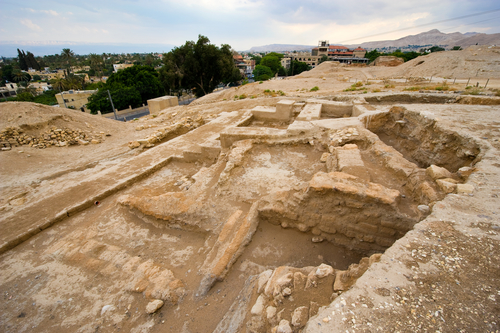
Ruins and remains in Tell es-Sultan, better known as Jericho, the oldest city in the world
I previously wrote a piece on the city of Jericho of biblical fame that was inspired by a presentation given by an archaeologist, Ted Wright, who excavated at tell es-Sultan, the modern site known formerly as Jericho. He commented that archaeology is not really divided over issues like whether Jericho existed. Rather, archaeologists differ on the chronology they find in the story of the stratified remains of prior habitation.
That issue of timing regarding the destruction of the city of Jericho was the focus of the previous blog. There is no doubt that Jericho was surrounded by a double wall of which the interior wall collapsed on the outer wall, forming a virtual ramp up into the city. The city was also clearly destroyed by a conflagration (fire). The only question is: when did those events that are evident in the rocky soils on the site took place?
The first archaeologist to dig at the site reached the conclusion that the city of Jericho was destroyed in the early bronze period, well before the Israelites may have come upon the heavily fortified City. According to the first assessment, Jericho had long been uninhabited by the time the Israelites arrived.
Subsequent archaeological digs revealed disputing conclusions. John Garstang found evidence in the 1930s that Jericho was destroyed around 1400 BC, exactly the time frame of the biblical account. Subsequently, archaeologist, Kathleen Canyon, came to the opposite conclusion, reaffirming the earlier opinion that the city was uninhabited by the time Joshua and his combatants came along. But wait… there is more.
The most recent archaeological findings, seem to suggest that the biblical timing is correct. Kathleen Canyon apparently ignored and failed to register the significance of Late Bronze period pottery that would not have been found in an area that was uninhabited by that time. Many factors that she missed reveal the error and suggest a date consistent with biblical chronology. (See Believers Score in Battle Over the Battle of Jericho, by John Noble Wilford, published February 22, 1990, The New York Times).
The story of the excavation of Jericho reveals how archaeology and interpreting what we find is sometimes highly influenced by what we believe about history. The same finding can suggest different conclusions, depending on what we are looking for (or not looking for). The difference as Ted Wright suggested, isn’t in the what, but the when.
The Bible, of course, has many fantastic stories in it. They are so fantastic, that many people simply find them incredible, as in not credible at all. Believers are told to take the stories on faith. Skeptics take the opposite view and reject them, hook, line and sinker (to turn a phrase). There is evidence consistent with belief that the stories are true, but insufficient evidence to prove them beyond a reasonable doubt.
Should modern archaeology require something more than reasonable doubt simply because the biblical accounts have a miraculous, religious bent to them?






 Navigating by Faith