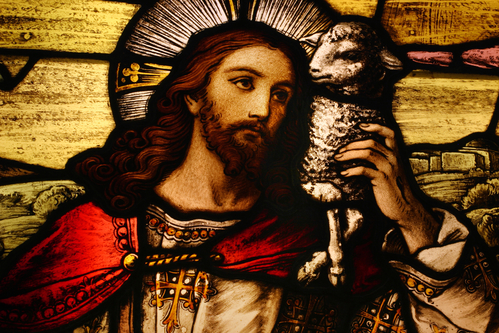
Who was Jesus? A friend recently asked, “Jesus was a Jew preaching Judaism. Right?” He explained his thought that the people who came after Jesus created a new religion using him as the central figure in spite of who he really was – just a Jewish man preaching Judaism.
This is a popular Internet characterization of Christianity. I am not a scholar on the subject, but I did minor in religion in college. I took all the courses for a religion major, including the thesis course, and I even did the research and wrote the thesis. I would have had a religion major if I had turned in my thesis. I didn’t do it because I didn’t need the major. I took the classes because I was interested in them. I didn’t hand in the thesis paper because I didn’t feel good about it.
A religion major at a small liberal arts school meant majoring in “religion” generally. There were no flavors available for particular study. We looked at all religions, though we focused most heavily on Judaism and Christianity. That is because there was one “Christian” professor and one “Jewish” professor.
The Christian professor took the position that “all roads lead to the top of the same mountain”. Of the Christian road, he was very fond of Liberation Theology that took the position that the God has been changing, progressing and more or less learning to be God throughout time. Liberation Theology was born in South America among the people who were oppressed by the corrupt government and military forces in the 1970’s, and the Catholic priests who espoused this theology believed in taking arms in counter-insurgence against the oppressive political and military regimes.
My “Christian” experience included some very progressive literature. We were encouraged to sit in on lectures given by people like Hare Krishnas and a European Muslim – both lectures that I attended, among others. The Jewish professor was very much the modern, reformed variety – not conservative or Hasidic. This was my introduction to religion and to the Bible.
I did read the Bible from cover to cover in college, not only as an academic exercise as part of my course of study, but because I was drawn to it. In the midst of the all-roads-lead-to-the-same-mountaintop atmosphere in which I studied, I began to be taken by Jesus, who said, “I am the way, and the truth and the life, and no one comes to the Father but by me.” (John 14:6) This is because Jesus stood head and shoulders above all the other religious personalities that I read about. There was something transcendentally different about him.
As I have been thinking about the (largely rhetorical) question my friend posed about Jesus, I think of the sweep of the Bible – Old Testament to New Testament, beginning to end. Having been intimate with it for well over 30 years, having read it many times over, and recounting my own journey of discovery, I feel compelled to tackle the question, but the scope of the answer is daunting.
Continue reading “Who Was Jesus?” →