The Story of Abraham and God’s Redemption of all Mankind – Part 3

God works through the hot mess of our choices to accomplish His purposes.

I am covering some ground in the story of God’s redemption of mankind through Abraham and his progeny. This is a story of God redeeming people because of their faith (trust in God), not for their morality. It’s also a story of God accomplishing His purposes through people despite their messiness.

Abraham and Sarah were childless for 25 years after God gave Abraham promises that He would give Abraham a land for his descendants who would be numerous and that God would bless all the nations through them. On the basis of those promises, Abraham left his ancestral home and journeyed to “a land God would show him”. 

Through those 25 years, Abraham and Sarah continued to live their lives. The moved many times over those years, in and out of the land of Canaan, which is the land God promised to them.

Abraham wavered at times. At one point, when God visited Abraham, Abraham questioned God, saying, “[Y]ou have given me no offspring….”, and telling God (as if He didn’t know), “[T]he heir of my house is Eliezer of Damascus.” (Gen. 15:2-3)

God God didn’t waiver, though. He renewed the promise, saying, “This man shall not be your heir; your very own son [out of your loins] shall be your heir.” (Gen. 15:4)

Years went by. Abraham and Sarah had been in Canaan for 10 years already (Gen. 16:3), and Abraham was 86 years old. (Gen. 16:16), Sarah got impatient and offered her Egyptian servant, Hagar to Abraham, they conceived, and Hagar gave birth to Ishmael. (Gen. 16:1-4)

We find out that this wasn’t God’s plan either, but He let 13 more years go by before letting Abraham know. Abraham was 99 years old when God visited again!

God said again, “I will make you very fruitful; I will make nations of you, and kings will come from you” (Gen. 17:6); and, “The whole land of Canaan, where you now reside as a foreigner, I will give as an everlasting possession to you and your descendants after you.” (Gen.17:8)

How would Abraham have taken that?

God had made this same promise since Abraham stood in Haran imagining the land God was promising him and the descendants he would have, but that was 25 years ago! Abraham was now 99, and Sara was 90. The likelihood that the two of them would have a child together was slim to none.

Thirteen years prior, Abraham had a son. His name was Ishmael. Surely, Abraham thought by that point that Ishmael was the fulfillment of God’s promise, but it wasn’t so.

After almost 25 years, God finally gave Abraham some missing details:

“As for Sarai your wife, you are no longer to call her Sarai; her name will be Sarah. I will bless her and will surely give you a son by her. I will bless her so that she will be the mother of nations; kings of peoples will come from her.” (Gen. 17:15-16)

Abraham’s response isn’t surprising:

“If only Ishmael might live under your blessing!” (Gen. 17:18)

Abraham had not only come to accept that Ishmael was the fulfillment of God’s promise; Abraham had embraced it. Abraham undoubtedly loved Ishmael, despite his abrasiveness. Thus, his response to God’s new direction was, “What about Ishmael?!”

Why did God wait 25 years from the time He first promised to fill the land with Abraham’s descendants to give Abraham all the details? Why did God let Abraham sleep with Sarah’s servant and have another son first? Why did God wait 13 more years before letting Abraham in on the additional details?

I’m not sure I know the answers. It was obviously God’s plan, though, to fulfill the promise to Abraham through Sarah, his half-sister, the daughter of Abraham’s father, Terah. God also wasn’t done with using the line of Terah in this story.

Continue reading “The Story of Abraham and God’s Redemption of all Mankind – Part 3”

The Story of Abraham and God’s Redemption of Mankind – Part 2

God works out His purposes through the messiness of human history.

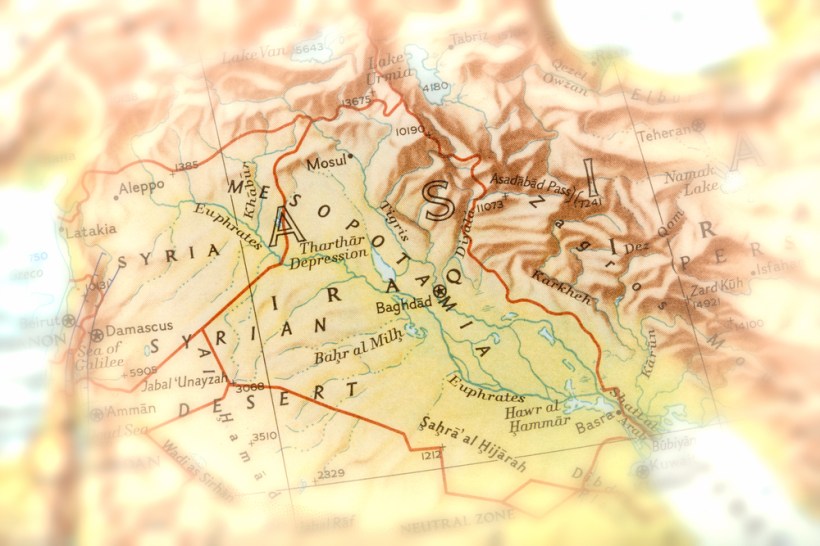
The story of God’s redemption of mankind in the Bible funnels through one man, Abraham from Mesopotamia. I introduced Abraham (known as Abram then) and his family in Part 1 of this series of articles.

Abram’s sister, Sarai, became his wife. Both of them were children of their father, Terah, by different mothers. Terah’s son, Haran, died in their homeland (Ur). The family with Lot, Haran’s son, left Ur and and traveled to a place they called Haran in southern Turkey, just north of Aleppo Syria.

Terah and Nahor remained in Haran, but God gave Abram the direction, “Go to the land that I will show you”, and the promise, “I will make you a great nation….”, and “Through you every family on earth will be blessed”. (Gen. 12:1-3) Thus, at the age of 75, Abram and Sarah left Haran and continued on to Canaan, and Lot went with them.

When they arrived at Shechem in Canaan, God renewed the promise as Abram looked out over the land: “I’m going to give this land to your descendants.” Abram built an altar there, Then, he continued on to the high country in Canaan, between Bethel and Ai, where he also built an altar and worshiped God. (Gen. 12:7-8)

Though God had promised him twice at this point to give Abram this land, Abram continued on. They traveled south out of Canaan, into the Negev desert, and they kept going further south to Egypt because of famine. (Gen 12:9-10)

Abram remained in Egypt long enough to accumulate some wealth before he started moving again. (Gen. 13:2) It is written that Abram “traveled from place to place” when he left Egypt. He seemed to be wandering.

He traveled north again, back to the Negev and eventually back to Bethel and Ai, where he settled down. (Gen. 13:3-4) It must have been some time, as he and Lot had accumulated so many animals their herds and servants couldn’t coexist peacefully. Thus, they parted ways. (Gen 13:5-13)

Lot settled south of Canaan in the Jordan Valley. Abram remained in Canaan, and God gave him the same promise a third time: “Look north, south, east, and west of where you are. I will give all the land you see to you and to your descendants….”; and “I will also give you as many descendants as the dust of the earth.” (Gen. 13:15-16)

Still, Abram moves again, this time south about 35 miles to another part of Canaan known as Hebron. Many years pass. Abram seems to be waiting for God to do what he said, and, for the first time, Abram begins to show signs of doubt that God’s promises would come to pass, . Perhaps, this is why God promises him a fourth time: “Your own son will be your heir” (Gen. 15:4); and “I will give this land to your descendants.” (Gen. 15:18)

When Abram was 86, however, Sarai takes matters into her own hands and offers her Egyptian servant, Hagar, to Abram. Abram agrees, Hagar conceives, but all is not well in the Abram household. Hagar disrespects the barren Sarai, and Sarai mistreats Hagar so badly that she runs away. (Gen 16)

God comforts Hagar in her distress and says of Ishmael, “He will be free and wild”, but “[h]e will fight with everyone, and everyone will fight with him….,” and “[h]e will have conflicts with all his relatives.” (Gen. 16:12)

It seems that nothing is going right for Abram, and God promise takes on a sour taste. Is this the son through whom God will bless all the nations? This wild and contentious boy? Is the son of Sarai’s now despised Egyptian servant Abram’s heritage?

Continue reading “The Story of Abraham and God’s Redemption of Mankind – Part 2”

The Story of Abraham and God’s Redemption of Mankind – Part 1

As I start my third journey through Scripture from beginning to end in as many years, I am picking up on things I didn’t see the first two times through. In this series of articles I am tracing some stories in the great theme of God’s redemption of mankind through the descendants of Abraham.

Scripture is multi-layered and contains many themes large and small. I expect a person can study Scripture for a lifetime and always be seeing new things. Today I am seeing something in the line of Abraham that I kind of knew already, but I am digging into it in more detail.

The intricate tapestry that is the 60-some writings of the Bible authored by 40 some different people over 1500 or so years always amazes me. That tapestry is often veiled to us, as if we were seeing it from the wrong side. Unless we see it from the side from which it was meant to be viewed, the picture won’t be clear to us.

When we read the stories of ancient people, they feel foreign to us today. For instance, Sarai (later known as Sarah) is the wife of Abram (later known as Abraham), and she is also his half-sister. (Gen. 20:12) They shared the same father, but they had different mothers.

We shudder at the thought today of a person marrying a close, blood relative like that – a sister to boot! (Such close relations were later explicitly banned in Leviticus 18:9.) It was common a couple of thousand years before Christ, though. Perhaps this was due to limited spousal options and the greater distances people lived from each other.

We also need to understand that large segments of the Bible read like a narrative of things that simply happened, often without commentary. A recitation of the facts does not necessarily mean an “endorsement” of them. They simply are what they are, and we are often left to draw our own conclusions.

What we see throughout Scripture is that all people are deeply flawed, even the people with whom God found an audience. Ethical shortcomings have existed throughout every era of recorded human history. The Bible is nothing if not candid about the human condition.

I am setting the stage, here, for the point I eventually want to make about God’s plan to redeem all of mankind that weaves through the tapestry of the biblical narrative. I will have to lay this out over a number of articles.

In this article, I want to focus on Sarai and Abram and their origins. In Abram, who God renamed Abraham, God found a willing ear, and so God made His covenant with Abraham and gave Abraham a promise to bless not only him and his descendants, but all the nations.

This covenant and promise becomes the central story of all Scripture and needs to be recognized to make sense of it. It is one of the biggest themes in the biblical narrative tapestry.

Continue reading “The Story of Abraham and God’s Redemption of Mankind – Part 1”

Why Would God Harden Pharaoh’s Heart? And How Did He Do It?

We are not programmed to obey God so that we are able to love Him.

The Bible is a complex and rich tapestry, but we often fail to see the patterns, let alone the overarching pattern, of it. For me at one time, it was like looking at a tapestry from the wrong side – just a jumble of threads going seemingly everywhere and nowhere, without any discernible design.

At the same time, the Bible is not safe. I found it to be a harsh reflection of me when I read it for the first time. It was dangerous.

It commanded itself to me, but I didn’t always like what I saw or felt. Primarily, I didn’t like what reflected back at me about myself.

I will never forget the day in a world religion class as a college freshman that I read these words:

“For the word of God is alive and active. Sharper than any double-edged sword, it penetrates even to dividing soul and spirit, joints and marrow; it judges the thoughts and attitudes of the heart.”

Hebrews 4:12 NIV

I wasn’t a believer then, but I could see it, and it made me feel uncomfortable. Even though the rich meaning of Scripture was veiled to me at the time it reflected back to me and probed my heart to expose the worst aspects of me.

I read in the words of David today in my reading from the Psalms:

“With the merciful you show yourself merciful; with the blameless man you show yourself blameless; with the purified you show yourself pure; and with the crooked you make yourself seem tortuous. For you save a humble people, but the haughty eyes you bring down.”

Psalm 18:25-27 ESV

God deals with each of us according to our own hearts. We see Him presently “as in a mirror dimly”, Paul says, “but then we shall see Him face to face!” (I Corinthians 13:12 ESV) We see God in this life through our own reflection, which may not always be clear.

We see in Scripture our own hearts mirrored back at us, and we see God as if He were standing over our shoulders looking on. How we respond to what we see and to determines how He reveals Himself to us.

As I read through Exodus in my daily reading, I read the passage in which God told Moses he would harden Pharaoh’s heart. Moses would do miraculous things in front of Pharaoh, but Pharaoh would not be moved by them. (Exodus 4:21)

This seems odd at first blush that God would do that. How can we blame Pharaoh for his hard heart if God hardened it? Why would God even do that?

Continue reading “Why Would God Harden Pharaoh’s Heart? And How Did He Do It?”

Thoughts on the Sanctity of Human Life, Injustice and Unity in the Church in the United States

God’s desire is to save us, to have relationship with us, to renew our minds and to conform us to His image.

Reading in Exodus today, I observe that two passages in the first two chapters have poignant application to the Body of Christ in the United States today. I see two predominant lines of injustice in the United States to which the Church collectively has given its attention that are identified in these first two chapters of Exodus.

At the same time, the Church is divided on justice issues. I don’t say this to condemn or to be judgmental. It’s simply a fact that I think we need to recognize soberly, honestly and humbly.

We might find many examples, but the one that comes to mind – the one that is, perhaps, most poignant in this given time – is the division between black and white and the division between supporters and and non-supporters of Donald Trump.

I know: I said one example, and it seems I given two here. These are two examples, but they coalesce into one. The proof for that is in the statistics that show that approximately 80% of white evangelicals support Trump, and approximately 80% of black “evangelicals”[i] do not support Trump.

Now, I recognize that these statistics are sweeping generalizations, but generalizations do tell a story. There is some reflection of truth in them. I also don’t mention Trump to be divisive here. The example simply is provided for illustration.

Churchgoing African Americans can be as theologically conservative on things like what it means to be born again as white evangelicals, but their individual and collective experiences give them a different perspective on life. Their view of the world and injustice is different than their white, evangelical counterparts, for the most part, and influences them to have different political affiliations.

My reading in Exodus (which I will get to) is timely because today is Sanctity of Life Sunday. I didn’t even realize it when I did my daily reading after I woke up this morning.

I didn’t realize it until I tuned into the Manchester (NH) Vineyard Community Church service this morning. I have never tuned into their services, until today, though I know people affiliated with them. When I set out to participate in a more local church service, I believe God drew my attention away to this one.

It was a great message, and I gained some perspective from it that, perhaps, God wanted me to have in writing this. With that introduction, let me explain the passages in Exodus that prompt my writing. Those texts include Exodus 1 (about the killing of babies) and Exodus 2 (about slavery).   

I will take these things one at a time and draw some conclusions consistent with the burden God has placed on my heart over the years. In another article, perhaps, I will explain how my perspectives have changed and, hopefully, shed some light on how the church can come together in the full council of God to advance His justice and righteousness.

Before I get into my immediate thoughts, though, I need to say that I speak with no condemnation in my heart

Just as Jesus said to the woman caught in adultery that he did not condemn her, I am reminded that God sent his son into the world not to condemn the world; God sent His son into the world so that the world might be saved through him. (John 3:17)

I do not say these things to condemn anyone because Jesus has redeemed us!


In the story of the woman caught in adultery, the Pharisees and Sadducees brought her to Jesus to challenge him because the Law required her to be stoned. They wanted to see what Jesus would do, but Jesus seemed to ignore them and began writing in the sand.

Some people believe that Jesus may have written the Ten Commandments out in the sand. When he looked up from from writing, Jesus “invited” them, saying, “He who is without sin may cast the first stone.” Then, he continued writing in the sand.

Some people believe he was writing down the sins those men had committed. They would say the men walked away silently because they realized that no one is without sin.


The wages of sin for every person is death.

Whatever he wrote, we know how the dialogue went next. “Jesus stood up and said to [the woman], ‘[W]here are they? Has no one condemned you?,” John 8:9) When she replied, “No one”, Jesus said, “Neither do I condemn you.” (John 8:10)

Jesus didn’t condemn the men either, because he told us he came not to condemn, but to save. I imagine that, Jesus would have received, forgiven and invited the men to follow him, if they had stayed and repented.

God desires to save us, to have relationship with us, to renew our minds and to conform us to His image. Our sin is the reason God became flesh and died for us. He came not to condemn, but to demonstrate His great love for us and to save us from the sin that enslaves us.

One last thing before I get into what I believe God has put on my heart to share: salvation and sanctification is a process. It starts where we are. When we are born again, God begins to work in us to will and to act according to His purposes and to conform us to His image, but we start that process in different places.

One point made in the sermon today, is that “a person doesn’t have to be pro-life to be saved”. People are saved by grace; it’s a gift that we haven’t earned. There will be no exam in heaven we must answer satisfactorily for salvation. It’s already been accomplished for us by Christ’s death and resurrection.

At the same time, if we are born again, God has begun a work within us. He has begun to renew our minds, and change our hearts, and we have begun to learn to think God’s thoughts after Him and become like Him.

With that said, I will address the two texts I read today in Exodus 1 and 2 that speak to me about the Church, collectively, in the United States. In writing this article, my hope is to provide some biblical basis on which we might begin to bridge the divide along racial and political lines and come together as the body of Christ. I hope to provide some perspective and understanding that will bring us together in Christ.

Continue reading “Thoughts on the Sanctity of Human Life, Injustice and Unity in the Church in the United States”