Did Jesus Come to Fulfill the Law or to Abolish the Law?

“We were held in custody under the law, locked up until faith should be revealed. So the law became our guardian to lead us to Christ….”

Much confusion in the early church arose out of the relationship of the Law to the “good news” that we now call the Gospel (which means good news). The confusion continues today. I continue to wrestle with the tension, myself.

Two passages come to mind that seem to be directly counter to each other. They establish a paradox – a seeming inconsistency – that needs to be resolved. Compare what Jesus said as recorded by Matthew, to the instruction of Paul to the Ephesians:

Do not think that I have come to abolish the Law or the Prophets; I have not come to abolish them but to fulfill themFor truly, I say to you, until heaven and earth pass away, not an iota, not a dot, will pass from the Law until all is accomplished. Therefore whoever relaxes one of the least of these commandments and teaches others to do the same will be called least in the kingdom of heaven, but whoever does them and teaches them will be called great in the kingdom of heaven. For I tell you, unless your righteousness exceeds that of the scribes and Pharisees, you will never enter the kingdom of heaven. (Matthew 5:17-20)


“But now in Christ Jesus you who once were far off have been brought near by the blood of Christ. For He Himself is our peace, who has made the two one and has torn down the dividing wall of hostility by abolishing in His flesh the law of commandments and decrees.” (Ephesians. 2:13-14)

In one place, Jesus said he did not come to abolish the law; and, in the other place, Paul says Jesus abolished the law. Which is it?

The answer is both. If we view this apparent dichotomy as a paradox, rather than a contradiction, we can make some sense of it.

First of all, we need to consider the context. When Jesus said he did not come to abolish the law, he was talking about his coming in the flesh. Jesus was God who became incarnate. Jesus was God who emptied Himself of all that separated Himself from His creation and became part of it in the form of a human being. (Phil. 2:5-8) Thus, when God became man and came to us, He did not come to abolish the law.

We also need to look at the larger context of the Law. The Law was a covenant (an agreement) with Israel. It was given to Moses for the descendants of Abraham after He brought them out of slavery in Egypt. God was faithful to this covenant, but the people were no. They filed at every turn.

This was a problem, because God promised to bless the people based on them holding up their part of the bargain, but they failed to do that. God was true to keep His part of the bargain, but He could not be true to keep His promise to bless them because they did not keep their part of the bargain.

When Jesus made the statement that he did not come to abolish the Law, but to fulfill it, he was putting that statement into the context of time and purpose. He was saying that the purpose for which he came was to fulfill the law, and now was the time.

Jesus came to fulfill the Law in the flesh as a man. When he said on the cross, “It is finished”, he was proclaiming that he had finished accomplishing the fulfillment of the Law in his human body. He lived it out perfectly. He was obedient to it unto death.

Jesus did what no man had done. God became a man so that he could keep man’s part of the bargain, and that enabled God to keep His promise to bless mankind. God, in a sense, carried out the terms and fulfilled both sides of the covenant.

But that is not the end of the story.

Continue reading “Did Jesus Come to Fulfill the Law or to Abolish the Law?”

CS Lewis in Song

No relatively contemporary writer or thinker has had more influence on me than CS Lewis. I read Mere Christianity as a college seeker. I read the Chronicles of Narnia also in college in a weekend, intrigued by the way his imagery grew out of and expanded the panoply of Scriptural ideas with nuance and depth.

I have read many of his books since then, including his science fiction trilogy, the allegorical Great Divorce, his autobiographical book, Surprised by Joy, and many of his books and essays with more philosophical and theological import. I still have books of his on my nightstand I have been meaning to read.

One of Lewis’s repeated themes is the so-called “argument from desire”. The “argument”, which can be reduced to a logical syllogism, is not really a strong logical argument for God, but it has strong existential appeal.

The idea appeals to the human condition and the sense in all of us that we are destined for more than what this world offers. The existentialist side of the coin is that nothing satisfies. Period. Both sides of the coin candidly recognize the frustrated desires of people that ultimately go unsatisfied.

Art Lindsley, Senior Fellow at the CS Lewis Institute, says, “[D]eep human aspirations are either pointers to something real, or else they are full of sound and fury but signifying nothing.” The desire to worship and capacity for awe are universal human feelings of which CS Lewis observes in the Problem of Pain are either “a mere twist in the human mind, corresponding to nothing objective and serving no biological function” or are an experience of some connection with the supernatural.

For a more complete treatment of the “argument from desire”, I suggest Lindsley’s article or The Argument from Desire from Boston College professor, Peter Kreeft. But all of this is, in truth, really an excuse to get to songs inspired by CS Lewis.

One of my favorite songs of all time is the CS Lewis Song by Brooke Frasier from New Zealand. The opening lines are an homage to Lewis’s argument from desire.


If I find in myself desires nothing in this world can satisfy,
I can only conclude that I was not made for here
If the flesh that I fight is at best only light and momentary,
Then of course I’ll feel nude when to where I’m destined I’m compared


Speak to me in the light of the dawn
Mercy comes with the morning
I will sigh and with all creation groan as I wait for hope to come for me

Am I lost or just less found? On the straight or on the roundabout of the wrong way?
Is this a soul that stirs in me, is it breaking free, wanting to come alive?
‘Cause my comfort would prefer for me to be numb
And avoid the impending birth of who I was born to become

Speak to me in the light of the dawn
Mercy comes with the morning
I will sigh and with all creation groan as I wait for hope to come for me


For we, we are not long here
Our time is but a breath, so we better breathe it
And I, I was made to live, I was made to love, I was made to know you
Hope is coming for me
Hope, He’s coming

Following is a video version of the song that takes a more Kafkaesque approach to the song.

Continue reading “CS Lewis in Song”

Envisioning Where We Are Heading: The Kingdom of God

When pray these words that Jesus taught us to pray:

Our Father in heaven,
hallowed be your name.
Your kingdom come,
your will be done….

This is what the Father’s will ultimately looks like:

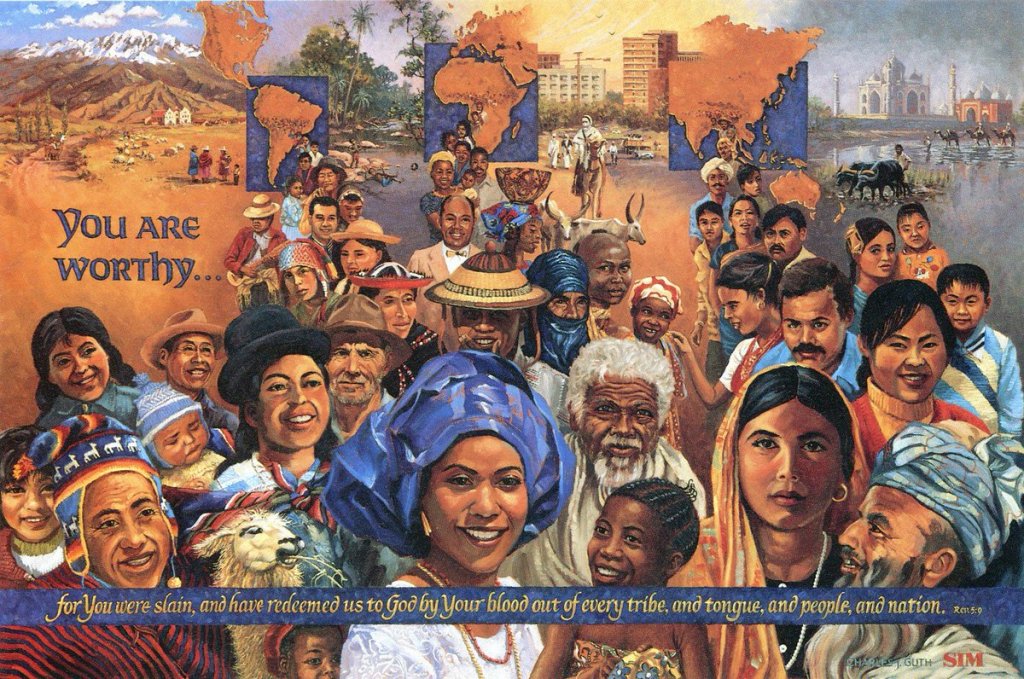
After this I looked, and behold, a great multitude that no one could number, from every nation, from all tribes and peoples and languages, standing before the throne and before the Lamb, clothed in white robes, with palm branches in their hands…. (Rev. 7:9)

Racial Justice: Having the Same Attitude Jesus Had

Jesus was the ultimate privileged individual in history. He was God who gave up His divine privilege to become one of us.

I consider myself fortunate to have been raised by parents who spoke about the evils of racial prejudice. I was rightfully appalled when I heard a racial comment spoken by a classmate in 1st grade. I was deeply affected by the assassination of Dr. Martin Luther King, Jr. when I was eight, so much that I remember what it was like walking to school the following day.

Dr. King’s death was a momentous event in my life. It affected me profoundly, but the darkness I glimpsed in the moment was as far away from me as the clouds way up in the bright morning sky that day as I walked to school.

As fortunate as I was to have had the good example of my parents’ just position on the issue of racism, I have been very slow to realize, personally, the real impact of racism in the routine lives of my brothers and sisters of color. The racism I understand (very incompletely) has has only slowly come into focus for me from the other side of that world.

I have never experienced racism directed at myself. I have not lived with the ever-present reality of racism bearing down on me from seen and, mostly, unseen sources (now).

I have never walked into a retail store knowing that someone, somewhere in that store, was watching me, suspicious of my every move. I have not driven my car in my own neighborhood conscious of the fact that eyes were following me, wondering what I am up to. I have not been stopped multiple times in my life on a pretense, though I was doing nothing wrong.

I do know the fear of being found out when I was doing something wrong, but that isn’t the same thing. I remember as a rebellious youth the fear that gripped me when I encountered a squad car at an intersection or when a squad car pulled behind me while I had an open container of alcohol in my car. But I could control my circumstances and change my ways to eliminate that fear.


I don’t know what it’s like to live in constant fear of circumstances I can’t control or predict – circumstances controlled by the fate of my birth in modern America with dark-colored skin.

As a child, I had hope and faith that we could truly see Dr. King’s dream come true: the dream that is deeply rooted in the American dream – that this nation would rise up and live out the true meaning of its creed:

“We hold these truths to be self-evident, that all men are created equal.”

We have made great strides, but the racism in this country is deeply rooted and pernicious than I believed it to be when I was child.

The deaths of Ahmaud Arbery and George Floyd are just the most recent examples of decades, generations and centuries of this cancer. The rioting that occurred last year is hard to understand from a purely rational perspective by those who don’t personally know the pain, grief, frustration and anger that wells up in response to injustice. Meanwhile, many people like me, people of good will, sit silently by.

We have not, yet, achieved the goal of the civil rights movement that was inspired by the tragic death of Dr. King. Half a century later, we aren’t colorblind. In fact, colorblindness has become a way of denying the racial disparities that still exist. Racial issues have gone underground and have become more insidious.

How does a white guy like me, who once thought that we had overcome racism with civil rights laws on the books, speak to these largely underground racial strains that remain? How do I conduct myself?

Some would say I have no legitimate voice to speak to these issues, but need to speak.

Continue reading “Racial Justice: Having the Same Attitude Jesus Had”

Immigration History and Confusion in the Church

Polls suggest that just 12% of evangelical Christians say that they think of immigration primarily through the lens of the Bible.

We have a somewhat romanticized view of immigration in the US. All of us in the United States reading this article are the benefactors of immigration, unless your ancestors were all Native American. Thus, the vast majority of us have benefitted from the various waves of immigration to the US in the past.

My ancestors immigrated at various times from England, Wales, Germany, Switzerland and France. It’s no wonder, then, that I view our history of immigration with some appreciation and sentimentality, and I believe most people with European ancestry feel like I do in that respect unless.

If you have much Native American or African ancestry, then, your view might be a bit different. If you have Chinese ancestry, you might feel differently. If you had German ancestry in 1750’s, you also might feel differently, but I will get to that.

We also tend to view our immigrant ancestors as hard-working, honest, and lawful people checking off the right boxes, jumping through the right hoops and diligently observing the protocols demanded of them to enter the country. We have earned the right to be citizens through their noble and respectful efforts.

Most of us, me included in years past, don’t really know the history of immigration to the United States other than the generalized and romanticized notions we carry from the US history we learned s children.

I am not a big fan of the new approach to American history that downplays the great positives that characterize the birth of our nation and its unique place in the world as a leader in many facets of human existence from governance to industry, science, and technology, medicine and human rights and in many other ways. At the same time, I think we should be honest about our history.

Immigration in the New World was relatively open, with exceptions, before 1882. Benjamin Franklin advocated in 1751 to exclude Germans and Africans from settling in the New World because he was “partial to the complexion of my country”.[1] Alexander Hamilton “warned of the dangers of absorbing and especially naturalizing too many foreigners”.[2] In fact, it seems that fear of immigrants is (at least) as old as the New World itself.[3]

People like Thomas Jefferson and George Washington opposed those views at the time, though Jefferson’s opinion may have been motived by a perception that German immigrants were more apt to support him politically. Some things don’t change!

I am not going to recount all the history of immigration in the United States. I am sure I don’t know the half of it, but a few noteworthy historical markers might be instructive in these times.

My interest here is the evangelical church in the United States, of which I am a member. How should we as a church orient ourselves to the immigration issues in our time in light of Scripture?

Continue reading “Immigration History and Confusion in the Church”