When It Gets Hard, to Whom Shall We Go?

I had gone back to medicating myself and chasing weekends. I was lost in a spiritual wilderness.

The passage from the Gospel of John reproduced below was the subject of a sermon recently where I attend church. It is also the catalyst for one of the most important turning points in my life.

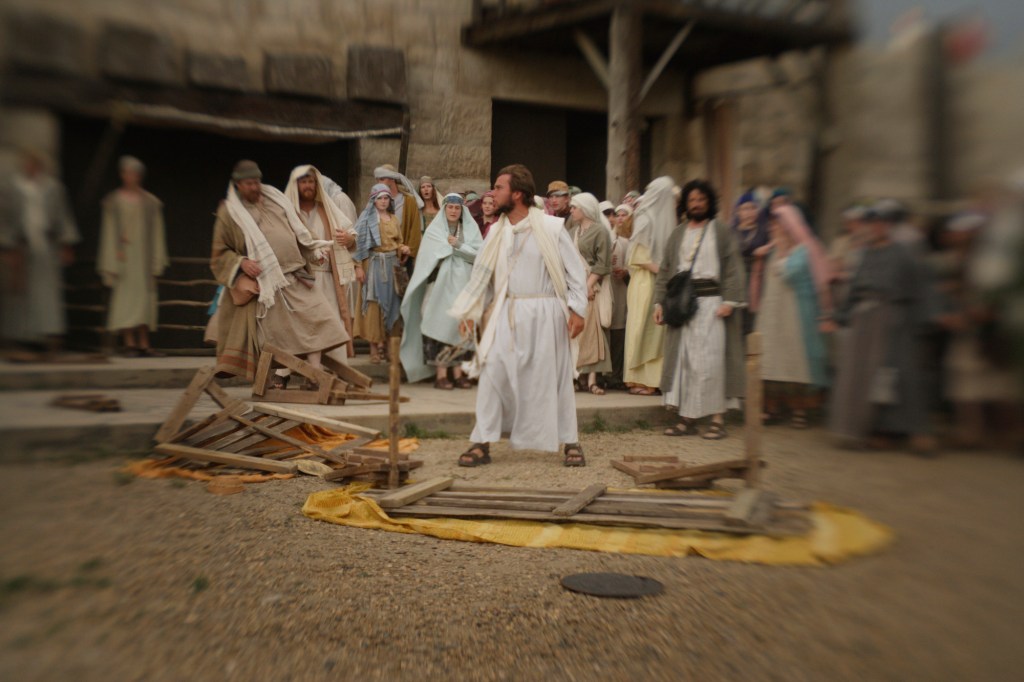
Jesus had just finished telling the crowd, “I am the bread of life….” (John 6:48); “And the bread that I will give for the life of the world is my flesh” (John 6:51); and, “Whoever feeds on my flesh and drinks my blood has eternal life.” (John 6: 54)

The Romans called the early Christians cannibals because of words like these and “the Lord’s Supper” that Christians observed ritually when they met. The crowd didn’t understand what he was saying either. The apostles also didn’t understand, as is evident by the following interchange in John 6:

60 On hearing it, many of his disciples said, “This is a hard teaching. Who can accept it?”

61 Aware that his disciples were grumbling about this, Jesus said to them, “Does this offend you? 62 Then what if you see the Son of Man ascend to where he was before! 63 The Spirit gives life; the flesh counts for nothing. The words I have spoken to you—they are full of the Spirit[e] and life. 64 Yet there are some of you who do not believe.” For Jesus had known from the beginning which of them did not believe and who would betray him. 65 He went on to say, “This is why I told you that no one can come to me unless the Father has enabled them.”

66 From this time many of his disciples turned back and no longer followed him.

67 “You do not want to leave too, do you?” Jesus asked the Twelve.

68 Simon Peter answered him, Lord, to whom shall we go? You have the words of eternal life. 69 We have come to believe and to know that you are the Holy One of God.” (Emphasis added)

These words Jesus spoke were allegorical of course. In the sermon on this passage the pastor developed the principal that we feed on what we follow.

Paul says, “Bad company corrupts good character.” (1 Corinthians 15:33) “Garbage in, garbage out”, as “they” say. It’s biblical, and it’s common wisdom, but this passage is about much more than an adage for life.

Continue reading “When It Gets Hard, to Whom Shall We Go?”

What Does It Mean to Be Transformed By the Renewal of Your Mind?

Broad is the way and wide is the path that leads to destruction.


I listened to a sermon by Tim Keller this morning. Before I get into what Keller said, though, allow me to share the verse I was meditating on before I listened to Keller. The verse is:

“Do not be conformed to this world, but be transformed by the renewal of your mind, that by testing you may discern what is the will of God, what is good and acceptable and perfect.” Romans 12:2 ESV

As I meditated on this verse this morning, I was first struck by the command, “Do not be conformed to this world, but be transformed by the renewal of your mind.” This is something Paul was telling the Romans to do.

As I went on in my meditation, I began to realize that the patterns of this world and the renewal of our minds are influenced by agents “outside” of us. We either allow ourselves to be conformed to the patterns of this world, or we allow ourselves to be transformed by the renewal of our minds. The patterns of this world and/or the renewal of our minds by God’s Spirit are influences on us that we can reject or embrace.

We have a choice to make, but the choice is in the allowing, in the submitting either to the patterns of this world or to the renewing of our minds by the Holy Spirit. It is something that happens to us that we can choose to participate in (or not).

The HELPS Word study (on biblehub.com) for the Greek word, sysxēmatízō, explains that “be conformed to the patterns of the world” means to be identified with those patterns and to assume a similar outward expression by following the same patterns. This conformance may happen consciously or unconsciously.

Paul is urging us to be conscious, to be mindful and intentional, in resisting conformance to the patterns of the world and to submit ourselves to the renewal (the transformation (metamorphóō)) of our minds by the influence of God’s Holy Spirit.,

The Greek word translated as “renewal” means literally metá “change after being with” and morphóō “changing form in keeping with inner reality”. The transformation Paul means is a metamorphosis. Like the caterpillar that changes into a butterfly, this is something that happens to us (within us), but only if we submit to it – only if we do not resist it and we allow it to happen.

We will be influenced one way or the other. We will conform to the patterns of this world unless we resist them. We will not be transformed by the renewal of our minds unless we choose to submit ourselves to God’s renewal process that is the work of the Holy Spirit.

My first thoughts focused on the fact that this is something that we do or do not do. We are acted on by outside agents either way. Yes, we participate in our own condition, but our participation is merely a matter of what we choose to respond to and yield ourselves to.

Continue reading “What Does It Mean to Be Transformed By the Renewal of Your Mind?”

Exchanging Death for the Gift of Life

From dust to dust is our natural end, but God offers us life.

“For the wages of sin is death, but the free gift of God is eternal life in Christ Jesus our Lord.” Romans 6:23 ESV

We have earned death. The “wages” we receive is what we have earned, God desires to give us the gift of life. He desires to exchange what we have earned for the gift of life.

We are from the dust, and to the dust we return. That is our natural lot in life. Death is our natural end, but God desires to give us life.

This is not unfair. Death is all we can expect as finite creatures. We cannot expect more, but God offers life. He offers us His life. 

We did not create the world. We are not the captains of our own destiny. We are aliens in this place. From dust to dust we is our natural condition.

Yet, God inexplicably and unbelievingly offers us His life.

How do we know this? We know it because of Jesus. Jesus sad no greater love has anyone for another than to lay down his life for that person. (John 15:13) Then Jesus laid down his life. He laid down his life for us.

We know we can trust God because He became one of us. He emptied Himself of His power, glory, and privilege to experience the life we have.  (Phil. 2:7-8 ESV) He didn’t have to do it. He did it willingly for us.

Then, he rose from the dead. He showed us that death has no hold on him. His life, the life that triumphs over death, is what He offers us.

It is not an automatic thing, though. We have to want it. We have to receive it. We have to accept it.

Some of us would rather accept only what we have earned. He came to the people with whom He long established a relationship, through whom He would reveal Himself to the world, but many did not receive Him. (1 John 1:11)

He chose to give us a choice. That choice He came to offer in person to the first century Hebrews with whom He cultivated a relationship over the centuries. Now He offers that choice to everyone, even us.

“Yet to all who did receive him, to those who believed in his name, he gave the right to become children of God — children born not of natural descent, nor of human decision or a husband’s will, but born of God.” (john 1:12-13)

The Top Ten Articles on Navigating By Faith in 2021

The top three articles were all written in 2020 as the world hunkered down against COVID.

When I set out to begin writing in 2012, I did it because I believed the Holy Spirit was prompting me to use the gifts God gave me and to be diligent in using them. This was the blog I set up in response to that prompting. I didn’t focus on the number of people who followed or read the blog. I was simply being obedient.

Each year since then, though, I have taken stock of the number of readers and the articles that are being read on this site: Navigating By Faith. The numbers have not always increased each year over the previous year, but they have trended up since 2012.

In the 2nd year, I topped 1000. By 2018, I topped 10,000. The blog wasn’t viral, but it was being read. In 2019, I was plateaued at just over 10,000 article views, with slightly fewer views in 2019 than the year before.

The last two years have seen jumps in readership by approximately 10,000 each year: a total of 20,084 in 2020 and 30,749 in 2021. I attribute the big jump last year to COVID. Everyone was hunkering down; they had more time; and they were reading more. I am not sure why the additional jump this year.

Maybe we have been more reflective as a society as we have come face to face with a deadly pandemic and have had more time to reflect? Maybe I hit on some topics that are particularly poignant in the current flux of issues bombarding the Church in the United States.

I began writing two blogs in 2012: one aimed at the general seeker; and this one aimed more specifically at Christ seekers/followers. Over time, I fund myself most focusing on the latter audience. I don’t think I have posted more than one article on the first blog in over a year.

In 2021, three articles account for the 10,000 increase over last year, and each one seems fitting for “the times” we have been experiencing.

The first one,

Who Were the Sons of Issachar? And What Might They Mean for Us Today?,

(written in September 2020) seems to have struck a nerve.


The article It has 6606 views which is over 4000 more than the next most read article. It was the product of my own angst about the evangelical support for Donald Trump, questioning my own increasingly critical posture, and digging deep into Scripture for answers. Could I have been wrong about him? Why are so many Christians defending him?

Because it went “viral” (relatively speaking) on my blog, I wrote a summary of just that one article. It was written before the presidential election and the January 6th confirmation, but it continues to be the most read article on the blog on a daily, weekly, and monthly basis. You can read my retrospective of the article for the back story and my current assessment of the article.

The second most read article in 2021, with 1669 views, is:

God Meets Us Where We Are.


It is a kind of response to the existential angst of the Christ seeker/follower. It runs along the vein of Psalm 139. We can’t go anywhere that God is not with us. We don’t have to climb up to Him because He “climbs down” to us and meets us right where we are.

The third most read article tackles Critical Race Theory from a Christian Perspective (1226 views).


It summarizes the position of Monique Duson, who gravitated from CRT follower to CRT critic. She now sees CRT as a religion-like worldview that is heretical to and competes with Christian faith. That this article garnered much more attention than other articles I wrote about CRT is ironic.

I am not reflexively against CRT. I believe it has been coopted by people with anti-religious, even Marxist views of the world, but CRT isn’t (in itself) threatening to faith. What troubles me more than CRT is the effort the Church puts into beating up the CRT boogeyman while ignoring the underlying issues of racial injustice and racial disparity that continue to exist.

The top three articles were all written in 2020 as the world hunkered down against COVID. As the world hunkered down, racial tensions and angst rose up. Thus, I think, the reason why these articles got the most attention is easy to understand.

Those three articles, alone, account for over 10,000 views. They exceed al the views of the other articles that fill out the top ten combined. I will address each one and make some comments as I go.

Continue reading “The Top Ten Articles on Navigating By Faith in 2021”

Certainty in Uncertain Times is the Theme of the Top Article from this Blog in 2021

The most read article in 2021 for this blog has prophetic and apocalyptic undertones.

Each year since I started this blog in 2012, I have reviewed the most read blog posts of the year. Certain posts on timeless themes, like “It is Well with my Soul: The Story” (from 2014), are perennial contenders. Not this year, though. That article doesn’t even make the top ten.

While some timeless “favorites” (recognizing this is a relative term here) tend to make the list each year, 2021 is marked by the emergence of relatively new writings and a new theme. We might call that theme the signs of the times. At least, we might say that writings which reflect the current times have emerged on top.

That statement is certainly true of the article that is by far the most read article on this blog this year: Who Were the Sons of Issachar? And What Might They Mean for Us Today?

This article was written in September of 2020. At that time we were careening toward a contentious presidential election. Though it was written with only three months to the end of the year, it became the most read article of 2020 (beating out It is Well with My Soul), and it is the most read article in 2021 by far.

In fact, the Sons of Issachar article has quickly become the most read article of my blog, ever, beating out the 2014 article (It is Well with My Soul) three times over. That it grew out of my own angst leading up to the presidential election is certainly a sign of the times. We have had much angst in the last two years!

I have never highlighted a single article in my past annual summaries. This year is different. I will get to the summary, but first I will tell the back story and reflect on the significance of the Sons of Issachar article, which seems to have hit home with people.

Continue reading “Certainty in Uncertain Times is the Theme of the Top Article from this Blog in 2021”