When demand that the Bible be taken literally in all respects, we are imposing our own standard on the Bible and insisting that it talk to us in that way.
Whether the Bible should be read and interpreted literally seems to be an open question in the 21st Century. Some Christians, and many people who criticize Christians, seem to think the Bible must be read in a literal, wooden fashion, and it must stand or fall based on what people say is “the literal interpretation” – the Bible is either literally true or literally false, and there is no third position.
So, let me put this out there – do we approach other literature that way?
Photo by Steve Murray – Where Moses looked into the promised land
“But the fruit of the spirit is love, joy, peace, patience, kindness, goodness, faithfulness, gentleness, self-control; against such things there is no law.” (Galatians 5:22-23)
The Spirit does what the Law could never do.
The law is exterior to us. It imposes a standard for us to follow, but it does not give us the desire or the power to follow it. The Spirit gives us both.
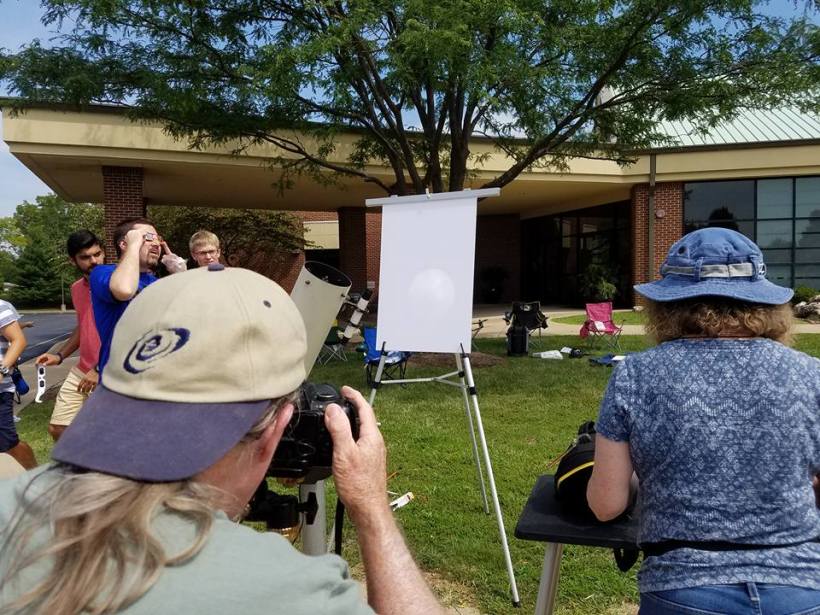
Photo taken of friends at a church in Missouri viewing the eclipse
I listened to a presentation by Jon Jorgenson on Science vs. the Bible in which he addressed the question whether the Bible has any scientific errors. Jon’s YouTube channel is aimed at teenagers and young adults, and he is a prolific producer of inspirational and devotional material.
He acknowledges, the answer, literally, is yes. For instance, in Genesis, the author describes the Moon as a “lesser light”, but we know the Moon is not technically a light. It doesn’t generate light of its own like the Sun.
Another example is the parable of the mustard seed. Jesus calls the mustard seed the smallest of all seeds. We know that there are other seeds in the world that are smaller than mustard seeds.
For these reasons, we cannot honestly say that the Bible, on its face, taken literally, is scientifically accurate. It simply isn’t.
Jon offers that we shouldn’t expect the Bible to be scientifically accurate because it isn’t meant to be. 2 Timothy 3:16 states: “All Scripture is inspired by God and profitable for teaching, for reproof, for correction, for training in righteousness”. (NASB) From this, he makes the point that the Bible is written for a different purpose.
Still, one might ask, doesn’t the God of the universe know these things? Why doesn’t He get the facts right?!
Ravi Zacharias is a well-known speaker on faith, culture and philosophy. He travels around the world, rubbing shoulders with the intellectual elite. He wasn’t always the intellectual sort. He wasn’t always a man faith. He called himself an atheist growing up.
In an interview, when he was pressed on that point, he said, “Atheism is a strong word. I was living like an atheist.”
New Atheists, like Richard Dawkins, deny that they have faith, but it is all in the way they define faith. Even so, they do have faith. Their faith is in the human intellect and capacity to reason, and this is their religion.
The New Atheists today scoff at people of faith. Richard Dawkins has even urged his followers to mock people of faith. The same people bristle at the suggestion that they, themselves, have faith.
Yet they do have faith, and they are apparently too blind to see it. As intelligent as they are in the field of science and their philosophical naturalism, they are ignorant of the true meaning of faith and not self-aware enough to know that they have it.
In fact, the faith they have might even be characterized as the kind of faith Dawkins urges people to mock. Let me explain.
To begin with, I need to identify how Dawkins has defined faith. In a debate with John Lennox, and in other contexts, Dawkins defines faith as belief without evidence or even belief “in the teeth of the evidence”. Dawkins limits faith…





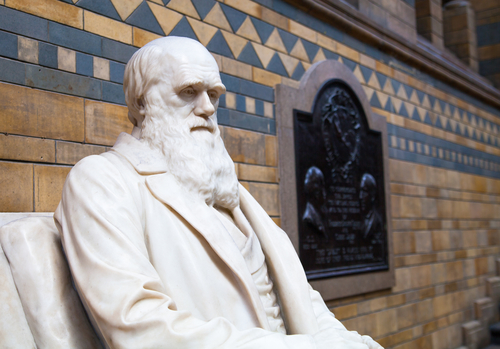 Depositphotos Photography ID: 59162885 Copyright: irstone
 Navigating by Faith