
Many things are said about judging, and confusion persists about whether Christians are to judge or not to judge. I wrestled through the seeming conundrum – to judge or not to judge – a number of years ago and came up with 8 Important Points About Judging and Judgment. I didn’t realize, then, how these principles tie into the way we should look at immigration.
In very brief summary, Jesus said, “Judge not, that you be not judged” (Matt. 7:1), and followed immediately with the statement, “For in the way you judge, you will be judged; and by your standard of measure, it will be measured to you.” (Mt. 7:2) He was not telling us not to judge; he was telling us to be careful how we judge. This is critical.
The statements in Matthew 7 cited above are the set up for the short parable of the person with a log in his eye trying to take the speck of his brother’s eye. The parable ends with Jesus telling us first to take the log out of our own eye; then we can see accurately to take the speck out of our brother’s eye.
Paul riffs on this theme Jesus preached when he said, “If we would judge ourselves, we would not be judged.” (1 Cor. 11:31 NKJV) Paul also picks up on something I missed for years in the log and speck parable. In that parable, Jesus is talking about “judging” our brother. Who we judge is just as critical as how we judge.
When I first discovered this, I realized that I and most Christians I know had it all wrong. That lightbulb went on when I read these words by the Apostle, Paul:
“What business is it of mine to judge those outside the church? Are you not to judge those inside?”
1 corinthians 5:12
Jesus only talked about judging our brothers, and Paul makes it clear this means people in the church. We have no business judging people outside the church. “God will judge those outside.” (1 Cor. 5:13) (This is why we need to preach the gospel to them!)
Of course, when we feel compelled to judge someone else, we should always examine ourselves first. We should always be careful how we judge, because we how we judge others is how we will each be judged. We should never judge people outside the church – because Jesus came not to condemn – and neither should we; he came to save.
Notice these themes that Jesus preached:
- We will be shown mercy as we show mercy to others (Matt. 5:7)
- We will be forgiven as we forgive others (Matt. 6:15); and
- We will be judged as we judge others (Matt. 7:2);
Consistent with what Jesus preached, the themes of judgment and mercy are tied together by James:
“[J]udgment without mercy will be shown to anyone who has not been merciful. Mercy triumphs over judgment.”
JAMES 2:13
When James adds that “mercy triumphs over judgment,” he is highlighting a standard that is based on God’s character. God desires mercy and not sacrifice (Hosea 6:6); God desires mercy, which is why Jesus came to call sinners to himself (Matt. 9:13); and God desires us to be merciful as He is merciful. (Luke 6:36)

So many people view God as an angry God who is full of wrath and judgment. Nothing could be further from the truth. “The Lord is merciful and gracious, slow to anger, and abounding in steadfast love.” (Psalm 103:8) “The steadfast love of the Lord never ceases; his mercies never come to an end.” (Lamentations 3:22)
God is just because he is merciful! Biblical justice is characterized by mercy. Thus, justice without mercy is not biblical justice:
“Therefore the Lord waits to be gracious to you; therefore he will rise up to show mercy to you. For the Lord is a God of justice; blessed are all those who wait for him.”
Isaiah 30:18
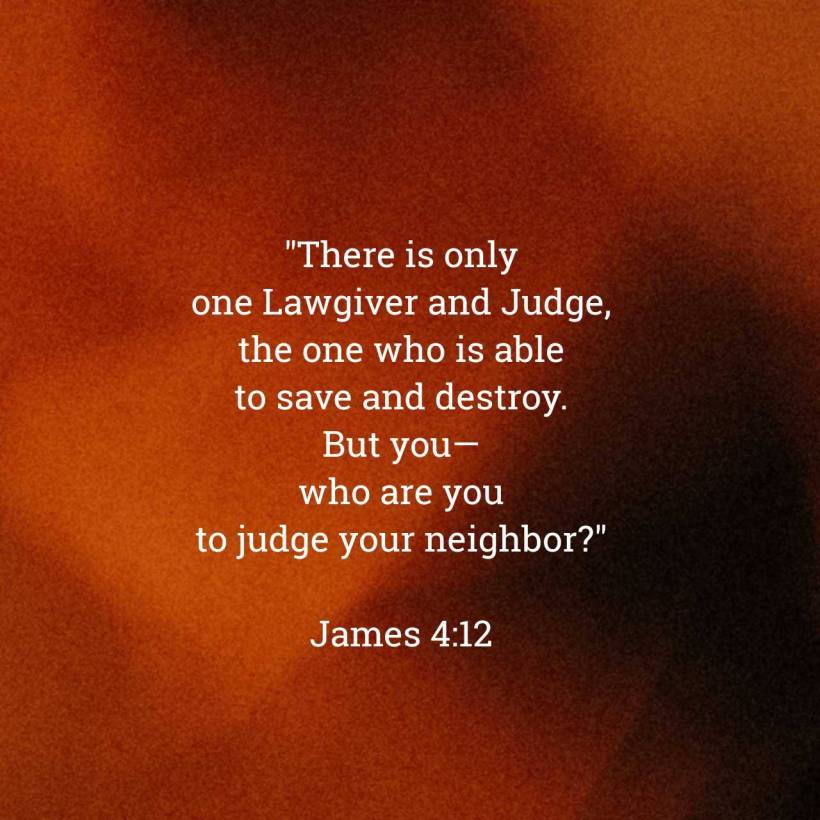
But what does this have to do with judging neighbors? Why did James ask the rhetorical question: “Who are you to judge your neighbors?” This question ripples back to the question, “Who is my neighbor?” The context in which God told us to love our neighbors is a good place to start with answers to these questions.
As noted above, the parable about the log/plank in our eyes focuses on brothers: “first take the plank out of your own eye, and then you will see clearly to remove the speck from your brother’s eye.” (Matt.7:5)
Paul applies this idea to the church. The people in the church (family of God) are our brothers and sisters. Among our brothers and sisters (the church) we are to exercise judgment (biblical judgment).
Neighbors are a different category of people. Jewish people in the First Century thought that neighbors (whom they were commanded to love) were only people of their own culture, ethnicity, and tribe, but Jesus disavowed them of that notion. (See The Backstory to the Parable of the Good Samaritan – A Lesson for These Times)
Neighbors are different than brothers (the church). The Jews thought their neighbors only included fellow Jews, but Jesus made clear in the Parable of the Good Samaritan (Luke 10:25-37) that neighbors included the Samaritans (who the Jews despised). Jesus went further in the Sermon on the Mount to add that the neighbors we should love include even our enemies. (Matt. 5:43-48) Everyone is our neighbor.
Now, let’s get to the point. The idea of loving our neighbors was introduced originally in Leviticus 19:18:
“Do not seek revenge or bear a grudge against anyone among your people, but love your neighbor as yourself. I am the Lord.”
The 1st Century Jews latched onto the language, “among your people”, and believed their neighbors were only their fellow Jews. They failed to consider, however, the larger context in which neighborly love was stated. Further on in Leviticus, it reads as follows:
“When a foreigner resides among you in your land, do not mistreat them. The foreigner residing among you must be treated as your native-born. Love them as yourself, for you were foreigners in Egypt.”
Leviticus 19:33-34
“Love your neighbor as yourself” in verse 18 finds a parallel in “love them [foreigners] as yourself” in verse 34. Thus, God’s command to love their neighbors and treat them as they would want to be treated was expressly made in the context of the foreigners residing among them.
Jesus riffed on this theme in the Sermon on the Mount and the Parable of the Good Samaritan. Jesus was even more pointed about these things in the Parable of the Sheep and the Goats when he said that anyone who welcomes strangers (foreigners) welcomes him, and anyone who turns them away turns him away. (Matt. 25:31-46)
In the verse with which I started this blog, James tells us not to judge our neighbors, because neighbors are distinct from brothers. We are instructed to judge our brothers (only if we judge rightly), but we are not to judge our neighbors.
Neighbors are a different story. Jesus never tells us to judge them. Thus, it makes sense that Paul says we have no business judging those outside the church, and it makes sense that James says we are not to judge our neighbors – because Jesus never told us to judge our neighbors.
Finally, I want to focus on the fact that God was talking about foreigners in Leviticus when He introduced to his people the command to love our neighbors.
God’s heart is to protect foreigners. (Psalm 146:9) Loving them, therefore, means protecting them. It means not mistreating them. (Ex. 22:21; Lev. 19:33) It means treating them as if they were native-born, and it means loving them as we love ourselves. (Lev. 19:34)
I dare say that we judge foreigners (immigrants, including “illegal aliens”) when we assume they are law breakers – all “murderers and rapists.” We judge foreigners when we assume they can’t be trusted. We judge foreigners when we lump them all together as “illegals” who are not worthy of the basic dignity we show citizens. We judge foreigners when we think it is ok to deport them without a hearing and a fair opportunity to plead their case.
The response, “But it’s the law,” is not merciful, and judgment without mercy is not justice. God does establish authorities to impose laws and to maintain order for the protection of society, but those laws need to be just, and the way we carry them out must be just/merciful – the way we would want to be treated if we were in their shoes.
I would venture to guess that most (if not all) of the people who read this blog are not directly involved in the immigration system in this country. We are just average citizens, so these things boil down to our hearts, our attitudes, and the support we express for the laws, policies, and practices of those who govern us.
We do not know the facts of any particular cases except for the very cursory details articles we read – that may not be completely accurate. It’s all hearsay to us; amd we don’t know the full stories of the people involved. So, all we have is our heart attitude on the these things and our expressions of support, judgement, compassion, criticism, etc.
I think the Bible couldn’t possibly be any clearer than it is: our attitudes should be to welcome strangers and not to judge our foreign neighbors because God, Himself, watches over and protects the foreigners among us, and He desires us to have the same attitude. That seems to suggest that we should not jump to judgmental conclusions about them – we should give them the benefit of the doubt.
We do need law and order. We should not allow murderers, rapists, drug traffickers, human traffickers, gang members, and people with criminal intent into our country. That would not be loving to our neighbors in this country. At the same time, we should have a system that welcomes strangers who desire to live peacefully and lawfully among us.
Jesus told us to judge rightly. To judge with the same measure with which we want to be judged. We will be judged in the same way we judge others. We need to take this seriously. How we judge is at least as important as how we forgive.
We should not, however, assume that all foreigners are murderers and rapists. When we do that, we judge them. When we support not giving them the due process that is provided to citizens, our position is in direct opposition to God’s commandments (to treat them as native-born, the way we would want to be treated).
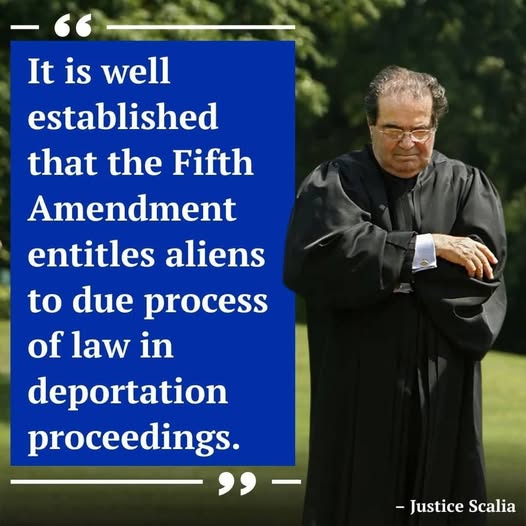
If the law didn’t afford non-citizens due process, God’s people should speak out against it, because it wouldn’t be a just law.
Our law, however, does extend due process to non-citizens. We should not be ok with our government violating due process for anyone.
Our constitutional system of justice is built on the notion of due process, which includes the adage of “innocent until proven guilty.”
Our system of justice is designed to make us go slowly and not to judge hastily. It requires the government to prove its case – even when the facts seems obvious. It treats all people (who God created in His image) with equal dignity – even if they have committed crimes (or are alleged to have committed crimes) – even if they are violent crimes.
Sometimes, the facts are not what they seem. We know this from stories of innocent men who have languished on death row or life imprisonment until the real killer is found. Injustice happens despite the safeguards in the system, like innocent until proven guilty. How much more injustice would be done in a system without safeguards?
If we do not have a heart attitude of compassion and mercy, we judge wrongly. If we do not consider how we would like to be judged in the way we judge others, we err. If we judge quickly, harshly, and unfairly, we will be judged the same way.
Let us, then, seek to judge rightly – with the right heart attitude – on immigration matters in this country. Even then, we will not all agree on exactly the right way to balance loving our immigrant neighbors with loving our native-born neighbors, but we will be starting from the right place – a place of justice tempered by mercy, which is the character of God. May we reflect God’s character in all we do!

 Navigating by Faith
One thought on “How Should We Judge Our Neighbors?”