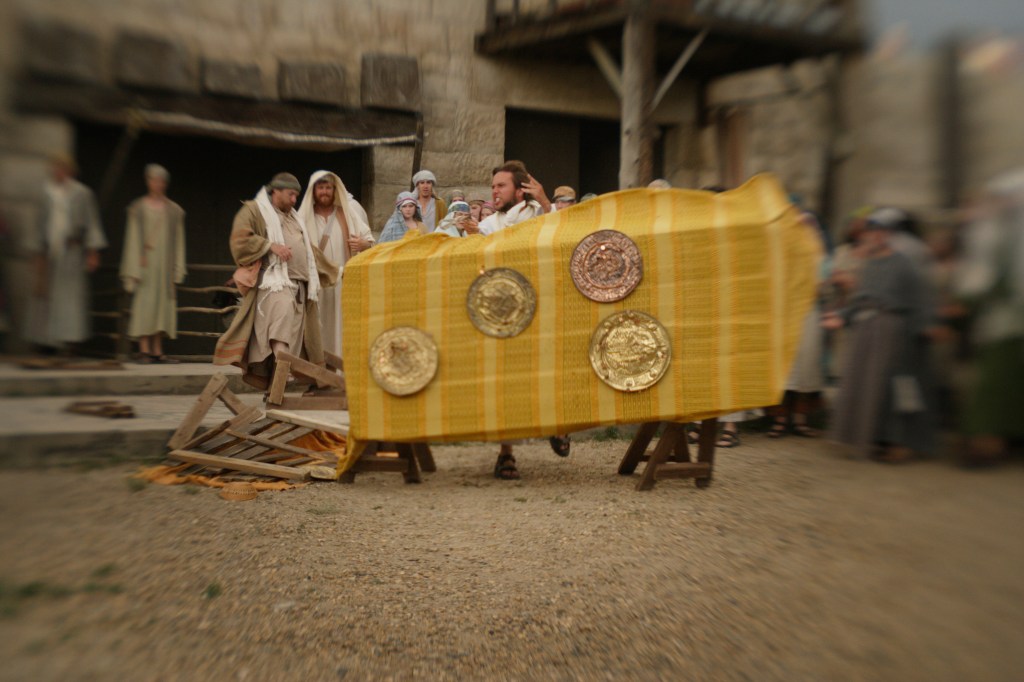
You Might Be A Pharisee If ….

Just when we become proud of our own spiritual advancement we are most in danger of spiritual catastrophe!


[29] “Woe to you, experts in the law and you Pharisees, hypocrites! You build tombs for the prophets and decorate the graves of the righteous. [30] And you say, ‘If we had lived in the days of our ancestors, we would not have participated with them in shedding the blood of the prophets.’

Matthew 23:29-30

Reading this passage in Matthew today reminded of the old bit by the comic, Jeff Foxworthy. If Jeff Foxworthy was a comic in 1st Century Judea, he might have said, “You might be a Pharisee if ____________________ (fill in the blank).”

In a similar vein, we could say, “You might be a Pharisee if you think you would not have opposed Jesus if you lived in Judea in the 1st Century.”

Of course, Jesus wasn’t being funny when he confronted the Pharisees, and this wouldn’t be a comedic schtick.

I don’t think Jesus was saying it was wrong for people to build tombs to the prophets or decorate them with flowers. Jesus was saying it was wrong to say (and think) they would have treated the prophets any differently.

The Pharisees are to us what the prophets were to the Pharisees. We may be tempted to think that we would embraced Jesus if we lived in 1st Century Judea, and would not have opposed him or called for his crucifixion if we we were in the crowd that shouted, “Crucify him!”.

But, that is no different than how the Pharisees thought and what the Pharisees claimed about the prophets that were resisted, derided, and sometimes killed by the “religious” people of their day. Jesus was clearly implying that the religious people of his day (the Pharisees), were no different than the religious people in the days of the prophets.

Can we say, then, that we are different than they?

Only if we adopt the same thinking as the Pharisees! (If I am understanding Jesus accurately.)

The Pharisees thought of themselves more highly than they should have. John came preaching repentance, for the Kingdom of God is near! But, the Pharisees didn’t repent. They didn’t think they needed to repent.

When Jesus – who was God in the flesh – came into the world, the Pharisees didn’t recognize Him or receive Him. (John 1:9-11) They did not prepare themselves for his coming by repenting, as John the Baptist exhorted. They adopted the wrong attitude about what God was doing in their time, and they didn’t hear and respond to what God God’s messenger was saying.

Pharisees say the right things, and they do the right things, but they fool themselves. What the Pharisees said and did was a façade. Their hearts were not aligned with their actions. They claimed to be experts in the Law, but Jesus called them blind guides leading blind followers. (Matt. 15:14)

Pharisees were concerned with appearances and the way people saw them. Pharisees were not as concerned with their heart attitudes. Jesus called them “white-washed tombs” that were empty inside (full of dead people’s bones and uncleanness). (Matt. 23:27-28) We need to be careful that we do become like the Pharisees.

Continue reading “You Might Be A Pharisee If ….”

People Are Enslaved to Whatever Defeats Them

God saves us to set us free from sin. We are meant for a freedom that empowers us to be good, knowledgeable, self-controlled, enduring, godly, filled with brotherly affection and with love.

The words that have become the title of this blog piece struck me in my daily Bible reading this morning. They are pulled from 2 Peter 2:19. I highlighted them in my digital Bible app.

We may tend to focus on the more encouraging provisions of the Bible and gloss over provisions like the one I am quoting here, but the Bible is a double-edged sword. It sometimes cuts to the marrow. It discerns and reveals the thoughts and intents of the heart. It is living and active… if we let it in to our hearts to do its job.

I am convicted today, as I should be, and I am encouraged, because God, the Father, disciplines His children whom He loves. God watches out for the ones He loves. He warns us when we are straying into dangerous territory.

If we are paying attention and willing to respond, these warnings will protect us. If we rush headlong ahead, not heeding the warnings, as we are apt to do, we find ourselves entangled in difficulties that can threaten to undo us if we fail to repent and turn around.

Even then, the going can be difficult. Bad habits are easy to form and very difficult to break. If we go too far down the road with them, we find reversing course to be very difficult, indeed. Forming new, good habits is many times more difficult than the path we followed into those bad habits.

Bad habits are easy to form because they come from a place that is instinctual. They are outgrowths of natural tendencies of people who simply do “what feels good”.

Bad habits form from desires that are common to people – not necessarily bad desires. Evil isn’t a thing in itself. Evil is the corruption of good. Bad habits for when we seek to satisfy our desires in the easiest, most accessible, self-centered and least beneficial ways.

For instance, loving God and loving our neighbors – the two greatest commandments of God – are wrapped up in loving ourselves. If we don’t love ourselves, we have a hard time loving others. If we love others, we usually have an easy time loving ourselves. Loving God and loving people are intimately related to loving ourselves.

The popular idea of “self love”, getting some “me time”, and “focusing on myself”, however, can be a corruption of what is basically good. We are naturally self-centered. We naturally love ourselves more than others. When Jesus told us that we should love our neighbors as ourselves, he was implicitly acknowledging the fact that we are naturally focused on ourselves and our needs.

We instinctually love ourselves and seek what is best for us. We have to be purposeful, intentional and self-sacrificing to consider others, and especially to consider others ahead of ourselves. It isn’t natural, and, therefore, it isn’t easy.

Loving others isn’t hating ourselves; it’s learning to love others on the same level as we love ourselves. It is thinking of others on the same level as we think of ourselves.

Many people today are self-loathing, which is also a corruption of what is good. People who loath themselves are equally as self-absorbed as people who are corrupted in self-love.

We are made in God’s image, so to loathe ourselves is to loathe the very image of God. We shouldn’t confuse loving our neighbors as ourselves with loathing ourselves.

Self-loathing is a kind of self-centeredness. People who are self-loathing are self-absorbed in a negative way. Self-absorption and self-focus are a corruption of what is good, regardless of whether the result is pleasurable or painful.

The words of Jesus are transcendent. They direct our eyes away from ourselves to God and to others. When Jesus says, “My yoke is easy and my burden is light”, he is speaking to the reality that our self-focus (the burden of the self) traps us into unhealthy and ultimately destructive behaviors that are more of a burden than a help to us.

Such is the burden of sin. When we are unable to overcome sin, we are enslaved to it. As Peter says, “We are enslaved to whatever defeats us.” And so, I have come back to the focus of this blog piece: these words in 2 Peter 2:19.

Continue reading “People Are Enslaved to Whatever Defeats Them”

Can a Tiger Change Its Stripes? A Tale of Scorpions and Frogs

A scorpion stings. That’s what they do. That is their nature.

Joel Furches recently posted the following on social media:

“The Aesop’s Fable I have come to most appreciate over the years is ‘The Frog and the Scorpion’. If you’re not familiar, it’s about a scorpion who asks a frog to swim him across the water. The frog doesn’t want to, because he’s afraid of getting stung. The scorpion points out that if he stings the frog, they will both drown. So the frog swims him, the scorpion stings the frog, and they both drown. Why? Because it is the nature of scorpions to sting.

“The moral: things act out of their nature, even at the expense of their self-interest. Or as my dad used to say, ‘a person will never do something that person wouldn’t do.’ Which, I suppose, could be rephrased, ‘A person’s always going to do what that person does.’ (My dad would say ‘peoples are peoples’)” 

A more modern version of this idea is the tiger that can’t change its stripes or the leopard that can’t change its spots. The fable or adage stands for the proposition that people don’t change their essential nature or character.

We shouldn’t expect people to be anything other than who they really are. Despite what the scorpions tells you, the scorpion IS going to sting you. That’s what they do. That’s who they are.

Fables are meant to teach life lessons. They are meant to pass on wisdom to help us avoid having to learn it the hard way – from experience. (Though it seems most of us need firsthand experience to learn wisdom, and even then we don’t always get it.)

Still, these fables are helpful in allowing us to crystallize those hard learned lessons into memorable, graphic illustrations that we can hold onto and pass on – if only people would listen. Right?

But what is the lesson? Don’t trust people? Fool me once, shame on you, but fool me twice shame on me!

Fables teach us something about human nature, but fables don’t give us specific guidance tailored to our own dilemmas. We still need wisdom to apply the lessons we learn (however we learn them) in our particular circumstances. “A word to the wise” requires wisdom for its application in our own lives.

Aesop may have been a very wise man (if there really was an Aesop), and Aesop’s fables carry with them the ring of truth, but truth is often more complicated than we like to think it is. Just when you think you understand the laws of physics, quantum mechanics comes along and turns everything inside out.

The fable of the Frog and Scorpion is something we identify with, but Scripture provides a different angle. Scripture provides guidance to deal with the scorpions in our lives.

Continue reading “Can a Tiger Change Its Stripes? A Tale of Scorpions and Frogs”

The Innate Sin within Us

We are all innately sinful. That is what the story of the fall teaches us.


I find something incredibly refreshing in the stories of gay and lesbian brothers and sisters in Christ. Dr. Rosario Butterfield, David Bennett, Sam Alberry and others have had truly inspirational journeys in their Christian faith. I find unique comfort and encouragement in their stories.

With that said, I’m going to be unusually candid in this piece: I’m a heterosexual male. But that is not the candid part. I have struggled all my Christian life with heterosexual lust. That’s the candid part.

By the time I became a believer and committed myself to Jesus Christ as my Lord and Savior in my very late teens and early twenties, I was very much a product of a society that objectifies sex, obsesses about sex and worships sex.

But, to be honest, I am not just a product of my environment. Attraction to women is innate in me. All of my life, as far back as I can remember, I have been attracted to girls. My first crushes are some of my earliest memories going back to even to preschool and kindergarten.

When I became a Christian, I began to recognize that the extent of the attraction, and the extent to which I fed the attraction, was unhealthy. In fact, it was sinful at the core. Jesus says if we even look at a woman lustfully, we have sinned.

The sin of sexual lust was ingrained deep within me. I can’t wholly blame the environment in which I grew up for the sinful lust that grew within me, though it was provoked and fed by that environment. The root of that sin grew deeply and innately from the core of my being.

I can only imagine a similar experience with same sex attraction. I understand Lady Gaga’s song, Born This Way, though I didn’t always understand it. While my heterosexual attraction is accepted and even celebrated in the world in which I grew up, my gay and lesbian brothers and sisters have had to labor under a general societal distaste and disdain for their same sex attraction.

When I first heard the assertion that people are born with same sex attraction, I didn’t believe it. It defied biology. It didn’t make common sense to me. I figured it is a deviation from the way things are supposed to be. It’s nuts and bolts.

I have come to realize that maybe people really are “born that way” – like me having an innate attraction to girls as far back as I can remember. I didn’t choose it. It is the way it is.

The thing is that any unhealthy attraction that is over-indulged and idolized is sin. Any inner urging that invites me to think and act contrary to conscience and what I know and understand to be God’s desire for me, if I indulge it or act on it, is sinful. I fight the struggle every day.

Continue reading “The Innate Sin within Us”

Conflating God with People

We can’t judge God by the conduct of the people

ed-sheeran-concert


I have an old friend who is “disgusted” that many Christians supported Donald Trump and were a significant factor in Trump winning the election. She, like many women (and men), cannot get past the infamous words that Trump spoke how about a woman reporter. I won’t repeat them here. They are too vulgar for polite company.

My friend has been so turned off of Christians and “the” Church by the fact that many Christians voted for Trump and were a factor in electing him, that she no longer goes to church at all after decades of being a church-goer.

I don’t want to get into politics here. That isn’t the issue I’m focused on.

I have family and friends who say that they can’t believe in God, or can’t believe in the Christian God, because Christians are hypocrites. This is what leads me to write this piece.

Continue reading “Conflating God with People”