Current Lessons in the Parable of the Good Samaritan: Focusing on the Weightier Matters of the Law

We often fail to help people in need because we are focused on the good things we are doing

I have been involved in the faith-based legal aid organization, Administer Justice, in different capacities for about 12 years. I am an attorney. AJ is an organization founded by an attorney, Bruce Strom, who left his lucrative law practice to provide pro bono (free) legal services for people who can’t afford a lawyer. AJ helps churches run Gospel Justice Centers.

Bruce’s book, Gospel Justice, describes his calling and the journey he began over 20 years ago. Gospel Justice follows the familiar parable of the Good Samaritan and what it means to love your neighbor as God commands. Implicit in the parable is the question: who is my neighbor?

I have learned recently, that parables were common in the rabbinical tradition of the time, and the set up of a priest, a Levite and a third person was a common parable structure. It is the equivalent to the modern set up for a joke: a priest, an Irishman, and a Scotsman walk into a bar…..

According to Marty Solomon of the BEMA Podcast, the third person (the one through whom the lesson is learned) was often a Pharisee in the rabbinical Jewish tradition of the First Century. Jesus turned the tables by making the third person a Samaritan.

Samaritans had Hebrew DNA. They were ancestors of the Israelites who were left behind during the exile. They had intermarried and changed their religious practices to accommodate their mixed marriages and life without the Temple. The Jewish remnant that returned to rebuild the Temple saw them as mongrels who abandoned the faith. For Centuries, Samaritans were despised by the Jews who rebuilt the Temple and carried on the traditions of the Mosaic Law.

The priests and Levites represent good, religious people and the devotion to traditional values. They represent respectable, hard-working people who have faithfully kept those traditional values through hundreds of years of faithful adherence in difficult times.

When the priest and Levite in the parable pass by the anonymous, injured man on the road, we react with modern sensibilities that are honed by two millennia of Christian thought, tradition, and conditioning to judge them. First Century Pharisees, however, would have viewed the situation differently.

The injured man had no identify. They might have wondered who he was. (Raising the question: who is my neighbor?) Pharisees and Sadducees may have disagreed on whether aid should be offered to Gentiles, but they would have agreed that the mongrel Samaritans did not merit their aid.

They also would have recognized that the priest and the Levite had good reasons to pass over to the other side of the road and keep going. Among other things, priests were forbidden to touch a corpse. (Lev. 21:1–3) Touching a corpse, or even being in the same space as a corpse meant impurity, and they needed to maintain purity to perform their duties.

The rules that governed these things were complex and nuanced. (See Introduction to the Jewish Rules of Purity and Impurity) Becoming impure meant that a priest could not attend to his ritual duties without going through a time of ritual cleansing. The risk that the injured man might be dead was no small consideration to them.

Perhaps, this seems like being generous to them, but their lives revolved around the rituals handed down centuries ago in the Torah. They were sacred, and their identity and their purpose in life revolved around maintaining those rituals, which they had done since the time of Moses, the great, great grandson of Levi.

If we think times and people are different now, they are, but less so than we might be tempted to think. Most modern Americans (even religious ones) do not practice ritual like First Century Jewish leaders did. We are less religiously ritualistic, perhaps, than ever before. Yet, we are no different, really, in our devotion to our own values and doctrines.

Continue reading “Current Lessons in the Parable of the Good Samaritan: Focusing on the Weightier Matters of the Law”

Jonathan Haidt and the Erosion of American Democracy by the Corrosive Waters of Social Media

Something went terribly wrong, very suddenly. We are disoriented, unable to speak the same language or recognize the same truth.

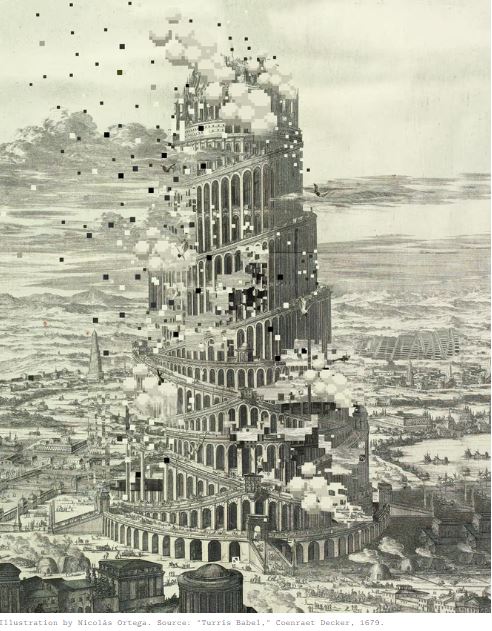
Courthouse Towers and Tower of Babel. Moab, Utah

Jonathan Haidt wrote this week in the Atlantic, “The story of Babel is the best metaphor I have found for what happened to America in the 2010s, and for the fractured country we now inhabit.” He says,


“Something went terribly wrong, very suddenly. We are disoriented, unable to speak the same language or recognize the same truth. We are cut off from one another and from the past.”

I resonate deeply with this.

Haidt observes that we are “becoming like two different countries claiming the same territory, with two different versions of the Constitution, economics, and American history.” Many people talk about the tribalism of our times, but Haidt suggests that tribalism isn’t the most accurate description of what is going on. Haidt finds the clearest understanding of the polarization of our times in the story of the Tower of Babel:

“Babel is not a story about tribalism; it’s a story about the fragmentation of everything. It’s about the shattering of all that had seemed solid, the scattering of people who had been a community. It’s a metaphor for what is happening not only between red and blue, but within the left and within the right, as well as within universities, companies, professional associations, museums, and even families.”

Haidt focuses blame on social media. He identifies 2011 as “the year humanity rebuilt the Tower of Babel” with Google Translate symbolically bridging the confusion of different languages. He says (for “techno-democratic optimists”), “[I]t seemed only the beginning of what humanity could do.”

Around the same time, Zuckerberg proclaimed “the power to share” a catalyst to transform “our core institutions and industries”. He may have been prophetic, but I doubt he envisioned such a corrosive change.

Haidt, something of a social scientist, himself, says, “Social scientists have identified at least three major forces that collectively bind together successful democracies: social capital (extensive social networks with high levels of trust), strong institutions, and shared stories.” Social media substantially weakens all three of these fundamental building blocks of a cohesive society.

It started harmlessly with the sharing of personal information to stay connected, but it quickly morphed into a kind of personal performance and branding platform. Along the way it developed into powerful weaponry at the fingertips of anyone and everyone at once.

The “Like” and “Share” buttons became commodities of individual enterprise and personal combat. Algorithms exposed (and exploited) the emotional currency of heightened individuality and the power of anger.

“Going viral” fed the hopes of Internet junkies like the possibility of a jackpot snares gambling addicts in its steely fingers, and the stakes were just as high. Haidt says, “The newly tweaked platforms were almost perfectly designed to bring out our most moralistic and least reflective selves. The volume of outrage was shocking….” The rapidity and its ability to spread was more virulent than COVID, or the plague.

Haidt lauds the framers of the Constitution for designing a republic built on “mechanisms to slow things down, cool passions, require compromise, and give leaders some insulation from the mania of the moment….” Haidt recalls Madison’s warning of “the innate human proclivity toward ‘faction’” so “inflamed with ‘mutual animosity’” that people are “more disposed to vex and oppress each other than to cooperate for their common good.’”

Haidt recalls also that Madison warned of a human tendency toward “factionalism” that can fan “the most frivolous and fanciful distinctions” into passions that ignite our most violent conflicts. Social media has ultimately proven him right.

Thus, Haidt says, “Social media has both magnified and weaponized the frivolous,” chipping away at our trust. The loss of trust makes every decision and election “a life-and-death struggle to save the country from the other side”.

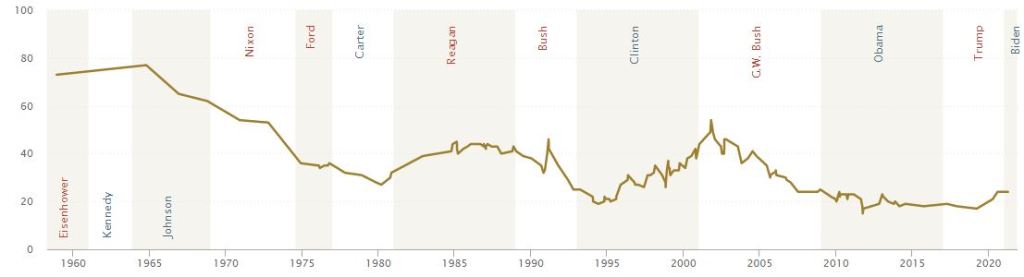
The sagging number of people who have faith in their elected officials hangs at an all time low. In my lifetime, the United Sates of America has gone from a high of 77% trust in the federal government (1964) to a low of 17% in 2019. (See Public Trust in Government: 1958-2021, by PEW Research May 21, 2021)

Social media has corroded trust in government, news media, institutions and people in general. Some claim that social media may be detrimental, maybe even toxic, to democracy, which requires “widely internalized acceptance of the legitimacy of rules, norms, and institutions” for survival. “When people lose trust in institutions”, says Haidt, “They lose trust in the stories told by those institutions.”

Insiders have been warning us of “the power of social media as a universal solvent, breaking down bonds and weakening institutions everywhere”, while offering nothing in return but the chaos of utter freedom and will. Haidt references movements like Occupy Wall Street, fomented primarily online, that “demanded the destruction of existing institutions without offering an alternative vision of the future or an organization that could bring it about”.

We have become a society of “people yelling at each other and living in bubbles of one sort or another”, says former CIA analyst Martin Gurri, in his 2014 book, The Revolt of the Public. The people behind the social media giants may not have intended such a result, but they have “unwittingly dissolved the mortar of trust, belief in institutions, and shared stories that had held a large and diverse secular democracy together”.

Haidt claims he can pinpoint the proverbial fall of the American Tower of Babel to the intersection of “the ‘great awokening’ on the left and the ascendancy of Donald Trump on the right”. Haidt doesn’t blame Trump for the fall; he merely exploited it. Trump proved that outrage is the currency of the post-Babel economy in which “stage performance crushes competence” and Twitter overwhelms newspapers and the nightly news, fracturing and fragmenting the truth before it can spread and take hold.

“After Babel”, Haidt says, “Nothing really means anything anymore––at least not in a way that is durable and on which people widely agree.” Haidt is particularly morose on the prospect of overcoming the rapid dissolution of the American democracy. Unfortunately, I share his pessimism. How did we get here? How do we move forward?

Continue reading “Jonathan Haidt and the Erosion of American Democracy by the Corrosive Waters of Social Media”

Tribalism and the Body of Christ: What Unifies Us, & What Separates Us is Key

We can’t avoid the conflict of differing views, but we need to be careful how we differ with people and over what we differ with them.

I have been listening to the podcast, Truth Over Tribe, beginning with the episode, How Tribalism Is Ruining Your Life, on Podbean. Check it out.

Whether you label it polarization or tribalism, I have seen people entrenching and doubling down in their political positions more than at any other time in my life. Thus, the podcast resonated loudly with me.

In writing this piece, I am not focusing on people, generally, or the state of governmental affairs. My focus here is the body of Christ and it’s witness in the world. People have always been divided. We have always had wars and fighting to prove it. The Church, however, should be different. The Church should stand a part, like a city of a hill.

Continue reading “Tribalism and the Body of Christ: What Unifies Us, & What Separates Us is Key”

The 2020 Census and the Breaking Down of the Dividing Walls of Hostility

Fundamentally, Christians should align with Christ, and nothing else.

The 2020 Census reveals a story of changing demographics in the United States. It should hardly come as a surprise that the story is diversity. “Over the past 10 years, people who identified as Hispanic, Asian or more than one race accounted for larger shares of the population….”[1]

I suspect we could say the same thing about many a decennial census over the history of the United States. During the history of this country, from one census to another, we can trace the movements of people, including the Spaniards and Portuguese, the English and French, the German, the Irish, the Italian, the African, the Chinese, the Poles, and on and on.

I grew up learning that the United Stated of America is a melting pot. The news of the 2020 Decennial Census is simply the continuation of the same story that is America. It is an uniquely American story, though rhetoric in the 21st Century might suggest otherwise.

The new census may reveal a plot twist of sorts, though: a “pivotal moment”. Whereas the American story of the past was primarily an European story, the plot is tending toward greater diversity. The population of “people of color” are increasingly “younger and growing more rapidly” then their traditional American counterparts with Eurocentric origins.

The population growth since 2010 “was made up entirely of people who identified as Hispanic, Asian, Black or more than one race”. We can speculate on the reasons for this major shift, but the fact remains that people of color are increasingly making up a larger percent of the population, and that trend will surely continue.

My thoughts, as always, turn to the impact on the Body of Christ and how the Church is responding… and should respond… to the times. These times are a changing, crooned Bob Dylan in my youth….. But then, they are always a changing.

Continue reading “The 2020 Census and the Breaking Down of the Dividing Walls of Hostility”

A Plea for Healing and Tending to the Garden in the Middle

The political and social atmosphere in America is playing into the hands of the radical fringe.

The events unfolding, the things going on in the world right now, are troubling from many angles. Racial injustice, polarization, the centrifugal force of political fringes, rhetoric over substance, political violence, conspiracy theories, fake news, the increasing control of popular speech by private monopolies of information, the abandonment of all semblance of non-bias by most media, the ability to choose our own tailored news, the hatred people are developing for others who don’t think like them, the unwillingness to show respect, listen and engage in real dialogue – these are things that are deeply troubling in “the land of the free and the home of the brave”.

The political, cultural, sociological, and philosophical winds are swirling chaotically and mixing at all levels into a tornadic gale that is bordering on dangerous. These forces are not coming from outside us but from within. Even if our present chaos is influenced by outside sources, they are merely putting pressure on elements already within us. “We have met the enemy, and the enemy is us.”

For four years, people have been blaming Donald Trump for every evil under the sun. (Pardon the hyperbole.) People have been lumping all Trump supporters into one group and condemning them (or so the rhetoric often goes). People have had good reason to be critical. (No hyperbole or rhetoric there.) But let’s take a step back (it may need to be a giant step) and attempt a look at the bigger picture.

Trump gained support over more than a dozen career Republican politicians in 2016 and was elected president over a person, in Hillary Clinton, who, perhaps more than anyone else, represented the entrenched political machine in America. Bernie Sanders mounted a credible offense with broad support against that machine but could not prevail.

I believe people gravitated to Trump and Sanders for the same reasons: they are tired of politics as usual. They feel that our political system has broken down. It has become big business designed to perpetuate power and control, rather than serve the people. Congress would rather do nothing and let presidents wield executive orders on issues that need their attention and a compromise solution (like immigration, for instance) because they don’t want to jeopardize offending their bases.

They are seemingly more motivated by a desire to remain in office, maintain control and serve themselves than the people who elect them. There is no give and take (in the good and appropriate sense) anymore. At least, not on anything that hits the hot buttons of political platforms.

We only have two choices. Those two choices are becoming increasingly unpalatable for people on both sides of the aisle, but practical wisdom suggests that voting third party candidates means taking a knee as the real game plays on without you.

Polarization is a serious issue that can’t be ignored. It is exasperated by social media that is designed for quick, shallow and knee-jerk reactions that cater to our worst instincts. Almost 100% of political campaigning involves demonizing opponents and “the other party”. We have become a nation that accepts rhetoric over substance.

The extreme polarization has given rise to the voices of the radical fringes who threaten to pull us apart. In a “normal” world, those voices would seem like largely inconsequential and impotent shrills in the distance. Today, they sound like megaphones on the Capitol lawn, infiltrating into the very House of the People.

The Democratic party has always been more diverse (in my lifetime) and has always had its diverse, radical fringes. The conservative fringes have largely operated outside the fold until recently.

I dare say the conservative fringes are more dangerous, ultimately, than the liberal ones, perhaps because they are more unified by common principles. They also bear arms like political badges.

The fringes are pulling good people from the center because the center has largely been abandoned today. It’s a no-man’s land where no grass grows, and nothing happens. People in the center are labeled “other” by the people on either side and ignored by both.

We need a “radical” change. By radical, I don’t mean extreme or fanatical. I mean a different approach to politics and dialogue with each other. We need common sense and a commitment to a bigger picture than political partisanship. We need someone who can bridge the gaps that divide us. We need a voice that brings people together on the common ground that unites us, rather than forcing all conversations to the battle lines.

Continue reading “A Plea for Healing and Tending to the Garden in the Middle”