Progression of Revelation in the Bible Part 1

The progression of the revelation in the Scriptures takes us from the faith of Abraham, to the Law of Moses, and full circle back to the beginning and the ultimate purposes of God.


My new favorite Podcast is the Unbelievable Podcast by Justin Brierley on the Premier Christian Radio in the UK. I was listening this morning to a dialogue with Abdu Murray, a Muslim, turned Christian, and Aliyah Saleem, a Muslim turned atheist. The discussion got me thinking about the idea of progressive revelation in both scriptures, the Bible and the Qur’an.

In Islam, the later sura exceed the earlier sura in importance. When a statement in a later sura contradicts a statement in an earlier sura, the doctrine of abrogation applies. The earlier statement is negated by the later statement. Thus, the statements found in the later sura carry the most weight.

A similar, but very different, idea arises in Christianity. Christians interpret the Old Testament through the lens of Jesus in the New Testament. In Christianity, however, statements in the Old Testament are not abrogated (negated); rather they are affirmed, explained and extended.

Jesus doesn’t give us the option of ignoring or negating the Old Testament. Perhaps, the most famous example of the way Jesus interpreted the Old Testament is found in the Sermon on the Mount where Jesus said,

“Do not think that I have come to abolish the Law or the Prophets; I have not come to abolish them but to fulfill them. For truly I tell you, until heaven and earth disappear, not the smallest letter, not the least stroke of a pen, will by any means disappear from the Law until everything is accomplished.” (Matthew 5:17-18)

Rather than abrogation, we get the idea of progressive revelation. Jesus affirms, builds on and extends the intent and purpose of the revelations revealed in the Old Testament. Even more significantly, Jesus says He is the fulfillment of the Law and the Prophets.

Continue reading “Progression of Revelation in the Bible Part 1”

Jesus in Our Midst

Whether we see God working in our lives may depend on the assumptions we make from our expectations and our experience.

Reading from Luke 24:13-21.

That very day two [men] were going to a village named Emmaus, about seven miles from Jerusalem, and they were talking with each other about all these things that had happened. While they were talking and discussing together, Jesus himself drew near and went with them. But their eyes were kept from recognizing him. And he said to them, “What is this conversation that you are holding with each other as you walk?” And they stood still, looking sad. Then one of them, named Cleopas, answered him, “Are you the only visitor to Jerusalem who does not know the things that have happened there in these days?” And he said to them, “What things?” And they said to him, “Concerning Jesus of Nazareth, a man who was a prophet mighty in deed and word before God and all the people, and how our chief priests and rulers delivered him up to be condemned to death, and crucified him. But we had hoped that he was the one to redeem Israel.

This encounter took place after Jesus was publicly seized, tried and crucified. These men were discussing the events that everyone was talking about – the death of Jesus.

Jesus had stirred up the hopes and dreams of the people in the region, including these two men, but that hope ended abruptly and shockingly just a couple of days ago.

Jesus was a controversial figure in the first century. He was born into a world that was ripe for his coming. The last of the Hebrew scriptures was written about 300 years prior, and the thrust of the last of those scriptures, the prophets, anticipated the coming of a Messiah.

The first century Palestinian Jews believed this Messiah would be a king that would rescue Israel from Roman rule and reestablish a Jewish Kingdom in the promised land, rekindling the glory of their heritage.

But Jesus defied the expectations.

Continue reading “Jesus in Our Midst”

Archaeology that Supports the New Testament Record

Depositphotos Image ID: 139260410 Copyright: vblinov
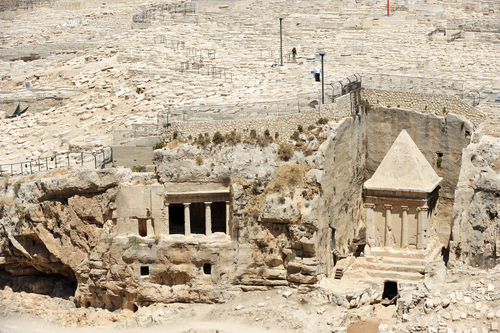
Kidron Valley and the Mount of Olives

This is the second in a two-part blog series inspired by an interview with archaeologist, Dr. Craig Evans. The first article was general in nature, focusing on people in the biblical record who are confirmed by archaeological finds, and noting that modern archaeology continues to affirm the historical reliability of the Bible. In this piece, we focus on the New Testament, which is Dr. Evans’s specialty.

Significantly, when asked whether he is aware of any archaeological finds that contradict the Gospels, Dr. Evans responded, “Where it relates to the Gospels – the Gospels talk certain people, certain places and certain events – and everywhere archaeology has any relevance that touches on it in any way, the archaeology supports what the Gospels say.” Thus, the theme continues: that modern archaeology, far from casting a shadow of doubt on the bible, shines light on it, illuminating the biblical accounts with archaeological discoveries.

Continue reading “Archaeology that Supports the New Testament Record”

Thoughts on Jesus and Miracles

Jesus was known in the 1st Century by his followers and critics alike as a person who performed miracles.

Depositphotos Image ID: 9803991 Copyright: Klanneke

Moderns have issues with miracles, but ancients did not. Many ancient histories reference miracles, and we do not discount them as histories for that fact. The miraculous element of the accounts of Jesus, however, are a basis on which many contemporary thinkers reject the claims of Jesus and claims about Jesus a priori.

Miracles are consistent with and flow from the nature and character of who Jesus claimed to be and who his followers claimed he was. If Jesus was God in the flesh, miracles are to be expected. The apostle John says that Jesus was the Word; he was with God in the beginning; He was God; and all things that were made were made through Jesus, the Word. (John 1:1-3) If the universe was made by and through Jesus, miracles are no big deal, and the resurrection is more than just possible.

This was thrust of the Gospels. The authority of Jesus resonated in his message and was attested by the miracles. Many moderns reject the message largely on the basis of the miracle claims because miracles are not allowed in a naturalistic worldview that dominates academia today. We can’t accurately judge what Jesus said, though, without being willing to suspend that disbelief, even if only to reach some understanding.

Continue reading “Thoughts on Jesus and Miracles”

The Significance of the Resurrection

Flesh gives birth to flesh, but spirit gives birth to spirit.

depositphotos Image ID: 24765707 Copyright: lexmomot

I have written about the central importance of the resurrection of Jesus many times, but I come back to it again. Nothing could be more important. Of this Paul, was crystal clear in his writing.

If Christ has not been raised, then our preaching is in vain and your faith is in vain;

If Christ has not been raised, your faith is futile and you are still in your sins;

If in Christ we have hope in this life only, we are evolved people most to be pitied;

If the dead are not raised, “Let us eat and drink, for tomorrow we die”;

What you sow does not come to life until you die.

These are all statements made by Paul in his first letter to the people in Corinth.[1] These statements underscore and highlight the importance of the resurrection in Christian thought.

Jesus is the center of the Christian faith, and the gospel is at the center of Christianity and the resurrection is at the center of the Gospel. If Jesus was not raised from the dead, everything falls apart. The claims of Christianity are bankrupt because they rise or fall on this one point.

If Jesus was raised from the dead, Jesus is who he said he was and no other event in human history is more significant; no  religion or philosophy lays a claim to hope in the present and the future like words of Jesus. Jesus truly is the “light of men”[2] and the “bread of life”[3].

Continue reading “The Significance of the Resurrection”