
Christmas: The Triumph of the Almighty God Is Not Exactly As We Might Have Imagined It

The hope we reflect on in wonderment at this time of year

The words of the ancient prophet, Isaiah, are spoken often this time of year:

“For to us a child is born, to us a son is given, and the government will be on his shoulders. And he will be called Wonderful Counselor, Mighty God, Everlasting Father, Prince of Peace. Of the greatness of his government and peace there will be no end. He will reign on David’s throne and over his kingdom, establishing and upholding it with justice and righteousness from that time on and forever. The zeal of the Lord Almighty will accomplish this.”

Isaiah 9:6-7 NIV

These words were spoken many centuries before one, Jesus of Nazareth, was born in Bethlehem while his parents were in town for a census. This passage is full of triumph: “Mighty God”, an “Everlasting Father”, and “Prince of Peace”. “The government will be on his shoulders,” and he will “reign on David’s throne” – the “Lord Almighty!”

These words foretell of a mighty, conquering, benevolent God. (Benevolent after the conquering bit, of course). Human beings have always venerated and celebrated strength, and what could be more compelling to us than a conquering king (provided he is benevolent also!)
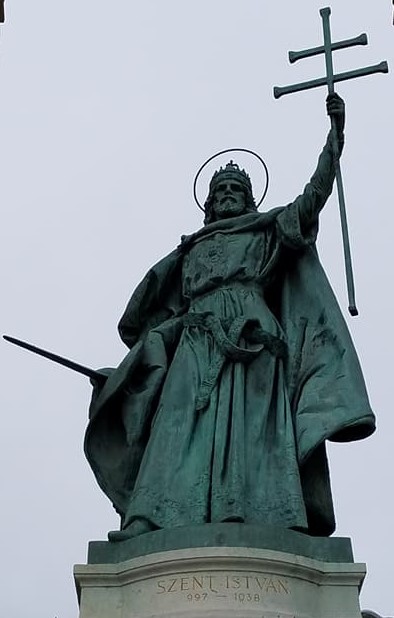
This is the way people view God and the world. This view of God inspired the crusades. It inspired many kings and nobleman through the ages like Stephen I, Szent István király. Born in 975, Stephen took the throne on December 25, 1000, and he became the last “grand prince of the Hungarians”, and he is the first King of Hungary.


I took the photos I have reproduced here when I was visiting my daughter in Hungary this time of year 6 years ago. The prominence of Steven and other kings in Hungarian lore is evident in the statuary around Budapest and in the stately basilica named after him that lies near the Danube in the center of the City.
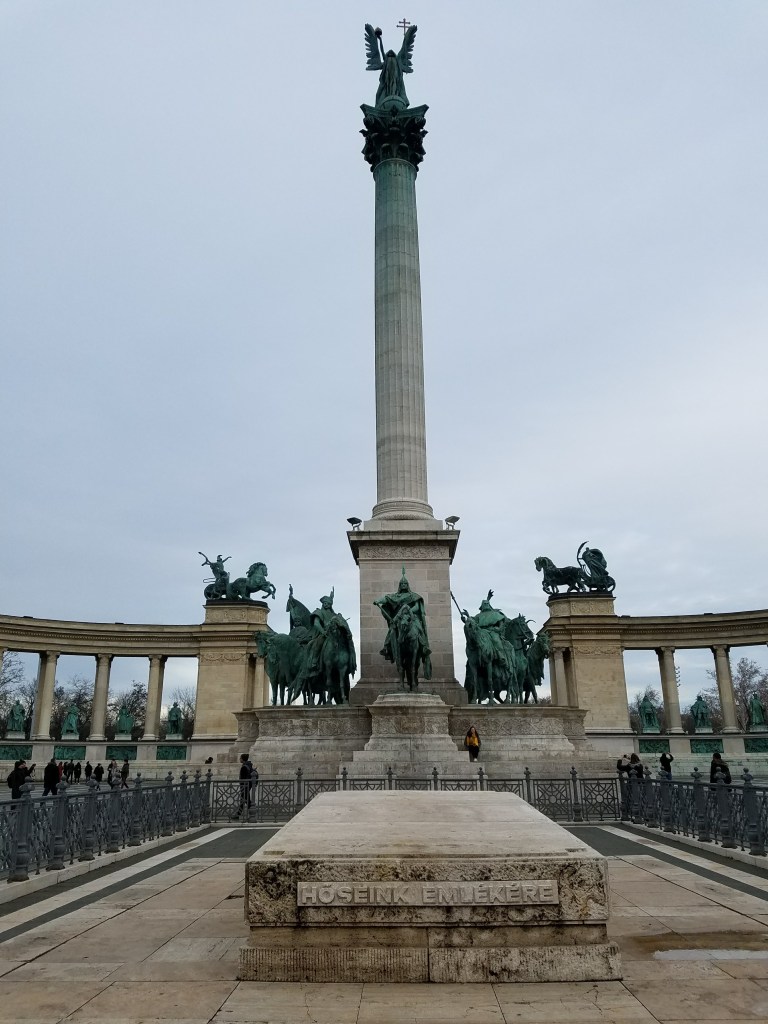

Stephen succeeded his father as a grand prince of the Hungarians, but he had to fight for the throne against his own extended family. He fought many wars against surrounding tribes and chieftains, including his own uncle. He “converted his uncle’s ‘country to the Christian faith by force’ after its conquest,” and he “encouraged” the spread of Christianity “by meting out severe punishments for ignoring Christian customs.” (See Wikipedia)

Many modern minded people with sensibilities trained over the last generation likely squirm (or fume) over stories like Stephen’s, as children are taught in grammar school to recoil at the “imperialism” of our Western/Christian forebears. The so-called “Christian nationalists” among us likely count Stephen a hero of the faith.

Indeed, Hungarians today proudly celebrate Saint Stephen as a national hero, but this celebration seems more focused on nationalistic pride than the spread of Christian faith – if faith can be commandeered by force. Stephen is hailed for unifying the tribal regions around him under his kingship, giving birth to the nation of Hungary.

That the nation was unified under a Christian flag seems to be more of a national identity than a statement of faith. While I was visiting, I observed that Hungarians did not appear, as a whole, to be a people of devout faith.

A 2017 poll reveals that Hungarians, indeed, are not very religious. While about 76% of Hungarians self-identified as “Christian”, only about 8% of Hungarians attended church services on a weekly basis, “placing Hungary among the countries with the lowest church attendance in Europe” (according to my very cursory research using Chat GPT).

While the notion of a king conquering in the name of Christ may be a source of national pride for some, it makes other people feel uneasy. It makes me uneasy.

We celebrate at Christmastime the triumphal prophecies foretold by Isaiah of the Lord Almighty taking the government on his shoulders with zeal and reigning on David’s throne. Yet, this imagery contrasts with the images of the story of the birth of Jesus, born of a humble virgin in a lowly manger because they had no influence to make room for themselves anywhere else.

As this story goes, God incarnate was born in poverty, on the edge of the Roman empire, in the humblest of circumstances, to parents who were not even married. God came into the world as an infant, weak and vulnerable.

God is human form became a refugee when his parents fled to Egypt to avoid King Herod’s decree to kill the male babies in the region of Galilee. They returned after Herod’s death but moved to the more remote and neglected area of Nazareth where Jesus grew up in almost total anonymity apart from the small community of people who knew him.

These realities stand in stark contrast to the conquering and reigning king imagery of Isaiah and the images of kingly might we celebrate in people like Saint Stephen. We consider these paradoxical images this Christmas day, December 25, 2024, as we recall the birth of our Savior and Lord, Jesus, and what it all means for us.

Continue reading “Christmas: The Triumph of the Almighty God Is Not Exactly As We Might Have Imagined It”

Of Shepherds, Angels, the Glory of the Lord, and the Christ Child Born in Humble Estate

At Christmas, we celebrate God coming to us and revealing Himself to us in human form to draw us to Him


“An angel of the Lord appeared to them, and the glory of the Lord shone around them, and they were terrified. But the angel said to them, ‘Do not be afraid. I bring you good news that will cause great joy for all the people. Today in the town of David a Savior has been born to you; he is the Messiah, the Lord.'”

Luke 2:9-11 NIV

This is a classic Christian text remembered at this time of year about the birth of the Christ child. The birth of Jesus in the town of David would have drawn the attention of 1st Century Hebrews who knew their Scripture. The significance of that understanding is preserved for us today by Luke, the traveling companion of Paul the Apostle.

Bethlehem was the birthplace and early home of King David, who is Israel’s most venerated and celebrated king. (1 Samuel 16:1, 1 Samuel 17:12). The prophet, Samuel, who presided over the coronation of David, foretold that God would establish from the lineage of David a kingdom that would last forever. (2 Samuel 7:12-16)

The prophet, Isaiah, lived about three centuries after David. Fourteen kings reigned between David and King Hezekiah, Isaiah’s contemporary. After a span of time longer than the United States of America has been a country, Isaiah repeated and expanded on what Samuel foretold:

“For to us a child is born,
    to us a son is given,
    and the government will be on his shoulders.
And he will be called
    Wonderful Counselor, Mighty God,
    Everlasting Father, Prince of Peace.
Of the greatness of his government and peace
    there will be no end.
He will reign on David’s throne
    and over his kingdom,
establishing and upholding it
    with justice and righteousness
    from that time on and forever.”

Isaiah 9:6-7

The prophet, Micah, a contemporary of Isaiah, He riffed on the same theme:

“But you, Bethlehem Ephrathah,
    though you are small among the clans of Judah,
out of you will come for me
    one who will be ruler over Israel,
whose origins are from of old,
    from ancient times.”

micah 5;2

According to the biblical chronology, these predictions of a coming kingdom and a king “whose origins are from ancient times” were declared 700-1000 years before the birth of Jesus. Those predictions were memorialized in the writings we identify with Samuel, Isaiah, Micah and others, and they were preserved for many centuries before Luke penned his own words tying them to the birth of Jesus of Nazareth, who was born in Bethlehem.

Though it was an ignoble birth by all accounts, we still remember back almost 2000 years now, recalling the prophecies declared from of old. We remember the birth of Jesus, lying in “humble estate” in a manger in the same space where the animals lived.

Hold that thought…. because today, I want to focus on the first half of the verse with which I introduced this article. The passage began with these words:

An angel of the Lord appeared to them, and the glory of the Lord shone around them, and they were terrified….

This may seem like a strange twist to the way I have started this article, but I will bring it back around. I think you will be glad to stick with me as I take seems like a left turn.

Continue reading “Of Shepherds, Angels, the Glory of the Lord, and the Christ Child Born in Humble Estate”

Thoughts on the Great Commission: Our Finite Tendency to Miss What God is Doing in Our Time

What are we missing? What dogmatic understanding have we clung to that is correct in some aspect, but not completely accurate?

Go into all the world and tell the gospel to all creation

‭As I read through the New Testament this year as part of my daily reading plan, I have finished the Gospels, and I am well into the Book of Acts. As I read through the Gospels, I was mindful of the context in location, time period, and the history of the area and the people of Israel, surrounding nations, and the Greco-Roman world leading up to the time that Jesus walked the earth. I have also been mindful of the sweep of this history as it has played out since that time to the present day.

As a believer in the story of God revealing himself to human beings in this history that we continue to live into, I am also mindful that this time was pivotal. God becoming incarnate (taking on human form and fully living into His own creation), is the centerpiece of our story. It ties the story together from the beginning to the end that will play out into the future fulfillment of God’s ultimate plans.

Abraham and his descendants have been the focus of this story from the time that he heard God encouraging him to leave his family and homeland and strike out to a land God would show him, full of the promise descendants as numerous as the sands of the shores of the sea and the stars in the sky. But the story has taken an unexpected turn – unexpected, at least, for those descendants who have been living into this story for millennia by the time of Christ.

But it shouldn’t have been unexpected. That original promise to Abraham included blessing for all the nations of the earth. This was God’s plan from the beginning – from the creation of Adam and Eve and the command to “be fruitful and multiply.”

The covenant God made with Moses with those descendants of Abraham, however, took on a life of its own – at least as far as they perceived it. They were (more or less) faithful to that covenant. At least, they clung to that story despite their failings to be faithful and despite their myopic view of what God was doing.

It was myopic because they lost sight of God’s intention to bless the nations of the earth through them. This blessing was embedded into the original promise to Abraham, and it was always intended to be part of the story. Yet, they had lost that thread.

Thus, when God entered into the story to move it along and begin to work out the thread of His ultimate plan, they didn’t recognize Him. The people God chose through whom He would work out this plan unwittingly resisted it.

Yet, God in His sovereignty was not surprised by this. He used their resistance to move the story forward. Jesus knew this when he read from the Isaiah scroll in his hometown synagogue:

“The Spirit of the Lord is on me,
    because he has anointed me
    to proclaim good news to the poor.
He has sent me to proclaim freedom for the prisoners
    and recovery of sight for the blind,
to set the oppressed free,
to proclaim the year of the Lord’s favor.”

Luke 4:18-19

When Jesus told them, “Today this scripture is fulfilled in your hearing”, they were not ready to receive it, though the fulfillment of it was long-awaited by them. Jesus knew their rejection of him would be the catalyst God would use to unfold the rest of the story:

“Jesus said to them, ‘Surely you will quote this proverb to me: ‘Physician, heal yourself!’ And you will tell me, ‘Do here in your hometown what we have heard that you did in Capernaum.’”

Luke 4:23

Jesus, the fullness of God in human form (Col. 2:9), knew he would die at the insistence of his own people, but this was meant to be.

“And being found in appearance as a man,
    he humbled himself
    by becoming obedient to death—
        even death on a cross!”

Pjilippians 2:8

God worked through this people He chose to prepare for the time He would enter the story, and their rejection of Him would be the turning point.

Continue reading “Thoughts on the Great Commission: Our Finite Tendency to Miss What God is Doing in Our Time”

Justice in Messianic Prophecy

Behold my servant, whom I uphold, my chosen, in whom my soul delights; I have put my Spirit upon him;  he will bring forth justice to the nations.

I have written much over the last two years on the subject of justice in Scripture. I don’t think I have done the subject justice (pun intended), so I continue to find the rights words, the right perspective and seek better understanding of God’s heart for justice as it is revealed in Scripture.

John the Apostle tells us that God is love, and the Psalmist says that justice and righteousness are the foundations of His throne. Certainly God’s love, justice and righteousness are closely intertwined.

When Jesus read from the Isaiah scroll in the temple and said it was fulfilled by him in the presence of the people who heard him, the passage he read was full of images of justice (Luke 4:18-19 (reading from Isaiah 58:6; 61:1-2)):

“The Spirit of the Lord is upon me,
    because he has anointed me
    to proclaim good news to the poor.
He has sent me to proclaim liberty to the captives
    and recovering of sight to the blind,
    to set at liberty those who are oppressed,
to proclaim the year of the Lord’s favor.”

The reading from the Isaiah scroll is a theme to which I return often

We could read this passage to mean that Jesus came to preach to those who are poor (in spirit), to proclaim liberty to the captives (in spirit), recovering of sight to the (spiritually) blind and to set at liberty those who are oppressed (spiritually). I don’t think that is an inaccurate way of interpreting what Jesus said. Jesus often used figurative language for spiritual realities and principals.

It isn’t the only way to read those words, of course. Indeed, throughout the rest of his life, Jesus healed people, gave sight to the blind, opened the ears of the deaf, set free those who were oppressed, raised people from the dead and met the physical needs of people as he traveled around preaching the good news.

Thus, I believe Jesus meant those words to have dual meanings. He was concerned about the spiritual condition of people. We might even say he was primarily concerned with spiritual well-being, but he met people at the point of their physical circumstances and conditions.

Listen to the testimonies of people, and you will find the spiritual and the physical are intertwined. Jesus still meets people at the point of their circumstances and physical, emotional and spiritual needs.

The physical needs and difficult circumstances (perhaps) a metaphor for the more critical and ultimately more important spiritual infirmity, but they are a reality that elevates and underscores the need for more holistic resolution. Without the difficulties in our lives, we might never perceive the need for that resolution

Many are the people who only want the physical healing and not spiritual healing. At the same time, the physical infirmities of a person can be so overwhelming and demanding that a person can hardly recognize the spiritual need.

Regardless of the interrelationship, Jesus addressed both the physical needs and spiritual needs of people. Justice and righteousness are God’s foundation. They are front in center in the Messianic message that foretold the coming of Jesus:

“Behold my servant, whom I uphold, my chosen, in whom my soul delights; I have put my Spirit upon him;  he will bring forth justice to the nations. He will not cry aloud or lift up his voice, or make it heard in the street; a bruised reed he will not break, and a faintly burning wick he will not quench; he will faithfully bring forth justice. He will not grow faint or be discouraged till he has established justice in the earth; and the coastlands wait for his law.”

Isaiah 42:1‭-‬4 ESV

Jesus is the fulfillment of the promise God made to Abraham. God’s promise to Abraham was a promise to all the nations (Gen. 12:2-3):

“I will make you into a great nation,
    and I will bless you;
I will make your name great,
    and you will be a blessing.
I will bless those who bless you,
    and whoever curses you I will curse;
and all peoples on earth
    will be blessed through you.”

Embedded in Isaiah’s Messianic prophecy was this promise to Abraham: “he will bring forth justice to the nations…. he will faithfully bring forth justice. He will not grow faint or be discouraged till he has established justice in the earth; and the coastlands wait for his law”.

Justice is a theme that runs through the prophets and is directly and intimately connected to Messianic prophecy. We see the Messianic character of justice in Jeremiah also:

“In those days and at that time I will cause a righteous Branch to spring up for David, and he shall execute justice and righteousness in the land. In those days Judah will be saved, and Jerusalem will dwell securely. And this is the name by which it will be called: ‘The Lord is our righteousness.’

Jeremiah 33:15-16 ESV

Jesus, of course, has become our righteousness, as the prophet foretold. He also executes justice. Justice, in the biblical sense, is not simply punishment or retribution. Justice is redemptive. It goes hand in hand with righteousness. As followers of Jesus, we are called to participate in righteousness and justice as components of the Messianic purpose of God.

Carried Off to Babylon

We are half-hearted creatures, fooling about with drink and sex and ambition when infinite joy is offered us.

Panorama of partially restored Babylon ruins and Former Saddam Hussein Palace, Babylon, Hillah, Iraq

“Behold, the days are coming, when all that is in your house, and that which your fathers have stored up till this day, shall be carried to Babylon. Nothing shall be left, says the Lord.” (Isaiah 39:6 ESV)

This is a follow up blog piece to Here Today Gone Tomorrow. The story of King Hezekiah, and Isaiah Chapter 39, is, illustrative of our tendency to hold on to things in this world and in this life contrary to what God intends for us. Jesus speaks to God’s intention when he urges us to lay up our treasures in heaven, and not to focus on accumulating treasures on earth.

Hezekiah was a pretty good king as kings of Judah go. Many of those kings turned away from God to idol worship and other behaviors influenced by the pagan culture of the nations around them. These were the people who were never completely driven out of the Promised Land as God instructed. The people and their kings became corrupted by those influences and succumbed to them.

The descendants of Abraham, Isaac and Jacob split into two camps early on after the people rejected the rule of judges and wanted kings like the nations around them.  They split into the nation of Israel and the nation of Judah.

By the time King Hezekiah came around, the nation of Israel had been overrun, captured, and exiled to Babylon. During Hezekiah’s reign the people were hanging on by a thread, with the threat of Babylonian exile dangling like the sword of Damocles over the remnant, Judah, that remained in Jerusalem.

In Hezekiah’s fourteenth year as king, Sennacherib, the king of Assyria, attacked all the fortified cities of Judah and captured them, but for Jerusalem. King Hezekiah responded to this threat by turning to God. He prayed, and, as the story goes, 185,000 troops of the Assyrian king died in the camp overnight, sparing the City of Jerusalem from certain doom. (Isaiah 37)

Hezekiah turned to God when circumstances were dire and his death was imminent. Like most of us, though, the King was short-sighted. He focused on the immediate, protecting himself for the remainder of his short life.

Continue reading “Carried Off to Babylon”