Decompressing from Politics, Storming the Capitol Building, and the Church in America

Does anyone think the “QAnon shaman” is really representative of Christians?

Crowd of Trump supporters marching on the US Capitol on 6 January 2021. Creative Commons License

I think many Americans have been trying to decompress from the events that took place on January 6th. The long, tense build up to the electoral college vote count, the persistent claims of fraud and a stolen election, the rally and then the sudden alarm of people storming the Capitol Building are being replayed now in the impeachment hearing.

Legal retribution is grinding forward. The Biden/Harris duo were confirmed, took over the White House and issued a flurry of executive orders, but we can’t put the genie back in the bottle. The ripple effect of the events that preceded the inauguration seethe and heave under the surface.

A majority of Americans condemn the outburst of misplaced patriotism that spilled into the Capitol Building and onto the congressional chamber floor. Most were horrified by it. It looks even worse in retrospect.

I recently heard someone emphasize that Trump lost by 7M votes. That seems like a hefty number, but consider that almost 75M people voted for him. Almost half the country voted for Donald Trump.

How do we move forward? How does the church move forward? (Divided as it, not much unlike the unchurched)

Our human penchant for sweeping generalization in times like these misses the nuance and complexity that fill out the truth. I think about these things as I listen to an interview of Sarah Posner on the podcast, Sacred & Profane, titled Render Unto Q.

Posner wrote the book, Unholy, WHY WHITE EVANGELICALS WORSHIP AT THE ALTAR OF DONALD TRUMP. She speaks in the interview about the New Right, Moral Majority and New Apostolic Reformation as precursors from the 1970’s and 80’s to what she calls “worship at the altar of Donald Trump” today.

I was involved in the New Apostolic Reformation during that time period, though we didn’t have a label for it. I remember the influence of politically minded religious leaders and religiously minded political leaders during those times.

I am now an outsider to the New Apostolic movement, but I was once an insider. I have friends who are still actively involved in current iterations. As I listen to the interview, many of the things Posner says ring true, but I can bring a little nuance into the dialogue from my own experience.

Sarah Posner has studied these things closely, and is somewhat a subject matter expert on the involvement of evangelicals in politics. She has a far more nuanced understanding than most people, so her comments bear some consideration. I will summarize some of Posner’s observations and add my own, especially where I can add some clarity from my own experience.

Part of the problem with critiques of what happened on January 6th is trying to understand the strange mixture of forces that came together in the storming of the Capitol. They have long been stewing together in a weird kettle of different fish.

As with any stew, the individual ingredients take on a singular flavor, given time, and this stew has been marinating for quite a while. To the extent the church is close enough to this stew to take on its flavor is concerning.

Continue reading “Decompressing from Politics, Storming the Capitol Building, and the Church in America”

Thoughts on the Sanctity of Human Life, Injustice and Unity in the Church in the United States

God’s desire is to save us, to have relationship with us, to renew our minds and to conform us to His image.

Reading in Exodus today, I observe that two passages in the first two chapters have poignant application to the Body of Christ in the United States today. I see two predominant lines of injustice in the United States to which the Church collectively has given its attention that are identified in these first two chapters of Exodus.

At the same time, the Church is divided on justice issues. I don’t say this to condemn or to be judgmental. It’s simply a fact that I think we need to recognize soberly, honestly and humbly.

We might find many examples, but the one that comes to mind – the one that is, perhaps, most poignant in this given time – is the division between black and white and the division between supporters and and non-supporters of Donald Trump.

I know: I said one example, and it seems I given two here. These are two examples, but they coalesce into one. The proof for that is in the statistics that show that approximately 80% of white evangelicals support Trump, and approximately 80% of black “evangelicals”[i] do not support Trump.

Now, I recognize that these statistics are sweeping generalizations, but generalizations do tell a story. There is some reflection of truth in them. I also don’t mention Trump to be divisive here. The example simply is provided for illustration.

Churchgoing African Americans can be as theologically conservative on things like what it means to be born again as white evangelicals, but their individual and collective experiences give them a different perspective on life. Their view of the world and injustice is different than their white, evangelical counterparts, for the most part, and influences them to have different political affiliations.

My reading in Exodus (which I will get to) is timely because today is Sanctity of Life Sunday. I didn’t even realize it when I did my daily reading after I woke up this morning.

I didn’t realize it until I tuned into the Manchester (NH) Vineyard Community Church service this morning. I have never tuned into their services, until today, though I know people affiliated with them. When I set out to participate in a more local church service, I believe God drew my attention away to this one.

It was a great message, and I gained some perspective from it that, perhaps, God wanted me to have in writing this. With that introduction, let me explain the passages in Exodus that prompt my writing. Those texts include Exodus 1 (about the killing of babies) and Exodus 2 (about slavery).   

I will take these things one at a time and draw some conclusions consistent with the burden God has placed on my heart over the years. In another article, perhaps, I will explain how my perspectives have changed and, hopefully, shed some light on how the church can come together in the full council of God to advance His justice and righteousness.

Before I get into my immediate thoughts, though, I need to say that I speak with no condemnation in my heart

Just as Jesus said to the woman caught in adultery that he did not condemn her, I am reminded that God sent his son into the world not to condemn the world; God sent His son into the world so that the world might be saved through him. (John 3:17)

I do not say these things to condemn anyone because Jesus has redeemed us!


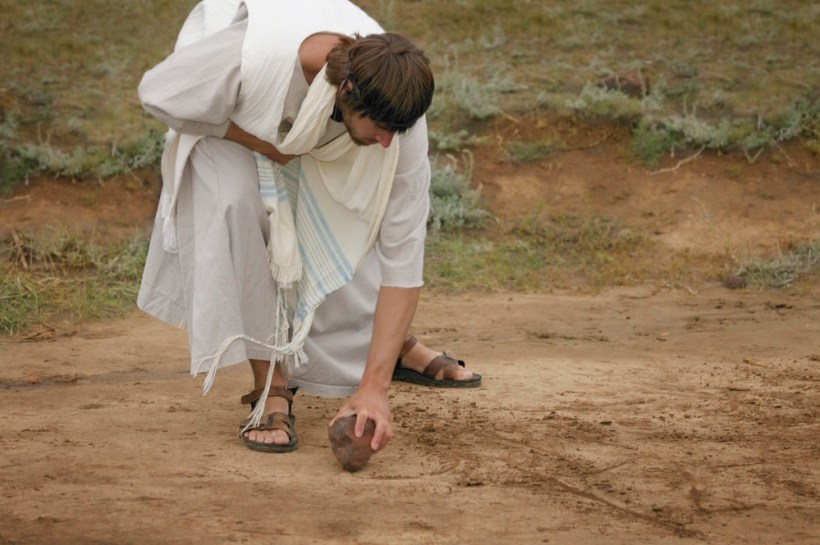
In the story of the woman caught in adultery, the Pharisees and Sadducees brought her to Jesus to challenge him because the Law required her to be stoned. They wanted to see what Jesus would do, but Jesus seemed to ignore them and began writing in the sand.

Some people believe that Jesus may have written the Ten Commandments out in the sand. When he looked up from from writing, Jesus “invited” them, saying, “He who is without sin may cast the first stone.” Then, he continued writing in the sand.

Some people believe he was writing down the sins those men had committed. They would say the men walked away silently because they realized that no one is without sin.


The wages of sin for every person is death.

Whatever he wrote, we know how the dialogue went next. “Jesus stood up and said to [the woman], ‘[W]here are they? Has no one condemned you?,” John 8:9) When she replied, “No one”, Jesus said, “Neither do I condemn you.” (John 8:10)

Jesus didn’t condemn the men either, because he told us he came not to condemn, but to save. I imagine that, Jesus would have received, forgiven and invited the men to follow him, if they had stayed and repented.

God desires to save us, to have relationship with us, to renew our minds and to conform us to His image. Our sin is the reason God became flesh and died for us. He came not to condemn, but to demonstrate His great love for us and to save us from the sin that enslaves us.

One last thing before I get into what I believe God has put on my heart to share: salvation and sanctification is a process. It starts where we are. When we are born again, God begins to work in us to will and to act according to His purposes and to conform us to His image, but we start that process in different places.

One point made in the sermon today, is that “a person doesn’t have to be pro-life to be saved”. People are saved by grace; it’s a gift that we haven’t earned. There will be no exam in heaven we must answer satisfactorily for salvation. It’s already been accomplished for us by Christ’s death and resurrection.

At the same time, if we are born again, God has begun a work within us. He has begun to renew our minds, and change our hearts, and we have begun to learn to think God’s thoughts after Him and become like Him.

With that said, I will address the two texts I read today in Exodus 1 and 2 that speak to me about the Church, collectively, in the United States. In writing this article, my hope is to provide some biblical basis on which we might begin to bridge the divide along racial and political lines and come together as the body of Christ. I hope to provide some perspective and understanding that will bring us together in Christ.

Continue reading “Thoughts on the Sanctity of Human Life, Injustice and Unity in the Church in the United States”

God Will Not Be Mocked; His Purpose Will Be Accomplished Among Us

I have no doubt God is accomplishing His purpose, but what role we play may surprise us

21 February 2016: Republican Presidential candidate Donald Trump speaks to several thousand supporters at a rally in Atlanta, Georgia.

The Washington Examiner reported that Republican senator, Ben Sasse, said in a “campaign telephone town hall call that went to about 17,000 Nebraskans”, among other things, that President Donald Trump trash-talks evangelicals behind their backs”. After briefly citing some points of agreement with Trump, Sasse “began to unload” on the President.

Sasse identified a litany of issues he has with Trump – careening “from curb to curb” on COVID (first ignoring it, then going “into full economic shutdown mode”), selling out allies, “the way he treats women”, spending “like a drunken sailor” and flirting with white supremacists – but the issue I want to focus on is the charge that Trump “mocks evangelicals behind closed doors”.

Sasse commented, “I think the overwhelming reason that President Trump won in 2016 was simply because Hillary Clinton was literally the most unpopular candidate in the history of polling.” It’s true, and most evangelicals I know said they were voting “only” for Trump as “the lesser of two evils”. They couldn’t stomach another Clinton presidency, perpetuating that inbred political machine in Washington that is openly hostile to concerns of evangelicals.

So, where along the timeline did Donald Trump become our champion? When did he stop being an evil? (Albeit an “lesser” one)

A little googling reveals (for those who’s memory is short) that “long before” Donald Trump ran for President of the United States, he was a Democrat. Donald was registered as a Democrat from 2001-2009. Have we forgotten the criticism leveled against The Donald by Jeb Bush? “He was a Democrat longer than he was a Republican. He’s given more money to Democrats [including Hillary Clinton] than he has to Republicans.”

To be completely accurate, Donald Trump changed his party affiliation at least five times since 1987, when he registered as a Republican. He changed to Independent in 1999, to Democrat in 2001, to Republican in 2009, to Independent in 2011, to Republican again in 2012. (See Political positions of Donald Trump at Wikipedia) But should that give Republicans comfort?

On the issue that has been historically most influential on the Evangelical vote, abortion, Donald Trump has been described as shifting “from pro-choice to pro-life only as he planned a presidential run”. Robb Ryerse, a pastor at Vintage Fellowship in Fayetteville, AR, said earlier this year, “I personally believe that the President is cynically using pro-life voters for his own electoral purposes and doesn’t actually care about protecting innocent life at all.”

The LA Times was less skeptical in its description of Trump’s turnabout recently, calling him “a late convert” to the pro-life cause. Noting Trump’s position in 1999 (“pro-choice in every respect”), Trump told the March For Life crowd in Washington this year that “every life is worth protecting”.

The Times added: “Trump is counting on the support of his base of conservative activists to help bring him across the finish line.” While I don’t share the Times’ anti-pro-life stance, that’s what concerns me – that Trump is saying simply what a large block of his constituents want to hear. (To be fair, my skepticism runs deep with all politicians, especially when they are in campaign mode.)

After all, politicians seem to think that moderates are not tolerated by voters anymore. Both political parties have “taken harder-line positions for and against abortion rights”. Trump had to choose sides. As former White House Press Secretary, Ari Fleischer, said recently, “There used to be a middle”, but now candidates must choose sides in an increasingly polarizing political environment.

Digging deeper, Trump’s political views have shifted from moderate populist (2003) to liberal-leaning populist to moderate populist (2003-2011) to moderate populist conservative (2011-12), to Libertarian leaning conservative (2012-15) to “hard-core conservative” just before the 2016 election. Interestingly, he back-stepped to Libertarian-leaning conservative, then moderate conservative after the election, but he may (again) be described as “hard-core conservative” … now that he campaigns for re-election. (See Political positions of Donald Trump ibid.)

I can’t help noticing that his hard-core conservativism seems to be timed with election campaigning, and that’s one of the things that troubles me about him. So, I began wondering today: what are his long-standing convictions? From my reading, I would say populism, authoritarianism, and nationalism, so let’s take a closer look at those threads of Donald Trump’s political life.

Continue reading “God Will Not Be Mocked; His Purpose Will Be Accomplished Among Us”

Who Were the Sons of Issachar? And What Might They Mean for Us Today?


A friend of mine referred to the “sons of Issachar… who understood the times” recently when speaking of the evangelical support for Donald Trump.  The reference comes from 1 Chronicles 12:32 where the “sons of Issachar” (descendants of the 9th son of Jacob) were described as men “who understood the times and knew what Israel should do”.

As I drifted near consciousness in my sleep last night, the phrase came back to me and ran through my head. I roused myself from a semi-conscious state and gave myself a reminder to look up the reference.

I followed up the next day. What does it mean? What does it mean for me? What does it mean in these times?

These were men who apparently understood the changing times in some unique way in a particular point in the history of Israel. The historical context was during the reign of King Saul when he became jealous of David and sought to kill him. David fled into the wilderness, taking with him other men who were loyal to him. As the various tribes learned of David’s plight and flight, they began to join David, including the sons of Issachar.  

Whether they were in tune with God’s purposes or simply saw that Saul was loosing stature in their society, while David was gaining in influence, we don’t know. My friend assumed the former meaning.

God was in the process of rejecting Saul and announced (at least to David) that He was making David king. Saul pursued David to kill him. Instead of confronting Saul, the man God chose as King of Israel, David went into hiding. David could have rallied the men who joined him to form a coup and dethrone Saul, but he would not do that.

The initial surge of supporters who joined David included warriors from the tribe of Benjamin, Saul’s own relatives. (1 Ch. 12:2) Members of the tribe of Manasseh joined David even though their desertion of Saul could cost them their heads. (1 Ch. 12:19) Day after day, men came to David’s aid at a place called Ziklag. (1 Ch. 12:20-22)

If the sons of Issachar knew the times, one might assume that they were among the first to join David, but that assumption would be wrong. They were not the first. They weren’t even in the first wave. The 200 sons of Issachar joined David at Hebron, after many others already joined David.

God had rejected Saul as king, and it was only a matter of time for Saul’s demise. God was making a change, and David was the one God chose to replace Saul. We know today that David was also the man through whom God planned, eventually, to raise up the Messiah – the root of Jesse’s seed – Jesus. (Jesse was the father of David, and Jesus is from the line of David and Jesse.)

Saul’s reign had run its course. Saul was out of touch with God. His head had gotten too big. Pride had taken over, and he no longer bowed to God in his heart. He was losing his grip on reality and the kingdom God had given him.

We know the rest of the story, but the men who joined David surely didn’t. Maybe they just believed it was time for a change. How much they knew of or perceived of God’s role in this story is just conjecture. I think we might take for granted that they did, but we have the benefit of hindsight memorialized in Scripture. They lived it in real time. 

As I read the story when I woke up in the morning, the number of the sons of Issachar who joined David struck me: 200 “chiefs” from the tribe of Issachar and all their kinsmen at their command. And, then I noticed something else.

Men from all twelve tribes of Israel joined David at Hebron, but only 200 “chiefs” from the tribe of Issachar were among them. Only 200 sons of Issachar actually joined David (though, perhaps, they represented all their kinsmen who were at their command). 

The number of men identified from the other tribes were far greater in number, including 120,0000 men from Reuben, Gad and the half-tribe of Manasseh; 50,000 men from Zebulun; 40,000 from Asher; 1000 “captains” and 37,000 men “with shield and spear” from Naphtali; and 28,600 from Dan.

So, what’s the big deal about only 200 men from Issachar? Why does Scripture say of them (and not of anyone else) that they were men who understood the times and knew what Israel should do?

One answer that occurs to me is that the rest of the “sons of Issachar” were not men who understood the times and did not know what Israel should do. Maybe only the chiefs of that tribe understood the times. In contrast, 1000 captains were accompanied by 37,000 warriors from the tribe of Naphtali! It seems none of the warriors of Issachar were willing to join the 200 chiefs of Issachar.

Were the 200 chiefs of the sons of Issachar the only people from all the tribes who understood the times? It seems not. In 1 Chronicles 12:32, it states, “And of the children of Issachar, which were men that had understanding of the times, to know what Israel ought to do; the heads of them were two hundred; and all their brethren were at their commandment.”

Of all the tribes of Israel, the men of the tribe of Issachar who came to David’s rescue were the least in number. Only the leaders were mentioned (who understood the times). Does that mean that they were least in tune with God’s plan and purposes? I don’t know. (I should acknowledge that God often works through the least, the smallest, the most unlikely.)

The backstory to all of this is that Saul was chosen (by God) as king, but God only chose a king for the people because they wanted “a king like the other nations”. In demanding a king, the people were actually rejecting God. They were putting their trust in a king, rather than trusting God to be all they needed. (1 Samuel 8:6-9)

So how does all this inform me and other Christians today?

Continue reading “Who Were the Sons of Issachar? And What Might They Mean for Us Today?”

Evangelicalism and Injustice Part II

We must recognize injustice and speak to it if we are going to represent God, the Father, accurately to the world. 


In Evangelicalism and Injustice Part I, I discussed how the evangelical world has been a champion of preaching the Gospel, but we have not been champions of doing justice. In fact, we have shied away from it.

Less Gospel-orientated people, religious and otherwise, have rushed in to fill the void we have left, including people with philosophies and worldviews that are hostile and antithetical to the Gospel. I will address those things in a follow up post.

Meanwhile, the burden that weighs on my heart in these days is that our God is a God of righteousness and justice at the very foundation of His throne. (Psalm 89:14) This should be our foundation too as children of God our Father.

Jesus carried that great pillar of God’s character forward in the parable of the sheep and the goats, instructing his followers that those who will be blessed by God and receive their inheritance at the throne of God (calling Psalm 89 to mind) are the people who feed the hungry, give drink to the thirsty, invite the stranger in, clothe those in need, heal the sick and visit prisoners.

Jesus announced his ministry by reading from the Isaiah scroll. He said that God anointed him to preach the gospel to the poor, to proclaim release to the captives, and recovery of sight to the blind, and to set free those who are oppressed. (Luke 4:18-19, quoting from Isaiah 61:1)

The good news (the Gospel), in this way, is holistic. Jesus demonstrated that holistic approach of preaching good news and doing justice in his ministry. If we are to be his followers, we should do what Jesus did as he did what he saw the Father doing. (John 5:19)

When Jesus quoted from Isaiah, the prophet, he was calling to mind the great theme of all the prophets, which is the call of God to His people to do justice. Zechariah, for instance, says,

“This is what the Lord Almighty said: ‘Administer true justice; show mercy and compassion to one another.'” (Zech 7:9)

And he adds what true justice looks like:

“‘Do not oppress the widow or the fatherless, the foreigner or the poor. Do not plot evil against each other.'” (Zech 7:10)

James picks up the same theme in the New Testament.

“Religion that God our Father accepts as pure and faultless is this: to look after orphans and widows in their distress and to keep oneself from being polluted by the world.” (James 1:27)

James emphasizes the need for doing, not simply giving mental ascent to what Jesus says. The example he provides falls into the Old Testament definition of “doing justice”:

“Suppose a brother or a sister is without clothes and daily food. If one of you says to them, ‘Go in peace; keep warm and well fed,’ but does nothing about their physical needs, what good is it? In the same way, faith by itself, if it is not accompanied by action, is dead.” (James 2:15-17)

Evangelicalism has been very good at preaching and proclaiming.  Many evangelical organizations exist, like Administer Justice (which I mentioned in the first blog article), that both proclaim the good news and do justice (meet the needs of the poor, the oppressed, the prisoners, widows, orphans and strangers), but evangelicalism, as a whole, falls a bit short on the justice side of the equation. Let’s be honest.

Continue reading “Evangelicalism and Injustice Part II”