Keeping the Main Thing the Main Thing

How do we faithfully follow Jesus in a divided world?


My daily Bible reading plan this morning began with this simple question:

How do you faithfully follow Jesus in a divided world?

(See the YouVersion plan called Fighting for Unity in a Divided World)

Judging by my social media feed, this question is poignantly apropos. It’s not just “people in the world” I see at odds with each other. I see many people posting memes under the banner of Christ, getting their lobbing verbal grenade’s at “the people in the world” and fellow Christians, alike.

I confess I have difficulty not being blunt, and for that I ask for your grace when I say that the spectacle saddens me. Humans have always lived in a world dominated by rising and falling empires, but Jesus came preaching a kingdom not of this world. Almost 2000 years after Jesus died and rose again to emphasize the Good News he proclaimed, we still fly our empire banners alongside Christ.

It wasn’t always like that, though. For almost three centuries after Jesus died on the cross at the hands of the Roman Empire, his followers proclaimed the Gospel without any influence or power in the world. His followers were mocked, derided, and marginalized, and they suffered cycles of persecution culminating in the Great Persecution.

Beginning in 303, Emperor Diocletian, who established a tetrarchy with Maximian, Galerius, and Constantius (the father of Constantine), issued a series of edicts demanding that Christians comply with traditional (pagan) religious practices. (See Wikipedia) Diocletian presaged the Great Persecution when he took power in 284, purging the army of Christians and surrounding himself with public opponents to Christianity. He led an “activist government” and promoted himself as “restorer of past Roman glory”. (Ibid.) (Making Rome great again?)

Diocletian finally ordered “a general persecution” on February 23, 303. The reign of persecution was short-lived (unless you endured it, I suppose). Constantius, the father of Constantine, restored legal equality for Christians in Gaul in 306, and Maxentius usurped Maximian’s control in Italy and North Africa in the same year with a promise of religious toleration. When Licinius ousted Maximinius in 313, the persecution was formally ended.

The political ebbs and tides of the time (with implications for the church) are reminiscent of our political shifts from right to left to right in recent years. Perhaps, little has changed in that way, yet the change that followed in 313 was unprecedented, and this change set the course of the Church on a path it had never before traversed.

Eusebius, the Christian historian, wrote as a contemporary of Constantine with glowing approval of the events that changed the course of Christianity forever. Eusebius is the person who preserved the details of Constantine’s personal story of conversion to Christianity.

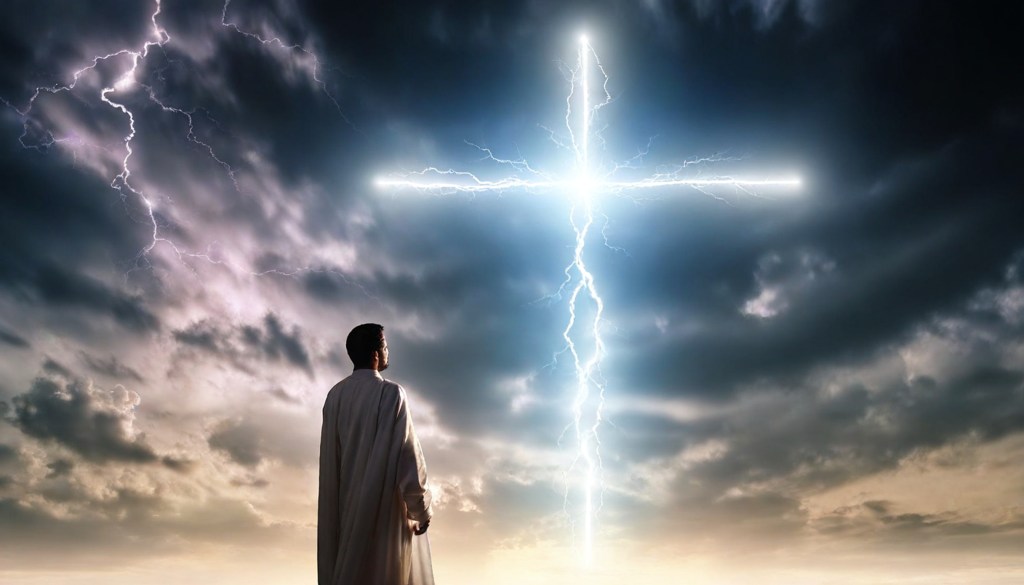
As the story was told by Constantine, he had a vision in 312 shortly before an imminent battle with a challenger to the throne of the Roman Empire, Maxentius, whose army outnumbered Constantine’s. Constantine saw in the sky a giant cross with the inscription, “In this sign conquer!” The vision was followed by a dream that evening in which Jesus purportedly came to him and told him to conquer in his name. Thereafter, Constantine established the cross as the standard for his army and the banner under which the Roman armies marched to battle and conquered in the name of Christ, the lamb of God who died that we might live.

The words of John Dickson have been echoing in my mind since I listened to Episode No. 21 of his Undeceptions podcast.

In the podcast (titled Post Christian) featuring the Australian journalist, Greg Sheridan. John Dickson commented on the approval by Eusebius of Constantine’s use of the cross as a symbol of conquering on behalf of the Roman Empire this way:

“A people used to mockery and social exclusion – and worse – were now invited into the very center of power. And perhaps most bizarrely, the Christian sign of humble self-sacrifice – a cross – was now the formal path – the very symbol – of the Roman war machine. It is so hard to get my head around when I consider what Jesus said about the cross – his cross – and its social implications.”

Juxtaposed to the image of Roman armies conquering under the sign of the cross in the name of Jesus, Dickson recalled the story of James and John, the sons of Zebedee, who asked Jesus asking to seat them on the right and the left of Jesus when Jesus rose to power. These brothers, like many First Century Jews, expected a conquering Messiah. They interpreted the prophets to predict a Jewish Messiah “who would lift Israel above Rome and crush the enemies of God.”

Jesus gave them a response they didn’t expect and likely didn’t understand at the time:

“You don’t know what you are asking,” Jesus said. “Can you drink the cup I drink or be baptized with the baptism I am baptized with?”

Mark 10:38

The other disciples became indignant with James and John thinking, perhaps, they they deserved glory and recognition also. They, like many before and after them, may have viewed religion as a path to power and influence, and they may have been annoyed at the audacity of James and John out of jealousy. At this, Jesus brought them together and set them straight.

“You know that those who are regarded as rulers of the Gentiles lord it over them, and their high officials exercise authority over them. Not so with you. Instead, whoever wants to become great among you must be your servant, and whoever wants to be first must be slave of all. For even the Son of Man did not come to be served, but to serve, and to give his life as a ransom for many.”

Mark 10:41-45
Continue reading “Keeping the Main Thing the Main Thing”

Divine Christmas Gifts

As another Christmas begins to fade in the rear view mirror, let us reflect on the One who we celebrate this time of year and pray that His light grows ever stronger as we fix our gaze on Him. These words from a writer I follow are apt today:

“I hope everyone was pleased with the gifts they may have received during their Christmas celebrations. As grandparents, my wife and I delighted in the presence of our children and grandchildren as we celebrated together Jesus’ Nativity. Which raises the subject of the proverbial ‘reason for the season.’ My hope is that Mere Inkling’s friends […]

Divine Christmas Gifts

Rising Up To Honor Christ Who Saves!

“[I]n your hearts honor Christ as holy….”

Most Christians, especially those who like apologetics, are familiar with the exhortation in 1 Peter 3:1 to “[be] prepared to make a defense to anyone who asks you for a reason for the hope that is in you….” I read this verse today, but the beginning of verse stood out for me today:

“[I]n your hearts honor Christ as holy….” (ESV)

Perhaps, this phrase stood out to me today because of my recent experience at a gathering on a bright, sunny and warm day. We were outside with neighbors, enjoying the turn of good weather, and I was very relaxed.

It was Easter. I had gone to church, but the poignance of the morning service had washed out in the sunlight and warm breeze of a lazy day. I wanted to hold onto and appreciate the significance of the day, but the pleasure of spring after a long, hard winter absorbed my attention.

I am reminded as I read 1 Peter 3:15 today that holiness means being set apart. A more literal reading of the Greek phrase might be as follows:

“Sanctify Christ in your hearts as Lord….”

The Greek word translated variously in different translations as honor, sanctify, reverse, worship, set apart, consecrate, dedicate, is ἁγιάζω (hagiazó). It means “to make holy, consecrate, sanctify”. It comes from the adjective, hágios, which means holy. It is a verb that means to make holy, consecrate, sanctify or to dedicate separate.

Thus, Christ is not simply holy. He is holy, of course, but we have to make Him holy in our hearts. We must actively participate in honoring, revering, consecrating, sanctifying and making Christ holy in our hearts. This is not a passive stance; we are called to be active participants in the process of making Christ holy and set apart in our hearts.

I was troubled in my heart the evening of our lazy Easter day. I went to bed troubled. I woke up troubled. I am still troubled.

This verse focuses the light of God’s word on my troubled heart: I was not actively participating in the holiness of Christ in my heart. I was a passive vessel after church the rest of that Easter day. I was passive, not active, in my heart to honor and revere Christ as Lord the rest of that day.

I am not beating myself up for this. Christ is my salvation. He alone is my hope. His gift of salvation is freely offered to me. It’s nothing I can add to, nothing I must strive to hold onto, and nothing in which I can boast.

Yet, my heart is troubled when I fall short of honoring Christ for what He has done for me.

I am not troubled for having enjoyed the day. All good things come from God. The warmth of spring after the cold of winter is a reminder of God’s love for us. We do well to enjoy the blessings of God.

We shouldn’t enjoy the blessings of God, however, as we are often tempted to do, in place of God from whom all blessings come. It’s easy, especially in the good times, to embrace the blessings while relaxing our embrace of God from whom those blessings come.

I believe I have been troubled because I failed in my heart to honor Christ well during the rest of the day after the morning church service in the way that I wanted to – in the way my heart desired to honor Christ, who died for my sins.

As I write this, I realize the danger of being the Pharisee here. I could beat myself up. I could do penance and scrub the outside of this tomb I call my body. I could polish it up so that my appearance to all who see me is whitewashed, but I would do nothing in the effort to drive out the darkness in me that would rather settle into the comfort of a lazy day than keep Christ sanctified in my heart.

Or, I could simply recognize that I need Christ all the more for having succumbed to the laziness that resides still within me. Christ is the Author and Perfector of my faith. Not I. So, I submit in writing this to Him who saves me to work in me to will and to act according to His good purpose.

The spirit in me aligns with God’s Holy Spirit to cry, Abba! Father! Save me from this heart of sin! Save me from the sin into which I so easily settle.

Stir my heart within me to rise up and honor Christ who saves me!

What We Can Learn from Expectations about What God Is Doing


“Now there was a man in Jerusalem, whose name was Simeon, and this man was righteous and devout, waiting for the consolation of Israel, and the Holy Spirit was upon him. And it had been revealed to him by the Holy Spirit that he would not see death before he had seen the Lord’s Christ[i]. And he came in the Spirit into the temple, and when the parents brought in the child Jesus, to do for him according to the custom of the Law, he took him up in his arms and blessed God and said,

“Lord, now you are letting your servant depart in peace,
    according to your word;
for my eyes have seen your salvation
    that you have prepared in the presence of all peoples,
a light for revelation to the Gentiles,
    and for glory to your people Israel.”

(Luke 2:25-32)

“Belief in the eventual coming of the mashiach [Messiah] is a basic and fundamental part of traditional Judaism”; though [m]odern scholars suggest that the messianic concept was introduced later in the history of Judaism, during the age of the prophets. The messianic concept is not explicitly mentioned anywhere in the Torah (the first five books of the Bible)”[ii], but an expectation of the coming of an Anointed One, Messiah (Christ in Greek) developed in the writings of the Prophets, and it reached the height of expectation shortly before the time of Jesus.

“The term ‘mashiach’ literally means ‘the anointed one,’ and refers to the ancient practice of anointing kings with oil when they took the throne. The mashiach is the one who will be anointed as king in the End of Days.”[iii] This is the belief of traditional Judaism, going back, at least, to the Prophets, with expectations building up to the time of Jesus.

This is where Judaism, as it continues to be practiced today, and Christianity diverge. The Jews had very specific ideas of what the Mashiach would do when he appeared, and Jesus didn’t fit their expectations.[iv] They did not expect the Messiah to be God who became man to sacrifice Himself to save the world from sin. Though Jews today still expect the coming of a messiah, they don’t even use the term, “messiah”, anymore because Christians have associated it with Jesus.

They believed the Mashiach would be “well-versed in Jewish law, and observant of its commandments (Isaiah 11:2-5), … a “charismatic leader, inspiring others to follow his example.”[v] These expectations are consistent with Jesus in the New Testament, but other expectations were not. They expected a “great political leader descended from King David[vi]”; a “great military leader, who will win battles for Israel”; a “great judge”; and, most of all, he would be completely and only human. Jews believe the Mashiach will bring people back to Israel and restore Jerusalem, establish the center of world government in Israel, rebuild the Temple, re-establish worship in the Temple, restore the religious court system and establish Jewish law for the world.[vii]

These things are all consistent with what we read in the New Testament about the way the Jewish leaders did not receive Jesus. John 1 says that the Word (Jesus), who was with God in the beginning and through whom God made the universe, came to his own, and his own did not receive him. (John 1:1-11) He didn’t meet their expectations. The religious leaders, the ones who interpreted Scripture and set the expectations for the Messiah to come, rejected Jesus because of the way they interpreted Scripture and perceived what the Messiah would be like.

Continue reading “What We Can Learn from Expectations about What God Is Doing”

Christmas Thoughts: Prophets & Fools


My Christmas Thoughts have taken me to the prophecies in the Old Testament of the coming Messiah. At Christmas, we celebrate the birth of Jesus, the Christ, which is the Greek term for Messiah. Jesus fulfilled the prophecies of the Old Testament, and he said the Old Testament is about him.[i]

The concept of a Messiah is unique to the Abrahamic religions. A messiah is a savior or liberator of the people. The Messiah predicted in the Old Testament (Tanahk) is the Savior of the Jewish people according to Jesus, and he is also the Savior of the world. The Messianic prediction goes back to Abraham:

I will greatly bless you, and I will greatly multiply your seed as the stars of the heavens and as the sand which is on the seashore; and your seed shall possess the gate of their enemies. “In your seed all the nations of the earth shall be blessed, because you have obeyed My voice.” (Gen. 22:18-10)[ii]

Both the Jews and Muslims trace their lineage and heritage back to Abraham, and Jesus, the Christ, the Messiah, is traced directly back to Abraham through David.  (Matthew 1:1-17)[iii] That the Messiah would come through the lineage of Judah, of whom David was a descendant, is echoed forward in the prophetic passages in the Old Testament writings.

Continue reading “Christmas Thoughts: Prophets & Fools”