An Exercise in Viewing Justice from God’s Perspective


In Justice from a Human Perspective, I explored the phenomenon that the vast majority of people have an inner sense of justice that is pricked every time they experience injustice themselves or by people they know and love. The very protest, “That’s not fair!” implies that the protester believes others should recognize it.

We have an innate sense of justice, and we innately feel that others should recognize the justice or injustice we see and feel. We do have have much general agreement, but the disagreements are many at the same time. Those disagreements might be attributable to our perspectives, which are limited and, therefore, subjective.

Thus, we can’t anchor an objective standard of justice in people. It must be anchored in something more immutable, like God (see Justice from God’s Perspective), but how do we know justice from God’s perspective?

I submit that we don’t… we can’t, unless He reveals it to us.

In the Bible we what purports to be a record of God’s communication and involvement in the history of men. While, I admit that we can learn something about justice in other religious books and literature, for many reasons I think the fullest and most accurate record of God’s revelation, generally, and of justice, specifically, is found in Scripture.

You might disagree with me, but stick with me as I consider the following story about Jesus that provides us some perspective on the issue.

Continue reading “An Exercise in Viewing Justice from God’s Perspective”

God’s Caring and Purpose in the Midst of Pain and Suffering

God is not cold or uncaring or unaware of our pain and suffering. Yet, He has a plan, and He intends to carry it out.


“No one has ever seen God, but the one and only Son, who is himself God and is in closest relationship with the Father, has made him known.” (John 1:18 NIV)

John is talking about Jesus, of course. The progression in the beginning of John’s Gospel goes like this: In the beginning was the Word; the Word was with God; the Word was God; all things were made through the Word; in Him was life; and the Word became flesh and dwelt among us. (John 1:1-4, 9, 14) Then, John makes the statement I have recited above. No one has ever seen God but the one and only Son, who is God.

The Greek word that is translated “one and only Son” in the New International Version of the Bible is monogenés, derived from the world monos, meaning one of a class (one of a kind) and genos, meaning only of its kind. A more literal translation of the word would be “only begotten”.

The beginning of the Nicene Creed[1] captures the idea as follows:

We believe in one God,
      the Father almighty,
      maker of heaven and earth,
      of all things visible and invisible.
And in one Lord Jesus Christ,
      the only Son of God,
      begotten from the Father before all ages,
           God from God,
           Light from Light,
           true God from true God,
      begotten, not made;
      of the same essence as the Father.
      Through him all things were made.
      For us and for our salvation
           he came down from heaven….

These thoughts arise today in the context of a discussion between the great Anglican scholar, Tom (N.T.) Wright[2], and Justin Brierley[3], the Unbelievable? Podcast and Ask NT Wright Anything host out of the UK. They were talking about the corona virus threat that is plaguing the world.

Among other things, Tom Wright (who is an historian) observed that a pandemic like the corona virus is not unique in the history of the world. The Justinian plague is believed to have killed as many as 25 million people (6th century), the Black Death killed probably double that in the 14th century. The Italian Plague (1629-31), Great Plague of London (1665-66) and Great Plague of Marseilles (1720-22) took millions of lives in Europe, and the Third Plague Pandemic killed about 15 million people, hitting China and India the hardest.[4]

After a discussion of how Christians should respond to the threat (in the same manner as they always have – with compassion and self-sacrifice, helping those in need), Justin prompted Tom by asking him for a five minute response to the hard question: why does God let things like plagues happen?

Tom Wright’s response recalls articles I wrote on March 22, 2020 (Change of Perspective: From the God of Moses to Jesus) and on March 28, 2020 (Perspective in the Reminder of Our Own Mortality). In the first article, I addressed the seeming incongruity between the picture of God we see in the Old Testament compared to the person of Jesus we meet in the New Testament. In the second article, I sought some perspective on the bad things that are happening in light of God’s revealed purpose in creating us and the world in which we live.

Tom Wright’s brief response (focusing on the raising of Lazarus from the dead) sits right in the middle. Right where we live. Let me explain.

Continue reading “God’s Caring and Purpose in the Midst of Pain and Suffering”

COVID-19 and Spirituality in the 21st Century

We are made for interaction and for relationship. 


To paraphrase from the article linked below, spirituality in the 21st Century is is a one-person-show. You tap in, you tap out. You are the curator of the experience; you are in the pilot’s seat. Self-betterment. Self-discovery. Self-awareness…. Spirituality in the 21st Century is a singular, self-focused pursuit.  You are your own god, attempting to build your own island paradise. Sounds like a dream.

That dream is a attractive to a recluse like me. As a child, Robinson Caruso and My Side of the Mountain influenced my impressionable psyche at an early age. Thoreau captured my imagination as a still impressionable, but disillusioned, teenager. Of the major world religions, Buddhism spoke to me as an early college student.

Retreating from the messy cacophony and harried competition of modern life seemed like Nirvana to me. Back to nature, isolated on my own island paradise, beholden to no one but myself, released from external duties and melting into the oneness of all life seemed like a laudable and desirable goal.

My inspiration comes from a blog I follow by a lovely lady and Christ follower. You can read the original blog post here: Eavesdropping on a Plane. She calls to mind the siren song that beckoned me up to a point in my life.

As I sit here in self-imposed quasi-quarantine (for the sake of others, not myself this time), some 40 years after a paradigm shift in my life that changed the trajectory of my journey, I recall the allure of that dream, and I am also convinced it’s a mirage, an unattainable state of illusory bliss.

We are social creatures, created for relationship with God and each other. The ordered, but largely self-regulating, isolation we now experience as we fight the threat of the alien invader, COVID-19, proves the point: we are uneasy, restless, and missing the regular, personal contact we need and thrive on.

Continue reading “COVID-19 and Spirituality in the 21st Century”

Perspective in the Reminder of Our Own Mortality

The lack of control that we feel is real, but there is purpose behind the chaos.


From the moment the Chinese government woke up to the significance of the corona virus threat, they kicked their efforts into high gear. I have a friend who described to me what it was like for his parents, who live in China. We have all heard reports of the virtual lock down of the country by the government.

That’s what totalitarian governments do. They exert the collective power of man by the force of governmental control en masse. Totalitarian governments rest on a foundation of top down, human power. The philosophies that gird them are largely humanistic, not reliant on divine power, but on the iron fist of self-governance.

Not that democracies, republics and other forms of government don’t rely equally on variations of collective human power, control and ingenuity. They all do. And we do the same on a personal level. In the face of the present corona virus threat, we have all taken personal measures to protect ourselves, our loved ones and our neighbors. As well we should.

Ultimately, though, the corona virus reminds us of things we can’t control, though we try.  Underneath the collective and individual determination to take control of this virus Thing that threatens us, and all the things that threaten us, runs an undercurrent of uncertainty and uneasiness, sometimes even dread. It ebbs and flows from conscious to unconscious. Some of us are more aware of it than others.

Its roots are found in the same place: try as we might, we know that we don’t ultimately control the outcomes. We don’t ultimately control our own fate.

Beginning with our own birth and the circumstances, time and geography in the world into which we were born, we are not in control. We didn’t choose any of it. If we strip away the façade, we don’t control our own lives.

We don’t control our nature or nurture. We don’t control the generations of DNA we carry in our genes, and we don’t control the way our parents raised us, the classrooms in which we were educated, the circle of friends that influenced us and the myriad influences that shaped us.

Things happen in our lives that we don’t control. We could be sailing along at a good clip when a rogue wave comes “out of nowhere” and knocks us overboard. The car we didn’t see coming, the cancer growing inside us, the closing of the place we always worked, an unseen virus that shuts down the state and national economy, putting hundreds of thousands out of work for who knows how long.

When we really think about it, there are so many things that we don’t control in our everyday lives that it can be quite overwhelming to spend much time thinking about it. It’s no wonder the undercurrent of alternating uncertainty, uneasiness and dread ebbs and flows in our conscious and unconscious minds. It causes many of us to panic and worry.

What’s the solution?

Continue reading “Perspective in the Reminder of Our Own Mortality”

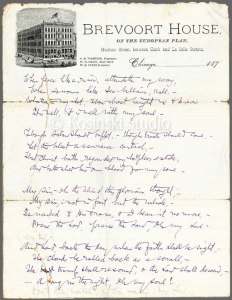
It is Well with My Soul: The Story

it-is-well-with-my-soul

Now might be a good time for an inspiring story of resilience, faith and hope in a time of great personal tragedy: It is Well with My Soul: The Story

Jon Foreman singing It Is Well with My Soul