Risky Living: Jumping from the Ultimate Precipice

I have briefly explored the idea of good risks and bad risks in relation to the corona virus threat we have been facing over the last year. Using that as a springboard, I will explored the idea of tempting death, something, which we can’t avoid, regardless of how carefully we live. Now, I want to talk about the good risk of jumping from the ultimate precipice.

Some people gravitate toward risky behavior like a moth to the flame, and others impulsively withdraw into bubbles of protection for fear of sickness, injury and ultimately death. As one who gravitated naturally a little closer to the flames than the bubble, I lived a somewhat reckless youth. The precipice of physical danger, however, brought me to a more metaphysical precipice. The reckless attempt to find fulfillment in corporal, temporal things, led me far enough down that path to rule them out as the missing thing I really wanted.

As I read the Gospels for the first time in a college class, I recognized the truth in the statement that we should not lay up for ourselves treasures on earth. I could see that earthly treasures promised no lasting fulfillment. I had tested their capacity for fulfillment and found them wanting. I could see far enough down that road to know it contained a dead end.

Those experiences, eventually, led me to another precipice – a spiritual one. If God is real, I was on the outside looking in. I couldn’t see “in”. God stood behind a curtain to me, shrouded in mystery that I couldn’t penetrate.

I didn’t realize, then, that would find what I was seeking behind that curtain, but I was propositioned one day with the task of explaining God why He should let me in to His heaven…. That question brought me to the brink of that spiritual precipice.

His heaven… I realized in that moment that heaven (whatever heaven might be) was God’s place. He didn’t have to let me in. I was treading on His turf there, if indeed God existed, and He was under no compulsion to let me enter.

And why should He?

The answer that came from my mouth rang hollow in my heart. “I am trying to do better.” Better is a pretty relative term, but was my effort good enough? Was my effort even the best I could do? …. I knew it wasn’t.

If my best wasn’t enough, I was sunk, and I “knew” in my heart that it wasn’t enough. I knew in my heart I hadn’t even given my best.

When my questioner offered (finally) that heaven is a gift that God gives us, and we can’t earn it, I was dumbfounded.

My entire life was about earning something – earning attention, earning respect, earning grades, earning my own self-acceptance – and I was always falling short. I couldn’t even live up to my own expectations of myself. I wasn’t who I thought I should be!

My recklessness for seeking attention and acceptance and achievement turned to recklessness (for a time) in my abandonment to drinking, doing drugs and risky living. I saw that I was incapable of living up to my own dreams, so I abandoned those dreams for a time to the numbness of a narcotic stupor. Yet, I couldn’t escape the longing, and it only deepened the gap to realization of it.

I had turned back from the inevitable dead-end of a self-induced stupor to a purposeful seeking, but that which I sought I couldn’t exactly define. It wasn’t in me, but it seemed attainable. It was elusive, but I could almost taste it.

I stood at a new precipice that day, when I realized that a God who created the earth controlled whether I might enter His heaven. At the prospect that He offered it freely to me, if I would take it, I jumped.

(I have been to other precipices since that day for which the jump wasn’t as easy, maybe because I wasn’t as reckless, maybe because I took the jump more seriously, counting the cost more completely.)

I had jumped from other precipices, physical ones, in my life in attempts to find the right combination of thrill and daring that would make me feel better about myself, earn the respect or (at least) the attention of my peers and help me fit in to the world I wanted to live in and the person I thought I wanted to be. Those jumps had not brought me any closer to anything that was really satisfying, but that metaphysical jump I took when faced with the prospect of a God who “owned” heaven changed my life.

I accepted the offer. I “accepted” Jesus as my Lord and Savior (not knowing nearly well enough what that really meant). Fortunately, God took me at my word (little, though, that I knew what I was doing).
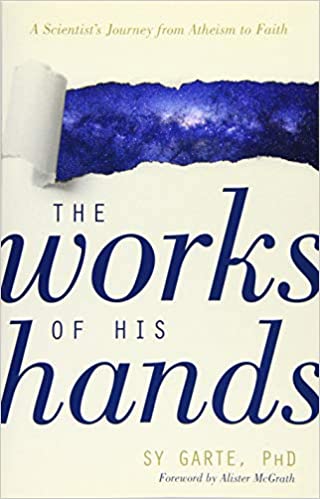
When I started this piece, I was reading The Works of His Hands: A Scientist’s Journey from Atheism to Faith by Sy Garte. He was a third-generation atheist, born to Russian immigrants who are members of the Communist party. He studied science and became a scientist. Along the way, the science that he was learning led him to question the philosophical naturalism and materialism that he had assumed was reality all his life.


I will end be telling the story of the precipice to which Sy Garte came. The landscape of this precipice looked different than the one to which I came many years earlier, but the decision to jump was no less momentous.

Continue reading “Risky Living: Jumping from the Ultimate Precipice”

Risky Living: Good Risks and Bad Risks

Living with risk: almost 600,000 Americans have died of COVID as of April 29, 2021

(I started writing this one year and one day ago. I might as well finish what I started.)

As a child growing up, I learned to swim at a local swim club where I also spent many lazy, summer days in the water. The high dive was the ultimate challenge at the club, and the divers who trained there were the people I looked up to. The thrill of somersaulting in the air into water was alluring.

I never took diving lessons. We moved when I was still young, but high dives always called me. As a teenager, the Quarry which became my new summer hangout had a high dive and a tower. The tower was only opened on special occasions, and only the bravest of kids would jump off.

I never had diving lessons, but I learned to somersault through the air, swan dive and a host of other playground tricks. I didn’t pass up an opportunity to dive from the tower either. I was somewhat a reckless youth.

The tower is still there today, but I am told they never “open” it because of the liability. My experiences were 45-50 years ago now.

I recall these things because I woke suddenly from a dream early yesterday morning to a man curled tightly in a rotating somersault spinning in the air. At 60 years old, now, the thrill of somersaulting in the air is more tinged with fear than it used to be, and the sudden vision of it jolted me awake with Adrenalin.

Every once in a while, I show my kids I can still do it, but the body doesn’t move like it once did. I can’t bounce or curl or rotate like a 15-year old anymore.

The moment of fear-tinged thrill I felt as I woke was more like the feeling I had when I was younger when I was tempted to see how close I could jump from the high dive to the edge of the swimming pool without hitting it. The “thought experiment” conjured up the same kind of feeling.

The two things – somersaulting from a high dive and trying to jump close to the edge of the pool without hitting it – are risky things to do. A misstep doing either one might result in injury or even death.

Not being instructed in the matter of high diving, I probably had more confidence than I should have in my own abilities. I pushed myself beyond what I feared I could not do. I might have been a bit brash about it, but I wasn’t foolish. Attempting to jump as close to the edge of the pool without hitting the concrete would have been not only brash, but utterly foolish.

Life is full of risks. Just swimming in water comes with the risk of drowning. (How many times did our mothers scold us about not swimming within an hour of eating?) The mother who doesn’t teach her kids to swim, though, isn’t doing them any favors. A person who never learned to swim, for fear of drowning, is much more likely to drown in a sudden fall into the water than a person who learned to swim.

For me, swimming was as natural as riding a bike. I did it for hours every day all summer long. Swimming in the water was familiar to me, so I didn’t fear it. Perhaps, I was even overconfident in my abilities and didn’t take seriously the warnings from my mother (though I listened to her anyway because she was my mother).

There are good risks and bad risks. Any business person knows that, as going into business is full of risk.

We are currently in the sixth week of sheltering in place from the corona virus threat here in Illinois. People throughout the country are starting to get restless, calling for the governors to declare an end to the stay-at-home orders and open up the states for business as usual. Many people are hunkered down because they are vulnerable or scared, while protesters are taking to the streets in defiance with no masks, daring government intervention.

How does the risk of COVID-19 fit into the spectrum of risk? It depends a lot on you.

Financial advisors always survey their clients’ risk tolerance. People have different levels of risk tolerance. Some of us are bolder, brasher and more confident than others. Some of us are timid and scared. People with vulnerabilities have reason to be concerned. Some people are just plain reckless.

Continue reading “Risky Living: Good Risks and Bad Risks”

Did Jesus Come to Fulfill the Law or to Abolish the Law?

“We were held in custody under the law, locked up until faith should be revealed. So the law became our guardian to lead us to Christ….”

Much confusion in the early church arose out of the relationship of the Law to the “good news” that we now call the Gospel (which means good news). The confusion continues today. I continue to wrestle with the tension, myself.

Two passages come to mind that seem to be directly counter to each other. They establish a paradox – a seeming inconsistency – that needs to be resolved. Compare what Jesus said as recorded by Matthew, to the instruction of Paul to the Ephesians:

Do not think that I have come to abolish the Law or the Prophets; I have not come to abolish them but to fulfill themFor truly, I say to you, until heaven and earth pass away, not an iota, not a dot, will pass from the Law until all is accomplished. Therefore whoever relaxes one of the least of these commandments and teaches others to do the same will be called least in the kingdom of heaven, but whoever does them and teaches them will be called great in the kingdom of heaven. For I tell you, unless your righteousness exceeds that of the scribes and Pharisees, you will never enter the kingdom of heaven. (Matthew 5:17-20)


“But now in Christ Jesus you who once were far off have been brought near by the blood of Christ. For He Himself is our peace, who has made the two one and has torn down the dividing wall of hostility by abolishing in His flesh the law of commandments and decrees.” (Ephesians. 2:13-14)

In one place, Jesus said he did not come to abolish the law; and, in the other place, Paul says Jesus abolished the law. Which is it?

The answer is both. If we view this apparent dichotomy as a paradox, rather than a contradiction, we can make some sense of it.

First of all, we need to consider the context. When Jesus said he did not come to abolish the law, he was talking about his coming in the flesh. Jesus was God who became incarnate. Jesus was God who emptied Himself of all that separated Himself from His creation and became part of it in the form of a human being. (Phil. 2:5-8) Thus, when God became man and came to us, He did not come to abolish the law.

We also need to look at the larger context of the Law. The Law was a covenant (an agreement) with Israel. It was given to Moses for the descendants of Abraham after He brought them out of slavery in Egypt. God was faithful to this covenant, but the people were no. They filed at every turn.

This was a problem, because God promised to bless the people based on them holding up their part of the bargain, but they failed to do that. God was true to keep His part of the bargain, but He could not be true to keep His promise to bless them because they did not keep their part of the bargain.

When Jesus made the statement that he did not come to abolish the Law, but to fulfill it, he was putting that statement into the context of time and purpose. He was saying that the purpose for which he came was to fulfill the law, and now was the time.

Jesus came to fulfill the Law in the flesh as a man. When he said on the cross, “It is finished”, he was proclaiming that he had finished accomplishing the fulfillment of the Law in his human body. He lived it out perfectly. He was obedient to it unto death.

Jesus did what no man had done. God became a man so that he could keep man’s part of the bargain, and that enabled God to keep His promise to bless mankind. God, in a sense, carried out the terms and fulfilled both sides of the covenant.

But that is not the end of the story.

Continue reading “Did Jesus Come to Fulfill the Law or to Abolish the Law?”

CS Lewis in Song

No relatively contemporary writer or thinker has had more influence on me than CS Lewis. I read Mere Christianity as a college seeker. I read the Chronicles of Narnia also in college in a weekend, intrigued by the way his imagery grew out of and expanded the panoply of Scriptural ideas with nuance and depth.

I have read many of his books since then, including his science fiction trilogy, the allegorical Great Divorce, his autobiographical book, Surprised by Joy, and many of his books and essays with more philosophical and theological import. I still have books of his on my nightstand I have been meaning to read.

One of Lewis’s repeated themes is the so-called “argument from desire”. The “argument”, which can be reduced to a logical syllogism, is not really a strong logical argument for God, but it has strong existential appeal.

The idea appeals to the human condition and the sense in all of us that we are destined for more than what this world offers. The existentialist side of the coin is that nothing satisfies. Period. Both sides of the coin candidly recognize the frustrated desires of people that ultimately go unsatisfied.

Art Lindsley, Senior Fellow at the CS Lewis Institute, says, “[D]eep human aspirations are either pointers to something real, or else they are full of sound and fury but signifying nothing.” The desire to worship and capacity for awe are universal human feelings of which CS Lewis observes in the Problem of Pain are either “a mere twist in the human mind, corresponding to nothing objective and serving no biological function” or are an experience of some connection with the supernatural.

For a more complete treatment of the “argument from desire”, I suggest Lindsley’s article or The Argument from Desire from Boston College professor, Peter Kreeft. But all of this is, in truth, really an excuse to get to songs inspired by CS Lewis.

One of my favorite songs of all time is the CS Lewis Song by Brooke Frasier from New Zealand. The opening lines are an homage to Lewis’s argument from desire.


If I find in myself desires nothing in this world can satisfy,
I can only conclude that I was not made for here
If the flesh that I fight is at best only light and momentary,
Then of course I’ll feel nude when to where I’m destined I’m compared


Speak to me in the light of the dawn
Mercy comes with the morning
I will sigh and with all creation groan as I wait for hope to come for me

Am I lost or just less found? On the straight or on the roundabout of the wrong way?
Is this a soul that stirs in me, is it breaking free, wanting to come alive?
‘Cause my comfort would prefer for me to be numb
And avoid the impending birth of who I was born to become

Speak to me in the light of the dawn
Mercy comes with the morning
I will sigh and with all creation groan as I wait for hope to come for me


For we, we are not long here
Our time is but a breath, so we better breathe it
And I, I was made to live, I was made to love, I was made to know you
Hope is coming for me
Hope, He’s coming

Following is a video version of the song that takes a more Kafkaesque approach to the song.

Continue reading “CS Lewis in Song”

Envisioning Where We Are Heading: The Kingdom of God

When pray these words that Jesus taught us to pray:

Our Father in heaven,
hallowed be your name.
Your kingdom come,
your will be done….

This is what the Father’s will ultimately looks like:

After this I looked, and behold, a great multitude that no one could number, from every nation, from all tribes and peoples and languages, standing before the throne and before the Lamb, clothed in white robes, with palm branches in their hands…. (Rev. 7:9)