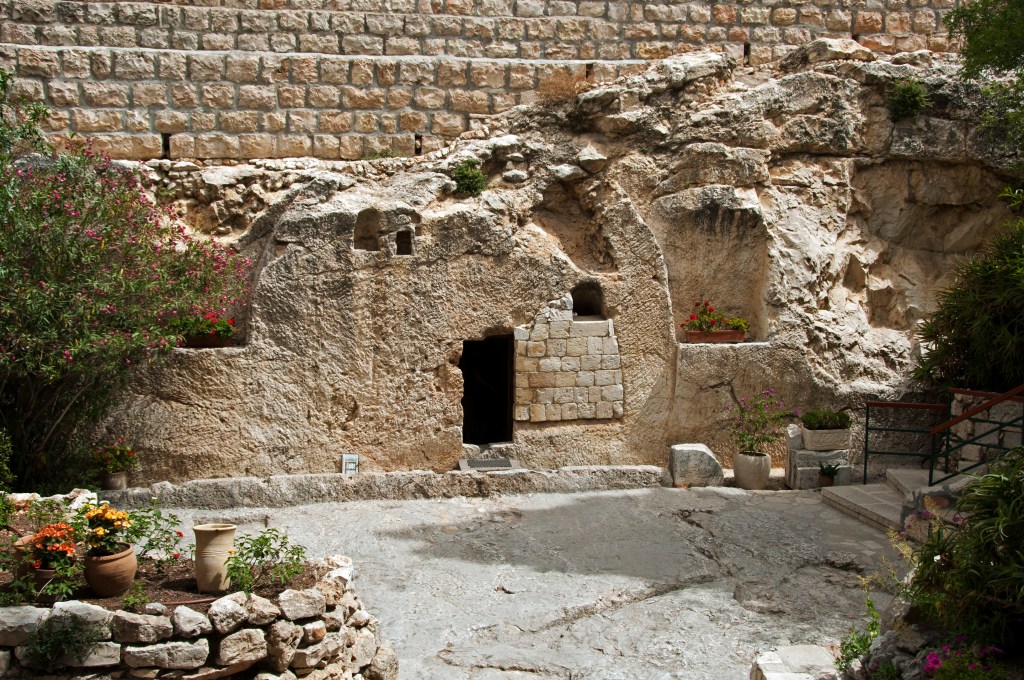
Thought to be the place of the resurrection of Jesus Christ in Jerusalem Israel
The title of this piece is tongue-in-cheek, a play on the “minimal facts” evidence for the resurrection made famous by Gary Habermas. I don’t really have a killer piece of evidence that uses fewer facts (or no facts) that trumps all other arguments. But, maybe I got your attention!
As often is the case, my inspiration comes from what someone said or wrote. In the podcast interview linked below, Mason Jones describes how he he decided to read through the Gospel accounts as an atheist who knew next to nothing about Christianity. He quickly caught on that the resurrection is the centerpiece of Christianity, so he focused his attention on that.
He researched the evidence for the resurrection. He googled arguments for the resurrection and arguments against the resurrection. Though he was an atheist at that time, he was willing to give the evidence that exists a chance. (Whether there was any, he didn’t know.)
As he considered the arguments and counterarguments, he found that the arguments against the resurrection didn’t address very well the arguments for the resurrection. They didn’t take them seriously.
Then he realized that the arguments against the resurrection only work if you start with the presupposition that the resurrection didn’t happen. Because it is impossible. Because people don’t come back to life. Ever.
If you take that presupposition out of the equation, thought Jones, the evidence favors the conclusion that the resurrection occurred, and the arguments against the resurrection loose their luster. If you want to hear the rest of Mason Jones’s thought journey from atheism to theism to Christianity in his own words, you can listen here.
Meanwhile, I want to spend a little time considering the presuppositions people make about the resurrection.
Some people say that we have absolutely no evidence for the resurrection (and no evidence that God exists in the first place). Nothing could be further from the truth. We have evidence. The issue isn’t a lack of evidence; the issue is how we approach the evidence and weigh it it.
A person who approaches “supernatural” phenomenon with purely materialistic assumptions will weigh the evidence differently than one who is open to nonmaterialistic possibilities. Jesus, though, lived in time and space in history. Many people in the first century who saw him die claim to have seen Jesus and interacted with him in the flesh after he died, and those people were willing to die for what they saw.
That is evidence. Full stop. People may be skeptical of it. People may assume Jesus couldn’t have risen from the dead, despite what people think they saw, because miracles don’t happen. But, now I am talking about how people approach and weigh the evidence.
People confuse proof, as in a mathematical proof, and proof, as in an offer of evidence that tends to support a proposition. Fallible, finite human beings deal almost exclusively in the latter realm of evidence, even in science, because we don’t know what we don’t know.
Mathematical proofs are an achievable goal in mathematics (though sometimes not even then). Such proof is impossible outside of mathematics.
Science does not provide us that kind of certainty, either. Science changes all the time on the basis of new evidence, and things we thought we knew in the past are constantly being adjusted, or even discarded, on the basis of additional evidence.
Finite beings such as ourselves are limited in our knowledge, our access to knowledge, and our understanding of how the knowledge we have fits together. We have to be humble as we cautiously put our confidence in the things we think we know because we are limited in our ability to know and understand our world, and we will always lack absolute proof for most, if not all, things.
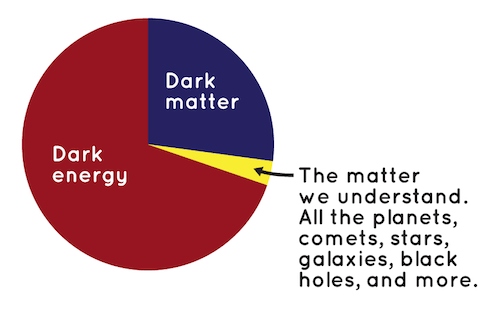
The extent of our limitations can even be quantified. For instance, 95% of the physical universe is invisible to us! The vast, unseen reaches of the universe are comprised of things like dark matter and dark energy that we cannot see and know little about, except for what we can infer about them. We aren’t sure what these things are, but we know they exist by the affects we see on the matter we see and know.
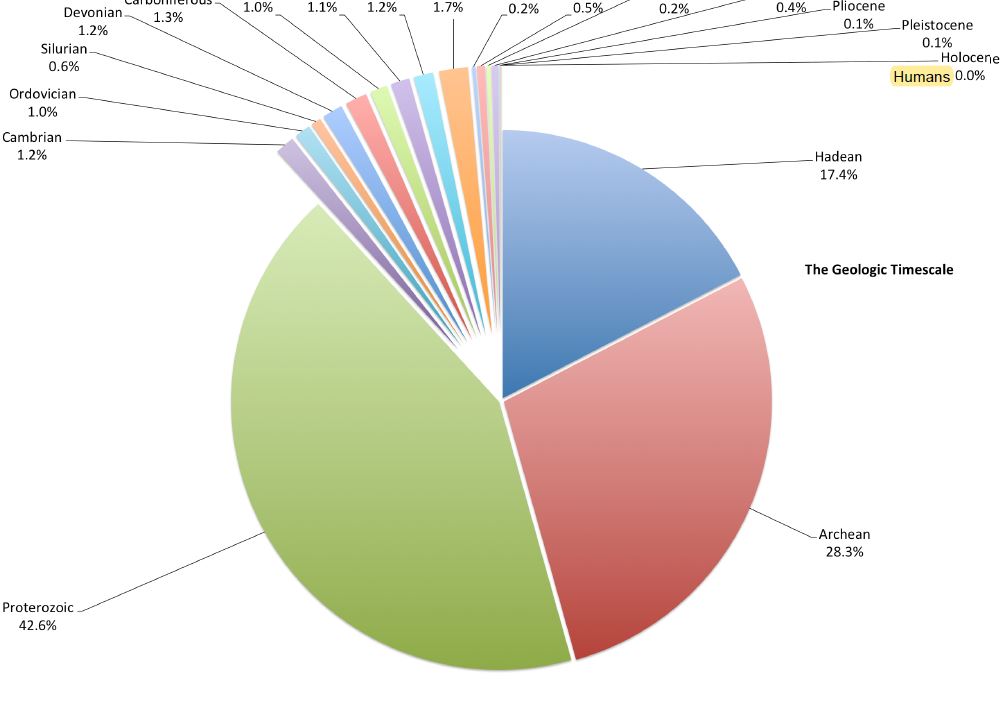
If we view the existence of the earth (not even the universe) on a 24-hour scale from the beginning to the present time, life began at 5:00 AM, the first vertebrates appeared at 8:00 AM, and human beings appeared just a fraction of a second before midnight.
Homo sapiens have only developed knowledge and the ability to communicate and preserve a record of it for about 5,500 years. We have been developing and recording our knowledge for only 0.00022% of the time the earth has existed, which is only 0.00007% of the time the universe has existed.
During that relatively short, 5500-year time period we have developed the capability to see only about five percent (5%) of the universe, though we have actually examined very little of it – and then only at very great distances. We hnave only explored more than five percent (5%) of the oceans on this earth – a very small planet orbiting a very small sun in a very small solar system in the inconceivably large expanse of what we we call the universe.
The body of our scientific knowledge has grown tremendously, even exponentially, especially in the last 200 years, but we have only just begun to know and understand the universe we live in. If humans live another 5,500 years, we will not have explored all of the universe, and we will not know all that there is to know.
We will likely never know all there is to know about the expanse of the universe and everything in it, large and small, in all the years mankind is on the earth. Thus, we are in no position to write off the possibility of God creating the universe and Jesus rising from the dead.
The title to this piece is (admittedly) a bit misleading, so I need to provide the following disclaimer. Some people will read the title and assume that I am attempting to prove the resurrection. I am not doing that. I am offering only the beginning of proof (as in offering evidence) in this article, but it is evidence. You can weigh it how you will.
We should at least be open to consider what evidence there is for the existence of God and not write off the possibility that God exists. If God exists and made the universe out of nothing, which is what the Bible claims in Genesis 1, John 1, and Hebrews 11, then He could certainly raise Jesus from the dead.
How arrogant it would be for us to determine for ourselves (categorically) that there is no God, that He did not create the universe, and that Jesus did not raise from the dead. We don’t know what we don’t know, and we don’t understand perfectly what we think we know.
With that said, I want to provide some minimal facts that provide some evidence that tends to support the resurrection. These things are not proof; they are an offer of proof. We cannot achieve definitive proof, but there is evidence for the credibility of the claims made that Jesus rose from dead.
I want to focus on the following statements Paul made in his letter to the Romans:
“[T]he mind set on the flesh is hostile toward God; for it does not subject[i]itself to the law of God, for it is not even able to do so….
Romans 8:7
“[C]reation was subjected[ii]to futility[iii], not willingly, but because of Him who subjected it, in hope that the creation itself also will be set free ….”
Romans 8: 20-21
Life and death, the universe and all the “stuff” that is, ever was and ever will be are “in God’s hands”. That is another way of saying that God created everything. God is timeless and immaterial and has created all that is material out of nothing, including us.
But the material world, the world as we know it, is passing away (1 John 2:17), even from the moment it was created! That’s what science (the second law of thermodynamics) tells us also. The world has been has been “winding down” since the “Big Bang”.
Paul’s statement about the “futility” to which the world has been subjected suggests that futility is part of God’s ultimate plan, because it was done “in hope”.
If that doesn’t add up for you, I don’t think you are alone. I have been puzzling on it for awhile. What possibly could be the plan?
The trite response that “God’s ways are not our ways” falls short. We want to know, though perhaps it’s true that we may never completely understand. Still, I have some ideas that are informed by Scripture that I will try to lay out in this article.
Oh, how I long for heaven in a place called earth Where every son and daughter will know their worth Where all the streets resound with thunderous joy Oh how I long for heaven in a place called earth
Song writers have common themes and images that run through their work. Jon Forman is one of my favorite song writers because he resonates with a theme that has run through my thinking over the last decade: the transience of this life and the transcendence of the life to come.
In the song, A Place Called Earth, he focuses on the “borderlines” between the transience of our lives and the longing for transcendence. It’s an age-old theme. It’s a theme that has been the subject of some of the greatest writers in the history of world from the author of Ecclesiastes to Shakespeare.
The video embedded above was a recent live performance of this song off the new EP, Departures. Linked below is the studio recording of A Place Called Earth that was written by Jon Foreman with his brother, Tim, and Lauren Daigle. I encourage you to listen to it in all of its orchestral fullness.
The hope of the Christ follower is the longing for heaven, a place where everyone knows their worth through the eyes of Jesus. Our hope to know even as we are fully known. Meanwhile, we see dimly as in a mirror, and we have this hope, the treasure of the Holy Spirit who gives us assurance, in earthen vessels. (2 Corinthians 4:7) We long for heaven in a place called earth.
Oh, the wars we haven’t won Oh, the songs we’ve left unsung Oh, the dreams we haven’t seen The borderlines
Jon Foreman’s plaintive voice captures the angst of these lines perfectly. We try to notch our belts with victories, but what of all the defeats? The songs we have left unsung? The great dreams we dared to dream that we haven’t seen?
All our victories are hollow trophies at the end of our days. Memories of them begin to fade from the moment of victory. Like the entropy to which our universe is subjected (Romans 8:20), those memories will fade into utter obscurity long after we have taken our last breaths.
We see this on the borderlines. On the borderlines, where we peer out over an endless expanse yawning out into a far distant future, and beyond it into an eternity we can’t even fathom. We realize our utter insignificance as we peer out beyond what we can see and comprehend.
I am starting a new Bible reading plan for the year, beginning in the beginning: in Genesis. Reading through the rich text of Genesis again I am seeing some things I hadn’t noticed before. Consider the following (with my emphasis added):
“Then God said, ‘Let the earth sprout vegetation, plants yielding seed, and fruit trees on the earth bearing fruitafter their kindwith seed in them‘; and it was so. The earth brought forth vegetation, plants yielding seedafter their kind, and trees bearing fruit with seed in them, after their kind; and God saw that it was good.
Genesis 1:11-12
“God created the great sea monsters and every living creature that moves, with which the waters swarmed after their kind, and every winged bird after its kind; and God saw that it was good. And God blessed them, saying, “Be fruitful and multiply and fill the waters in the seas, and let birds multiply on the earth.’“
Genesis 1:21-22
“Then God said, ‘Let the earth bring forth living creatures after their kind: cattle and creeping things and beasts of the earth after their kind‘; and it was so. God made the beasts of the earth after their kind, and the cattle after their kind, and everything that creeps on the ground after its kind; and God saw that it was good.”
Genesis 1:24-25
Then God said, ‘Let us make man in our image, after our likeness. And let them have dominion over the fish of the sea and over the birds of the heavens and over the livestock and over all the earth and over every creeping thing that creeps on the earth.’ So God created man in his own image, in the image of God he created him; male and female he created them. And God blessed them. And God said to them, ‘Be fruitful and multiply and fill the earth and subdue it….'”
I color-coded the various provisions that form the pattern that informs my thinking today. The provisions in each color correspond with the other provisions of the same color.
Now, let me see if I can put all my thoughts together in a coherent whole.
First of all, God ordered (in the sense of designed) all living beings to multiply after they own kind. We see this everywhere in nature: apple trees produce seeds that grow into new apple trees; asparagus plants produce seeds that grow into new asparagus plants; lions beget lions; polar bears beget polar bears; yellow polka dotted salamanders beget yellow polka dotted salamanders; bluefin tuna beget bluefin tuna; and purple finches beget purple finches.
This is the order of living things. Not only that, but we now know that something (call it evolution or something else) works powerfully within living beings to reproduce and even to adapt with changes over time.
Every living thing bears seed or otherwise reproduces more of its kind. Human beings included, but only humans are made in the image of God. (Hold that thought.)
God “blessed” the living things He created, saying, “Be fruitful and multiply” and fill the earth. (Gen. 1:22) He also blessed man who God made in His own image, and gave similar blessing/order: “Be fruitful and multiply and fill the earth and subdue it….” (Gen. 1:28)
Note that God “ordered” (as in designed) the living things He created to reproduce after their kinds and to be fruitful and multiply, but God ordered – as in not only designed, but commanded – man to do the same. The difference is an important key to understanding what God is doing.
Unlike the other living creatures that are designed to reproduce and multiply after their kinds, humans have some agency in the matter. God designed them for the same purpose, but He also commanded them to do it – and gave them agency in doing it – because humans are created in the image of God who has agency – the ability to exercise will and to do (or not do) things.
Humans, of course, had no choice in their creation, but they do have choice in whether to “participate in God’s design” and how they would participate in God’s design. This choice was demonstrated in the one tree in the garden that was forbidden to them.
It was a real choice, and it had real consequences. It had to have real consequences or it wouldn’t have been a real choice. That choice was part of what it meant to be made in the image of God. Without the ability to choose, humans would have been just like the other living things God created. The ability to choose set humans apart.
As the story goes, humans ate the fruit of the one tree that was forbidden.
They exercised the choice God gave them. In eating the fruit of the tree of the knowledge of good and evil, humans opened up their world to all the ways they might choose to go against the order of creation.
Throughout Genesis 1, we read over and over again that what God did “was good” (Gen. 1:4, 10, 12, 18, 21, 25, 31). If what God designed was good, choosing to operate counter to that design would be evil (the opposite of good).
None of this is very revelatory so far, but I am getting there.
Genesis 1 reminds me of 1 Corinthians 15 where Paul says:
God gives [all living things] a body as he has chosen, and to each kind of seed its own body.For not all flesh is the same, but there is one kind for humans, another for animals, another for birds, and another for fish.
1 Corinthians 15:38-39
The order/design of life – of reality – is immutable. Life is ordered the way God created it, though humans have some choice (within limits) of whether to align with God’s design or to buck against it. Indeed, the story of the fall is the story of humans exercising that choice, God built into His design an adaptation (if you will) to accomplish His ultimate plan.










 Navigating by Faith