Ritual, Spirit and Truth

Depositphotos Image ID: 23471738 Copyright: ChiccoDodiFC

I was raised Catholic. I say that often. Not that it is a bad thing. It’s just my experience. During my time in the Catholic church, through my childhood and early adulthood, I had no connection with God. I can’t lay the blame for that at the feet of the Catholic Church. That was just where I was.

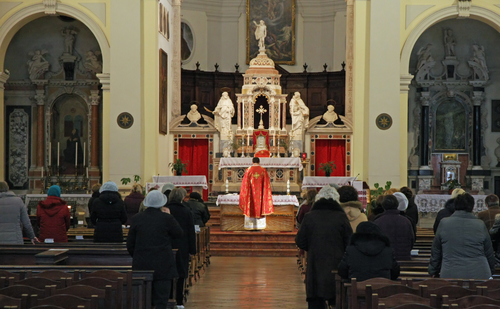
When I became a Believer, when I accepted Christ as my personal Lord and Savior, my life changed. I also began to see the Catholic Church in a different light. I was never into the ritual and observance, which is a major component of the Catholic Church. Not that other denominations and religions don’t have central religious rituals. All religions have ritual observances and traditions.

Those ritual observances and traditions are not, in themselves, bad, but they can create a facade that hides emptiness, darkness and sin. They can create an appearance of piety with no spiritual reality behind them. They can be more superstitious than spiritual, like stroking a rabbits foot for good fortune. In these and other ways, ritual observances can become a substitute for relationship with God.

Continue reading “Ritual, Spirit and Truth”

Spirit and Truth vs. Self-Made Religion

It isn’t things from outside that corrupt a person, but things from inside.

Depositphotos Image ID: 91001324 Copyright: carlosyudica

In a previous blog article, I talked about the shadow of things to come. Paul says that following rules and observing religious ritual is just a shadow of things to come. Later in the same chapter in Colossians, Paul explains in more detail what he is getting at. When we are focused only on the do’s and the don’ts and on observing religious rituals, we are focused on the wrong things.

“If with Christ you died to the elemental spirits of the world, why, as if you were alive in the world, do you submit to regulations – ‘Do not handle,  Do not taste,  Do not touch’ (referring to things that all perish as they are used) – according to human precepts and teachings? These have indeed an appearance of wisdom in promoting self-made religion and asceticism and severity to the body, but they are of no value in stopping the indulgence of the flesh.” (Colossians 2:20-23)

Paul isn’t advocating that followers of Christ abandon self-discipline and self-control and do whatever they like. “Are we to continue in sin that grace may abound? By no means!” (Romans 6:1-2) But, following Jesus doesn’t mean stepping up religious observances and following rules and regulations more closely. The focus on rules and rituals entirely misses the point.

Continue reading “Spirit and Truth vs. Self-Made Religion”

Sizing Up God

Depositphotos Image ID: 147545805 Copyright: kamchatka

In ancient times people saw gods in the rocks and trees, idols they made and volcanoes and lightning and thunder. These were gods that were larger than they, but they were accessible. Their gods lived in their environment. Their gods were arbitrary, but they tried to appease them anyway.

Roman and Greek gods were larger than the material world, and they manipulated the material world for their own ends. They controlled volcanoes and earthquakes and lightning and thunder, but they were human-like, even in their imperfections. People could approach them. People could reason with and try to appease them.

Buddhist, Hindu and Eastern gods are not defined by the rocks, trees, lightning and thunder. They do not simply manipulate the material world. They are intimately and intricately part of the material world, and the material world is an extension of them, and the entirety of the material world is all ultimately one and the same in its essence.

Many scientists, like Einstein, who stood in awe of the universe, saw “god” in this way. People can fathom these gods/this god and understand them/it and seek to become one with them/it because these gods are made of the same stuff as people and all of the universe ultimately. These gods cannot be appeased. We can only hope to understand them.

But these gods are too small.

Continue reading “Sizing Up God”

Distinctions Make All the Difference

Key distinctions between religions come into greatest focus as we celebrate Christmas, which is the recognition and acknowledgement of the birth of the Christ child.

Photo courtesy of Tyler Drendel

Ravi Zacharias has spoken to orthodox theological scholars of Islam and orthodox theological scholars of Christianity around the world. He speaks from experience when he says that those orthodox scholars who know the sacred texts do not say that the God of the Quran and the God of the Bible are the same deity. Pluralism is a positive and important cultural value, and we can value pluralism without sacrificing distinctions or truth.

We don’t embrace the beliefs of “Flat-earthers” in the name of pluralism. They are free to believe what they want to believe, but we shouldn’t let the flat earth position affect how we do science or how we view the world because of pluralism. An appreciation and respect for different cultures and ways of viewing and living in the world should not dictate an embrace of positions that are inherently contradictory with each other or compel us to abandon reason or truth.

In the clamor and noise of the connected world in which we live, we are tempted to minimize or ignore differences. We often only see a rudimentary and distorted view of things, and we are apt, therefore, to come to incomplete and inaccurate conclusions without a nuanced understanding of those things. We might be tempted to think that all major world religions are fundamentally geared in the same direction, being merely different approaches to the same end. We might be tempted to think that Christianity is a very politically orientated and conservative, western worldview that is arbitrarily exclusive and, therefore, elitist.

Ravi Zacharias grew up Hindu in a world in which Buddhism, Islam, and other religions were more prevalent than Christianity. His background lends some credibility to his observation that no religion offers redemption like Christianity does. Other world religions offer a way of attainment that must be earned. Christianity is unique in this respect in its view of God and our relation to God, and Christianity is uniquely accessible to all people in all places to the same extent.

Continue reading “Distinctions Make All the Difference”

Reformation and Renewal

If we aren’t willing to renew our wineskins periodically, the old ones wear out and don’t hold the new wine like they did when they were fresh.

depositphotos Image ID: 10694365 Copyright: rumifaz

Today us Reformation day. I don’t really care about Halloween, so I figure I should say something about the Reformation.

You might call me a reformed Catholic. I grew up in the Catholic Church. When I encountered Jesus Christ, the living Son of God, who shed His glory to become a man, walked in obedience to His own purposes, died on the cross for our sins, and rose again from the dead, my life changed.

When I accepted Jesus Christ as my Lord and Savior, I left the Catholic Church for greener pastures. I have been involved with and visited many churches since then, and I am still looking for greener pastures. Along the way, I have learned that Catholics haven’t cornered the market on rigid structures and white-washed tombs.

Continue reading “Reformation and Renewal”