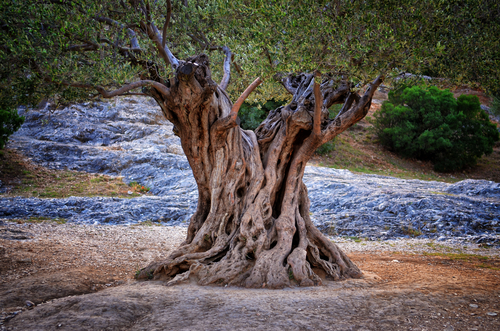
The tree of life is mentioned only three places in the Bible. The first and most prominent appearance of the tree of life is in Genesis. The tree of life appears in Proverbs (three times) and again in the Book of Revelation (on either side of the “river of the water of life… flowing from the throne of God….”[1])
The tree of life was there in the beginning, and it will be reappear in the end. In between, where we are now, between Genesis and Revelations, we are presently cut off from the tree of life.
The tree of life obviously figures into God’s ultimate plan and purpose. But how? Where is the tree of life between the Garden of Eden and standing beside the river of the water of life flowing from the throne of God? Let’s take a look.
The Christian response to the age old problem lies in the story of Adam and Eve. Created in God’s own image, they were given a choice but were forbidden from exercising it. Anyone with a modicum of understanding about human nature knows that forbidden fruit is a temptation that is hard to ignore. It should come as no surprise to us (or God) that Adam and Eve gave into the temptation and ate of the fruit.
God surely must have known that they would exercise that forbidden choice! Yet, he banished them from the idyllic “garden” He created for them and cursed the world, subjecting it to difficulty, pain, suffering and death. We are looking for a clue to the question that screams from our guts, “Why?!”
This indeed is the harsh reality in which we live. There can be no denying it. Recognition of this harsh reality is not uniquely Christian. It is a universal truth. The explanation of it is what differs. The atheist might simply say that we all die and “then worms will eat our bodies”. That’s just the way it is. The Hindu might say we suffer because of karma, and we all die, and die again, and again, and again, and again. The Buddhist might say we suffer only because we haven’t reached enlightenment because pain and suffering are just a figment of the unenlightened imagination. All worldviews must contend with the fact that we live in a less than idyllic world.
The Christian says we suffer pain and death because Adam sinned. “And we’ve been attending funerals ever since,” Clay Jones says; and “Only one thing is going to prevent you from watching absolutely every person you know die from murder, accident, or disease, and that will be your own death from murder, accident, or disease.” What a harsh sentence!
If the Bible is an accurate reflection of God and of reality, why in the world would God have cursed the ground and subjected His creation to futility?
The Apostle Paul tells us in his letter to the Romans that God subjected the world to futility “in hope that the creation itself will be set free from its bondage to corruption….” (Romans 8:20) This suggests that the choice that led man to corruption and the cursing of the world to futility was part of the plan all along. In this second half of “the story” we try to make some sense of it.
Photo by Steve Murray – Where Moses looked into the promised land
“But the fruit of the spirit is love, joy, peace, patience, kindness, goodness, faithfulness, gentleness, self-control; against such things there is no law.” (Galatians 5:22-23)
The Spirit does what the Law could never do.
The law is exterior to us. It imposes a standard for us to follow, but it does not give us the desire or the power to follow it. The Spirit gives us both.
My Christmas thoughts have taken me to the genealogy in Matthew of the lineage of Jesus and the curious inclusion of five women in that patriarchal history. They stand out, not only as women in a patriarchal society, but as examples of faith and of God’s redeeming love.
Tamar and Rahab, the first two women in the list, were unlikely examples. Tamar prostituted herself with Judah, and Rahab was actually a prostitute. That God would use such sinful and lowly women is shocking, if not remarkable. Their stations in life and their choices before the encounters which defined them were humble and base.
Their faith, however, is the story. They believed God. They made a choice to trust God and His promise. Though they were both flawed and of low station in life, they are remembered in the genealogy of Jesus Christ, the Savior of the world who will also rule all that God has made at the end of this age. Though they were women in a patriarchal society, they are remembered side by side with the men.
The real story is God and His redeeming work in the lives of people and in the history of world. No story is more pregnant with God’s redemptive work than the story of Ruth, who is the third women listed in the genealogy of Jesus.
Amazingly, the genealogy of Jesus in Matthew lists five women. In a patriarchal society governed by paternal lineage, that fact should jump out at us and cause us to take notice. What is God saying? What was He doing? How should we view that today?
We can gain insights by looking at the women who are listed. The first woman listed is Tamar. Her story is found in Genesis 38, and it is a wild one for people of polite sensibilities.
Tamar was the wife of Judah’s oldest son, Er. Judah was the fourth son of Jacob (son of Isaac, son of Abraham). It might seem odd that Judah, the fourth son, is the one from whom Jesus (the Messiah) descends, but that is only a minor oddity compared to the rest. Continue reading “Christmas Thoughts: God Redeems the Line of Judah through Tamar”→






 Navigating by Faith