As I think about the events of this week (and of the past four plus years) and read through social media comments, I am thinking about things that have been percolating in my mind and heart for some time. I will try to lay them out in this blog article by borrowing some quotations from my social media feed with some hope I can tie them together and make some sense of it.
I write this thinking about neighbors and people I have spent time with, shared a drink or meal with, laughed with, worked with and done some aspect of life with who don’t think or vote exactly as I do. Some of them voted for Trump; some would never vote for Trump.
I may find it hard to synthesize all of these points as I let my social media feed direct my steps, but here goes.
The events unfolding, the things going on in the world right now, are troubling from many angles. Racial injustice, polarization, the centrifugal force of political fringes, rhetoric over substance, political violence, conspiracy theories, fake news, the increasing control of popular speech by private monopolies of information, the abandonment of all semblance of non-bias by most media, the ability to choose our own tailored news, the hatred people are developing for others who don’t think like them, the unwillingness to show respect, listen and engage in real dialogue – these are things that are deeply troubling in “the land of the free and the home of the brave”.
The political, cultural, sociological, and philosophical winds are swirling chaotically and mixing at all levels into a tornadic gale that is bordering on dangerous. These forces are not coming from outside us but from within. Even if our present chaos is influenced by outside sources, they are merely putting pressure on elements already within us. “We have met the enemy, and the enemy is us.”
For four years, people have been blaming Donald Trump for every evil under the sun. (Pardon the hyperbole.) People have been lumping all Trump supporters into one group and condemning them (or so the rhetoric often goes). People have had good reason to be critical. (No hyperbole or rhetoric there.) But let’s take a step back (it may need to be a giant step) and attempt a look at the bigger picture.
Trump gained support over more than a dozen career Republican politicians in 2016 and was elected president over a person, in Hillary Clinton, who, perhaps more than anyone else, represented the entrenched political machine in America. Bernie Sanders mounted a credible offense with broad support against that machine but could not prevail.
I believe people gravitated to Trump and Sanders for the same reasons: they are tired of politics as usual. They feel that our political system has broken down. It has become big business designed to perpetuate power and control, rather than serve the people. Congress would rather do nothing and let presidents wield executive orders on issues that need their attention and a compromise solution (like immigration, for instance) because they don’t want to jeopardize offending their bases.
They are seemingly more motivated by a desire to remain in office, maintain control and serve themselves than the people who elect them. There is no give and take (in the good and appropriate sense) anymore. At least, not on anything that hits the hot buttons of political platforms.
We only have two choices. Those two choices are becoming increasingly unpalatable for people on both sides of the aisle, but practical wisdom suggests that voting third party candidates means taking a knee as the real game plays on without you.
Polarization is a serious issue that can’t be ignored. It is exasperated by social media that is designed for quick, shallow and knee-jerk reactions that cater to our worst instincts. Almost 100% of political campaigning involves demonizing opponents and “the other party”. We have become a nation that accepts rhetoric over substance.
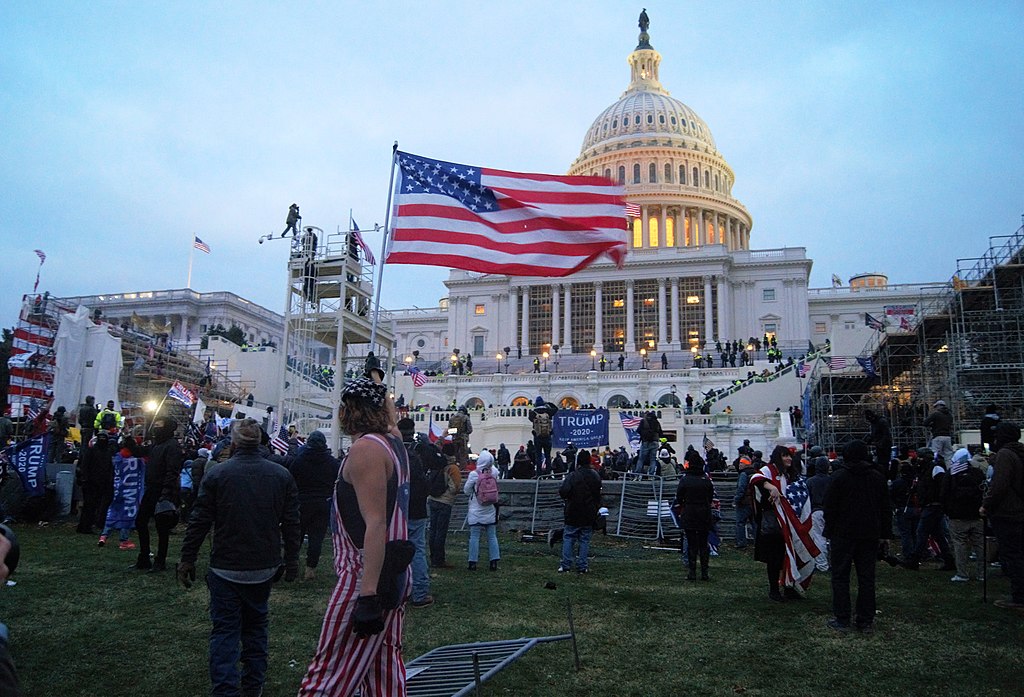
The extreme polarization has given rise to the voices of the radical fringes who threaten to pull us apart. In a “normal” world, those voices would seem like largely inconsequential and impotent shrills in the distance. Today, they sound like megaphones on the Capitol lawn, infiltrating into the very House of the People.
The Democratic party has always been more diverse (in my lifetime) and has always had its diverse, radical fringes. The conservative fringes have largely operated outside the fold until recently.
I dare say the conservative fringes are more dangerous, ultimately, than the liberal ones, perhaps because they are more unified by common principles. They also bear arms like political badges.
The fringes are pulling good people from the center because the center has largely been abandoned today. It’s a no-man’s land where no grass grows, and nothing happens. People in the center are labeled “other” by the people on either side and ignored by both.
We need a “radical” change. By radical, I don’t mean extreme or fanatical. I mean a different approach to politics and dialogue with each other. We need common sense and a commitment to a bigger picture than political partisanship. We need someone who can bridge the gaps that divide us. We need a voice that brings people together on the common ground that unites us, rather than forcing all conversations to the battle lines.
The events that are unfolding in the United States are troubling from many angles. Many Christians pinned their immediate and long term hopes on Donald Trump. With Biden as President, the fight against the killing of the unborn has been dealt a significant blow.
But there are many other problems. The racial divide, polarization, political fringe groups, extreme rhetoric, threats of violence, conspiracy theories, fake news, increasing control of popular speech by private monopolies of information, an abandonment of all semblance of non-bias by media, our ability to choose our own tailored news, hatred for people who don’t think like us, an unwillingness to show respect, listen and engage in real dialogue – these are things that are deeply troubling in “the land of the free and the home of the brave”.
To my brothers and sisters in Christ, Jesus said we would have tribulation in this world. He didn’t tell us to take up arms and fight it. He said we should follow him, spread the Gospel and make disciples.
His kingdom is not of this world. Jesus didn’t come to empower the Zealots, but to turn them into self-sacrificing servants of God and His kingdom – spreading the Gospel and making disciples.
Islam spreads by the sword. The Gospel spreads by people who wash others’ feet, turn the other cheek and love God, neighbors and even enemies. The Christian wields not a political flag, but a cross that he carries on his own back.
If we are going to fight for the mission of Jesus, our fight should be “to proclaim good news to the poor… to proclaim liberty to the captives and recovering of sight to the blind, to set at liberty those who are oppressed, to proclaim the year of the Lord’s favor”. (Luke 4:18-19) This was how Jesus described his own purpose on the day when he stood up in the temple and announced his ministry.
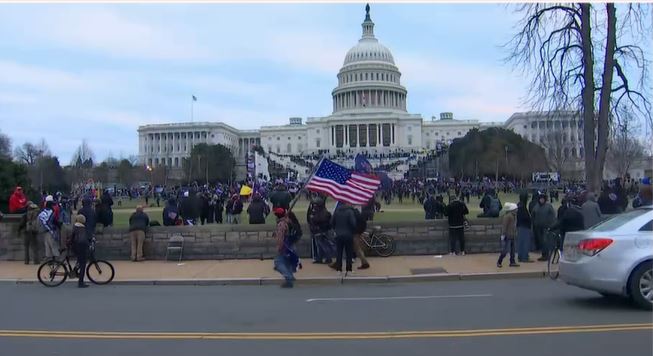
I come back to this with a heavy sigh. I started it yesterday as the news unfolded of people breaching the Capitol building as the Trump rally changed gears. I know there were people there peacefully gathering, but a good many of them crossed the line.
As I watched the events unfold, I struggled to find some solid ground to stand on as I see people who call themselves Christians continue to support Trump regardless of what he says and does. At best, he sent mixed messages that were ambiguous enough to encourage what happened. At worst he incited insurrection, and stood by watching it happen, saying nothing until it was too late. Even then, it was a poor excuse for what he should have said.
The thing that troubles me most as I think about these things is the way Christians who support Trump and this “resistance” at at all costs ignore Scripture that is inconvenient. Paul defined the way followers of Jesus Christ should act regarding authority:
“Let every person be subject to the governing authorities. For there is no authority except from God, and those that exist have been instituted by God. Therefore whoever resists the authorities resists what God has appointed, and those who resist will incur judgment.”
Romans 13:1-2
Peter, the rock on whom Jesus said he would build his church, said the same thing:
“Be subject for the Lord’s sake to every human institution, whether it be to the emperor as supreme, or to governors as sent by him….”
1 Peter 2:13-14
If anyone thinks insurrection is justified because Democrats are “bad” today, consider that Peter and Paul said these things at a time when their world was ruled by Nero.
Nero was a bad leader, even by pagan, Roman standards. He considered himself God. He persecuted Christians and had them publicly killed, setting them on fire at night to light the City. Peter and Paul were both martyred under the rule of Nero.
Democrats are not nearly as bad as Nero. Peter’s and Paul’s words were spoken at a time much worse than the political squabbling today. We can’t justify resisting authority because Democrats are bad – not when we consider the context in which Peter and Paul told believers to respect governing authorities!
At the same time, I am aware that people may justify their resistance on other grounds. Peter, himself, resisted the governing authority in the Book of Acts. Peter and John were arrested for preaching. (Acts 4:2-3) They were commanded not to preach about Jesus, but Peter and John refused to comply, saying,
“Which is right in God’s eyes: to listen to you, or to him? You be the judges! As for us, we cannot help speaking about what we have seen and heard.”
Acts 4:19
They were arrested again for refusing to remain quiet. (Acts 5:20) Again, they were commanded not to speak. Again, they responded, “We must obey God rather than human beings!” (Acts 5:19) This time they were flogged and let go.
So which is it? Submit to authorities? Or boldly rebel?
It seems like a conundrum. Do we get to take our Pick?
Maybe those are not the right questions to ask. Maybe we need to be more careful to weigh the words of Peter and Paul together with their actions and divide the Word of God more accurately.
I watched the Chapelstreet church service today and listened to the sermon by Jeff Frazier in Batavia, IL. It was just what I needed to hear. Not that it tills new ground; it covers familiar ground from a new angle. It avoids the ruts of old, tired ways of thinking and finds fresh new ground (for me) from which to approach how we see Jesus.
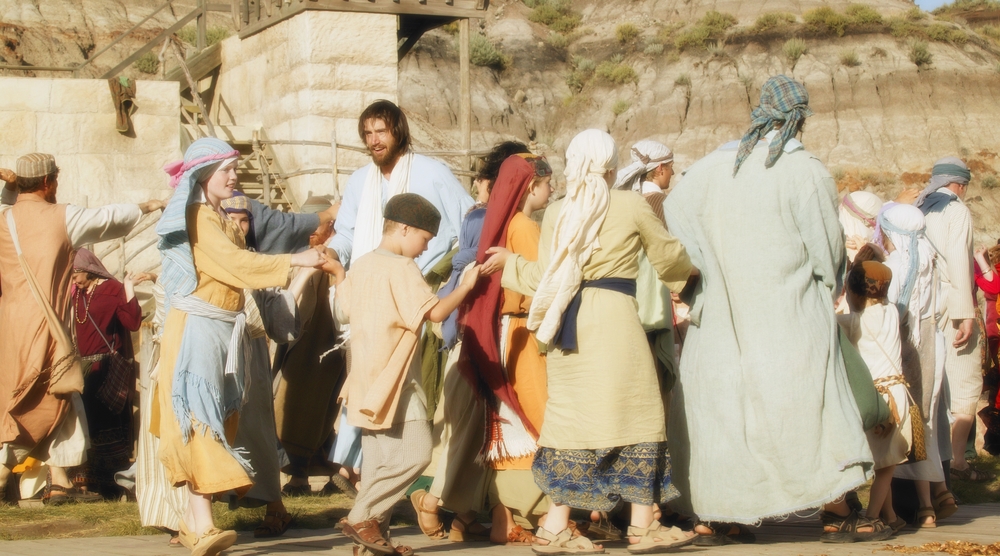
The sermon today was inspired by Matthew 9:9-13.[i] You can read it in full at the endnote below. In summary, Jesus called Matthew from the tax booth where he was sitting to follow him, and Matthew responded by following him. That was the extent of the initial story
Then Scripture jumps to another scene: Jesus reclining at a table with “many tax collectors and sinners”. We are left to draw our own conclusions about what happened in the interim. It could be that Matthew invited all his friends, who were naturally other tax collectors and “sinners”, to met Jesus who had just connected with him.
The focus of the new scene, though, isn’t on Matthew anymore. The focus shifts to the Pharisees who ask the disciples why Jesus eats with “tax collectors and sinners”.
Before I describe how Jesus responded to them, I want to focus on the fact that the people who had a problem with Jesus were the religious people. Jesus was hanging around with all the wrong people according to the religious insiders of his day.
It isn’t a new thing to realize Jesus defied categorization; he shattered expectations and common ways of thinking. He challenged everyone he met to see the world differently, but we sometimes forget the radicalness of Jesus in our routine orthodoxy.
I dare say, if we are not challenged to rethink what we think we know from time to time, we are not likely coming into close enough contact with Jesus!
Back to the story: in First Century Judea, tax collectors were traitors and sell-outs. They were Hebrews who collected taxes for the Romans and used the authority of the Roman occupiers of the Hebrew Promised Land to accumulate wealth for themselves. They were hated by good Jews. They were outsiders in their own community.
As outsiders, they naturally associated with other outsiders (“sinners”). Thus, for Jesus to establish a relationship with Matthew – and worse than that: to “hang out” with other tax collectors and “sinners” – was scandalous. It was unthinkable!
When Jesus heard the Pharisees challenge the disciples to explain why Jesus was associating with “such people”, Jesus famously responded:
“Those who are well have no need of a physician, but those who are sick. Go and learn what this means: ‘I desire mercy, and not sacrifice.’ For I came not to call the righteous, but sinners.”
Matthew 9:12-13
This is a familiar passage to us, but I think the application of the message is sometimes lost on us today. I think we can fall into the trap of the Pharisees in our thinking without even realizing it. Thus, we need to be challenged to see things from a different angle, just as Jesus challenged the Pharisees in the first century.
Again, these are not new thoughts, but the the change of perspective (for me) comes courtesy of Paul G. Hiebert. Born to missionary parents in India, he became “arguably, the world’s leading missiological anthropologist”.[ii]
When he moved back to the west, he wrestled with questions like these: What does it mean for an illiterate, Hindu peasant to know Jesus? How much of their old life and traditions must be left behind?
Having observed missionaries in India, he concluded that the western mission movement was importing too many western traditions and thoughts. He saw the need for thinking outside the western box – like Jesus encouraged the followers of his day to think outside the box…. or rather, outside the circle, as we will see.






 Navigating by Faith