It Is All Relative

On the application of scientific theory to theological constructs.


I encourage reading the post I am reblogging (https://wp.me/p13zfD-1zB) if you like science and faith, or just thinking generally. I firmly believe that science and faith are not only reconcilable, they are intricately synergistic. One informs the other. Whether we study the special revelation of the Word of God or the natural revelation of the creation of God, we learn something of our Creator in the process.

I have often played (only played) with the thought that we misunderstand God and sin and judgment when we see them primarily through a moral filter. It’s not necessarily that the type of filter is the problem so much as our perception of that filter, perhaps. In western thought, we tend to view moral absolutes as ideals that exist in and of themselves. Thank you Plato.

We view moral absolutes as stand alone ideals, independent of God and, therefore, applicable to God. We get caught in the undertow of the Euthyphro dilemma because of this misconception. (Are morally good acts willed by God because they are morally good, or are they morally good because they are willed by God? (See God’s Love is Not Platonic)) There is no way out of the construct, but the construct, itself, is wrong.

Rather, God is God and everything flows from Him. Goodness is good because it is God’s nature and character. Good is only determined relative to God. The article that I am reblogging quickly reviews the book, Faith Across the Multiverse, by Andy Walsh. Walsh applies scientific theory to theological principals with some interesting illumination. Among those scientific theories is the theory of relativity and what it might illuminate about faith. If you like thinking about these things as much as I do, you will like the article and may want to buy the book.

Commitment to a Worldview

The commitment to atheism can be as dogmatic as any other belief.

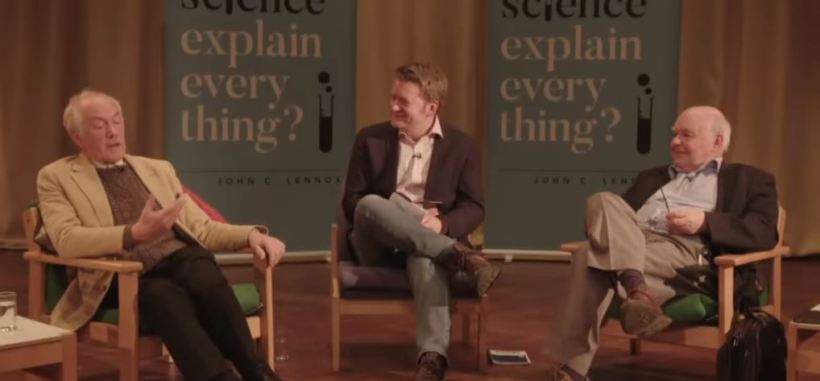
From the Unbelievable! discussion involving John Lennox vs Peter Atkins – Can science explain everything?

In a recent discussion on theism and atheism with the Oxford professors, John Lennox and Peter Atkins representing both ends of the spectrum, the dialogue stopped, and a time of questions and answers began. One person, a scientist, wrote in saying that he is an atheist, but his commitment as a scientist to follow the evidence suggested to him that God does exist. For him, the issue isn’t the evidence, but his own feelings, instincts and emotions.

When this question was put to the two guests to respond, the answers were very intriguing. John Lennox, the Christian, suggested that the man should continue to question and research and to test the position (that God exists) personally, not from afar. The response of the atheist, Peter Atkins, was simple: stick to your “commitment to rationality” (which to him presupposes atheism).


Think about it. Would you suppose the answer, to stick to your commitment, would more likely come from the Christian or the atheist? I would. I think most people would expect that answer to come from the Christian, but it doesn’t in this case. It’s the atheist sticking dogmatically to a presupposition.

Continue reading “Commitment to a Worldview” →

God’s Love is Not Platonic

The love that God offers is relational, intimate and personal.


John the Apostle, a Hebrew from a remote province in the Roman Empire, lived a long life. The other apostles died premature deaths, but John, a typical Hebrew, lived long enough to be elevated out of his provincial Jewish world by the God who created it. His writing, as much as any of the New Testament authors, has a strong philosophical theme, but that philosophical theme is no abstract intellectual construct.

John the one-time fisherman became familiar with the greater Greco-Roman world by which the Palestinian province of his birth was governed and influenced. That familiarity is reflected in the Gospel that bears his name.

His gospel begins philosophically: “In the beginning was the Word”, the Logos.  (John 1:1)  The word, logos, carried poignant philosophical meaning in the Greco-Roman world. John’s use of that word to open his account of the life and message of Jesus shows that John, the provincial Hebrew, familiarized himself with that world and its thought.

This is in keeping with the instruction from Jesus to his followers to go into all the world explaining the message Jesus gave them. To go into the world, we have to become familiar with it and conversant with the thought that predominates in the world to which we go.

Though John’s Gospel begins philosophically, focusing on the loaded word, logos, he didn’t have the abstract notions of philosophy in mind. John’s use of that word pointed outside the Greco-Roman world and transcended it.

Continue reading “God’s Love is Not Platonic” →

The Intersectionality of Jesus Christ

Intersectionality is the focus of my Christmas thoughts this morning.


A recent podcast hosted by Justin Brierley, Debating the Statement on Social Justice – Jarrod McKenna and James White, sparks my thinking this morning. One might wonder what social justice has to do with Christmas Eve that I should be thinking about it. Quite a lot actually.

Before tying up that loose end, though, I feel the need to comment on the discussion. James White was a drafter of the Statement on Social Justice and the Gospel. The express purpose of the Statement is to clarify the meaning of the Gospel in order to guard against false teachings creeping into the Church through modern “sociological, psychological, and political theories”. Certainly, concern over false teachings and false gospels is a theme we find as far back as the Gospels, themselves, and the Pauline letters. We are right o be concerned.

On the other hand, as I listened to the discussion, another concern occurred to me. Yes, we are not of the world, but we are in the world, and the world is our mission field. Jesus left the 99 to search for the one lost sheep. Paul was a Jew to the Jews and a Greek to the Greeks, becoming all things to all people so that he could reach them with the Gospel. (1 Corinthians 9:19-23) Though Paul was concerned about false gospels creeping into the Church, he was also concerned about relating to the lost world.

Continue reading “The Intersectionality of Jesus Christ” →

The Trickiness of Consciousness

Is the ghost in the machine nothing more than information?


Justin Brierley has been doing a series of interviews entitled “the Big Conversation” on his Unbelievable? podcast on the British Premiere Christian Radio. In the latest, and I believe the last, episode, he interviews Daniel Dennett, the Tufts professor and so-called “new atheist” and Keith Ward, the British philosopher, theologian, priest and scholar. Their topic is consciousness. The idea of the “ghost in the machine” comes up about half way through the discussion, and Dennett responds in the segment below:


Among other things, Dennett says that the “ghost in the machine” is nothing more than information. He says, “Information is embodied in the brain”, and “the user of the brain is the brain.” There is no “ghost”.

Of course, to call what Keith Ward describes as the most important aspect of you and me a “ghost” is to minimize it and to reduce it to something of insignificance. Dennett, though would say that the information is the significant thing. There is nothing going on other than the embodiment, transfer and process of information.

So what about consciousness?

Dennett says, “Consciousness is the user illusion of the brain itself…. The brain has been designed to have user interfaces inside it…. Consciousness is a user illusion that is designed by evolution and by learning and by cultural evolution to make our brains capable of getting out bodies through this complicated world.” [Emphasis added]

These remarks are the backdrop for my thoughts today.

Continue reading “The Trickiness of Consciousness” →