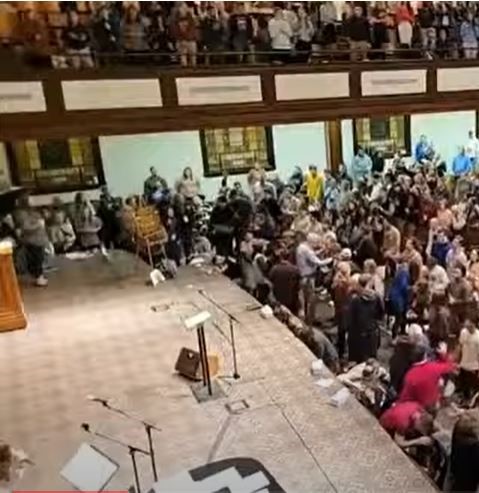
Of the Holy Spirit, Truth, Tares, and Wheat at the Asbury Revival

“[N]o one can say, ‘Jesus is Lord,’ except by the Holy Spirit.”


I listened to Voddie Bauchaum summarize what is wrong at Asbury recently. The video title is (Wow) The Asbury Revival is NOT of God. His summary is similar to other skeptical takes I have heard, so I will summarize his summary here. (You can also watch the video and hear what he says for yourself.)

Bauchaum said he listened to four testimonies of students who attended the “revival”, and they “confirmed exactly what I figured was going on.” It’s a small sampling size, but I have no reason to believe he didn’t hear what he heard.

His conclusions were more in number than his sampling size. First, he said, “This event is nothing more than strange fire.” (The whole event.) For proof, he offered what the students said in their testimonies: One student admitted said he experienced a “fit of laughter”; another student claimed his mother began speaking in “unknown tongues”. (If Bauchaum supplied a summary of the other two testimonies he heard, I missed it.)

The phrase, “strange fire”, is a reference to Leviticus 10:1-3 an incident in which two priests put incense into censors and offered “strange fire before the Lord, which he commanded them not.” (KJV) Those men were consumed by fire from the Lord, the passage says. Therefore, Bauchaum is comparing the people at Asbury to the two rogue priests who presented offerings to God they were not instructed to give and were killed for it.

Clearly, Bauchaum is suggesting that “this event” is not of God; it is “unauthorized” worship; and God views it like He viewed the priests who offered strange fire and were killed for it.

As further proof that this event could not be from God, he said, “A lot of this took place out of the church!” He added that “the university ordains women for ministry, so there is a lot wrong here.”

He went on to explain to say that he was looking for a man of God taking the pulpit to open the Bible and preach the word of God, “and it never happened.” Though he didn’t say it, I am left to assume that revivals must happen only inside church buildings, and then only when a man of God preaches the word of God from a proper pulpit.

I note that he didn’t do much research if he only heard four testimonies, as I found testimonies all over the Internet, including many statements by professors and school administrators. The happenings at Asbury took place over roughly a two-week period, so there was a lot of footage to see and many people who were there talking about it.

I also note that the chapel service began with someone preaching, but, then, I don’t know if he was “a men of God”, and I don’t recall whether he used a pulpit. (Sarcasm alert.)

Bauchaum warned that Satan tricks people with music. As anecdotal proof, he recounted his own experience attending a Pentecostal church a few times when he was a new believer. He recalled feeling emotional, on the verge of tears, because he felt like God was moving, but he determined it was “nonsense” after reading the Bible for himself for several weeks.

To his credit, he said that he “matured really fast” during during those few weeks. (I am not being sarcastic now. These were his words, not mine.) He said he desired to hear someone preach the Word of God because he was hungry for preaching.

To be fair, I can appreciate. I have been in his shoes before when all I wanted was to hear a meaty sermon that dug deep into God’s word.

Bauchaum recalled an old Paul Washer sermon in which people were moved by the preaching of the word, not by the music. As proof that this is the way it should be done, he quoted Romans 10:17: “Faith comes by hearing, and hearing by the word of God.” (No issue there.)

I don’t know if Bauchaum is a cessationist (someone who believes the “gifts of the Holy spirit” have ceased), so I don’t want to make any assumptions. If he is a cessationist, then it would not matter if people had limbs grow back: a cessationist has already determined God doesn’t do those things anymore.

To give him the benefit of the doubt, I can admit that his concerns might be just as validly expressed by someone who is not a cessationist. His concerns do suggest a need for some circumspection, but I have greater concern over his conclusions than any of the spectacle he described that took place on the Asbury University campus for over two weeks in February of 2023.

Continue reading “Of the Holy Spirit, Truth, Tares, and Wheat at the Asbury Revival”

Asbury University and the Manifest Presence of God

I am cautioned, at the same time, by the words of Jesus to the woman at the well that we need to worship God in spirit and truth.

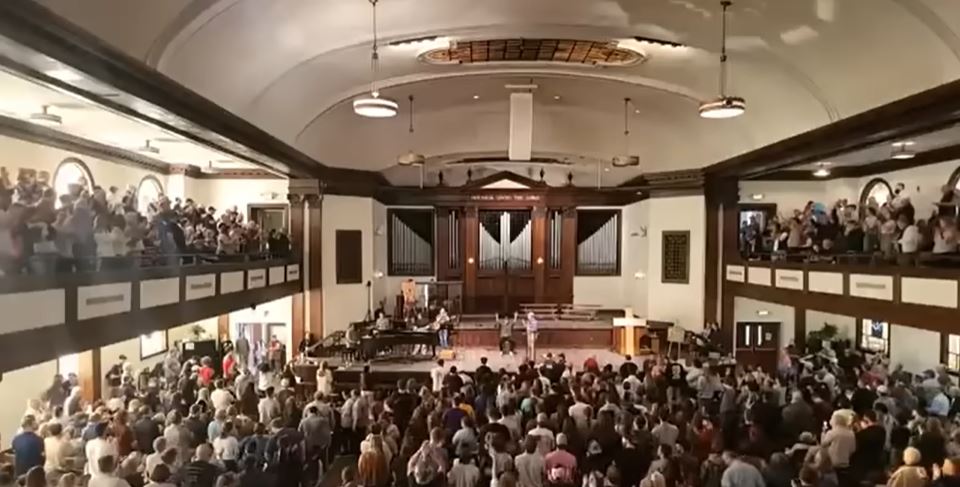
I don’t recall where I obtained this capture, but I am grateful for it.

I woke up thinking about the phrase, “manifest presence of God”. I am not sure where I even heard that phrase. I had not thought of it in ages, but the phrase popped into my head when I slipped from my dreams last night into a brief state of consciousness.

I would say that the so-called “Asbury revival” is an example of the manifest presence of God. What happened there was completely organic. It began after Chapel ended. it began after a very ordinary sermon on a very normal Wednesday morning.

It wasn’t planned or orchestrated. There was no leader. Some students simply lingered. They did not want to stop worshipping. They began praying for each other. Then someone felt the need to repent openly for sin. Others did the same.

One thing led to another. At the same time, students who left the chapel began to make their way back to the Chapel for reasons they could not express. Other students heard that Chapel hadn’t ended and began coming to see what was going on.

Administrators found out something was going on, and they investigated. They recognized that something special was happening, and they had the wisdom to give their blessing to it, not to take over leadership of it, but to let what God was doing simply unfold.

The ongoing Chapel was student led from the beginning. Most of the time, the students leading worship were off to the side. People playing instruments came and went. No one was the center of attention – only Jesus who was lifted up in reverent, tender worship one moment and exuberant praise in the next.


Administrators stayed in the background and supported the students. They protected them when outsiders came flooding in, and they prayed with them. They kept Christian celebrities from taking over the stage and they kept news media out. The University President described it this way:

“What we have experienced since that Wednesday morning has been a current of immeasurable goodness flooding our community and quickly moving into other regions of the world. Words fail any effort to communicate the abundance of experiences and stories that will leave us forever changed.”

The routine chapel service that started on February 8, 2023, was officially ended on February 23, 2023, fittingly on the National Day of Prayer.

God’s manifest present was demonstrated in the repentance of sin, the deep and abiding sense of God’s peace, love, forgiveness, and healing. People spoke of physical healing and deliverance, but it wasn’t front and center. There was little to no spectacle.

The atmosphere in the Chapel was reverent and convicting, but uplifting at the same time, and Jesus was at the center of it. God God was exalted, and Jesus was lifted up as people confessed their sins to one another and to God, repented with tears and weeping, found forgiveness and new joy, prayed for each other and worshipped God. All without a program, or a plan, or a person directing what happened.

Many people would say this was a revival. I don’t know, but it was an example of the manifest presence of God. God simply “showed up”. Not that He was not already present; rather His presence was manifest. To individuals and to all who worshipped corporately.

As I think about the idea of the manifest presence of God, I am reminded of Psalm 139. We can go nowhere that God is not present. We cannot escape him. If we ascended into the heavens, or even to hell, He is there!

He is intimate with us. He knows our innermost thoughts and the intents of our heart. He can even number the hairs on our head, and He knows the words we speak before we even say them.

God is present with us, but his presence is not always manifest. We do not always feel the presence of God. Sometimes, we go long (weeks, months or years) with no sense of the presence of God in our lives. Sometimes, we have trouble even giving mental assent, if we are being honest, to the fact that God is present with us.


When we do feel or sense or see evidence of the presence of God in our lives, we are encouraged, inspired, comforted, and renewed by it. Those times when we are aware of God’s presence can sustain us through the longer, wilderness times. We need to know God in this way.

Jesus is the Bread of Life and the Living Water! What bread that we eat does not satisfy our hunger, and what water that we drink does not quench our thirst? How much more should the Bread of Life and Living Water fill us up and sustain us?!

Continue reading “Asbury University and the Manifest Presence of God”

What Is a Revival? And What Does It Matter?

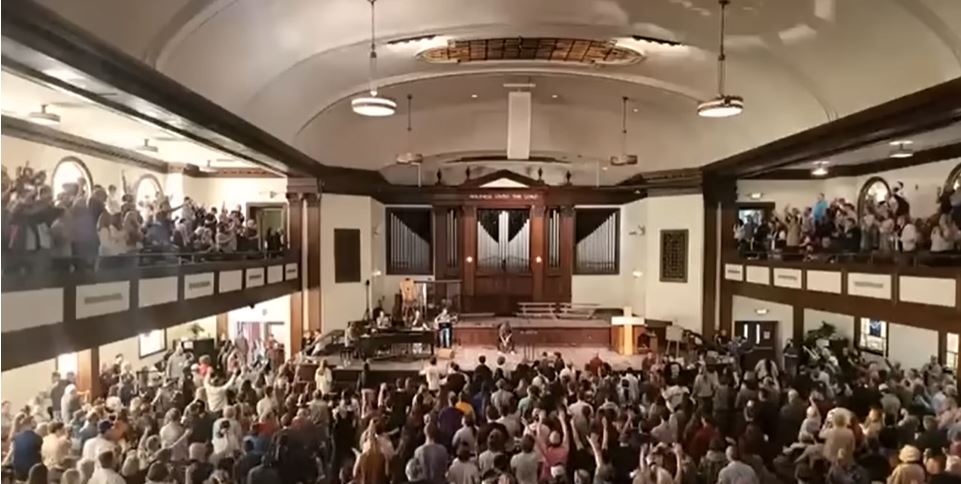
The spark in the beginning seemed to be a small group of students who didn’t want to leave. They didn’t want to stop worshiping.

I did not take this photo, but I am grateful to the person who captured the scene.

I pay only casual attention to the news. Maybe that is why I didn’t know much about what is going on at Asbury University in Wilmore, KY until about 10 days into the 1-hour chapel service that turned into a two-week long, around the clock gathering of young people worshiping Jesus.

Or maybe I hadn’t noticed because most media outlets weren’t reporting on it. Not that they would know what to do with it if they had!

When I began scrolling through Instagram that Friday evening, I found one video after another from the chapel at Asbury University. It seemed like these videos were all I had in my feed, and I started following it.

Along with the live feeds, video, and people self-reporting on the Asbury phenomenon, I began seeing many cautionary pundits who were concerned about whether what was happening is a revival, and these people were convinced it wasn’t.

Notably, the Asbury school administrators and staff seemed uniformly hesitant to categorize what was happening as a revival. They were in agreement with the critics, but criticism rang hollow to me.

I have watched a lot of live video. I have listened to interviews with students, staff, professors and visitors. I have listened to people who are skeptical. I have listened to the cautions and warnings.

I “grew up” in my faith in charismatic churches in the 1980’s. Since the 1990’s, however, I have gravitated away from charismatic churches to more traditional evangelical churches. I have focused on daily Scripture reading, weekly church attendance, and getting involved in leading and participating in small groups, apologetics, and regular fellowship – and writing.

I have been disillusioned by the emotionalism and thrill-seeking that can characterize the charismatic movement. I have seen the dangers of idolizing charismatic leaders and the charismatic movement, itself.  

It’s all too easy to want what God can do for us more than we want God.

Some people I looked up to in those charismatic churches walked away from God. The church that I practically idolized in my early Christian walk, splintered and fragmented and fell apart in a very short time. The pastor who married my wife and I got divorced a few years later. It didn’t last.

I am an attorney. I am trained to be analytical, even skeptical. I am naturally more comfortable exercising my brain than my heart. I can easily settle into an intellectual faith that is thin on experience and authenticity.

I didn’t immediately pay attention to the Asbury University “revival”. We live in a sensationalized world of clickbait, and I have learned to look away.

Revival isn’t a biblical term, as far as I know. I can’t think of a verse or passage that uses that terminology (other than a plea for God to revive).

Anyway, I began scrolling through Instagram on this Friday night. I know better than to scroll through Instagram late at night like that, but it was a long week. I was looking for some mindless entertainment before I shut my eyes and went to sleep.

I scrolled to one video after another from Asbury University. Mild interest began to pique. Something was going on there. It was then that I realized that 10 days is a long time for a routine school chapel to last!

One video showed the last few minutes of the message that ended the chapel. It was ok, but anything but spectacular. It was far from a passionate call to the altar. It was an ordinary message by any measure.

Now, I was even more interested.

Continue reading “What Is a Revival? And What Does It Matter?”

Is Offense a Measure of whether the Gospel is Authentically Preached?

Jesus said, “My sheep hear my voice, and I know them, and they follow me.” (John 10:27)

On a recent Unbelievable Podcast, Justin Brierley posed the question: is the gospel really being preached if no one is being offended?

That question might seem odd out of context, so I should quickly add that the question was posed in the context of the “Asbury Revival”. Many Christians are advocating caution. They are expressing concern about calling the happening at Asbury University in Wilmore, KY a “revival”. Some are questioning whether God was involved at all.

The claims people are making include, among other things, that there is no preaching going on, that the Gospel is not being preached, and that no one is being offended by the message. The latter statement prompted the question.

Is that the measure of whether the gospel is being preached? That some people are offended? Do we really think that it isn’t really the Gospel unless some people are offended?

Because some people were offended that no one seemed offended, does that count as people being offended?

As food for thought, it seems that everyone was offended during the Super Bowl by the two commercials paid for by a Christian group (with a lot of money) conveying the message that “God gets us”. It seems that everyone was offended by those ads, both the secular world and the Christian world. Does the offense mean that the Gospel was preached?

Perhaps, but only if the right people are offended? What if Christians are offended? What if progressive Christians are offended? What do we mean by “progressive”?

Again, is that really the measure of whether the Gospel was preached? Is that really the right question? Isn’t the Gospel the Gospel? Isn’t the Gospel the Gospel, whether some people are offended or not?

What is the Gospel?

We all know that “gospel” means good news, right? But, what is it? What is the good news?

Paul defines the Gospel to the Corinthians when he says, “I want to remind you of the Gospel I preached to you….” (1 Cor. 15:2) He adds, “ By this gospel you are saved, if you hold firmly to the word I preached to you. Otherwise, you have believed in vain.” (1 Cor. 15:3) Then, he says that the gospel message, which is “of first importance”, is as follows:

“… that Christ died for our sins according to the Scriptures, that he was buried, that he was raised on the third day according to the Scriptures, and that he appeared to Cephas [Peter], and then to the Twelve.”

1 Corinthians 15:3-5

When disagreements arose among the Corinthians, and some were lining up behind Paul, and others were lining up behind Apollos, Paul was perplexed by their disunity. He implored them “that all of you agree with one another in what you say and that there be no divisions among you, but that you be perfectly united in mind and thought.” (1 Cor. 1:10)

Paul was perplexed that some were touting him above Apollos, and the other way around. “Is Christ divided”, he asked rhetorically. (1 Cor. 1:13) The obvious answer is no! And the obvious implication is that we should not be divided either.

The problem with the Corinthians was that they were quarreling with each other over their allegiances to Paul and to Apollos. They were disagreeing and quarreling over peripheral things. Thus, Paul says he only came “to preach the gospel—not with wisdom and eloquence, lest the cross of Christ be emptied of its power.” (1 Cor. 1:17)

Emptied of its power? What did Paul mean? Paul said,

“When I came to you, I did not come with eloquence or human wisdom as I proclaimed to you the testimony about God. For I resolved to know nothing while I was with you except Jesus Christ and him crucified. I came to you in weakness with great fear and trembling. My message and my preaching were not with wise and persuasive words, but with a demonstration of the Spirit’s power, so that your faith might not rest on human wisdom, but on God’s power.”

Paul didn’t emphasize his preaching. He didn’t come with “wise and persuasive words”. He emphasized the “demonstration of the Spirit’s power”. The demonstration of the Spirit’s power is usually what we associate with a revival or an awakening. It isn’t the preaching; there is always preaching, but we don’t always get a demonstration of the Holy Spirit.

Continue reading “Is Offense a Measure of whether the Gospel is Authentically Preached?”

What Is the Christian Hope for a Better Life?

What are God’s plans to prosper you and not to harm you, plans to give you hope and a future?


Most people hope for a better life. Many people turn to Jesus because of hope for a better life, but what is the Christian hope for a better life? Sometimes I think even believers lose sight of it.

I was at church yesterday for a meeting I was leading, and I talked to someone who was there for another reason. We talked about the service there the day before for a 25-year old young man who lost his life in a car accident. It was hard.

I made the comment that we are all going to die. I didn’t say it just like that. I recognized with her that it’s hard for someone so young to die suddenly. It isn’t the natural order of things. We miss our loved ones terribly. The ache and the pain is real. A “life cut too short”, as we say, is a tragedy.

But, we should never lose sight of the bigger picture.

We are all going to die.

Sometimes … maybe most of the time … we don’t live like that reality is a fact.

I am not talking about the “eat, drink and be merry for tomorrow you die” kind of attitude. Yet, the people we know who live like that are living with the reality of death, perhaps, more than we might do. Without God, everything is meaningless under the sun!

That reality should point the Christian to Jesus, who rose from the dead, conquering sin and death, and who gives us a better hope. That hope, however, is not just that we will live a better life, but that we will be resurrected to a better life!

Yes, we will live a better life here with Jesus, but this life is not the end game. That’s what I am getting at today. Jesus does not guaranty that we will live a more prosperous life now, a pain-free life, or even a happier life on this earth (under the sun). To the contrary, he said, “In this world you will have trouble!”

Ecclesiastes tells us in no uncertain terms that everything under the sun is meaningless; if this is all there is, this life is vanity; we die like animals and turn back to dust; it doesn’t matter how good we are, how much we accumulate, or how many people like us, know us or honor us. We go down to the grave and live no more, the king and the pauper alike.

This line of thinking prompts me to question: Why do we put so much effort and energy into hope for this life?

The message at church when I began writing this piece was from Hebrews 11. If this topic resonates with you, take some time to read Hebrews 11.

Continue reading “What Is the Christian Hope for a Better Life?”