What Is a Revival? And What Does It Matter?

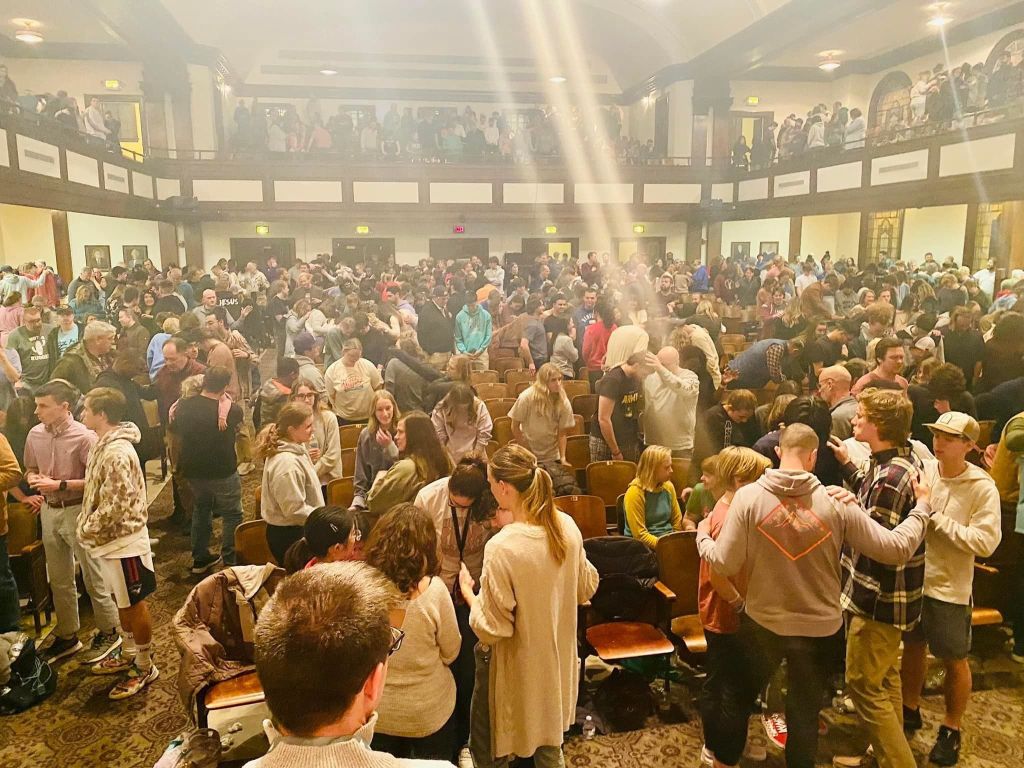
The spark in the beginning seemed to be a small group of students who didn’t want to leave. They didn’t want to stop worshiping.

I did not take this photo, but I am grateful to the person who captured the scene.

I pay only casual attention to the news. Maybe that is why I didn’t know much about what is going on at Asbury University in Wilmore, KY until about 10 days into the 1-hour chapel service that turned into a two-week long, around the clock gathering of young people worshiping Jesus.

Or maybe I hadn’t noticed because most media outlets weren’t reporting on it. Not that they would know what to do with it if they had!

When I began scrolling through Instagram that Friday evening, I found one video after another from the chapel at Asbury University. It seemed like these videos were all I had in my feed, and I started following it.

Along with the live feeds, video, and people self-reporting on the Asbury phenomenon, I began seeing many cautionary pundits who were concerned about whether what was happening is a revival, and these people were convinced it wasn’t.

Notably, the Asbury school administrators and staff seemed uniformly hesitant to categorize what was happening as a revival. They were in agreement with the critics, but criticism rang hollow to me.

I have watched a lot of live video. I have listened to interviews with students, staff, professors and visitors. I have listened to people who are skeptical. I have listened to the cautions and warnings.

I “grew up” in my faith in charismatic churches in the 1980’s. Since the 1990’s, however, I have gravitated away from charismatic churches to more traditional evangelical churches. I have focused on daily Scripture reading, weekly church attendance, and getting involved in leading and participating in small groups, apologetics, and regular fellowship – and writing.

I have been disillusioned by the emotionalism and thrill-seeking that can characterize the charismatic movement. I have seen the dangers of idolizing charismatic leaders and the charismatic movement, itself.  

It’s all too easy to want what God can do for us more than we want God.

Some people I looked up to in those charismatic churches walked away from God. The church that I practically idolized in my early Christian walk, splintered and fragmented and fell apart in a very short time. The pastor who married my wife and I got divorced a few years later. It didn’t last.

I am an attorney. I am trained to be analytical, even skeptical. I am naturally more comfortable exercising my brain than my heart. I can easily settle into an intellectual faith that is thin on experience and authenticity.

I didn’t immediately pay attention to the Asbury University “revival”. We live in a sensationalized world of clickbait, and I have learned to look away.

Revival isn’t a biblical term, as far as I know. I can’t think of a verse or passage that uses that terminology (other than a plea for God to revive).

Anyway, I began scrolling through Instagram on this Friday night. I know better than to scroll through Instagram late at night like that, but it was a long week. I was looking for some mindless entertainment before I shut my eyes and went to sleep.

I scrolled to one video after another from Asbury University. Mild interest began to pique. Something was going on there. It was then that I realized that 10 days is a long time for a routine school chapel to last!

One video showed the last few minutes of the message that ended the chapel. It was ok, but anything but spectacular. It was far from a passionate call to the altar. It was an ordinary message by any measure.

Now, I was even more interested.

Continue reading “What Is a Revival? And What Does It Matter?”

Simple Faith, Like Enoch Who Walked with God

Most of us are more “prone to wander” than we are like Enoch, who “walked with God”.

Man Walking to Heavenly Kingdom

I am afraid that the title to this piece promises more than I can deliver. I don’t have it all figured out. Not even close. If I had it all figured out in my mind, I would still be an impossible gap away from waling it out.

If my mind knew all there was to be known about faith, I am not confident my heart would be sure to follow. In fact, I fear my heart would not follow. It often does not follow where my mind, limited as it is, knows it should go – wretch that I am.

I say this with no love lost for myself and no false humility (to the extent that I can muster a humility that is true).

The worship leader prayed, “You are a God of love”, and he followed with the acknowledgment, “You loved us first.” He continued, speaking to us to remind us that “God forgives is; we fall short, but His mercies are new every day”.

I humbly, gratefully, and joyfully accept these truths. If God were not such as He is, I could not live with myself. I could not forgive myself, but that God forgives me.

This morning I tuned in online to the church service from my easy chair because I tested positive for COVID on Friday. I barely left this easy chair yesterday.

I don’t do well with nothing to do – nothing to do that I want to do anyway, other than mindlessly scrolling through everything my various technological devices will offer me.

Some people are given to doom scrolling, “spending an excessive amount of time reading large quantities of negative news online”, according to Wikipedia, which can cause the mind to race, leading to burnout, and causing you to” feel uncertain, anxious, or distressed”, according to WebMD.

Ironic, isn’t it? The Internet offers conveniently a ready definition to a malady caused by excessive time spent on the Internet. I don’t need to search my mind for the right words. They are at my fingertips with the click of a mouse. I barely need to think about it!

Not that it helps at all. I can define doom scrolling, acknowledge it, understand it and still fall victim to it. Knowledge is like that. It gives us a false sense of mastery and control.

Boredom and mindlessness are a bad combination for me. I constantly desire to be intrigued, engaged, entertained, piqued, inspired … yet I am not always willing to put in the work or thoughtfulness out of which real inspiration, meaning and purpose comes. I also sometimes look for inspiration and meaning in sources that are not capable of delivering it.

Sometimes, I simply don’t want to be bored, but I am too lazy to work at not being bored. Like I said, this is a bad combination for me. It’s a real time suck. An utter waste of time. It leaves me feeling completely unfulfilled and tempted to fill that gap with shadowy pleasures.

After getting up in the morning yesterday and reading through the daily Scriptures that are mapped out for me in the bible app I use, I failed to devote my attention to God or anything meaningful for the rest of the day. I might have said a half-hearted prayer or posted half a thought here and there – nothing but a mist floating over a never-ending torrent of things to see and hear on the Internet.

The sermon this morning was on “the crisis of pleasure”. The crisis of pleasure is a crisis of faith.

It’s a crisis of focusing our primary attention on seeking the scraps we can scrounge up in a world subjected to futility, heads down, eyes focused in the dust, when God is nudging us to look up. It’s a crisis of settling for the meager samplings found in the here-and-now while ignoring Christ, the hope of glory, who offers us things we can’t even imagine.

My mind knows these things full well. I write about them often. It might even be the most common theme of my writing – letting go of the things of this world to seek first the Kingdom, living as strangers and aliens in this world that is passing away, because we long for a heavenly country.

The pleasure we seek in this world is to please the self. There is no other kind. The pleasure we long for is the pleasure God gives back to us when we please Him:

Give, and it will be given to you. A good measure, pressed down, shaken together and running over, will be poured into your lap. For with the measure you use, it will be measured to you.

Luke 6:38

That brings us to the sermon, which was about Enoch, a man who was commended for his faith, because he pleased God. (Heb. 11:5) Enoch was a man who “walked with God”. (Gen. 5:22, 24) Reading these passages together tells us that walking with God and pleasing Him are the same things, and they are evidence of our faith, because:

[“W]ithout faith it is impossible to please God, because anyone who comes to him must believe that he exists and that he rewards those who earnestly seek him.”

Heb. 11:6

Once again, we see that faith is an action word, something I have noted a few times lately. Faith is an action that involves walking!

Continue reading “Simple Faith, Like Enoch Who Walked with God”

What The Bible Has to Say about Grumbling and How to Overcome It

The pressures we face and how we react to them determines our character.

The Bible has a something to say about “grumbling”. Have you ever noticed that? What’s the deal with grumbling? What IS grumbling, anyway? I was realized recently that maybe I should not assume I know, so I spent a little time digging into it. My writing today is inspired by James:

Don’t grumble against one another, brothers and sisters, or you will be judged. The Judge is standing at the door! Brothers and sisters, as an example of patience in the face of suffering, take the prophets who spoke in the name of the Lord. As you know, we count as blessed those who have persevered. You have heard of Job’s perseverance and have seen what the Lord finally brought about. The Lord is full of compassion and mercy.

James 5:9-11 NIV

James tackles grumbling against others, and says that people who grumble against others judge them. (While our own Judge is at the door!) James also contrasts grumbling to perseverance, grumbling against others seems to be a failure to persevere.

If anyone had a legitimate opportunity to grumble it was Job, who was afflicted though he was a man who was considered blameless, full of integrity and pure in his desire to worship God. When he was afflicted, his wife urged him to grumble against the Lord. His wife said to him,

“Are you still maintaining your integrity? Curse God and die!” He replied, “You are talking like a foolish woman. Shall we accept good from God, and not trouble?” In all this, Job did not sin in what he said.

Job 2:9-10 NIV

Thus, grumbling is something we do against God also. Grumbling is something we encourage each other to do at times, perhaps, because “misery loves company”. Job was goaded by his wife to grumble against God, but he refused. Job is held up by James as a model for us to follow: a man who persevered patiently in difficult circumstances without grumbling.

The word translated “grumbling” in James 5:9 is the Greek word, στενάζω (stenazó), which means literally “to groan (within oneself)”. It can be used as an expression of grief, anger, or even desire.

The word, stenázō, comes from the root word, stenós, which means “compressed, constricted”. The idea is that one who groans is doing so “because of pressure being exerted forward (like the forward pressure of childbirth)”. Figuratively, it means “to feel pressure from what is coming on – which can be intensely pleasant or anguishing (depending on the context)”. (See Biblehub)

Stenós, then, seems to be the internal pressure that causes us to groan inwardly, and stenázō seems to be an outward negative response to that inward pressure – to grumble. The word is also translated complain, murmur, and grudge.

As I think about these things, I realize that we do not control the pressures that bear down on us from within (and without), but we do control how we react to those pressures. Grumbling, complaining, and murmuring against others and against God is a negative reaction to the pressures we face.

James calls us to react differently to the pressures we face. He calls us to bear up with patience and perseverance. If we give in to grumbling and complaining against each other, we become judges of each other, forgetting that we have a Judge who stands at the door. When we grumble against God, we judge our Judge!

This passage also suggests that, while we may groan inwardly, we do not have to groan (grumble and complain) outwardly – though we may strongly desire to! We have a choice in the matter, and the better choice is to be patient and persevere.

That observation, perhaps, begs the question: why is it better to persevere with patience rather than grumble?

Continue reading “What The Bible Has to Say about Grumbling and How to Overcome It”

The Importance of Building Your Ark as God Instructs

We do not walk alone; we walk with God and with each other. Perhaps, my experience will be helpful as I have been helped by others who have had similar experiences.


I was praying one morning recently for God’s help to guide me away from the paths of thought and actions that take me down. I had been wrestling lately with old sin and losing the battle.

I do not often get so personal on this blog, but God knows all. He knows my heart, my thoughts, my actions – everything. He knows the words I speak before I even say them (or write them as the case may be). Nothing is hidden from Him.

I do have people who are close to me who I confide in and help me sort through these things. Still, being so personal is hard.

To get to the point, I have been married for 38 years as of November, but my wife informed me last June that she hasn’t been happy in a long time, and she moved out. I have been sad and depressed since she left.

Her leaving, and the present silence and emptiness in my life without her have filled my thoughts and haunted my waking hours since then. I have spent most of my life working to support my family. Our kids are out on their own now, and I was beginning to let myself think about retirement for us.

Now, everything has changed. At the age of 63, I am adrift. My future is uncertain. I am sad for her, and I am sad for me and I fear the future will not be easy for either of us.

I doubt she will not be happier now. I have often said and believe that the grass isn’t always greener….. But, she doesn’t seem to see it that way. Perhaps, she is willing to trade one kind of unhappiness for another.

Maybe I haven’t been happy myself for a long time, but I don’t really think about it. I have come to believe that happiness is fleeting. I can live with unhappiness. I would rather search for a joy that lasts forever than settle for mere happiness that is here today and gone tomorrow.

Maybe that attitude doesn’t make for a good marriage. I don’t know. I do know that I am no hero in this story. I have failed in many ways, and my failures hang like a dark cloud over me. They threaten to crush me.

I have not written much since June because of these things. I haven’t had the inspiration or the energy to write. Yet, I feel God called me to write, so I am trying to plod on.

I don’t want to dwell on these thoughts, but this is where I was when I approached God one recent morning. My failures, disappointments, regret and other negative emotions are ever before me, and they threaten to undo me.

Not the least of which is the gravitational pull to give in to old ways of thinking and to succumb to old habits. I have at various times lost the will to overcome and fallen back, and I have despaired in my falling back.

As I asked God to help me, to rescue me from my thoughts that threaten to take me down, a verse I read in my daily Bible reading that morning seeped back into my conscious thoughts, and I engaged with it:


“And Noah and his sons and his wife and his sons’ wives entered the ark to escape the waters of the flood.” 

Genesis 7:7 NIV


Noah, who was said to be “blameless in his generation”, was saved from the judgment of God by building an ark. That ark was the vessel that lifted Noah and his family above the waters and carried them on to safety.

Continue reading “The Importance of Building Your Ark as God Instructs”

What Is the Christian Hope for a Better Life?

What are God’s plans to prosper you and not to harm you, plans to give you hope and a future?


Most people hope for a better life. Many people turn to Jesus because of hope for a better life, but what is the Christian hope for a better life? Sometimes I think even believers lose sight of it.

I was at church yesterday for a meeting I was leading, and I talked to someone who was there for another reason. We talked about the service there the day before for a 25-year old young man who lost his life in a car accident. It was hard.

I made the comment that we are all going to die. I didn’t say it just like that. I recognized with her that it’s hard for someone so young to die suddenly. It isn’t the natural order of things. We miss our loved ones terribly. The ache and the pain is real. A “life cut too short”, as we say, is a tragedy.

But, we should never lose sight of the bigger picture.

We are all going to die.

Sometimes … maybe most of the time … we don’t live like that reality is a fact.

I am not talking about the “eat, drink and be merry for tomorrow you die” kind of attitude. Yet, the people we know who live like that are living with the reality of death, perhaps, more than we might do. Without God, everything is meaningless under the sun!

That reality should point the Christian to Jesus, who rose from the dead, conquering sin and death, and who gives us a better hope. That hope, however, is not just that we will live a better life, but that we will be resurrected to a better life!

Yes, we will live a better life here with Jesus, but this life is not the end game. That’s what I am getting at today. Jesus does not guaranty that we will live a more prosperous life now, a pain-free life, or even a happier life on this earth (under the sun). To the contrary, he said, “In this world you will have trouble!”

Ecclesiastes tells us in no uncertain terms that everything under the sun is meaningless; if this is all there is, this life is vanity; we die like animals and turn back to dust; it doesn’t matter how good we are, how much we accumulate, or how many people like us, know us or honor us. We go down to the grave and live no more, the king and the pauper alike.

This line of thinking prompts me to question: Why do we put so much effort and energy into hope for this life?

The message at church when I began writing this piece was from Hebrews 11. If this topic resonates with you, take some time to read Hebrews 11.

Continue reading “What Is the Christian Hope for a Better Life?”