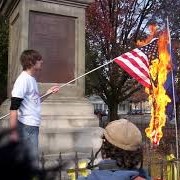
Comments on Freedom and the Clash of Ideas

If any speech or expression is deemed unworthy of protection on the basis of its content, no speech or expression is safe.


“The clash of ideas is the sound of freedom.”  (Lady Bird Johnson)

I grew up in the 1960’s and 1970’s, bring born at the very end of 1959. My young, impressionable mind recalls the assassination of JFK, Robert Kennedy and Dr. Martin Luther King, Jr. I remember watching the riots during the Democratic National Convention in Chicago, the Kent State protest and shooting, the footage of the Vietnam War and the Nixon impeachment on the nightly news.

The world seemed a chaotic place, no less than it does today, on this 4th day of July, 2020.

In the 1960’s, the dissident voice championed First Amendment rights that included the freedom of assembly and freedom of speech. I remember that freedom cry as a child superimposed over news footage of a burning US flag. The patriot in my young heart was equally shocked by the flag burning and impressed by the necessity of the freedom that allowed that flag to burn.

In law school, I learned the nuances of the jurisprudence that grows out of our US Constitution in which the First Amendment is enshrined. The clash of ideas is so sacred in our constitutional framework that it allows even the idea of abolishing that very framework to be heard.

In the 21st Century, many things have changed, while somethings have remained the same. Many of the dissident ideas from the 1960’s have become mainstream, and more “conservative” voices have become dissident. I am no longer shocked by the burning of the flag (and, perhaps, the point of burning a flag is no longer poignant for the same reason).

The angst of the 1960’s of my youth has been replaced by the angst of the 21st Century of my middle age. The reasons for my angst are much different, yet very much the same at their core. I have grown and changed in my views, but the emotional strain of the human condition remains.

I fear, at times, that the framework that protected the freedom to burn US flags in the 1960’s might, itself, be destroyed in my lifetime, or the lifetime of my children, by the fire of ideas that are antithetical to that freedom.


The ideas in colleges and universities around the country that seem to dominate those institutions promote the silencing of dissident voices. Speaker engagements are canceled as the loudest voices want not even a whisper to be heard in opposition.


One theme of the dominant social, philosophical and political ideologies that thrive on college campuses today is that certain voices should be silenced, while other voices should be magnified – a kind of totalitarianism of ideas. This worldview would destroy the foundation of the First Amendment if the First Amendment is not held firm.

I am shocked by this new predominant view as I was once shocked by the burning of a US flag. The shock stems not from the evils in society this ideological view aims to address, as I find some common ground in those concerns. I am shocked that the proposed remedy involves weakening the most fundamental freedom that protects freedom itself – the freedom of ideas and the right to express them.

The idea of “hate speech”, as well-intentioned as it sounds, is inimical to a framework of freedom that protects the clash of ideas. Nowhere is freedom more necessary to be protected, than at the intersection of ideas and the right to express them. One person’s hate speech is another person’s freedom of expression.

If we allow the idea of hate speech into the fabric of First Amendment jurisprudence, we threaten its very foundation. What we characterize as “hate” today is subject to change with changing societal norms tomorrow. No speech is safe from the label of “hate” if labels are allowed to silence speech.

While such a worldview has some appeal and laudable goals, it cannot be advanced by the abolition of freedom of speech. Yet, I realize at the same time, that freedom, real freedom, protects even those ideas that are antithetical to freedom and demands that they be heard.


As shocked as I was in my naïve youth to watch the US flag burn in the streets of America, I understood the importance of allowing that expression to be heard. That I am no longer shocked by that expression is of no consequence.


In fact, freedom of speech is nowhere more vital than the protection of speech that is offensive. Favored speech doesn’t need protection.  If any speech or expression is deemed unworthy of protection on the basis of its content, no speech or expression is safe.

Continue reading “Comments on Freedom and the Clash of Ideas”

Learning to Walk in God’s Way: A Life Journey


Solomon’s story is a tale of a wise and noble man, as far as men go. He was the wisest of men. (1 Kings 4:30) He had everything. He was handed the kingdom of Israel from his father, David, who had subdued all the warring nations around them.

Solomon had peace for the entire 40 years of his reign because of David’s prowess and provision. Solomon was also a great statesman in his own right, maintaining strong relationships with foreign leaders.

Without the ever-present threat of war, and with the help of favored nations, Solomon was able to build a stunning Temple for God and a magnificent house for himself.

Solomon was also called Jedidiah (beloved of the Lord).

When God offered him whatever he wanted, Solomon chose wisdom. The wisdom literature in the Bible, and possibly Ecclesiastes, were written by Solomon, along with some Psalms that remain with us today. Leaders from around the known world traveled to take counsel from Solomon.

Among the things Solomon wrote was Proverbs 5:1-4:

My son, pay attention to my wisdom,
turn your ear to my words of insight,
that you may maintain discretion
and your lips may preserve knowledge.
For the lips of the adulterous woman drip honey,
and her speech is smoother than oil;
but in the end she is bitter as gall,
sharp as a double-edged sword.

In Proverbs 5:15-16, these famous poetic words were penned:

Drink water from your own cistern,
running water from your own well.
Should your springs overflow in the streets,
your streams of water in the public squares?

Surely, Solomon was too smart and wise to be tripped up by lust, right?

Well… no. I am not sure that Solomon committed adultery (like his father David did, taking Bathsheba, the wife of Uriah, who gave birth to Solomon). He didn’t need to, because he took for himself hundreds of wives and hundreds of concubines on top of that! (1 Kings 11:3)

God had spoken many years before to Moses about the conduct of kings. Solomon in his wisdom certainly would have known these words: “[The king] must not take many wives, or his heart will be led astray. He must not accumulate large amounts of silver and gold.” (Deut. 17:17)

Of course, Solomon did both. We learn in 1 Kings 11 that those hundreds of wives turned Solomon’s heart from God, which tarnished his legacy and led to the break up of the nation of Israel forever.

What does the story of Solomon tell us?

Some people might conclude (too easily) that the Bible is full of contradictions. Is this the lesson: don’t do as I do; do as I say?  If Solomon, as wise as he was, got tripped up by common lust and greed, what does that mean for the rest of us?

Continue reading “Learning to Walk in God’s Way: A Life Journey”

Don’t Let Fear Win: Keep the Conversation Going


“When two enemies are talking, they aren’t fighting. It’s when the talking stops that the violence starts. Keep the conversation going.”

This is how Daryl Davis concludes his Ted X Talk, Why I, as a black man, attend KKK rallies, December 8, 2017. Yes, that’s right, a black man who attends KKK rallies!

Let that sink in a little bit.

It’s not that Daryl Davis has any affinity for the KKK. He certainly doesn’t, but he is an outside-the-box thinker. When he came to the realization that racial prejudice exists as a young boy, and that it was aimed at him (it took some time for that to sink in at 10 years old), he began to ask questions. In his boyish curiosity, he wondered, “How people could hate me if they didn’t even now me?”

That question led him to read books on white supremacy, black supremacy, and similar topics, but he couldn’t find a good answer. He figured, then, that the best way to get an answer would be to go to the source. By that time, he was an adult.

His curiosity led him to invite the Imperial Wizard, the national leader, of the Ku Klux Klan, to meet with him. He was warned, “Don’t fool with Mr. Kelly. He will kill you!” Daryl Davis, though, is no ordinary person. His curiosity was stronger than his fear.

His secretary set up the meeting, as requested, in a local hotel room. His imperial guest knew only that the interview was to about his involvement in Klan. No one told the Imperial Wizard that his interviewee was black.

Kelly showed up to the hotel room right on time with his armed body guard. They froze when they saw their host, but they entered anyway as Daryl Davis invited them to sit down.

The meeting was tense. About an hour into the meeting there was a strange noise that Davis thought came from his guest. He was instantly ready to lunge from his seat to take down his guest and his bodyguard as those previous words of warning rushed like lava ready to erupt to the surface. (“He will kill you!)

Daryl glared into the eyes of Mr. Kelly with the intensity of a man demanding to know what caused that noise! The Imperial Wizard glared back at him with the same urgent intensity as the body guard looked from one man, then to the other with his hand on his gun. Anything could have happened.

In a moment, Daryl’s secretary, Mary, realized what happened and began to laugh. She had filled a cooler with ice and cans of soda pop for the meeting. She knew immediately that the sudden noise was merely the cans falling as the ice melted and shifted underneath.

They all laughed in relief. It was a literal and figurative ice breaker.

The story gets better, and the lessons to be drawn from it are especially poignant in this time of increasing political, racial and religious polarization in the United States. This is the rest of the story of the black musician who invited the Imperial Wizard of the KKK to meet him in a hotel room.

Continue reading “Don’t Let Fear Win: Keep the Conversation Going”

The Story of the Napalm Girl and the Healing Power of Jesus

Kim Phuc saw another plane coming in low, fast and loud. She saw the bombs drop, and she froze….


Kim Phuc is “the girl in the picture”, maybe the most iconic picture of the Vietnam War. It’s one of the most memorable wartime photos ever taken. She is the girl in the picture running from a napalm bomb that dropped on her village.

Kim grew up in a happy family that was well off and lived far from the war, or so they thought. Then, the war came to them. The villagers had taken refuge in the local temple, and the South Vietnamese Army had taken up guard to protect them.

One day, however, planes flew overhead. The first plane dropped a marker at the temple. The soldiers, knowing what that meant, screamed for everyone to run. As Kim reached the exit of the temple, she saw another plane coming in low, fast and loud. She saw the bombs drop, and she froze.

Before she knew what was happening, she was surrounded by flames. When she saw her arm on fire, she ran in panic and fear until she couldn’t run anymore.

When she stopped running, a soldier gave her water. She remembers crying, “Too hot! Too hot!” The soldier poured water on her, thinking it would ease her pain, but the water reacted with the napalm, intensifying the pain, and she passed out.

Kim suffered 3rd degree burns over a third of her body. The photographer who took the photo dropped his camera and took her to the hospital.

The hospital didn’t have enough room for her because of the number of injured from the raid on her village. She was in such bad condition they moved her to a morgue. They left her for dead to tend to the living.

Her mother and brother searched for her, found her, and carried her back to the hospital. When her father arrived, she was transferred to a burn clinic in Saigon. She was saved by her family’s determination to help her, but she would have a long, painful road ahead.

Every morning when the nurse took her to the “burn bath” to soften her dead skin to be removed, she cried through the excruciating pain until she passed out. She had a dozen laser treatments. She had eighteen surgeries. She spent years in physical and emotional pain.

Her father spent all his waking hours tending to her with a broken heart. She was in so much pain, he prayed she would die to end her misery. Her parents feared something would happen to them that would leave her alone in her pain.

She lived of course, but she was ashamed of her scars. Friends stopped wanting to be with her. Her family loved her, but she became lonely. She was no longer the beautiful, young girl she once was. She saw nothing but ugliness when she looked in the mirror.

She also lived with trauma and nightmares from her experience. She was filled with bitterness, hatred and anger. She kept asking, “Why me?!” She despaired of life. She felt like only death would give her an end to the suffering and pain.

Continue reading “The Story of the Napalm Girl and the Healing Power of Jesus”

Comparative Views on Pain and Suffering

What we have in Christianity is a God who is separate from His creation, but He isn’t detached. He is intimately engaged even with our suffering.


I studied World Religions in college at a time when I was searching. Buddhism was attractive to me at the time. (I have written on this before in Lured by Buddha but Taken By Christ and Reflecting Back On the Path I Have Traveled, among other places.) Perhaps, the reason that I think about the comparison of Christianity to Buddhism (in particular) is that I was attracted to Buddhism once, so I am interested to read or listen to what others have to say about it.

Though I eventually gave my life to Jesus Christ and vowed to follow Him, that decision was made in the environment of a secular college. My new found faith was challenged from the start. I engaged in a constant measuring of that belief against competing views early on, and that habit of measuring Christian belief against competing worldviews continues to this day.

Though we are all susceptible to confirmation bias, I strive to put my faith to the test. While I have held tightly to “mere Christianity”, I have held loosely to denominational doctrines, peripheral views and political positions, among other things. I have “evolved” in my thinking on evolution and science, and I have spent the better part of 4+ years deconstructing my political views at age 60 (now), to identify just a couple of area sin which my views have changed.

I also have spent much time wandering in my own wilderness. I have not always been a faithful follower.  Though I have had many reasons to turn aside and have nearly been undone by my own proclivity toward sin, I have not found any worldview or way more compellingly true then what I have found in following Christ.

Since I became a believer in Jesus, I have always been keenly aware of the intersection of belief and unbelief, probably because of the environment in which I became a Christian. I was confronted from the beginning by alternative and opposing views, and testing Scriptural text against alternative and opposing views has become a force of habit.

As I do, I am reminded of certain signposts along my journey, benchmarks of enlightenment – the light bulb moments in my journey – that have marked my way. I am reminded of them again when they pop up in front of me from time to time.

I came across one reminder of an old signpost this week. It was in a letter to Justin Brierley, host of the Unbelievable? Podcast, that he read on the air. The writer of the letter commented on a discussion about Christianity in India and the native religion of India, Hinduism. Brierley read the letter, prefacing it with the questions: “Which worldview offers the most satisfactory explanation [for pain and suffering], and which worldview offers the most opportunity for healing?”

Below, I will recite from the letter verbatim and make a few comments on the the dramatically different ways in which Christianity and Buddhism  (and Hinduism) approach suffering: Continue reading “Comparative Views on Pain and Suffering”