The age of the Earth is a hot button topic for Christians today. Science suggests that the Earth is old, but a large segment of western Christianity has put down big stakes on the claim that the Earth is young. We have to be careful here that this tension doesn’t overshadow the Gospel.
To be fair, it isn’t all western Christianity. It’s American Christianity where the age of the earth has become almost a litmus test in some circles for belief in God. But is it a good litmus test? Does the Bible speak to the age of the universe?
Frank Turek observes that we have to make assumptions when we talk about the age of the universe. (See The Bible and the Age of the Universe) For instance, when we measure the universe by the speed of light, the calculation shows that the universe is 13.8 billion years old. If we assume the speed of light has not changed since the earth was created, then the earth is 13.8 million years.
But, “Is that a good assumption?” asks Turek. What do you think? Does the Bible have answers for these kinds of questions? Read on if you want to know.
Has there ever been a greater evil in the world then this…
That God humbled himself to become one if us, divesting himself of all of his greatness and glory, to give Himself to us. The light came into the world, but the world loved darkness instead.
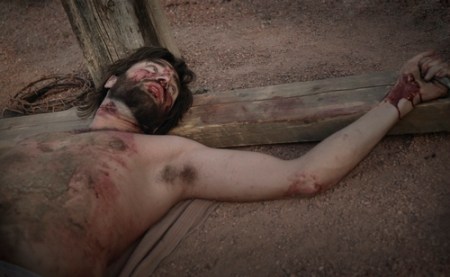
God became a man and came to us, and we rejected him. God presented himself to us, and we crucified him, publicly humiliated him, cruelly beat and tortured him, mocking him as he died on the cross.
Is there no greater love than this…
That God, the creator of the universe became one of us. He laid aside all of his greatness that sets Him above everything that He created and become part of His creation.
That he would do that for us, experiencing the same sorrows, the same humiliation, the same awful pain, the same rejection, the same fatigue and need for sleep and hunger and thirst as we experience – that God would stoop to become one of us and to die on a cross as a sacrifice for us to redeem us from our own sinful ways – is an unbelievable feat of love.
He did even for the sin of rejecting the very God who created us.
That God would do these things reveals to us that he works in and through a sinful, fallen, and evil world, and He uses the very darkness of the world to display His light and His love for us.
God stands above and beyond time, surveying all that is, all that ever was, and all that ever will be. He knew the time of His coming before the initial burst of the creation of the cosmos that spawned the earth and eventual life it would contain, including us.
He knew the reception He would be given. He knew the time of His dying at the hands of His creation. He knew the time of His rising from the dead, and He knows the end He has planned out for all those who receive Him.
Just as God’s light shone in the darkness of the world in the life, death and resurrection of Jesus, we can take comfort in the hope of salvation God wrought for us and the promises that await us.
Jesus didn’t live up to the expectations of the crowd who followed him, and, no longer believing he was the Messiah they had hoped for, they turned on him
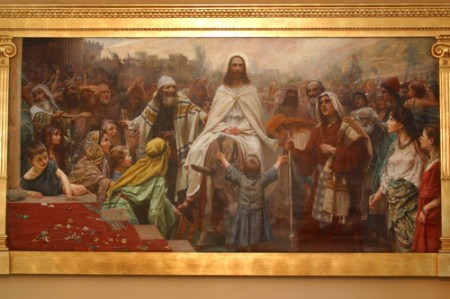
Today is Palm Sunday. This is the day we celebrate the “triumphal entry” of Jesus into the City of Jerusalem. He rode into the city on a donkey. Many hundreds of thousands were gathered in Jerusalem for the coming Passover. John tells us that people gathered in expectation of seeing Jesus because of the word that he had raised a man (Lazarus) from the dead days before. (John 12:17-18)
As Jesus entered the City, people lined the streets with palm branches. They threw their cloaks on the road in front him, and they hailed him with. This is Luke’s account:
As he went along, people spread their cloaks on the road. When he came near the place where the road goes down the Mount of Olives, the whole crowd of disciples began joyfully to praise God in loud voices for all the miracles they had seen: “Blessed is the king who comes in the name of the Lord!”
Luke 19:36-38
And here is John’s account:
The next day the great crowd that had come for the festival heard that Jesus was on his way to Jerusalem. They took palm branches and went out to meet him, shouting, “Hosanna!” “Blessed is he who comes in the name of the LORD!” “Blessed is the king of Israel!”
John 12:12-13
As we celebrate Palm Sunday today, we know the story of Jesus is about to take a very dramatic, tragic turn for the worse. The triumphal entry of Jesus into Jerusalem is not the precursor of celebratory times. Ominous clouds are looming on the horizon.
The incongruity of this joyous moment days before Jesus will be crucified is sobering. He was hailed King of the Jews by an adoring crowd days before a jeering crowd yelled, “Crucify him!” Most sobering of all is the likelihood that many people in those crowds were the same people.
The Ham/Nye debates were my introduction to Ken Ham (and to Bill Nye for that matter). I wanted Ken Ham to be my champion of a biblical view of science, but I just came away unsettled. (See Debriefing the Nye v. Ham Debate)
As I’ve admitted before, I am decidedly not a science guy. I tend to put these things on my back burner and let them simmer, and that is what I did with the debates. Quite some later I came across Hugh Ross and Reasons to Believe. He made sense of the science and the biblical creation account in Genesis. He still does to me, though I tend to take all of these things with a grain of salt because I still don’t know what I don’t know.
I have consciously avoided criticizing Ken Ham because so many Christians love him. And again, I don’t know what I don’t know about the science. But, I am changing on that score too. It isn’t the science that I am chiefly focused on at this point, but something far more fundamental to the Christian faith – the Gospel.
I often listen to podcasts in the morning as I shave, shower, brush my teeth and get ready for work. Today I was listening to Dr. William Lane Craig respond to some questions about free will and suffering, and his comments prompt this blog piece.
He made the following statement
“Natural suffering forms the arena in which the drama is played out of people being freely called to come into the kingdom of God and find an eternal relationship with God. It is not at all improbable that only in a world infused with natural suffering would an optimal number of people freely respond to God’s gracious initiatives and come to enjoy a relationship with God and eternal salvation.”
Dr. Craig represents the Molinist view of the tension between God’s sovereignty, knowledge and power and man’s free will. On the Molinist view, God knows the future, but he does not determine it. Knowing the future, God chose to set the universe in motion, but he does not determine every aspect of it, including the choices that people make.
Knowing the future, God chose to set the universe in motion, and to that extent, He determines the outcome, because He knows the outcome. He does not determine it, however, to the extent of interfering with the free will He gave humans who are created in His image.
The fact that he knows the outcome, does not mean that He determines the choices each person makes. Each person is free to choose as they will, but God knows how they will choose from the beginning, and so He can be said to have willed it.
This is (my simple version of) the Molinist view. It respects God’s sovereignty, while acknowledging the clear implication of free will and moral responsibility to which God holds us that is reflected from beginning to end in the Bible.
I tend to like the Molinist view, but I am always somewhat cautioned in my own thinking not to be overly concerned with doctrinal nuances on matters that are, frankly, beyond us. I don’t want to die on a Molinist hill, or any other hill than the Gospel.
The Calvinist resurgence in the church today stands in contrast to a more Armenian view of inviolate free will. Many have been the discussions and debates between these two views. I fear we spend too much time and energy on debating when we should spend more time living out the Gospel. I think Paul might lump these debates in the category of vain discussions.
Still, I think it is good to chew on these things as they may be beneficial to our knowledge and understanding of God. As I thought about Dr. Craig’s comment above, I could not help think that this is a kind of divine utilitarianism – what is optimal for generating the most free will responses of love for, relationship with God, and eternal life with God.
Dr. Craig’s thesis is an attempt to explain why suffering exists in the world when God is supposed to be good, all-powerful and sovereign. Why doesn’t God stop suffering if He is all those things? Why does he allow suffering at all?