Take a Risk to Prepare Room for God in Your Life

If you won’t leave what you’re guarding to see what God is doing, then what you are guarding is your god.

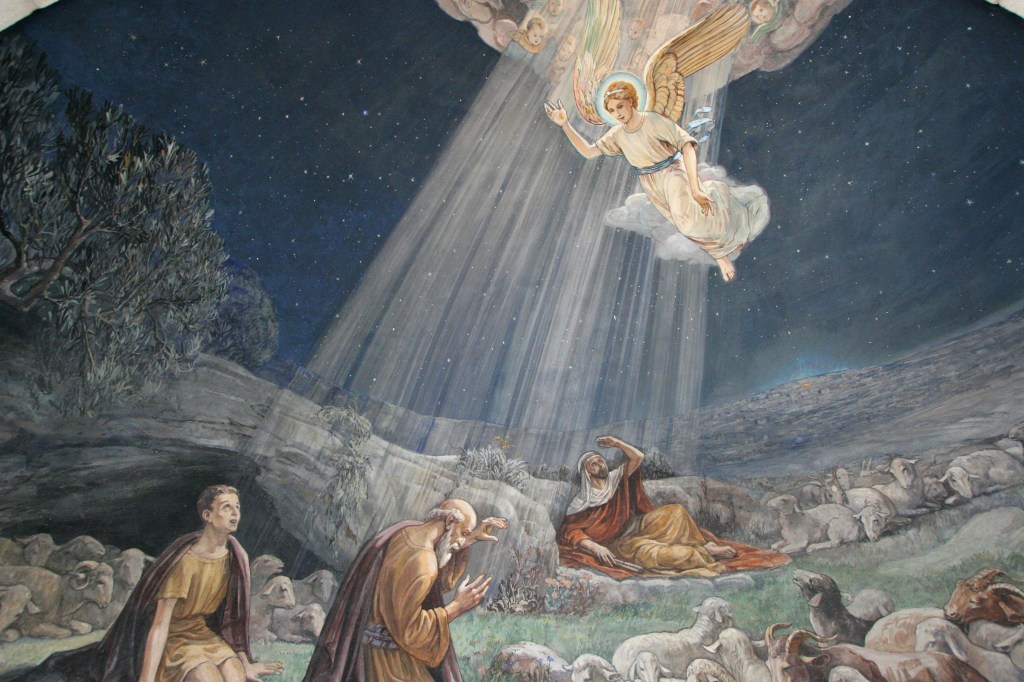
An angel of the Lord visited the shepherds and informed them of Jesus’ birth, Bethlehem, Church at the Shepherds’ Fields

My inspiration today comes from the sermon at church.[1] Very little of my material in this blog is original. If I am being perfectly candid, none of it is. After all, there is nothing new under the sun!

The sermon today was on the shepherds who left their fields in response to the message they received from an angel to seek out and visit the Christ child who was born near them in a manger used to feed animals.[2] If we are tempted to think that the purpose of this story in Luke’s Gospel is the miraculous appearance of an angel to these shepherds, I believe we would be wrong.

The story of the shepherds follows right on the heels of the story of Joseph and Mary traveling to Joseph’s ancestral home, Bethlehem, for a census that was being taken. While they were there, Mary gave birth to Jesus. Luke concludes that story with this seemingly insignificant statement:


“Then she gave birth to her firstborn son, and she wrapped him tightly in cloth and laid him in a manger, because there was no guest room available for them”.

Luke 2:2:7


We have the wrong picture in our heads if we are imagining a guest room in an inn. Mary and Joseph went to Joseph’s ancestral community where his family was gathering from wherever they were scattered. They may not have known their extended family members well, but they likely stayed in one of their homes.

The guest room in the home would have been upstairs, and it was already taken by the time they arrived, so they were forced to stay on the ground floor of the home with the animals. The manger was a food trough. Their accommodations were not the least bit inviting.

The smell of animal dung, urine, and straw hung in the darkness of the cold, dank air. The animals slept or chewed their cud. There was no fanfare for God who was had just entered His own creation in the humblest of circumstances.  

Meanwhile, an angel suddenly stood before a watchful group of shepherds in the outlying hills of Bethlehem. The abrupt apparition broke the silence like lightning from the sky. They were alarmed, but the angel calmed them. “Do not be afraid”, the angel said.


“Look, I proclaim to you good news that will be for all the people: Today in the city of David a Savior was born for you, who is the Messiah, the Lord.”

Luke 2:10-11


The angel added the instruction that they would find a sign: a baby wrapped tightly in cloth, laying in a manger. (Luke 2:13) Nothing seems special about this sign. A little unusual, maybe, that the child would have no other place to lay. Perhaps, though, the shepherds heard echoes of these words in the angel’s statement:


“Therefore the Lord himself will give you a sign: The virgin will conceive and give birth to a son, and will call him Immanuel.”

Isaiah 7: 14


An inkling from the Prophet Isaiah may have just dawned on them when “a multitude of heavenly host” appeared with the angel praising God and saying:


“Glory to God in the highest heave, and peace on earth to people he favors.”

Luke 2:14


They were moved. The angel encouraged them to “look” for themselves, and they didn’t hesitate. They decided among themselves “to go see”. (Luke 2:15)

We might be tempted gloss over the scene and fail to consider their circumstances. They were shepherds, and their job was to watch over the sheep. Sheep are prone to wander off. Even if they don’t stray, they are sitting ducks for large predators like lions, wolves and bears. Guarding the sheep was their livelihood.

The shepherds risked losing the sheep to leave them. They risked the sheep wandering off or being attacked if they left them. They risked losing their jobs.

The shepherds were menial laborers, dispensable and easily replaceable, but when the angel encouraged them to go see, they didn’t hesitate. They responded and went.

The word, “see”, is emphasized in this passage. They responded and saw for themselves. They experienced God for themselves. They didn’t just listen and ponder; they went and saw for themselves.

As I reflect on this, I note that they might have missed the Messiah if they didn’t respond right away. It occurs to that, when God prompts us, perhaps not as dramatically, how we respond is critical. Whether we respond at all, and how promptly we respond, may be a matter of whether we encounter God… or not.

Continue reading “Take a Risk to Prepare Room for God in Your Life”

Hope in the Midst of the Warnings in Hebrews

A believing heart turns toward God. As long as it is “today”, we can turn toward God, and we can have confidence that He will forgive.


“Therefore, since we are surrounded by such a great cloud of witnesses, let us throw off every encumbrance and the sin that so easily entangles, and let us run with endurance the race set out for us. Let us fix our eyes on Jesus, the author and perfecter of our faith, who for the joy set before Him endured the cross, scorning its shame, and sat down at the right hand of the throne of God.”

Hebrews 12:1-2[1]


These two verses in Hebrews 12 were shared with me by a gentleman at the church I go to who sends out daily verses by text to a group of men. Sometimes things like this are particularly timely and poignant. These verses inspires my thoughts today.

I have been wrestling with my own sinfulness lately. I have been painfully aware of areas of sinful behavior in my life and sinful attitudes in my heart that I have yet to conquer. The threads of this sinfulness go back to childhood, and they are rooted deeply.

I find myself stumbling over the same things time and again. I sometimes feel like a bird caught in a snare that cannot escape. I am tempted to be completely disgusted with myself, indignant, and condemning. Then, I recall that God is faithful to forgive; and I must ask myself, “Who am I to condemn?” Unless, of course, I am not really “saved”.

I have variously felt convicted, forgiven, hopeful, condemned, hopeless, and depressed in cycles for a long time. I tire of continually going back to God, asking for forgiveness…. again! I fear that my lack of success in overcoming these things means that I do not have the power of the Holy Spirit in me; and maybe I have fooled myself into believing in Christ’s power in my life.

I am reminded today that the letter to the Hebrews carries in it some of the most hopeful and some of the most despairing verses that can be found in the New Testament, like my cycle of feelings. I am digging deeper today to explore them. In doing so, I am reminded that the trajectory of Hebrews is hope!

The following verses provide great hope to the weary Christ follower:


“[S]ince we have a great high priest who has ascended into heaven, Jesus the Son of God, let us hold firmly to the faith we profess. For we do not have a high priest who is unable to empathize with our weaknesses, but we have one who has been tempted in every way, just as we are—yet he did not sin. Let us then approach God’s throne of grace with confidence, so that we may receive mercy and find grace to help us in our time of need.”

Hebrews 4:14-16


If we “hold firmly to the faith we profess” and “approach God’s throne of grace with confidence”, these verses promise mercy and grace to help us in our time of need. These words bring great comfort to a person like me.

Yet, thoughts arise in my mind that are concerning: What does it mean to “find grace to help us in our time of need”? How does this grace help us? Does this grace mean forgiveness in our time of need? If so, then I am thankful for that grace?

What is that grace in our time of need us the power to overcome the sin – to put a stop to it? What if the grace we receive is meant to empower us to stop, and I don’t stop? Does that mean I didn’t receive the grace that is offered? Am I doomed if I continue to fail?

A fear naturally arises that grace is not enough for me, that maybe it isn’t offered to me, or that I have spurned that grace by continuing to fail. If we go on sinning, we fear we will exhaust God’s well of mercy. The consequences of “falling away” loom ominously:


“It is impossible for those who have once been enlightened, who have tasted the heavenly gift, who have shared in the Holy Spirit, who have tasted the goodness of the word of God and the powers of the coming age and who have fallen away, to be brought back to repentance. To their loss they are crucifying the Son of God all over again and subjecting him to public disgrace.”

Hebrews 6:4-6


This passage is particularly ominous in its finality and the impossibility of coming back from “falling away”. I have tasted of the goodness of the word of God, If I go on sinning is there no repentance for me?

Am I the only who thinks like this? Am I the only one who fears being on the wrong side of this grace that is offered, doomed to a life of sin and, eventually, death? Fortunately for us, we have hope!

Continue reading “Hope in the Midst of the Warnings in Hebrews”

What Laws Must a Christian Follow?

The tension between the Law and the Gospel and how they relate to each other is the key to understanding Christianity.


The themes of law and grace are central to Christianity. Sorting them out gets to the very heart of the gospel message. Yet, many people inside and outside of the Christian community are unclear on what laws Christians must follow, what laws are no longer applicable, and why.

Someone recently posted the following question to a group to which I belong on social media:


I get the message of we are not under the law but under grace. But if we live through Christ we will follow the law. How do we know what law to follow? Does this go as far back as to not mix fabrics? 

Obviously everyone says we’re no longer under the law, but ”faith without works is dead” so I am confused. 

How do we know which laws to follow?


Human tendency is to want a list of rules to follow so we can check them off. The rich young ruler demonstrates that human tendency when he came to Jesus one day and asked, “Teacher, what good thing must I do to get eternal life?” (Matt. 19:16)

We also have a tendency to want to quantify rules, and to simplify them to make them easier to follow. Perhaps, that is what motivated someone to ask Jesus, “Teacher, which is the greatest commandment in the Law?” (Matt. 22:36)

Or we go the other direction: we add rules on top of rules on top of rules to make sure that we don’t miss anything. The Pharisees demonstrated this approach in how they handled the commandment to observe the Sabbath. The created a list of “work” that was forbidden including, among other things: sowing, plowing, reaping, binding sheaves, threshing, winnowing, selecting, grinding, sifting, kneading, and baking bread; twelve similar activities related to the preparation of clothing, from shearing sheep to sewing; and seven activities related to preparing the carcass of a deer for food or leather. (See What are some Sabbath Observance rules that the Pharisees made?)

Moses started with ten commandments. By the time the books of Moses were completed, there were 613 commandments! (Though not everyone agrees on exactly what they are.)

The Torah (the Five Books of Moses – Genesis, Exodus, Leviticus, Numbers & Deuteronomy) focused on laws. That focus carries through the entire Old Testament. Though the laws are often more prominent in the breach, than in the observance thereof!

The same focus continued into the New Testament. We see it in the question asked by the rich young ruler and the Pharisees’ questions to Jesus. We see it in the tension between Paul and Peter that threatened to divide the early church over whether believing Jews must follow the Law and what laws believing Gentiles must follow.

This is the tension between the Law and the Gospel. If we understand only one thing about the Gospel message, the relationship of the Law to the Gospel might be the most important thing! I have written about it often, including How the Moorings of the Gospel Were Secured.

For the sake of brevity, I won’t summarize everything here. You can click in the links in the last two paragraphs to get an overview from the articles linked there. Understanding what Jesus meant when he said he didn’t come to abolish the law, but to fulfill it is critical.

If you are not a Christian, or you are a Christian, but you are not sure you understand these things, please do not just gloss over them. The tension between the Law and the Gospel and how they relate to each other is the key to Christianity.

It was the focus of almost all of Paul’s writings. It is the major theme in Romans, Galatians, Ephesians, Hebrews and the other epistles. Take some time now to wrestle with it. Don’t stop until it makes sense to you!

Hopefully, the rest of my thoughts in this piece will help.

Continue reading “What Laws Must a Christian Follow?”

Christmas thoughts: Humble Beginnings, Worldwide Ends

The Christmas story rises softly and quietly from the humblest of beginnings to sweep across history and the globe into the grandest of all stories.

kevingdrendel's avatarNavigating by Faith

canstockphoto7454869
(c) Can Stock Photo / Anke


Christmastime is a time to consider the birth of Christ. It’s “the reason for the season”, as the saying goes. Even with the busyness, commercialism and looming red eclipse of Santa, we usually pause to connect the dots to the birth of Jesus.

Whether you wish people a Merry Christmas or Happy Holidays, Christmas involves some acknowledgment of the birth of a man who was called Jesus who lived and died in the 1st Century in the region we identify as Palestine and Israel today. Here, in the confluence of Roman, Greek, Jewish and pagan influences, an obscure carpenter who lived maybe 33 years began a movement in human history that has spanned the globe and stood the test of time.

That movement has become the largest religion in the world today found on every continent and in every corner of the world. It…

View original post 863 more words

Christmas Thoughts

The incongruity of joyful festivities during a time of loss, sorrow and loneliness can make this time of year especially difficult for many people.

kevingdrendel's avatarNavigating by Faith


This time of year is a joyful, festive time of year filled with family time, days off from work, presents given and received and celebration. At least, that is how this time of year is billed to be; and I often it is, for most of us, for the most part, a joyful time of year. But, life does not live up to the billing or expectations.

I checked Facebook this morning when I awoke. A high school classmate reports that his wife, mother of his daughters, went to “be with the angels” last night. A friend I met in college said goodbye to his mother yesterday, and she is no longer with us today. An acquaintance I know through wrestling described a colleague, only a few months past 50, who passed yesterday. Another high school friend asked for prayers for his daughter, going on two weeks in the hospital…

View original post 425 more words