In Exodus 7, we read that God moved in visible and compelling ways to convince Pharaoh to listen to the request by Moses to let the people go into the wilderness and be with God. Pharaoh was given demonstrative signs that God was behind the request, but Pharaoh was not swayed.
“Instead, he turned and went into his palace, and did not take even this to heart.”
Exodus 7:23 NIV
Pharaoh’s magicians answered Moses and Aaron with their own divination, and Pharaoh did not take the demonstration of the movement of God to heart. This is the character of hardness of heart. We see God move, but we have an answer to explain it away, and we do not take it to heart.
Pharaoh and Egypt are considered to be analogous to the world that does not know God, a world that has set itself against God. We don’t consider ourselves to be like Pharaoh or like Egypt.
When we do the same thing, however, we are no different. When we see God move, and we explain it away and do not take it to heart, we are no different.
The Pharisees, the religious leaders of God’s people, did the same thing. When Jesus performed miracles right in front of them, they explained it away. They said it was of the devil, and they did not take it to heart.
Be careful that you are not quick with an answer to explain away what God is doing and fail to take it to heart.
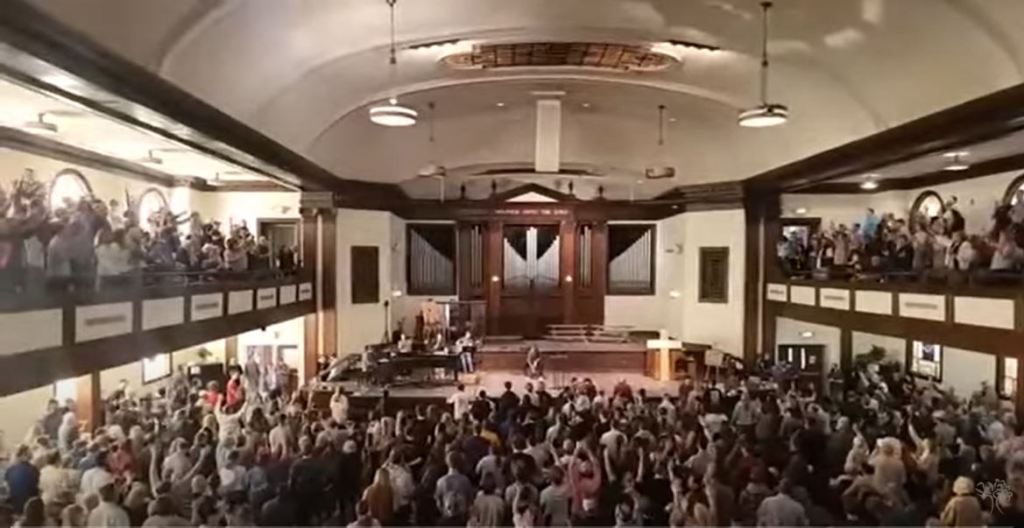
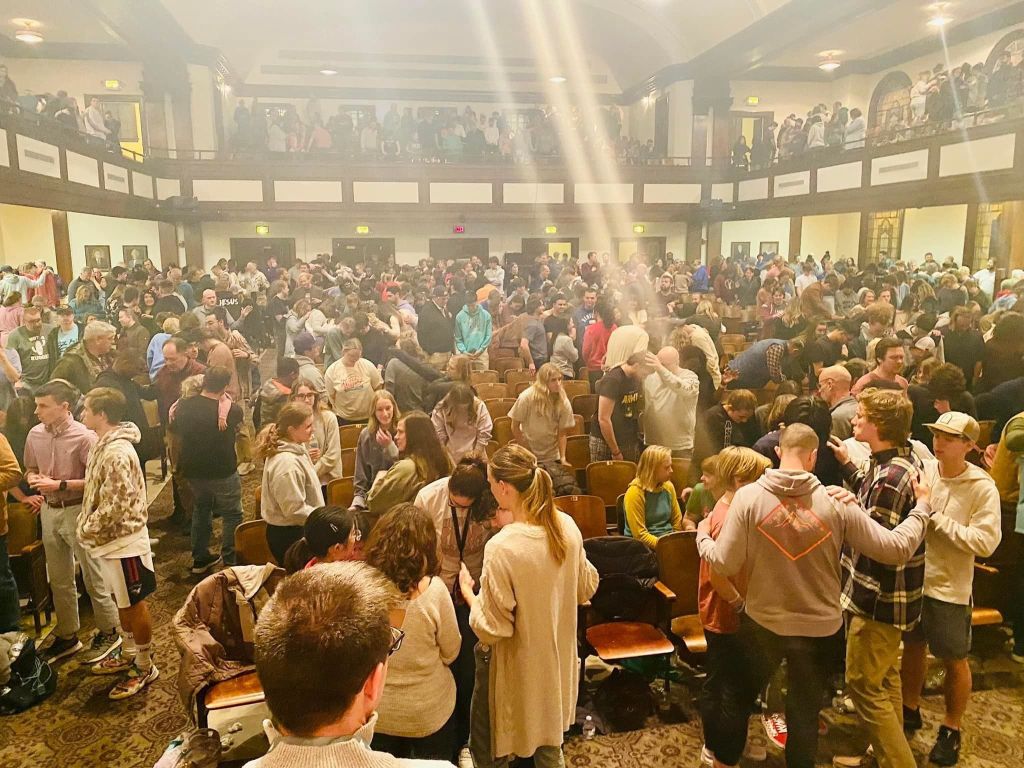
Do not be quick to explain away what is happening at Asbury University (and reportedly at other universities now, too). Do not be quick to dismiss it and miss what God is doing.
Take it to heart. Ponder it like Mary pondered what the angel told her: that she would give birth to Jesus. Be open to what God is doing, and what God wants to do in you.
The Pharaoh that didn’t take to heart what God was doing in his time lies entombed today like a stone. The God of Israel lives! Jesus, who was also entombed, rose from the dead and lives! The grave could not hold him, and he offers that same life to you!
I have noticed with some mild interest at what is going on at the chapel on the Asbury University campus in Kentucky. Posts show up in my Facebook feed daily, as I am connected to many Christians (and many other people too) on Facebook. One post today, shared from someone who has been there from the beginning, described it succinctly as follows:
“A chapel service that didn’t stop but continued spontaneously for 8 days now.”
Today has been ten (10) days since that spontaneous beginning, and I have been watching various live streams of the February 8th chapel service that is still going on. This is how it started:
How the Asbury University chapel started on February 8, 2023
I have seen doubters and critics, I have seen posts from people who jumped in their cars and traveled hundreds of miles to see it for themselves: this chapel service that started and has not stopped. It has continued around the clock for 10 days now.
I have seen hype. I have seen caution. Critics caution about emotionalism. Critics want to de-emphasize experience and double down on the Bible and doctrine. Critics say that an omnipresent God should not require a person to travel to a particular location to experience Him.
I have been cautious myself. I am also aware that a sovereign God does what He wants to do despite our understanding of scripture, and theology and the way things ought to be. I have experienced “moves of the Holy spirit”, myself.
I have experienced that people cannot dictate how, when, or whether the Holy Spirit moves. “The wind blows where it will.” We don’t put the Holy Spirit in our pocket like a rabbit foot. We don’t command or possess Him.
People have described what is going on at Asbury University as a revival. That term may conjure up images of a “tent revival” and flamboyantly crass preachers, artificially slick hair, words that drip like honey, and ecstatic chaos.
The Asbury Revival is characterized by a different atmosphere. The person’s post from today who has been there from the beginning said this:
“To quote Professor McCall, a theology professor at Asbury Seminary, ‘what we are experiencing now—this inexpressibly deep sense of peace, wholeness, holiness, belonging, and love—is only the smallest of windows into the life for which we are made.’”
As a child of the 60’s and 70’s, I am reminded of the hippies who wanted “Peace and love. Not war!” I think of John Lennon who imagined a world without war – and without religion – with only peace. Hippies, however, were a contentious bunch, and John Lennon was no saint.
Not that I blame them for dreaming or trying. It’s just that people are completely incapable of making these kinds of dreams come true. Just when we think we have created our utopia, it is already disintegrating and slipping through our fingers like a mirage we feel we can grab hold of.
I lived for several years in a communal house. It was a leftover from the flower children of the 1960’s who became the Jesus people of the 1970’s. I loved it, but it was no utopia. The reality is that people have rough edges. So, “iron sharpens iron,” but the sharpening isn’t always a pleasant process.
Yet, when people get together to devout themselves to following God together, to worship and pray together, to do life together, God is in their midst. These words of Jesus are as true today as the day he spoke them:
“Where two or three gather in my name, there am I with them.”
Matthew 18:20
These words are true when our rough edges are rubbing against each other as much as when we “feel the love” (which may not be as often as we like). Even then, I have never experienced the intimacy with another human being as I have experienced when I have experienced the Holy Spirit “moving” in me, usually during times of group worship..
I have experienced the “inexpressibly deep sense of peace, wholeness, holiness, belonging, and love” described by the Asbury professor. It cannot be manufactured or trumped up. When it “happens”, words are difficult to describe it; the experience is life changing.
The experience is only truly life changing, however, if we recognize that the experience is not the point. The experience is a brush with God, who is the source of peace, wholeness, holiness, belonging and love.
If we walk away from the experience longing for another experience, we have missed the important thing. It isn’t ultimately the experience that we long for at all; we long for God, and relationship with Him.
If we chase the experience, it becomes ever more elusive. In our desperation and desire to repeat it, we may resort to emotionalism. We may even resort to trumping up experiences that are artificial.
We desperately need connection to our Creator and the lover of our souls.
I did the research and wrote a thesis in college in support of the concept that Scripture is inerrant. I have mentioned this before. I was not a religion major in college only because I did not turn in my thesis.
I didn’t turn it in because I was having a hard time getting to where I wanted to go using Scripture and the scholarly work that was done up to the early 1980’s. I could not support my thesis with integrity, so I shelved it and did not return to the subject for almost 40 years!
I had a high view of Scripture then, and I have a high view of Scripture now. I read the Bible daily for personal guidance and edification. I believe the Bible is the inspired Word of God (which I can support from Scripture itself. (2 Timothy 3:16-17))
I believe, like the Moody Bible Institute, that the Old and New Testaments are divine revelation from God. The original autographs were verbally inspired by the Holy Spirit. The revelation is God’s self-disclosure recorded in human language. God is the source of it.
I stop, though, in going further to say that every word is true, and the Bible is free from error. The very statement begs the questions: which version? Written in which language? And other questions.
I agree with the Moody statement that the Bible is the supreme source of our knowledge of God and of salvation through Jesus Christ. I agree that it is “our indispensable resource for daily living”. I agree, also, that humans are left to interpret the Bible, and our interpretation is guided by “our reception and understanding of that which God revealed”.
I stop short of saying that God “recorded” Scripture, because we all know that it was written down by men. This difference distinguishes the Bible from the Quran and the Book of Mormon, both of which are claimed to have been dictated to men in a trance-like state.
I agree that “revelation is a divine act”, and “interpretation is a human responsibility”. I agree that our interpretation is fallible, but I must admit the possibility that the writing down of the Bible may, also, be fallible.
I also recognize that I am fallible and must remain humble in my approach, so take what I say with a grain of salt and make your own determinations. I share my thoughts for what they are worth.
When I was in college sitting in a World Religion class, reading the Bible for the first time in my life, I was struck by a thought that I believe to this day came from the Holy Spirit (along with others). My professor was liberal and progressive, so I can’t “blame” it on him.
It occurred to me that, if God is real, and the God of the Bible is the creator of the universe, then He could orchestrate His communications to humans in a way that they could understand them and preserve the important points for posterity. If God is sovereign, He can do that.
I believe the Bible is the book God wanted us to have.
NT Wright
I still believe that, but I also like the way NT Wright puts it: “I believe the Bible is the book God wanted us to have.” I can buy that! Other things NT Wright says about the character of Scripture also make sense to me, so I will mix his words with mine in the remainder of this piece.
I am afraid that the title to this piece promises more than I can deliver. I don’t have it all figured out. Not even close. If I had it all figured out in my mind, I would still be an impossible gap away from waling it out.
If my mind knew all there was to be known about faith, I am not confident my heart would be sure to follow. In fact, I fear my heart would not follow. It often does not follow where my mind, limited as it is, knows it should go – wretch that I am.
I say this with no love lost for myself and no false humility (to the extent that I can muster a humility that is true).
The worship leader prayed, “You are a God of love”, and he followed with the acknowledgment, “You loved us first.” He continued, speaking to us to remind us that “God forgives is; we fall short, but His mercies are new every day”.
I humbly, gratefully, and joyfully accept these truths. If God were not such as He is, I could not live with myself. I could not forgive myself, but that God forgives me.
This morning I tuned in online to the church service from my easy chair because I tested positive for COVID on Friday. I barely left this easy chair yesterday.
I don’t do well with nothing to do – nothing to do that I want to do anyway, other than mindlessly scrolling through everything my various technological devices will offer me.
Some people are given to doom scrolling, “spending an excessive amount of time reading large quantities of negative news online”, according to Wikipedia, which can cause the mind to race, leading to burnout, and causing you to” feel uncertain, anxious, or distressed”, according to WebMD.
Ironic, isn’t it? The Internet offers conveniently a ready definition to a malady caused by excessive time spent on the Internet. I don’t need to search my mind for the right words. They are at my fingertips with the click of a mouse. I barely need to think about it!
Not that it helps at all. I can define doom scrolling, acknowledge it, understand it and still fall victim to it. Knowledge is like that. It gives us a false sense of mastery and control.
Boredom and mindlessness are a bad combination for me. I constantly desire to be intrigued, engaged, entertained, piqued, inspired … yet I am not always willing to put in the work or thoughtfulness out of which real inspiration, meaning and purpose comes. I also sometimes look for inspiration and meaning in sources that are not capable of delivering it.
Sometimes, I simply don’t want to be bored, but I am too lazy to work at not being bored. Like I said, this is a bad combination for me. It’s a real time suck. An utter waste of time. It leaves me feeling completely unfulfilled and tempted to fill that gap with shadowy pleasures.
After getting up in the morning yesterday and reading through the daily Scriptures that are mapped out for me in the bible app I use, I failed to devote my attention to God or anything meaningful for the rest of the day. I might have said a half-hearted prayer or posted half a thought here and there – nothing but a mist floating over a never-ending torrent of things to see and hear on the Internet.
The sermon this morning was on “the crisis of pleasure”. The crisis of pleasure is a crisis of faith.
It’s a crisis of focusing our primary attention on seeking the scraps we can scrounge up in a world subjected to futility, heads down, eyes focused in the dust, when God is nudging us to look up. It’s a crisis of settling for the meager samplings found in the here-and-now while ignoring Christ, the hope of glory, who offers us things we can’t even imagine.
My mind knows these things full well. I write about them often. It might even be the most common theme of my writing – letting go of the things of this world to seek first the Kingdom, living as strangers and aliens in this world that is passing away, because we long for a heavenly country.
The pleasure we seek in this world is to please the self. There is no other kind. The pleasure we long for is the pleasure God gives back to us when we please Him:
“Give, and it will be given to you. A good measure, pressed down, shaken together and running over, will be poured into your lap. For with the measure you use, it will be measured to you.“
Luke 6:38
That brings us to the sermon, which was about Enoch, a man who was commended for his faith, because he pleased God. (Heb. 11:5) Enoch was a man who “walked with God”. (Gen. 5:22, 24) Reading these passages together tells us that walking with God and pleasing Him are the same things, and they are evidence of our faith, because:
[“W]ithout faith it is impossible to please God, because anyone who comes to him must believe that he exists and that he rewards those who earnestly seek him.”
Heb. 11:6
Once again, we see that faith is an action word, something I have noted a few times lately. Faith is an action that involves walking!
The Bible has a something to say about “grumbling”. Have you ever noticed that? What’s the deal with grumbling? What IS grumbling, anyway? I realized recently that maybe I should not assume I know, so I spent a little time digging into it. My writing today is inspired by James:
“Don’t grumble against one another, brothers and sisters, or you will be judged. The Judge is standing at the door! Brothers and sisters, as an example of patience in the face of suffering, take the prophets who spoke in the name of the Lord. As you know, we count as blessed those who have persevered. You have heard of Job’s perseverance and have seen what the Lord finally brought about. The Lord is full of compassion and mercy.“
James 5:9-11 NIV
James says that people who grumble against others judge them. (While our own Judge is at the door!) James also contrasts grumbling to perseverance, so it seems that grumbling against others seems to be a failure to persevere (from a biblical perspective anyway).
If anyone had a legitimate opportunity to grumble it was Job, who was afflicted though he was a man who was considered “blameless in his generation.” When he was afflicted, his wife urged him to grumble against the Lord. She said,
“’Are you still maintaining your integrity? Curse God and die!’ He replied, ‘You are talking like a foolish woman. Shall we accept good from God, and not trouble?’‘”
Job 2:9 NIV
Thus, grumbling is something we do against God also. Grumbling is something we encourage each other to do at times, perhaps, because “misery loves company.” Job was goaded by his wife to grumble against God, but he refused. Job is held up by James as a model for us to follow: a man who persevered patiently in difficult circumstances without grumbling.
The word translated “grumbling” in James 5:9 is the Greek word, στενάζω (stenazó), which means literally “to groan (within oneself).” It can be used as an expression of grief, anger, or even desire.
The word, stenázō, comes from the root word, stenós, which means “compressed, constricted.” The idea is that one who groans is doing so “because of pressure being exerted forward (like the forward pressure of childbirth).” Figuratively, it means “to feel pressure from what is coming on – which can be intensely pleasant or anguishing (depending on the context).” (See Biblehub)
Stenós, then, seems to be the internal pressure that causes us to groan inwardly, and stenázō seems to be an outward negative response to that inward pressure – to grumble. The word is also translated complain, murmur, and grudge.
As I think about these things, I realize that we do not control the pressures that bear down on us from within (and without), but we do control how we react to those pressures. Grumbling, complaining, and murmuring against others and against God is a negative reaction to the pressures we face.
James calls us to react differently to the pressures we face. He calls us to bear up with patience and perseverance. If we give in to grumbling and complaining against each other, we become judges of each other, forgetting that we have a Judge who stands at the door. When we grumble against God, we judge our Judge!
This passage also suggests that, while we may groan inwardly, we do not have to groan (grumble and complain) outwardly – though we may strongly desire to! We have a choice in the matter, and the better choice is to be patient and persevere – not to take it out on the people around us.
That observation, perhaps, begs the question: why is it better to persevere with patience rather than grumble?