Authority from Above in Politics

Do we trust in the authority from above?


As I was listening through the last four chapters of the Gospel of John this morning, these words impressed me:

He entered his headquarters again and said to Jesus, “Where are you from?” But Jesus gave him no answer. So Pilate said to him, “You will not speak to me? Do you not know that I have authority to release you and authority to crucify you?” Jesus answered him, “You would have no authority over me at all unless it had been given you from above. Therefore he who delivered me over to you has the greater sin.” John 19:9-11 ESV

This was part of the interchange between Pontius Pilate, the Roman prefect of the province of Judea, and Jesus. Pilate exercised the authority given him over the province of Judea in the Roman empire given him by the Roman authorities, but Jesus said, “You would have no authority over me at all unless it had been given you from above.”

I am reminded of God’s sovereignty. Jesus came to die. That was his plan. Pilate was just part of the plan. We tend to think of Pilate in negative terms as we look back at the story, but he was just part of God’s plan, like Judas.

These things remind, also, of President Trump. Though I voted for him, I have been hyper critical of him. Though Christians supported him in large numbers, Trump has not displayed the kind of fruit we should expect from a God lover; he might even be a wolf in sheep’s clothing. Though Christians have also been divided over Trump the zealot, he prevailed and is our president.

Of course, Barack Obama was also our president. So was Bill Clinton. If we really believe the words that Jesus spoke to Pontius Pilate, these men would not have authority as presidents of the United States unless it was given from above.

Continue reading “Authority from Above in Politics”

Reading the Writing on the Cave Wall

Genevieve Von Petzinger speaks at TED Fellows Retreat 2015, August 26-30, 2015, Asilomar Conference Grounds, Pacific Grove, California. Photo: Ryan Lash/TED

Genevieve von Petzinger, a paleoanthropologist, has a TED talk that is garnering some attention. She speaks on her findings from the exploration of art and geometric signs in caves around Europe. Most people have long known about the cave art, but the geometric signs were largely ignored until von Petzinger decided to focus on them and catalogue them.

Maybe fascination with the art distracted people from the significance of the geometric signs. Whatever the reason, Von Petzinger is the first person to document and create a database of those geometric signs. She reports previously undocumented geometric signs in 70% of the caves she surveyed.

Her TED talk focused on a stunning discovery. She found only 32 different geometric signs in all the caves she visited. Thus, only 32 different geometric signs were developed over a 30,000-year span on the entire continent of Europe!

“What’s the big deal?”, you might ask. The answer is that we would expect much more variation if they were random doodles or decorations. The fact that the same signs were used over and over again suggests something more than mere art.

The signs were repeated from location to location. About 60% of the signs were used throughout the entire 30,000-year time span. Some signs appeared early and ceased to be used. Other signs appeared later. Some signs appeared in wide geographic distribution, while other signs appeared in more concentrated geographic areas. But most of the signs were found throughout the continent and throughout the 30,000-year span.

Another interesting observation is that cave art in Europe bears some resemblance to cave art as far away as Indonesia and Australia. Many of the same signs appear in far flung places, especially in the same 30,000-40,000 year range. Genevieve von Petzinger believes these findings indicate an increasing likelihood that “this invention traces back to a common point of origin in Africa”.

“[T]hat is a subject for a future talk”, says von Petzinger. Meanwhile, let’s explore the significance of the geometric signs found in the European caves

Continue reading “Reading the Writing on the Cave Wall”

Recognizing Leon Lederman and the God Particle


Leon Lederman has passed away today at the age of 96.[1] “What’s the big deal”, you might ask. Well Leon Lederman is a big deal around these parts – Batavia, IL where I graduated from high school and where my office has been since 1994. That’s because Batavia is home to the Fermi National Accelerator Lab where Leon Lederman worked and earned a Nobel prize.

Leon Lederman was the director of Fermilab, as it is more commonly known, from 1978 to 1989, and was the principal driver behind the development of the Tevatron, the world’s highest-energy particle collider from 1983 to 2010. He also won the Nobel Prize in physics in 1988 for proving the existence of a new type of neutrino, muon neutrino.

Leon Lederman is a local, national and international legend. He taught for years at the Illinois Mathematics and Science Academy in Aurora, IL, which is a model for high school education for students from all over the state who are gifted in math and science. The law firm I started my career with and the predecessor to the present firm I am in drafted the legislation for IMSA, and we represented IMSA for many years even after I joined the firm.

On this day, it is more than fitting that I recognize the incredible person Leon Lederman was and the significant contribution he made to the study of physics and science. Among other things, Lean Lederman is the person who called the Higgs Boson the “God Particle” in a 1993 book he wrote by the same name.[2]

On this day, therefore, I honor Lean Lederman by some consideration of that name he gave the Higgs Boson, which stuck somewhat to his own dismay.

Continue reading “Recognizing Leon Lederman and the God Particle”

Looking at Both Sides of the Wall

Walls can provide peace and security, but they can also be used to oppress and to prevent us from accomplishing God’s purposes.

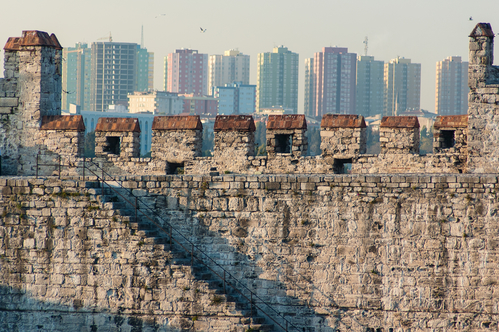
Ancient city walls and modern buildings in Istanbul, Turkey

Wayne Gruden, a Christian ethicist, makes a case for building a wall. He cites to biblical passages that reinforce the idea that walls provide protection, peace and security to those inside the walls. These are good things, he says, and he cites to support for this proposition in the Scriptures.

The Psalmist prays (for Jerusalem) for “peace within your walls and security within your towers” (Psalm 122:7) and praises God for strengthening the bars of Jerusalem’s gates, making peace within its borders. (Psalm 147:12-14) David prayed to God to build up the walls of Jerusalem. (Psalm 51:18) King David built walls around Jerusalem, and King Solomon strengthened those walls after him. (1 Kings 3:1)

God used the Babylonians to visit judgment on the people of Israel by breaking down the walls of Jerusalem and burning down the temple and the palaces. (2 Chronicles 36:19. See also Jeremiah 52:14) The first thing the remnant did when they returned to Jerusalem was to rebuild the wall. (Nehemiah 2:17)

Indeed, walls and gates and towers are all pictures that convey the peace and security that the ancients hoped and prayed for from God. These symbols stand for the peace and protection for which ancient people longed in the harsh world of their time.

Proverbs says, “A man without self-control is like a city broken into and left without walls.” (Proverbs 25:28) Thus, walls around cities are symbols of self-control and self-defense.

Certainly, building walls in a hostile world is a prudent thing to do. On different levels, we do this (provide peace and security) for our families, our communities and our nations. Basic decency demands it. Therefore, Wayne Grudem concludes that “the Bible views border walls as a morally good thing”.

I agree with him, but that isn’t necessarily the end of the story. Like many things, walls can be good, and they can be bad. Few people, for instance, believe the Berlin Wall was a morally good thing. Whether building a wall is a morally good or appropriate thing depends on the circumstances and the purposes for which it is built.

Moral goodness can’t be determined in a vacuum. Morality, or righteousness and justice, to use more biblical terms, is a matter of relationship with God and other people. The determination of what is righteous and just begins with a determination of God what God desires and purposes We must have to apply what we know about God’s heart for righteousness and justice in a given situation by considering specific circumstances in light of the big picture.

Walls are not good or evil in themselves. They can protect and maintain peace and security for the people within the walls. They were a critical and necessary component of safe community in most centuries gone by. People who were not protected by walls were exposed to the vagaries of every vagabond with bad intent.

But walls that are designed to keep people captive to an oppressive regime are not good. Walls that were necessary and appropriate for the safety and security of people in ancient times may not be as necessary of appropriate in modern times.

Walls can be used to provide peace and security, but they can also be used for evil purposes like oppression. The issue isn’t walls, but purpose and intent. For Christians that means God’s ultimate purposes and intent.

Continue reading “Looking at Both Sides of the Wall”

When Your King is a Child

Was the election of Donald Trump a blessing from God? Or a curse?


“And I will make boys their princes, and infants [caprice] shall rule over them.” (Isaiah 3:4)

The 2nd chapter of Isaiah starts out with a futuristic vision. Isaiah 2 provides a picture of God and his law and order being exalted above all other things. In this vision, God settles disputes, people beat their swords into plow shares, and everyone learns from God and worships God in harmony. Nations cease to war against nations. (Is. 2:3-4)  It sounds like an utopian dream.

When I was young in the 1960’s, I remember “flower children” protesting the Vietnam war and urging the world to live in peace. They were advocating for a similar dream. It seemed so pure and simple. All we need is love.

Except, the 1960’s was also a tumultuous and chaotic time.  Drugs, violence, and free sex were the order of the day. Young people were challenging and throwing off moral and religious convictions. Unlike the Isaiah’s vision, the 1960’s dream was a secular one.

I have seen the consequences of that societal upheaval throughout my life. Drugs have taken their toll in lives lost and wasted. The opiate and heroin epidemic of our current times is partially a product of opening Pandora’s pillbox in the 1960’s.

Violence is as much or more a part of our world today than it was in the 1960’s. We don’t live in peace with each other. Wars continue to rage. Neighbors continue to fight with neighbors. More Americans are killed in the City of Chicago each year, alone, than in foreign wars.

Of course, Chicago is only a drop in the bucket. Multiply all the other crime-ridden cities in the US, and number is astronomically higher. Killings in the US don’t even begin to compare to what is happening in other parts of the world.

Free sex has also taken its toll as well. More children live in single family households today than ever before. The scourge of AIDs has taken God knows how many lives in the US and around the world. Pornography threatens to undo the fabric of our society, warping the minds and hearts of children at young ages, objectifying women and sex and feeding a ruthless and insatiable underworld industry that preys on vulnerable people in our communities.

After describing the utopian vision in chapter 2, Isaiah comes back to reality. Jerusalem and greater Judah in Isaiah’s day were far from the utopian ideal he envisioned. Isaiah’s description of the people in his time could be aptly applied to the people today:

“Their land is filled with silver and gold, and there is no end to their treasures; their land is filled with horses, and there is no end to their chariots.

“Their land is filled with idols; they bow down to the work of their hands, to what their own fingers have made.”

We live in a land “filled with silver and gold”. We have plenty in the US like never before. Even the poor among us have computers in their hands and Nikes on their feet. We have leisure time, and things, and pleasure, and comfort like no civilization has ever experienced. The things we own, the pleasures we seek, the wealth that we covet, the entertainment and diversions that fill our time have become gods to us that dominate our attention, our energies and our hearts.

At the same time, suicide rates have risen precipitously over the last 20 years, and school shootings that were unheard of before 1966 have become routine. Wars rage around the world, and violence rages in our city streets.

Continue reading “When Your King is a Child”