Os Guinness says, “It’s no secret that the world doesn’t know how to handle our differences.” Just consider countries like China, Iran and others in which dissidents are treated as enemies of the state, rounded up and imprisoned or even killed.
In the West, we have handled our differences better than most in the last couple of hundred years, but we have had our issues as well. Guinness addressed religious matters, in particular, and notes that we have different views for how to address differences. There are those who advocate for the “sacred public square” where religion is king, while others urge a “naked public square” that is wiped clean of religious and faith expression.
He advocates for a third way of dealing with religious differences: “the civil public square”. In the civil public square, all people are given freedom of conscience to speak from their own faith tradition, or no faith tradition at all (which is also a kind of faith).
Guinness criticized the last 50 years in the United States during which culture wars have been battled out in the public square. The result is that differences have become more entrenched, and they are getting deeper and wider as time goes on.
As a Christian, Guinness is concerned about the state of the church in these times. He observes that millions of people are dropping out of religion altogether because of “the ugliness of Christian extremism in public life”.
He is quick to say that the secular extreme is just as bad, but I agree with him that we (Christians) should be concerned for our own influence in the world.
Many Christians deny that climate change is happening, perhaps because many Christians distrust science. More accurately, perhaps, they distrust scientists, as a large number of scientists are atheists, especially some extremely vocal scientists who “preach” a form of scientism[1].
As Christians, though, we need to be careful here. We need to respect truth wherever we find it and wherever it leads. Without letting go of the revealed truth of God in Scripture, we need to recognize and acknowledge truth that science reveals – the truth of God’s creation.
We also need to recognize and understand the difference between science and scientists. Science, done right, reveals the truth of God’s creation. The scientists who do science are influenced by their own biases, assumptions and preconceptions, worldviews and individual perspectives, but that doesn’t mean that the results of the science they do can’t be trusted.
We have to separate out the science and the conclusions drawn by scientists from the science. Even there, those conclusions shouldn’t be discarded without consideration. Scientific conclusions (conclusions that naturally and inevitably follow from proven premises) should be distinguished from philosophical conclusions (extrapolations from the scientific conclusions that go beyond the bare facts and enter into philosophical territory).
What does that mean? A very extreme example might be the assertion by Neil deGrasse Tyson that science has replaced philosophy and made it irrelevant. He maintains that science tells us everything we need to know about reality. This very statement is a philosophical statement. (Hint: it’s not science.) Just because a scientist says something doesn’t make it true.
We also have to keep in mind that science has been reduced over the decades and centuries to mean something more limited than what it once meant. (Theology was once known as the Queen of the Sciences). Science is now limited in its definition to mean the study of the natural world and its material components and processes. Scientific method is limited to what can be proven by observation of the material world and its processes.
Science is a species of knowledge, but we sometimes conflate science with knowledge, thinking that science is the end-all and be-all of knowledge and that knowledge is only that which science reveals to us. As Christians, we don’t believe this. Philosophers don’t believe this. Artists, and poets and musicians don’t believe this. Many scientists don’t believe this as well.
But, I digress. I believe that the science for climate change is accurate – at least to some extent. To what extent, I am unable to conclude, as I don’t know the science well enough. But that the climate is changing is fact. It is changing, and we shouldn’t be ignorant of that fact.
It is also fact that we are contributing to that change. CO2 emissions, for example, have gone up dramatically since the industrial revolution. That is science that can’t (shouldn’t) be denied. It’s been substantially demonstrated in a multitude of ways.
To what extent has our activity contributed to the change? To what extent is our activity driving the change? To what extent can we reverse the change? Can we reverse climate change by our efforts? I think these are all open questions as I understand the state of the science.
As Christians, I think we need to be careful to respect the truth of science; otherwise we are guilty of denying and misrepresenting truth. We need to respect truth wherever it is found because our God is true, Jesus was truth personified. For that reason, also, we have no reason to be afraid of the truth.
Our approach should be appropriately nuanced on issues like climate change. How we deal with the truth and respond to it must be placed into context. There is a higher truth than climate change: God and His purposes that we learn from revealed truth found in Scripture.
For the Christian, the prospect of climate change does not appear as the ominous a threat it is for the non-believer. This is because we understand that the earth is passing away;[2] and God has promised a new heavens and a new earth.[3] In fact, Jesus warns us not to store up our treasures on earth where they are subject to rot, decay and destruction (sounds like the second law of thermodynamics), but to store them up in heaven.[4]
Entry into the kingdom of God is by way of the cross, and followers in that way are cross-bearers who walk in the way of Jesus and invite their enemies to join them.
In a discussion with Canadians, Krish Kandiah and Tom Newman, on the unbelievable Podcast with Justin Brierley (Agnostic ‘trying on’ church talks to a Christian – Tom Newman & Krish Kandiah), the conversation turned to the fact that Christians are a minority in Canadian and British society. The agnostic, Tom Newman, discussed his “experiment” with Christianity that was the subject of his own podcast. He found that Christians bring value to society, because Christians are particularly motivated to do good things. This led to an interesting dialogue.
Krish Kandiah, a pastor, observed that the temptation of Christians as minorities in society is to go private, turn inward, and become cloistered. Doing that, however, is not How Jesus instructed Christians to act. Jesus says you don’t light a candle to put it under a bushel. So, Krish Kandiah says,
“It becomes the obligation of the Christian minority to serve and bless the majority.”
What a difficult statement for an American Christian to hear! It almost doesn’t register. Did he really just say that? (I note that the interviewees ware both Canadian, and the host is British. Canada and Great Britain are decidedly post-Christian.)
The United States is heading that way too, though we don’t like to admit it.
Interestingly, Christianity is growing in other parts of the world like Africa, Asia, Latin America, the Muslim world, and Oceania. Christianity is noticeably declining in the United States, Europe, and the rest of the “western” world.
I think about these things in the context of the cultural wars that are raging in the United States. Christians are desperately fighting to hold on to a Christian consensus that was once called the “Moral Majority”, but Christians have been losing ground. American society is incrementally moving the other way, and the movement is gaining momentum despite the efforts of the most ardent culture warriors.
How do we deal with that? In a classic American Christian way, I wonder, “What would Jesus do?” More poignantly, I wonder what God is saying to us (American Christians) in this day and age?
I became a Christian in college, despite the progressive, skeptical atmosphere in the Iowa liberal arts college I attended. One that had roots in the Methodist Church, but the current tree had all but separated from those roots in favor of more modern fertilizer. I learned to put into perspective the tensions I saw between what I read in Scripture and what I was learning in college.
I compartmentalized some of the differences. I was able to synthesize many of them, but some of the tensions I learned to “shelve” for later consideration.
I wasn’t very career minded when I graduated from college. I only wanted to follow and serve Jesus. I ended up packing my bags to go to Alton Bay, NH for a summer job, believing that I was going, like Abraham, to a place God was calling me. I didn’t know exactly what I was in for. I only had a summer job, but I didn’t think I was coming back to the Midwest.
I got deeply involved in the local church in Laconia, NH after the summer job ran its course. It was a dynamic church, growing out of the Jesus People movement in the 60’s, and still going strong.
During my time there, the Moral Majority was on the rise and gaining influence. Pat Robertson ran for President while I lived in the Granite State. Live Free or Die was the NH motto, and people were proud of it.
Politics crept into my faith and into the church. I rubbed shoulders with sometime churchgoers who were members of the John Birch Society. As I look back, though, they were infrequent participants, but they left their mark.
I didn’t know it at the time, but this dynamic church with a storied local history was about to implode. I was there about six years, got married there and had two children. I left in 1988 to go to law school and pursue a new path. (Not long after I left NH, the church splintered into many pieces and is, now, only a distant memory.)
That path brought my back to the Midwest where I have remained ever since. I have wandered through much wilderness and have been challenged in my faith since then. Law school sharpened my thinking, but it dulled my spiritual edge.
I compartmentalized my faith once again, as I had done in college. I set things “on the shelf” as I devoted myself to learning the law.
It turns out I was pretty adept at understanding the law, leaving law school with a diploma and the academic standing of second in my graduating class. This was in keeping with a vision a wise and spiritual woman had for me that was part of the confirmation from God that I should go.
The certainty with which I left to go, similar to the certainty I had when I left for New Hampshire, gave way to uncertainty in how I should reconcile the political and cultural influences that bore down on me under the scrutiny of the jealous mistress of the law.
I kept that jealous mistress at bay, but it would be years before I reached a point of resolution. My faith survived, but the political and cultural baggage I brought with me from New Hampshire did not.
The dynamic church I attended there a long ago now disintegrated into myriad pieces of broken relationships, broken dreams and broken promises during my sojourn away. The way was difficult, but I think I am a better Christian because of it, and this is what I believe I have learned.
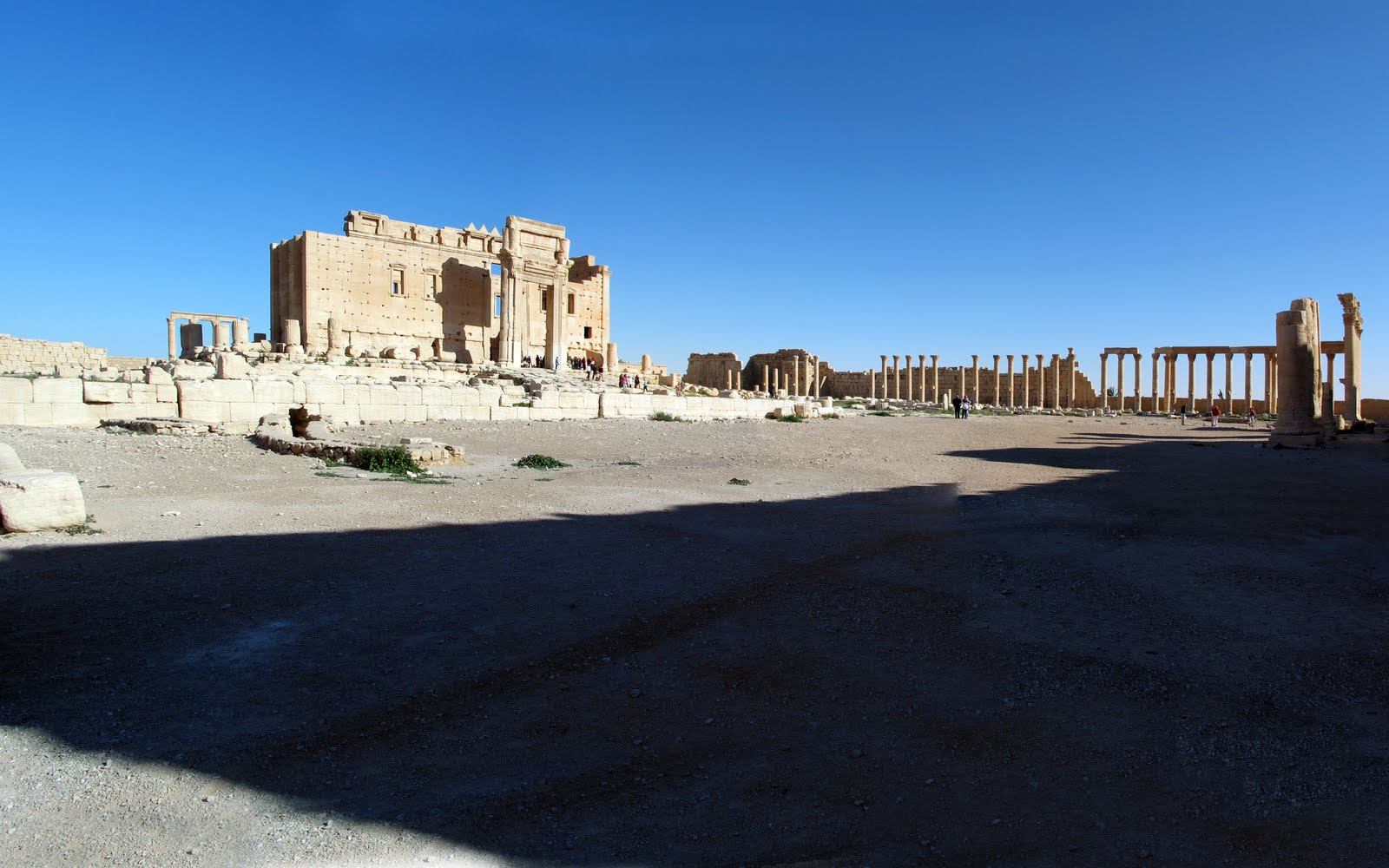
Sometimes things we read in the news hit close to home, even from halfway around the world in an ancient, foreign land. A friend from college has a personal connection to the ruins of the temple in the Palmyra Valley of Syria. He visited there and took the photos I have published in this blog with his permission. He describes the Valley, sitting about 125 miles north-east of Damascus, Syria, in the desert, as it appears above, “a welcome relief after weeks, months on the road” for the people traveling the Silk Road from the east.
The “peaceful place… filled with memories” was no longer peaceful and filled with pleasant memories when I began this piece. I started this blog article years ago, when ISIS was at it’s public height. I don’t know how things stand today. The news has moved on, leaving whatever ravages that continue and desolation that remains out of the pubic eye.
“‘Among the great cities of antiquity, Palmyra is comparable only to Petra in Jordan, Angkor Wat in Cambodia, and the Athenian Acropolis in Greece,’ argues GW Bowersock, professor emeritus of ancient history at the Institute for Advanced Study in Princeton.””(quoted in Isis’s Destruction Of Palmyra: ‘The Heart Has Been Ripped Out of the City’ by Stuart Jeffries in the Guardian Sept. 2, 2015)
In light of fond reminiscences of a peaceful time, relationships developed between disparate brothers and sisters who shared good will and the historic significance of this desert oasis along the ancient Silk Road, the utter sadness and ache of the loss of the ruins is deep and vacuous. And more so now that my part of world has largely forgotten the devastation that exploded in front of the world’s eyes just a few short years ago.
In the Atlantic, the headline read with finality, An Ancient Temple in Palmyra Is Destroyed. “Reports of the site’s destruction come just days after the Islamic State killed Khaled Asaad, an 82-year-old Syrian expert on Palmyra who refused to divulge the location of artifacts despised by the militant group [and coveted for the booty they would bring]. Asaad had run Palmyra’s antiquities department for 50 years.”
“The taking of the historic city of Palmyra by Islamic State represents ‘the fall of a civilisation’, according to Syria’s antiquities chief Maamoun Abdulkarim. Speaking to Reuters today, he said: ‘Human, civilized society has lost the battle against barbarism. I have lost all hope.’” (Mark Woods Christian Today Contributing Editor 21 May 2015)
Temple at Palmyra by Steve Murray
Barbaric, incomprehensible, brutal, evil, criminal, atrocity …. Words fall short. No regard for history, culture, art, life …. The ISIS militants did not even have regard for their own lives, and the wrought unspeakable destruction and the taking of precious life in the Venice of the Sands.
Christians, humanists, peaceful Muslims, people of all stripes condemn what ISIS has done. The destruction of the ancient ruin of Palmyra is a war crime. The killing of Khaled al-Assad, the curator and protector of the Palmyran antiquities, is an atrocity of the worst order. He gave his life to protect those beautiful, ancient ruins…, but the ruins were destroyed with him. The various reactions to the crime and atrocity are understandable and expected.
The worldwide reports emphasized a common theme: the harsh clash of religious fundamentalism with civilized society is characterized by destruction and violence. “ISIS did not merely blast apart old stones—it attacked the very foundations of pluralistic society.” (The Rubble of Palmyraby Leon Wieseltier in the Atlantic Sept. 4, 2015). Indeed, ISIS displayed the worst of religion – the worst of humanity.
The destruction of ancient historical artifacts and buildings is nothing new, of course.
“In this iconoclasm – literally, the destruction of religious icons and other images or monuments for religious or political motives – Isis has its place in a rich history of destruction. Moses reduced the Golden Calf, made from Israelites’ golden earrings, to dust. Centuries later, the 93 carved relief sculptures of the life and miracles of the Virgin Mary in Ely Cathedral’s lady chapel, were hacked off during the Reformation. In between Moses and the mutilation of Ely was something called the Iconoclastic controversy in the history of the Eastern or Byzantine Christian church. Between AD 726 and 843, the then emperors of Byzantium believed icons were not only a reversion to the pagan idolatry of the ancient Greeks and Romans, but that their existence was the chief obstacle to the conversion to Christianity of Jews and Muslims, to both of whom the image was anathema. Iconoclasm, then, is by no means only an Islamic thing.” (quoted in Isis’s Destruction Of Palmyra: ‘The Heart Has Been Ripped Out of the City’ by Stuart Jeffries in the Guardian Sept. 2, 2015)
As we reel in sadness and righteous anger (something the irreligious seem to have learned well from the religious in recent times) over the destruction of such significant ancient preserves, there is a greater loss. Ross Burns, adjunct professor of ancient history at Macquarie University in Sydney, Australia, whose life is devoted to the preservation, study and appreciation of antiquity, appropriately recognized,
“[T]here are more important considerations in Syria in 2015 than the preservation of ancient monuments. ‘The physical damage to monuments has to be assessed against the scale of the human tragedy….’” (Id.)







 Navigating by Faith