The Story of Abraham and Isaac Revisited: Here I am!

I set the stage for digging deeper into the story of Abraham and Isaac in The Story of Abraham and Isaac Revisited: Introduction. Abraham’s faith is the lesson we all learned in Sunday school. Faith is the basic place we start, but Abraham’s faith is only scratching the surface of the story.

We often view this story as simply a test of Abraham’s faith, which it is, but it’s much more than that. This story is not simply about Abraham’s faith, because what we learn through Abraham’s faith may be just as important, if not more important.

Think about it: Does God need to test Abraham to know who he is? God already knows what kind of man Abraham is. He knows our thoughts from afar and the words we speak even before we say them! (See Psalm 139) That should give us a clue that there is more to this story, so let’s go back and see what else there is to see.

Many decades before, we are told that Abraham believed God, and his faith was credited to him as righteousness. When God called Abraham to leave his country, his people, and his father’s household – which was his legacy – and God said He would make a great nation of Abraham’s descendants, Abraham left – though he didn’t even knowing where he was going! Though he was 75, Abraham responded with faith and went. (Gen. 12:1-4)

Many years and adventures later, Abraham was still childless, living in the land God showed him, and Abraham still believed the promise God made to him, though he had nothing to show for it. Abraham’s faith was already counted to Abraham as righteousness, but the promise Abraham believed was not yet realized. (Gen. 15:1-6)

Isaac was not born to Abraham and Sarah until Abraham was 100 years old, a quarter century after the initial promise was made. (Gen. 21:1-7) All the while, Abraham had faith. The story of Abraham and Isaac is not just a story about Abraham’s faith, but about how God is revealed through Abraham’s faith.


Though the story begins with the statement that God was testing Abraham, it doesn’t say God was testing Abraham’s faith. (Gen. 22:1) Perhaps, God tested Abraham, at least in part, to show Abraham (and us) who God is!

I will explain, but first we need to understand something of the Ancient Near East culture Abraham lived in. A key element of this story is the fact that child sacrifice was a common and universal practice in the Ancient Near East.

Abraham would have been intimately familiar with how people understood the gods of his culture. They were considered unpredictable, arbitrary, and capricious, demanding allegiance and sometimes even child sacrifice to be appeased.

What Abraham may have sensed, but didn’t fully understand, was that his God was not like the other Ancient Near East gods. The character of God, as revealed to Abraham, would have been a complete paradigm shift from what he and his culture believed about gods.

In our western mindset, we might expect God to announce at the outset who He is: we might expect Him simply to tell us. In a more eastern mindset, we they expected to discover truth through their lived experience and the lived experiences (stories) of other people.

Similarly, it seems, God doesn’t simply tell us who He is; God desires to show us. To “know” God is not simply an intellectual exercise; it is a lived experience. Thus, all of Abraham’s life is an example for us, and we learn who God is through Abraham’s lived experience (and our own).

God reveals Himself to Abraham experientially through Abraham’s faith, and He reveals Himself to us through Abraham’s story and our own faith. If you haven’t read the introductory article yet, I encourage you to do it now at the link above.

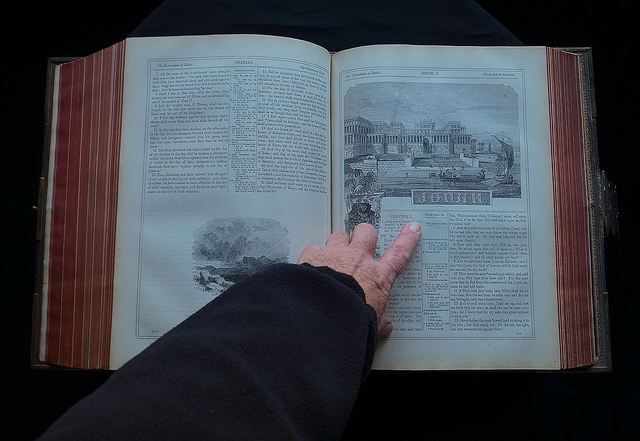
With this basic understanding, I encourage you to read Genesis 22:1-14. Then, we get into the details of the story.

Continue reading “The Story of Abraham and Isaac Revisited: Here I am!”

The Story of Abraham and Isaac Revisited: Introduction

God tests Abraham’s faith by asking him to sacrifice his son. Abraham in faith goes ahead but God intervenes to provide a ram for sacrifice instead.
Genesis 22.

Everyone in the western world has heard of the story of Abraham and Isaac. It is iconic. Even people who didn’t hear the story in Sunday school as a child have heard the story somewhere along the way in their lives. The story is a commonly referenced in literature and art, and often with negative connotations in our modern world.

Dare I say that most people have a shallow understanding of the story – even Christians? I would include myself in that category for most of my life, though I had the fortune of hearing the story and considering it for the first time, not in Sunday school, but in a college World Religion class.

The “fortune” of hearing the story for the first time in the context of an academic environment is that that I approached it first intellectually with an open mind. I approached it critically – not as in being critical of it, but as in being thoughtful about it.

Those discussions have stuck with me. We learned about the Mesopotamian world in which the story arose, including the theory that monotheism was born in that time and region (not necessarily of Hebrew origin).

I have since spent many hours thinking and writing about those things I first learned in that class about the Ancient Near Eastern world in which Abraham would have lived. I have learned other things as well, such as the apparently universal practice of child sacrifice to the gods that dominated the religious thought in that culture.

The story of Abraham and Isaac must be read in that context to understand how it fits in. We learn through the story that the God of Abraham was radically different from the gods of the Ancient Near East culture in which Abraham lived.

In Abraham’s world, every people group and community had their own gods. While each community of people had their own gods, and each god was different from the next, one thing those gods all had in common: they were unpredictable, arbitrary and capricious.

Everyone Abraham knew assumed that the gods had to be appeased, and appeasing the gods often meant sacrificing your own children to them if necessary. Abraham would not have recoiled in moral horror at the thought that God was insisting he sacrifice his son. As difficult as it might be, you didn’t argue with the gods.

We tend to focus only on Abraham’s faith, as if that is the sum and substance of the story. Faith is the Sunday school lesson, but it’s only a shallow understanding if we see nothing else in the story. Faith is merely the beginning of understanding:

“And without faith it is impossible to please him, for whoever would draw near to God must believe that he exists and that he rewards those who seek him.”

Hebrews 11:6

Without Abraham’s faith in God, he would not have learned that God was different than other gods. Abraham’s faith was the key to learning that God was different, and Abraham’s discovery of the unique character of God is the real gem of this story – that He is not unpredictable, arbitrary and capricious like the other gods.

Abraham was a man of faith. He believed God exists, and he believed that his God was the God of gods. He believed that God could be approached; God could be trusted; and God rewards those who seek Him. Abraham was a man who sought to draw near to God, but that is only the beginning.

In the story, we see that Abraham expected God to be like the other gods he knew, but we also see that Abraham sensed something different about God. God used Abraham’s cultural understanding of the gods to show Abraham that He was different.

God is not arbitrary and capricious. He has plans for His creation. He desires to bless His creation. He desires relationship with His creation, and we (like Abraham) can engage God in that purpose by faith – by trust in God’s benevolence and good intentions toward us.

This understanding of the story will become more evident as we dig deeper in the next article: The Story of Abraham and Isaac Revisited: Here I Am. While the Sunday School version is all about Abraham’s faith, and the secular, cynical version fixates of the savage notion that a god might demand child sacrifice, the real gem of the story is that God is not like the other gods Abraham knew.


Enough Is Enough: Entering into God’s Rest

God’s work has been finished since creation, but that doesn’t mean His purposes are accomplished, yet

I am listening to the BEMA Podcast with Marty Solomon and Brent Billings as they work their way through Genesis applying a more Hebrew, eastern approach to understanding and interpreting scripture. I have talked about these things in previous articles, so I will not rehash.

One of the observations made in the story of creation is that God rested on day 7. The theme of God resting can be followed throughout scripture, especially in the law of the Sabbath rest.

The writer of Hebrews says that the nation of Israel would not enter His rest because they hardened their hearts “in the rebellion” in the wilderness when they “tested and tried” God; rather, they went astray in their hearts and did not know God’s way. (Heb. 3:7-11) From these statements, we understand that God withholds His rest to those who harden their hearts, test and try God, go their own ways and do not “know” God’s ways.

In Hebrew thinking, to know God’s ways is not just an intellectual thing. It’s an experiential thing. To know is to connect personally with and to experience. Knowing is not just intellectually grasping, but becoming personally intimate with something.

God promises us that we will enter into His rest if we do not harden our hearts, if we do not test and try Him and do not go astray, but know (experience, become intimate with) God’s ways. (Heb. 4:1-2) God desires for us to enter His rest.

One conclusion a person might draw from the story of creation is that God knew when to stop creating. He knew when to rest. He knew when enough was enough, and He invites us likewise to know when enough is enough: to rest.

God’s work has been finished since creation (Heb. 4:3), but that doesn’t mean His purposes are accomplished, yet. We know, for instance, that He subjected creation to futility (mataiotés – vanity, emptiness, unreality, purposelessness, ineffectiveness, instability, frailty….”) in hope. (Rom. 8:20)

If He subjected creation to futility in hope, He did it with the expectation and purpose that the hope would be fulfilled and accomplished. The hope is that “the creation itself will be liberated from its bondage to decay and brought into the freedom and glory of the children of God”. (Rom. 8:21)

This suggests that God may have been done with His works when he rested, but His purposes were not yet accomplished. Gods rest prior to the ultimate accomplishment of all that He purposed is part of the story. There is more to the story then simply the creation.

The creation was intended for a purpose that is yet to be accomplished, and our freedom and glory is needed to accomplish that purpose and to liberate creation from its bondage to decay! But what is that yet unfulfilled purpose?

Continue reading “Enough Is Enough: Entering into God’s Rest”

The Perfect Imperfection of the Universe

We need to know the purpose of a design before we can comment on how well it accomplishes that purpose.

Photo credit to Beth Drendel

This article is inspired by the following article in which the author takes issue with an author of another article taking issue with the idea of the eye as proof of an Intelligent Designer. Go ahead and read the article if you are curious. My point goes in a different direction, though. I will pick up when you are done. (Or you can skip it and jump to where I start again.)

Nathan Lentz finds fault with the human eye and, therefore, argues that the human eye is poor evidence that a Designer God is behind it. Lentz comes from an evolutionary materialist position. Cornelius Hunter uses the force of Lentz’s argument against him.

In essence, Hunter counters that the fault-prone human eye should have spelled the demise of the human species if evolutionary materialism is true. The fault-prone human eye would have prevented humans from climbing to the top of the food chain and would have weeded us out long ago (on the evolutionary paradigm).

I am not really convinced by the counterargument. But then, I am not really convinced by the initial argument. Both arguments boast of knowledge and wisdom we have no claim on.

If God exists, who are we to find fault in His design? Design requires a purpose. Design doesn’t drive purpose; rather, purpose drives design. We must know the purpose of something before we can really comment on the design.

A design may be well suited to certain purposes and not to others, in varying degrees. The human eye serves a purpose in providing us the ability to do many things, and we have survived (obviously) despite the faults to which the human eye is prone. Perhaps, we could do more and survive better if the human eye wasn’t so subject to problems.

Then again, maybe the point (the purpose) of the human eye isn’t primary or only to allow us to do things and to survive. Maybe the human eye is designed to accomplish a much a greater purpose than mere utility and survival.

One the other hand, the fact that humans have survived despite having eyes that are susceptible to near-sightedness, far-sightedness, glaucoma and a host of other issues may simply suggest that we have evolved with other strengths that overcame the weaknesses in the human eye. The faults in the human eye don’t really disprove evolution.

But I have no interest here in continuing to prove or disprove either argument. I believe sufficient evidence exists to establish that a creator God is the best explanation for the universe.

What interests me is the following passage in Romans that speaks to the Lentz article on the seemingly flawed design of the human eye:

“[T]he creation waits with eager longing for the revealing of the sons of God. For the creation was subjected to futility, not willingly, but because of him who subjected it, in hope …..”

Romans 8:19 (ESV)

The idea I come back to is that God subjected the creation to futility… in hope. That means God subjected the creation to futility for a purpose. If the human eye is “flawed” (from our perspective), it is “flawed” for a purpose.

Continue reading “The Perfect Imperfection of the Universe”

How Does the Tower of Babel Fit into God’s Plan for People to Love Him and Love Our Neighbors?

Our frustration, toil and separation from other people are not contrary to the purposes of God, but part of the plan.

The story of the Tower of Babel is included in Scripture for a reason, right? So, Why is it there? How does the tower of Babel fit into God’s redemptive plans and purposes?

These are questions we should think to ask. In fact, Scripture is designed, according to Hebrew thinking, to invite us to ask questions.

Western thinking might assume that we just take things on faith and don’t ask questions. Or the opposite: take it at face value and dismiss it when we find problems (“contradictions”) in the text. The biblical texts, however, are inherently Hebrew (“eastern”) in their assumptions, and we lose something if we do not understand that.

God wants us to seek Him, and that includes asking questions of Scripture, wrestling with it, and finding answers to our questions. We don’t exhibit a lack of faith when we find “problems” in Scripture and ask questions. Our faith propels us forward to wrestle with the text and seek answers through study, prayer, and the guidance of the Holy Spirit.

We can hold to a high view of Scripture and admit there are “problems” in the text. Those problems can lead us to some real gems in the answers they reveal.

God desires us to seek him and find him, as Paul says to the philosophers in Athens. (Acts17:27) Jesus, of course, promised that those who ask, seek, and knock will be answered, will find, and the door will be open to them. (Matthew 7:7) Faith is evident when we use the problems we see as the springboard to seek answers.

I recently wrote an article on the Tower of Babel story exploring some of the questions it invites us to ask, and trying on answers that are suggested by a more eastern (Hebrew) mindset than most westerners might be adopt.

One question we might ask is: why is the story there to begin with?

We might assume the story is simply an explanation for how people became scattered all over the world in different language groups. If that is all we get out of the story, though, we miss the most important meaning. If we stop there, and assume there is no more to the story, we may be missing the most important part of the story!

A Hebrew (or eastern) mind always asks, “Why?”

I resonate with this basic practice incorporated into the BEMA Podcast because of a Jewish professor I had in college. He explained one day the difference between the western and eastern approaches to Scripture. He illustrated it with the following example.

If the universe consisted of a chair in a room, people with western minds and eastern minds would approach the room differently. The westerner would measure the height, width, depth and mass of the chair. He would weigh it and measure the distance of the chair from the walls and the ceiling. The easterner (the Hebrew) would start by asking, “Why is the chair here?”

In my previous article, I discussed how the story is a chiasm (a type of poetry). A chiasm puts emphasis on the middle verse. In this story, the emphasis falls on the people’s desire to “make a name for ourselves” because “otherwise we will be scattered over the face of the earth”. (Gen. 11:4)

Why were they concerned about being scattered? Why does God care? What is God doing in confusing their languages and scattering them?

For starters, God does not break into the story, yet, when they are making bricks. We might assume, therefore, that God isn’t threatened or concerned about their development of new technology. He doesn’t break into the story until they say they are going to build a tower to make a name for themselves.

We also need to be mindful, always, of context. The context here is that people are moving away from God, away from his plans. (Moving east.) God wanted them to multiply and fill the earth, but they wanted to put down roots in the plains of Shinar (Babylon), lest they be scattered, and build a tower to exalt themselves.

God’s plan was to have them “multiply and fill the earth”. This was the instruction from God to Adam and Eve. The people who built the Tower of Babel didn’t want to do that. They didn’t want to be “scattered”. They resisted, and they put down roots when they should have been filling the earth.

Building a tower to make a name for themselves, in this context, means wanting to pursue their own plans to achieve their own ends. The concern about being scattered suggests they knew they were doing their own thing contrary to God’s plans for them. They might have feared being scattered because it would disrupt their plans to exalt themselves.

Maybe they thought God couldn’t scatter them if they built a fortified tower. Maybe they were trying to make God deal with them on their own terms, in a location they established, by a structure by which they thought they could ascend to God and control where God met with them.

Of course, God did exactly what they feared, and scattered them a against their wishes by confusing their languages.

But why? Was God threatened by them?

Um…., no. God is sovereign. He created the heavens and earth, and He created these people. They were no threat to Him. So why did God scatter them?

I believe the answer lies partly in the fact that they were pursuing their own plans in exultation of themselves. God had other plans, and God frustrated their plans that were not in keeping with His plans.

That might all seem arbitrary unless we keep asking questions and seeking answers. Why were the peoples’ plans something God couldn’t abide? How did the peoples’ plans interfere with God’s plans?

What were God’s plans?

Continue reading “How Does the Tower of Babel Fit into God’s Plan for People to Love Him and Love Our Neighbors?”