I am on a year-long plan to read through the Bible chronologically (which is not exactly the way the Bible reads if you start in Genesis and read straight through to Revelations). I also read a “verse of the day” in the Bible app (YouVersion) that I use. I begin most mornings with reading the passages of the day in the year-long plan I am following and the Scripture of the day.
Today’s chronological reading begins with Psalm 1[i]. The verse of the day is Psalm 1:1-2:
1 Blessed is the one
who does not walk in step with the wicked
or stand in the way that sinners take
or sit in the company of mockers, 2 but whose delight is in the law of the Lord,
and who meditates on his law day and night.
I almost glossed over the fact that the chronological reading of the day and the verse of the day converged on the same text – Psalm 1. I kept reading out of force of habit, but that still, small voice was whispering in my ear.
“Maybe”, I thought, “God wants me to focus on Psalm 1 today. Maybe He has something to say to me.”
It would take too long for me to explain where I am in my journey of praying, reading and meditating on Scripture and what God has been laying on my heart or how I got here. Suffice it to say that my attention was drawn to the contrast of the righteous and the wicked in Psalm 1.
I realized as I read Psalm 1 a second time, more carefully, that I have some assumptions about those two categories of people – the wicked and the righteous – that I have carried a long time and which may not be completely accurate.
As I have been reading chronologically through the Bible, I have been focusing on the theme of righteousness and justice. I realized this morning that what I have been learning about righteousness and justice reveals that my assumptions about righteousness and wickedness may be a bit shallow and, therefore, a bit off center.
Who are the righteous and the wicked?
That is the question that I believe God prompted in my heart.
“The clash of ideas is the sound of freedom.” (Lady Bird Johnson)
I grew up in the 1960’s and 1970’s, bring born at the very end of 1959. My young, impressionable mind recalls the assassination of JFK, Robert Kennedy and Dr. Martin Luther King, Jr. I remember watching the riots during the Democratic National Convention in Chicago, the Kent State protest and shooting, the footage of the Vietnam War and the Nixon impeachment on the nightly news.
The world seemed a chaotic place, no less than it does today, on this 4th day of July, 2020.
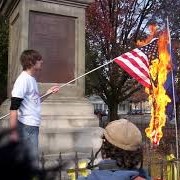
In the 1960’s, the dissident voice championed First Amendment rights that included the freedom of assembly and freedom of speech. I remember that freedom cry as a child superimposed over news footage of a burning US flag. The patriot in my young heart was equally shocked by the flag burning and impressed by the necessity of the freedom that allowed that flag to burn.
In law school, I learned the nuances of the jurisprudence that grows out of our US Constitution in which the First Amendment is enshrined. The clash of ideas is so sacred in our constitutional framework that it allows even the idea of abolishing that very framework to be heard.
In the 21st Century, many things have changed, while somethings have remained the same. Many of the dissident ideas from the 1960’s have become mainstream, and more “conservative” voices have become dissident. I am no longer shocked by the burning of the flag (and, perhaps, the point of burning a flag is no longer poignant for the same reason).
The angst of the 1960’s of my youth has been replaced by the angst of the 21st Century of my middle age. The reasons for my angst are much different, yet very much the same at their core. I have grown and changed in my views, but the emotional strain of the human condition remains.
I fear, at times, that the framework that protected the freedom to burn US flags in the 1960’s might, itself, be destroyed in my lifetime, or the lifetime of my children, by the fire of ideas that are antithetical to that freedom.
The ideas in colleges and universities around the country that seem to dominate those institutions promote the silencing of dissident voices. Speaker engagements are canceled as the loudest voices want not even a whisper to be heard in opposition.
One theme of the dominant social, philosophical and political ideologies that thrive on college campuses today is that certain voices should be silenced, while other voices should be magnified – a kind of totalitarianism of ideas. This worldview would destroy the foundation of the First Amendment if the First Amendment is not held firm.
I am shocked by this new predominant view as I was once shocked by the burning of a US flag. The shock stems not from the evils in society this ideological view aims to address, as I find some common ground in those concerns. I am shocked that the proposed remedy involves weakening the most fundamental freedom that protects freedom itself – the freedom of ideas and the right to express them.
The idea of “hate speech”, as well-intentioned as it sounds, is inimical to a framework of freedom that protects the clash of ideas. Nowhere is freedom more necessary to be protected, than at the intersection of ideas and the right to express them. One person’s hate speech is another person’s freedom of expression.
If we allow the idea of hate speech into the fabric of First Amendment jurisprudence, we threaten its very foundation. What we characterize as “hate” today is subject to change with changing societal norms tomorrow. No speech is safe from the label of “hate” if labels are allowed to silence speech.
While such a worldview has some appeal and laudable goals, it cannot be advanced by the abolition of freedom of speech. Yet, I realize at the same time, that freedom, real freedom, protects even those ideas that are antithetical to freedom and demands that they be heard.
As shocked as I was in my naïve youth to watch the US flag burn in the streets of America, I understood the importance of allowing that expression to be heard. That I am no longer shocked by that expression is of no consequence.
In fact, freedom of speech is nowhere more vital than the protection of speech that is offensive. Favored speech doesn’t need protection. If any speech or expression is deemed unworthy of protection on the basis of its content, no speech or expression is safe.
Have you ever heard of the rebellion of Korah? How about the Sons of Korah? The rebellion of Korah and the Sons of Korah have a connection with each other, and the connection is fascinating.
The rebellion of Korah occurred during the 40 years Moses led the nation of Israel in the wilderness following God’s miraculous deliverance of the people out of captivity in Egypt. Korah rose up during their time of desert wandering and rallied a group of people to oppose Moses.
Korah was a grandson of one of Levi’s three sons (Kohath). He was a Levite, which meant that he was involved in the Levitical duties of caring for the tent of meeting and the tabernacle where God’s “presence” resided in the midst of the people. The Levitical duties were sacred and honorific.
The Kohathites were specifically in charge of caring for the Ark of the Covenant, the table, lamp stand, altars, articles of the sanctuary and the curtain behind which the priests performed the sacred rituals God passed down to Moses. (Numbers 3) Unlike the other Levites who were allowed to transport their items in carts, the Kohathites were required to hand carry their items.
The Ark of the Covenant was particularly sacred, of course, but the Kohathites may have been jealous of the ease enjoyed by the other priests who didn’t have to hand carry the items for which they were responsible. We don’t know. The text doesn’t tell us.
The text does tell us that Korah and several others rallied 250 other men in public opposition to the authority of Moses. They claimed that all the people of Israel are holy, and they questioned why Moses and Aaron “exalted themselves” above everyone else. (Numbers 16:3) They might as well have said more pointedly, “Who put you in charge?!”
Moses responded by challenging Korah and his followers to put the issue before God. He said, “This is how you will know that the LORD has sent me to do all these things and that it was not my idea.” (Num. 16:28)
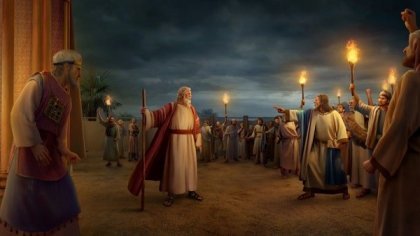
As the story goes, they gathered publicly before all the people in front of the Tent of Meeting, each man with incense burning in censors. This is how Moses and Aaron faced off with the contentious lot led by Korah. I am really not sure of the point of this faceoff. If anyone has any insight, post in the comments below.
In any event, God warned Moses, and Moses warned the crowd to stand back. When he finished talking, the ground opened up and “swallowed” up the 250 men rebels that supported Korah in his opposition to Moses. (Numbers 16)
The story stands as a warning to those who are not content with their place in the world and people who get jealous of others to whom God has given greater responsibility and authority. God chose Moses and Aaron to lead the people. By opposing God’s chosen leaders, Korah and his band of rebels were ultimately opposing God and God’s authority.
From this story, I assumed that Korah and his clan were wiped out. The text seemed to imply that all his family were included in the 250 agitators. It turns out that my assumption was wrong, however, because the “sons of Korah” appear many generations later, and their place in the history of God’s people is truly intriguing.
Now, for the “rest of the story”, as Paul Harvey used to say.
“Two things I ask of you; deny them not to me before I die: Remove far from me falsehood and lying; give me neither poverty nor riches; feed me with the food that is needful for me….”
.
Proverbs 30:7-9
I read this short passage in Proverbs in my early years as a follower of Christ. It might have been in college after I gave my life and my heart to the Lordship and salvation of Jesus Christ, or it might have been in the few years that followed. I remember praying these things to God earnestly, and I have remembered these words and my prayer ever since.
During my late 20’s and through my 30’s, I struggled through many difficult years with a young and growing family. I didn’t realize how much this prayer would mean for me. At the age of 28, married for 3 years and with 2 children, I was restless. We had no debt, but we lived hand to mouth. I felt God leading me (I believed) to law school, but I was also focused on what I needed to do to increase my income so that we were not one bad circumstance away from the poorhouse.
I believe God did lead me to go to law school, but I also let worry, and sometimes even fear, creep in and sit at the threshold to my heart. Those three years of law school were very difficult. We had a third child at the end of my first year. The pressure of the work, of the necessity not to fail, of going into a hole financially, of an uncertain future and more was a very great burden. The pressures and the worry and fear overtook me.
I let those weeds grow up and choke the spiritual life in me. I didn’t maintain the discipline of regularly reading Scripture or daily prayer. My prayers were Hail Mary’s thrown up in the midst of the weariness and pressures of my life at that time. Even going to church was filled with tensions of herding three rambunctious boys into a car on Sunday mornings amid the whining, squabbling and desire simply to take a break. it became more of a duty that something I looked forward to.
Three more children, and new pressures and tensions as a new lawyer, struggling under the load of debt, and many, many activities threatened to snuff out the spiritual life in me. The worry, fear, busyness and lack of discipline on my part to take time out on a regular basis to sit before my God, listening for His voice, waiting on Him, being renewed by Him was a recipe for spiritual death.
In addition to praying the prayer of Proverbs 30:7-9, I prayed desperately to God before those days of tension, worry and fear not to let me slip ever from His hands. I didn’t pray that because I saw anything in my own heart that caused concern, but I had seen enough other people who seemed to have had it all spiritually together at one point walk (or slip) away into spiritual darkness.
It puzzled me then (in the joy of being a new Christian), and the inability to understand it at the time added to my concern that I might be no different than they. After all, everyone of us sins and falls short. There is nothing new under the sun. Though I had fully embraced Christ, and even left family and home and all that was familiar to me, to follow Him, Scripture gave me pause not to be so confident.
As I look back, I see that I was right to pray those prayers. Not that I count any advantage to being right. Rather, I have learned that Scripture is full of wisdom to which we would well to pay attention. Above all, though, God is faithful! Continue reading “Give Me Neither Poverty nor Riches”→
I am catching up on my Scripture reading after a 9-day vacation in the north woods where my reading was sporadic. I am reading through the Bible chronologically. I am in Isaiah and Hosea as the prophets begin to address the coming doom for Israel and Judah who have continuously wandered in their faithlessness to God since they left Egypt.
Their’s is a spotted history, marked more by failure than success. The began grumbling and complaining soon after God led them miraculously out of Egypt. They made an idol of a golden calf even as Moses was meeting God on the mountain to receive God’s covenant. They failed to drive all the wicked people out of the promised land as God instructed, and they were influenced by them all the days they inhabited that land.
They set up idols in the high places where they offered sacrifices to the foreign gods despite all the efforts of God to establish a people for Himself to whom He could pour out His blessings and, through them, bless all the nations of the earth (such was His promise to Abraham). The cycle of sin and straying from relationship with God was growing ever worse as God raised up prophets to warn them.
The promised land, filled with milk and honey and all good things as it was, afforded the people wealth and comfort. In their abundance, they wandered further still from God.
“Israel is a luxuriant vine that yields its fruit. The more his fruit increased, the more altars he built; as his country improved, he improved his pillars.” (Hosea 10:1)
Those altars were the structures on which they offered sacrifices to foreign gods – idols. The practice of sacrificing on altars seems strange to us today. We don’t make golden calves or build altars to gods. We aren’t like them. Right?










 Navigating by Faith