Paul said, “What business is it of mine to judge those outside the church?” (1 Cor. 5:12) This is where my mind went when I watched An (Un)Civil War: The Evangelical Divide posted online recently by CBS News. In the next moment, I was asking question Joshua asked the commander of the army of the Lord: “Are you for us or for our enemies?” (Joshua 5:13)
If you know the Lord’s answer to Joshua’s question, think about it for a moment. The subject here is the modern form of evangelicalism that is highlighted in the CBS piece linked above: hyper patriotic, nationalistic and political. I will come back to the Lord’s response to Joshua before I conclude. (You can read the passage now if you are too curious to wait.)
I hardly watch the news anymore, and CBS is certainly not my “go to” news source. I don’t have one. The portions of the CBS piece that are ringing in my head are the clips of the evangelical leaders preaching and explaining themselves in their own words.
I do understand that these clips are selected and don’t represent all that these leaders stand for or all that they might say. What they reveal, though, is enough to move me to write.
The clips show various preachers unapologetically “speaking the truth” from the pulpit, which the commentator calls “sermonizing a brand of social conservatism defined by conspiracy and apocalyptic rhetoric”. The words of the commentator are not what catch my attention, but they should be noted for the way they are perceived.
The piece focuses on what is described as a “power struggle” in evangelical circles. That is how the world sees the difference in opinions by evangelicals: a power struggle inside Christianity “at war within itself”.
One firebrand pastor (Greg Locke) touts the amount of support for his position, seeming to affirm the perception that it’s all about power and influence. In the world of politics, the number of evangelical constituents (over 1 in 4 Americans) is a matter of power and influence to political pundits. Locke’s comment and the concern expressed in the media piece align on that basis.
(I question whether 1 in 4 Americans are really evangelicals in the way I and most people of genuine faith define evangelicals. The statistic is a political one, not a religious one, but that is a topic for another day.)
One pastor is heard saying, “But we shouldn’t talk politics in religion. Says who? Satan?! That’s the only way they control us!”, he says. “To get us to be silent.”
Indeed, power, influence, and control are at the center of this phenomenon. At the same time, Locke claims that the Bible is the issue, “Here is what the Bible says. Boom! We’re going to go with it!”
Locke views himself as fighting for the Bible, fighting for ‘God and country”, trying to wrestle the United States out of the grip of the left and Satan. But, is that really what is going on? What about the Bible?
Are they actually preaching what the Bible says?
There is so much to be said here, but I want to focus on just three things: 1) what the Bible says; 2) what the message of the Gospel is; and 3) whose side God is on in this struggle.
The creation of Adam – Vatican Sistine Chapel in Rome, Italy. Created by Michelangelo Buonarroti.
I took some interest in a Facebook post at Bible Archaeology[1] about the image of Tiberius Caesar on a Roman coin like the one Jesus referenced in Matthew 22:15-22.[2] Some scriptural references and back ground facts are the subject of my writing today.
The story is well-known. Some Jewish leaders challenged Jesus with the question, “Is it lawful to pay taxes to Caesar, or not?”
It was a ruse. They were trying put Jesus into the impossible position of aligning either with the Jews (against the Romans, losing credibility with them) or with the Romans (against the Jews, risking punishment for opposing Rome) on the issue of paying taxes.
Jesus famously asked for a coin, and then he asked whose image was imprinted on the coin. It was Caesar’s image, of course. Then Jesus said, “Therefore render to Caesar the things that are Caesar’s, and to God the things that are God’s.”
Perhaps, my interest was piqued because I have written about the story before. I talk about rendering unto Caesar in the context of how Christians should respond to secular authority.[3] I wrote about Jordan Peterson’s comment, crediting the words of Jesus to the creation of the modern principal of the separation of church and state.[4] But I haven’t focused on what it is we are to “render” to God.
I am always excited to learn something new, and the Bible Archaeology post added some details I didn’t know. The first details provide the backstory to the story, which involves Judas the Galilean. The interrelationship of the two stories shows how intertwined, complex, nuanced and harmonious Scripture is within itself and with external facts discovered through historical and archaeological sources, among other things.
I appreciate the historians and archaeologists, like Bible Archaeology, that dig up corroborating details. In the Facebook post, they cite additional scriptural passages on Judas the Galilean that give us insight into why the Pharisees in Galilee challenged Jesus on the issue of paying taxes.
I have been busy of late (what else is new?), so I haven’t written much, though I always have thoughts swirling in my head that I would like to get “down on paper”. Today, I have just a short thread I want to get out of my head.
Paul speaks of the God Abraham believed in as the God “who gives life to the dead and calls into existence the things that do not exist.” (Romans 4:17 ESV)
Many are the gods that people have believed in since time immemorial. From gods made of wood and stone, to trees, mountains, the sun and other natural objects, to the pantheons of Greek and Roman gods, the number of gods people have believed in are legion.
Today, Hindus still have a panoply of gods, and pagans still worship objects of nature (or simply nature, itself). Christians and Muslims have whittled the legion down to one, and atheists believe in, simply, one less God than they. Other than the atheists of the world, most of humanity believes in something transcendent that is labeled divine.
The human drive is to attempt to discern the transcendent. Most agnostic believe that something transcends the natural worlds, though they won’t dare to divine what it is. Even some atheists hold out some form of believe in transcendence, even if they ultimately determine it is illusory. They acknowledge, like Stephen Hawking did, that it is helpful to believe it.
There is mystery in the transcendence we sense breaking into the world. There is intrigue. There is anticipation, and there is hope in the sense of transcendence that lingers often on the blurry edges of our mundane existence, sneaking into it at times leaving us breathless and wondering.
I often allude the curious statement in Ecclesiastes 3:11 that God put eternity in the hearts of men:
“He has made everything beautiful in its time. He has also set eternity in the human heart; yet no one can fathom what God has done from beginning to end.” (NIV)
If God didn’t put a yearning for transcendence into the human heart, where does it come from? I believe that is a rhetorical question.
For many, the idea of a transcendent being or reality is just too much to grasp. It is surrounded by too much uncertainty and requires too much strain and effort to attain even a dark understanding of it that they determine the simpler, easier and preferable course is to remain agnostic or to dismiss the idea of transcendence altogether.
Others have taken the leap to embrace one understanding or another and have committed themselves to that understanding. Thus, the legions of gods that have existed in the constructs of human thought. And that might just be what all or most of them are – constructs of human thought, attempts at putting a “face” on the transcendence we sense in he universe.
One man, Abraham, believed in a God “who gives life to the dead and calls into existence the things that do not exist.” This was a God above all gods. This was a God who spoke the universe into existence.
This was a God who Paul and other first century Judeans believed entered into the world He created in the form of a created being in whom He imprinted His own image. God could enter that being because He created room for Himself in that being. The writer of Hebrews says:
“[Jesus] is the radiance of the glory of God and the exact imprint of his nature…. (Heb. 1:3)
In very recent times, our best scientists have determined that the universe had a beginning. It came into existence a finite time ago. Stephen Hawking demonstrated the necessity of “singularity” (a beginning) mathematically.
The trio of Arvind Borde, Alan Guth and Alexander Vilenkin determined mathematically that any universe that is expanding had a beginning (a singularity) a finite time ago. Thus, a point of singularity, a beginning, would apply to any number of multiverses.
The fact that our universe, and any universe like ours that exists or could possibly exist, had a beginning a finite time ago raises the specter of the transcendent – a Beginner who initiated our universe into existence.
This is the God Abraham believed (a God who “calls into existence the things that do not exist”) in at a time when people were still making gods out of wood and stone. Though the entire world he knew thought they could conjure up and appease gods they made, Abraham believed in the kind of God that is utterly transcendent and which could create a universe out of nothing by speaking it into existence.
Abraham also believed in a God who could raise dead things to life. Paul in the first century, and all the followers of the man, Jesus, claimed that Jesus is the vindication of that belief. That Jesus was God who became man – emptying Himself (Phil. 2:7) to take on the form of a being (man) who God created in His image. (Thus, it was a good fit!)
That man demonstrated the character of God for us in the way he lived out his life. He reflected God’s love for us by his willingness to give his own life for us. He gave us the ultimate, transcendent hope by rising from the dead in that same body and inviting us to follow him.
Now, Paul says, we only have a partial understanding of that God who would stoop to come to us and demonstrate His love for us, but there will come a day when we shall know as we are fully known:
“For now we see only a reflection as in a mirror; then we shall see face to face. Now I know in part; then I shall know fully, even as I am fully known.” (1 Corinthians 13:12)
We yearn for Him because of the eternity that He set in our hearts, and we have some understanding of him because of His image that He placed in us. We can put a “face” to God in the life of Jesus, and we have hope that we will see Him “face to face” because of the resurrection of Jesus in human body he inhabited.
He holds out the promise to all of us that He made through Abraham thousands of years ago – a promise that Abraham could not even articulate other than to say that, through him and his descendants, God would bless all the people of the earth.
And Jesus left for us the Holy Spirit, which is God in the form of Spirit who is available to come into and reside in each one of us (John 14:15-21) who have invited Him in to reside with us to bear witness with our spirits that we are children of God. (Romans 8:16)
These things characterize the God of Abraham who was revealed more completely through the incarnation of Jesus. These things set one conception of God apart from all other conceptions of gods, and even the conceptions of one god that remains aloof. The hope of the God of Abraham is Christ in us!
The Son is the image of the invisible God, the firstborn over all creation.For in him all things were created: things in heaven and on earth, visible and invisible, whether thrones or powers or rulers or authorities; all things have been created through him and for him.He is before all things, and in him all things hold together…. [and he is] Christ in you, the hope of glory.” (Colossians 1:15-17, 26)
I have been trying to clear the way for an “unapologetic” argument for God. I am four articles in, and still making me way to the beginning. Standing in the way as I move forward is Hume’s standard of proof for miracles.
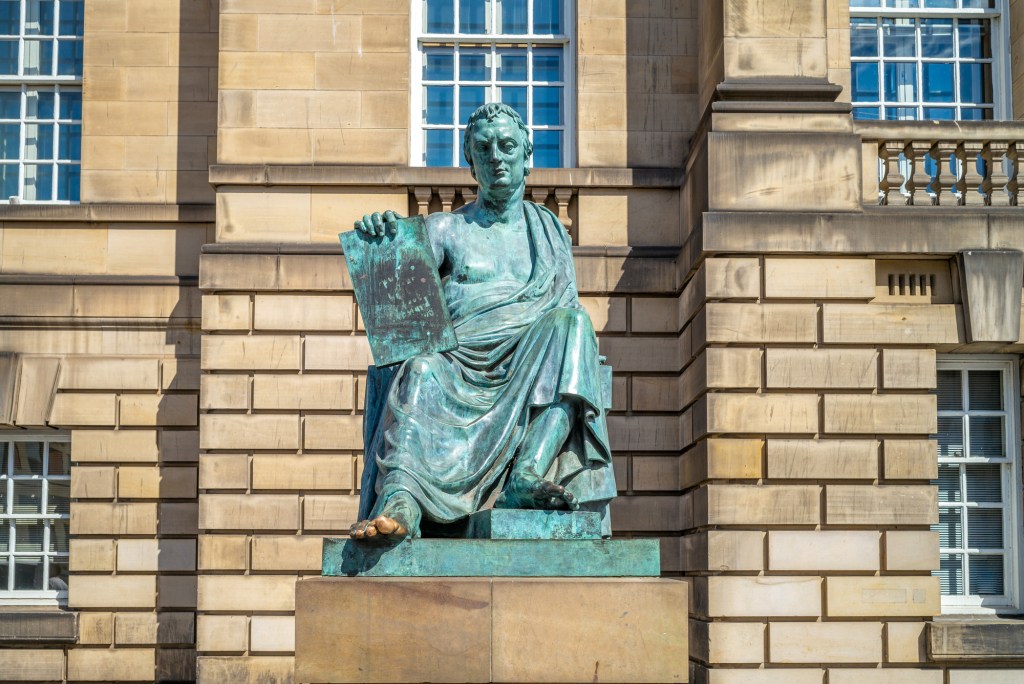
David Hume has had a profound influence on Western thought in the promotion of the Enlightenment view, which values human reason as the supreme measuring stick. Hume’s argument against miracles has been viewed as a gold standard among proofs that Christianity is not credible, especially to the extent that Christianity stands on the foundation of a miraculous event – the resurrection of Jesus.
Hume does not hide his antipathy for Christianity.[1] He calls the “Christian religion” a doctrine “so little worthy of a serious refutation … founded merely in the testimony of the apostles”. He labels belief in Christianity “arrogant bigotry and superstition”.
Hume speaks of the “greediness” with which “miraculous accounts” are received. He characterizes the “religionist” as “an enthusiast who sees no reality”, whose vanity is excited by strong temptations and self-interest to promote narratives he knows to be false for what he deems to be a “holy cause”. Hume accuses religionists of renouncing judgment by principle and losing grip on judgment by “passion and a heated imagination”.
Hume blames the popularity of religion on a “strong propensity of mankind to the extraordinary and the marvellous”. Hume’s disdain carries over from his view of “the generality of mankind” emerging from “ignorant and barbarous nations” who he says are fools … industrious in propagating the imposture” of the “supernatural and marvellous”, the “grossest delusions”, and “delusive prophecies”.
Hume rails on the religions “of ancient Rome, of Turkey, of Siam, and of China” equally. He lumps together the testimony of “a few barbarous Arabians” about Mahomet with “Titus Livius, Plutarch, Tacitus, and… all the authors and witnesses, Grecian, Chinese, and Roman Catholic, who have related any miracle in their particular religion”.
Me thinks he doth protest too much.
The standard Hume created to determine the veracity and credibility of a miraculous account contains the poison of his passionate convictions – a passion that smacks of the same kind of bias he accuses the “religionist” of committing. Yet, that standard has adherents today, perhaps because he reduces it to mathematical proportions that have the appearance of sacred science. Hume says,
“A hundred instances or experiments on one side, and fifty on another, afford a doubtful expectation of any event; though a hundred uniform experiments, with only one that is contradictory, reasonably beget a pretty strong degree of assurance. In all cases, we must balance the opposite experiments, where they are opposite, and deduct the smaller number from the greater, in order to know the exact force of the superior evidence.”
He acknowledges the importance of eyewitness testimony, but he imposes a standard on it that diminishes the value of any eyewitness testimony that contradicts widely established human experience. This seems reasonable on its face. “Marvelous” assertions are suspect; miraculous ones are even more suspect.
I think most of us can “go there” with him. On miracles, Hume says.
“A miracle is a violation of the laws of nature; and as a firm and unalterable experience has established these laws, the proof against a miracle, from the very nature of the fact, is as entire as any argument from experience can possibly be imagined.”
In one sense, Hume is merely acknowledging the nature of a miracle: it is a miracle that goes against (or seems to go against) the laws of nature that are commonly recognized and the weight of common experience. Nothing would be considered a miracle that was common to the experience of people, even if that experience is relatively uncommon among human experience. He reasonably says,
“There must, therefore, be a uniform experience against every miraculous event, otherwise the event would not merit that appellation.”
Hume, though, is not content to relegate miracles to the rarity they are by definition. He proceeds to define them out of the realm of possibility:
“And as an uniform experience amounts to a proof, there is here a direct and full proof, from the nature of the fact, against the existence of any miracle; nor can such a proof be destroyed, or the miracle rendered credible, but by an opposite proof, which is superior.”
Perhaps, wanting to appear open-minded, Hume allows for some proof that might establish a miracle. The proof of a miracle, Hume says, must so weighty “that its falsehood would be more miraculous, than the fact, which it endeavours [sic] to establish”.
Even then, Hume says, such counter-balancing evidence only levels the scales; it doesn’t make the factual assertion of the miracle more likely than not (and rejection of the assertion of a miracle would be justified either way).
Hume says, the mere testimony that a miracle occurred should be dismissed out of hand unless the falsehood of the assertion would require believing the miraculous, itself.
Hume seems to assume the possibility of such corroborative evidence, but a simple application of math belies the lack of substance he saw in anything miraculous. Nil plus nil equals nil.
As Hume’s approach is a mathematical one, we can see by the application of math and the value Hume has given to the miraculous the impossibility of establishing proof of a miracle on Hume’s position. The likelihood of proof is nil.
Indeed, he sets his bar so high and makes the requisite proof so onerous that a miracle would be required to prove a miracle. Lest there be any doubt about the meaninglessness of Hume’s standard, he admits:
“I beg the limitations here made may be remarked, when I say, that a miracle can never be proved….”
For this reason, Hume’s argument against miracles seems (to me) to be more of an exercise in satire than a sincere exercise in reasoning. I am surprised, therefore, that we take him at all seriously. To give further illustration and to remove all doubt about his pretense, Hume seems to beg the question in the following example:
“But suppose, that all the historians who treat of England, should agree, that, on the first of January 1600, Queen Elizabeth died; that both before and after her death she was seen by her physicians and the whole court, as is usual with persons of her rank; that her successor was acknowledged and proclaimed by the parliament; and that, after being interred a month, she again appeared, resumed the throne, and governed England for three years: I must confess that I should be surprized [sic] at the concurrence of so many odd circumstances, but should not have the least inclination to believe so miraculous an event.”
The fact that people still take him seriously, though the blunt force of his conviction seems stronger than his argument, is one reason I address him here.
In two previous articles attempting to make an “unapologetic” argument for God, I have just been ramping up to make the argument. I still haven’t gotten there yet, and I am still just getting started.
That’s right. I am still working on getting to the starting line. Maybe I will still get there.
I say, “unapologetic”, rather loosely, in case you are wondering. I am not being apologetic in the sense of apologizing for anything. Apologetics has nothing to do with being sorry, of course. It means to provide a defense, and it specifically describes the effort of providing a defense for Christianity.
The word, apologetics, derives from the Greek word, apologia, which means “a speech in defense” or a “verbal defense” or a “well-reasoned reply”. The world is used in Peter 3:15 as follows:
“Always be prepared to give an answer [apologia] to everyone who asks you to give the reason [logos] for the hope that you have.”
I am using “unapologetic” as a kind of play on words. I am not giving a typical apologetic argument for the existence of God, and I am not being apologetic about doing that.
I previously made the observation that we all start with axioms, premises on which we support our positions for and against God, but we are incapable of proving those axioms. We consider them “self-evident”, but that is, frankly, just another way of saying that we can’t prove our starting premises” we have to assume they are true, and we go from there.
We take our fundamental premises on faith, essentially. This includes everyone, even in science.
As an example, consider the scientist, like a few I have heard, who says that science is the only way to know truth and all truths can be revealed by science. That premise cannot be scientifically proven. Therefore, you just must take it on faith.
Ironically, that statement is also self-contradictory. If science is the only way to know truth, and the statement itself cannot be proven by science, then even if it is right, it is wrong! (Echoing John Lennox here.)
I recently heard the astrophysicist, Michael Guillen, say similarly that science does not prove anything absolutely. As an example, he says we could posit that ravens are always black. Every raven the modern world has ever encountered and documented may be black, but that doesn’t mean that every raven that ever existed and every raven that will ever exist is always black.
To make the claim that all ravens are black is to go beyond science. We can only verify the blackness of all the ravens we can find and the ravens that other people have documented, but we can’t verify the blackness of the ravens that were never documented or the ravens that have not yet existed.
William Lane Craig talks about the philosophy of logical positivism championed by people like AJ Ayer in the 1940’s and 50’s. Logical positivism, or “verificationism”, as Craig calls it, was claimed that consideration of the existence of God is meaningless because it is not verifiable by the five senses. The book, Language, Proof and Logic, was a kind of “manifesto” of this view, says Craig,
Verificationsim was used by Ayer to nix anything metaphysical. According to this view, a statement is only meaningful if it is capable of being empirically verified. Since metaphysical statements are beyond the reach of empirical science, they cannot be verified. Metaphysical statements were, therefore, dismissed out of hand. According to Craig,
“Ayer was very explicit about the theological implications of this verificationism. Since God is a metaphysical object, the possibility of knowledge was ‘ruled out’ by our treatment of metaphysics. Thus, there can be no knowledge of God.”
Do you see the problem with this view? One only need ask, “Is that statement capable of being empirically verified?”
Ayer’s view was built on an axiom he could not prove, and which could not be proven by the methods he arbitrarily limited according to the premise he assumed. His view could not even stand up to itself!
Craig says the collapse of verificationism was “the most philosophical event of the twentieth century”. The verification principal was not only unscientific; it was self-refuting. “The statement, ‘You should only believe what can be scientifically proven cannot, itself, be scientifically proven.’”
In the previous “unapologetic” articles, I claim that we all have to take certain things on faith, especially our starting premises, which are the tools by which we view and explore the world, but not all of those starting premises are created equal. Some of them cannot even stand up to themselves!
But, enough of that. I need to get to the point of this article.
It seems axiomatic that, if one wants to determine whether God exists, and if one is sincere in making that determination, one will not start with a premise that will inevitably result in the logic that God does not exist.









 Navigating by Faith