The Reports of the Death of the Big Bang Are Greatly Exaggerated

Why the James Webb Telescope discoveries do not undermine the Big Bang theory

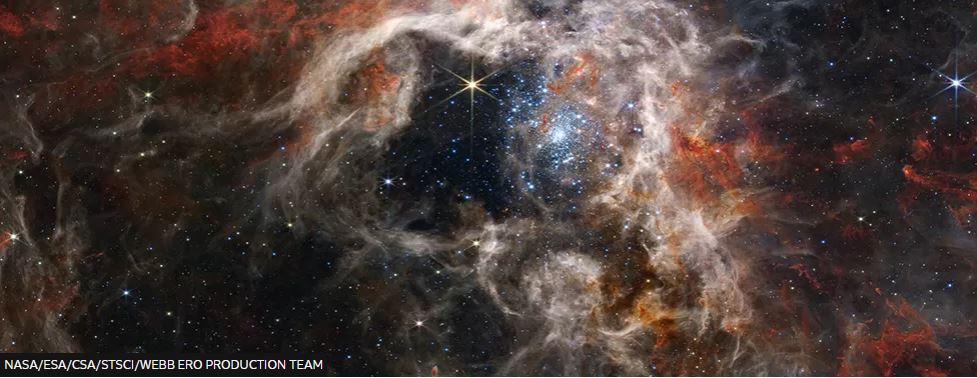
I previously wrote on the subject of the James Webb Telescope and the headlines claiming that recent discoveries call the Big Bang into question. (Is the Big Bang finally Over?) The Big Bang theory is a theory based upon the fact that we have an expanding universe, and the fact that we have an expanding universe suggests that it is expanding from a point in time. The Big Bang theory that the universe is expanding from a point of beginning some finite time ago is alive and well, but the standard model(s) developed to explain how the expansion we see is being called into question by the James Webb discoveries.

I didn’t go into technical detail about why the evidence for an expanding universe remains solid, mostly because I am not physicist, or even a “science guy”. I am interested in science and try to keep up with certain areas of science because they interest me, but I am not educated or trained in the sciences.

Today, however I heard an explanation for why the James Webb discoveries do not undermine the basic Big Bang principal, that the universe is expanding, that was simple and clear and worth repeating (if for no other reason than for me to remember it).

In conversation with Joe Rogan on his podcast, Stephen Meyer explains why the James Webb Telescope discoveries do not undermine the basic premise of the Big Bang theory. To understand this, we need to understand how the James Webb Telescope is constructed to observe matters in space further away from us than we have observed before.

We also need to understand the evidence for an expanding universe because the James Webb Telescope incorporates design elements that take advantage of the phenomenon that gives us proof of expansion in the universe. That evidence was discovered in the 1920s, and it provided the first evidence that the universe is expanding, and not static as was thought up to that point.

I will quickly explain that first evidence for an expanding universe. Then I will explain how the James Webb Telescope’s design is based on this evidence (thanks to Stephen Meyer in his conversation with Joe Rogan), and then I will explain how the success of the James Webb Telescope actually proves the basic Big Bang principal – that the universe is expanding.

Continue reading “The Reports of the Death of the Big Bang Are Greatly Exaggerated”
Joe Rogan Interviews Stephen Meyer on Intelligent Design

Joe Rogan tackles intelligent design


I am going to do something unusual (for me) today. I have listened to long podcasts and summarized them or focused on particular aspects of them. I have also read books and done the same.

Today, I am going to link to a long podcast without much comment. the podcast is the Joe Rogan Experience, the most poplar podcast available today. I am not really a Joe Rogan fan. I don’t often listen to his podcast. I am not sure I have ever listened to an entire episode, so this is a first for me.

Joe Rogan is unquestionably a curious and surprisingly intelligent interviewer. He can say some stupid things, but then (I have to confess) so can I. I suppose that combination of “common guy” persona, willingness to ask the “stupid” questions and challenge the status quo, and a modicum of intelligence is why he is so popular.

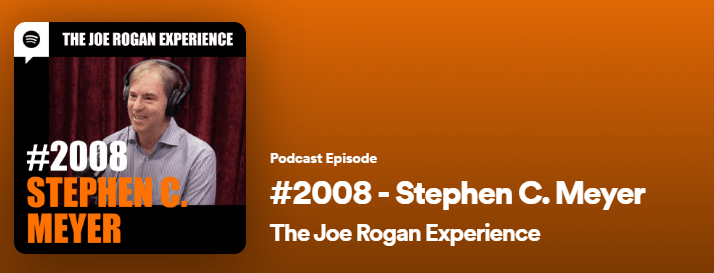
In the episode I am embedding below, Joe Rogan interviews Stephen C. Meyer, a “proponent” of “intelligent design”. The interview is particularly interesting because Joe Rogan tends toward people like Sam Harris, and Bart Erhman, and other materialists, atheists, and skeptics of religion.

Rogan isn’t just a Cretan (to use an old biblical word) as his popular persona might suggest. Though he clearly favors materialist explanations of the world, he asks good questions and gives his guests opportunity to explore contrary points of view. This is the case in the embedded interview that lasts for over 3 hours.

I am still working my way through it, but I have heard enough at the 50 minute mark to consider it worthy of putting it out there. Maybe I will come back to summarize or focus on particular aspects of the conversation. If you have listened to it (or are listening to it as I am), feel free to post your own comments.

Stephen Meyer is the author of the New York Times bestseller Darwin’s Doubt: The Explosive Origin of Animal Life and the Case for Intelligent Design and Times (of London) Literary Supplement Book of the Year Signature in the Cell: DNA and the Evidence for Intelligent Design. His many other publications include contributions to, and the editing of, the peer-reviewed volume Darwinism, Design and Public Education (Michigan State University Press, 2004) and the innovative textbook Explore Evolution (Hill House Publishers, 2007). His most recent book, Return of the God Hypothesis: Three Scientific Discoveries That Reveal the Mind Behind the Universe, is generating much discussion, like the interview embedded in this blog.

Meyer graduated from Whitworth College in Spokane, Washington, in 1981 with a degree in physics and earth science. He worked as a geophysicist before returning to academia at Cambridge University, to earn an M.Phil. in 1987 and a Ph.D. in 1991 in the Philosophy of Science. His doctoral thesis was titled “Of Clues and Causes: A Methodological Interpretation of Origin-of-Life Research.”

An Invitation to Test and See Whether God Exists

The title of this piece is a bit of poetic license. I am combining the Psalmist’s challenge to “taste and see that the Lord is good….” (Psalm 34:8) with Paul’s admonition to “test everything”. (1 Thess. 5:21) The general thrust of these two verses is an invitation to seek God and truth and to test what we think we know.

Tasting suggests that we can experience that God is good, and testing suggests that we can measure, in some respect, that experience with God. While the existence of God is not susceptible to testing and measurement like we do with science in a laboratory or in physics (for many reasons), these statements are claims that we can in some sense measure, prove, and have confidence in our conclusions.

Both writers are talking about experience in these passages, something that is frowned upon as evidence in our modern, western culture. I will come back to that. First, though, I want to make some observations.

It should go without saying that tasting and testing requires some commitment to the process. Tasting is highly experiential. If we are going try to “taste” something, we have to engage in that process.

We cannot taste through another person’s experience. It requires our own engagement in the tasting, and that requires some willingness on our part to engage.

On the subject of being scientific about spiritual experience, we can and should listen to what others say who claim to have tasted that God is good. We can and should weigh the “results” and conclusions of various people who make these claims.

In that process, we could categorize, compare, and contrast the tasting and the testing and reach some conclusions purely on basis of the data collected. I have done that anecdotally for years, and I suspect I could find some more objective data pools of these largely subjective “experiences”. The larger the data pool, the more objective we can be in our analysis of them, though they are subjective for the individuals involved.

Tasting and testing, as we are challenged to understand it in the Bible, however, is more personal than that. We can study other peoples’ experiences for a lifetime and never really know what the experience is like in the “biblical” sense of knowing.

These thoughts today are inspired by the following quotation by CS Lewis from his seminal book, Mere Christianity:

“A man can accept what Christ has done without knowing how it works; indeed, he certainly won’t know how it works until he’s accepted it.”

The emphasis on accepting something without knowing how it works seems to run counter to the way we do science, but I don’t think it really is. We do a lot of science on a hunch without knowing whether we are right or wrong. We might call those hunches educated guesses. We don’t know whether a hunch or educated guess is right until we put it to the test, and we understand it better in the process.

Continue reading “An Invitation to Test and See Whether God Exists”

Meeting People Where They Are

We don’t do this journey alone. We do it in fellowship with each other. We need each other, and we need to love each other.


The title of this blog piece seems so simplistic. Yet, this simple statement spoken by Kyla Gillespie to Preston Sprinkle in their conversation on his podcast, Theology in the Raw, hit me like a breath of fresh new air this morning.

Before getting to my point in this article, I want to reference an article I previously wrote that was largely about my perspective in my journey to faith and through faith to the spiritual place I am now. I called it, God Meets Us Where We Are.

I mention my article because it was no small revelation to me that God amazingly accommodates to us in offering us salvation. “God demonstrates his own love for us in this: While we were still sinners, Christ Died for us!” (Romans 5:8)

Again, that title seems simplistic, not very insightful, really, more like a platitude. Yet, as I unpacked the revelation of God meeting us where we are in relation to my own life journey, it didn’t so simple. It certainly wasn’t obvious to me that God meets us where we are.

Most of the world, including me at one point in my life, believes that we need to become good enough for God. The goal of most world religions and of most people who are seeking to gain salvation, nirvana, or whatever concept of “heaven” or acceptance by the divine creator of the universe people have, is to meet whatever standard that is required.

When I was asked one day why Jesus should let me into his heaven, I immediately searched my life for the positive things I had done that hoped would convince him to let me in. I don’t think I was alone in that thinking.

When the man who asked me that question eventually told me (after patiently listening to me rattle off the good things I had done) that I could do nothing to earn my way into heaven, I was floored. I wasn’t even convincing myself that Jesus should let me in!

“You mean it’s a free gift?! No one can earn it, so no one can boast?” I recited to myself, asking rhetorical questions to wrap my head around that revelation bomb that was dropped on me! Mind blown!

I have never been the same.

I grew up in an era of spiritual seeking. From Zen Buddhism to Hari Krishnas, I was just another spiritual seeker trying to “find myself”. many people like me took to the road looking for truth and meaning anywhere we could find it. Even before Oprah, people were looking inside themselves and everywhere else for God and ultimate meaning wherever they could find it.

It really isn’t all that obvious that God would come after us. After all, he is the sovereign creator of the world. Why would he have anything to do with human beings who are here today and gone tomorrow? Who are we that God should come to us?

“[W]hat is mankind that you are mindful of them, human beings that you care for them?” (Psalm 8:4)

Yet, Jesus says God loves us! He knows each one of us so intimately that He can count every hair on our heads! He knows when we come and go; He knows the words we speak, even before they trip off our tongues; and He is near to us wherever we are! (Psalm 139)

His attitude towards us is like the shepherd who seeks a lost sheep when it has wandered off. (Matthew 18:12-14) He seeks after us!

The story of Kayla is complex. She struggled most of her life with same sex attraction and gender dysphoria. She ran from church because she didn’t think she belonged and sought meaning in her dysphoria and sexual identity.


We are not different than Kyla. Most people hide the complexity (messiness) of our lives from other people because of shame and confusion, and many other things. But, God knows us. Intimately.

And He loves us. He loves us enough to die for us in our current condition! He meets us where we are.

That basic concept is the backdrop for my thoughts today: If God meets us where we are; we need to be willing to meet other people where they are.

Continue reading “Meeting People Where They Are”

Should Christians Be Like Elijah and Call Down Fire on People Who Reject Them?

God has been working out His plans and unfolding His purposes – the redemption of mankind and of His creation – throughout history


I am reading through Kings and Chronicles right now in my annual trek through the Bible, and the Prophet, Elijah, has been the “star” these last few days. Elijah means “Yahweh is my God” in Hebrew. He is known for his great faith and is one of the most prominent and revered prophets in the Old Testament.

Elijah is known for his fierce faith in the face of difficult circumstances when Ahab, the King of Israel, and his domineering, foreign wife, Jezebel killed off most of the faithful Hebrew prophets and instituted the worship of Baal and Asherah for the nation of Israel.

Elijah stood defiantly against Ahab and Jezebel who sought to kill him for his defiance Elijah is, perhaps, most known for his public challenge to the prophets of Baal and Asherah that culminated in a powerful demonstration of Yahweh’s superiority to those foreign gods.

This story and another story in a similar vein to it are the backdrop for this article. If Elijah is an exemplary man of faith, to what extent should we follow his example today in the expression of our faith in the face of governmental and cultural opposition?

Continue reading “Should Christians Be Like Elijah and Call Down Fire on People Who Reject Them?”