The Incomparable Importance of the Salvation of Kanye West

Kanye West has come out of his cocoon with big, bright butterfly wings that have all the markings of a man who is born again


I dare say that Kanye West will likely do more for North American Christianity than Donald Trump will. There is more rejoicing in heaven over one sinner who is found than over the 99, and the kingdom impact may be even more profound.

I don’t know where Donald Trump is in his spiritual walk, if he has one. The fruit isn’t apparent to me (not that I am the one to measure it). Kanye West, on the other hand, has come out of his cocoon with big, bright butterfly wings that have all the markings of a man who is born again.

He just recently announced that he will never sing his old songs (as they are) again. One Facebooker commented that Kanye West will lose millions of dollars if he does that! That is the mark of a man who has been changed by the Holy Spirt, who has traded earthly treasure for a heavenly one.

From “I am God” to “Jesus is King”

From “I am God” to “Jesus is King”, the title of his new album, the transformation is extreme. It strikes me that Kanye West is not a person to do things halfway or halfheartedly. How many of us would dare to proclaim publicly, “I am God?”

Yet everyone who refuses God’s love, who ignores that God is God, the Creator of the heavens and the earth and all that is in them, is essentially “saying” the same thing. We might not dare to say it out loud for fear that someone will think we are nuts, but we live as if we are little gods when we do not acknowledge and honor God as God.

We have watched Kanye West live out his extravagant and extreme life in the most public of ways. He is a cultural icon, one of the biggest idols of our time, but he is just a person like you and I. God is no respecter of persons.

On the other hand, God knows the innermost thoughts and intents of Kanye West’s heart, like He knows ours. God knows us all intimately. The good and the bad.

Though he once proclaimed he is God, Kanye West was not too far gone for God to reach him, to redeem him, to wash him white as snow and to set him free from the delusions and blindness that afflict us all (though maybe not as publicly). Until the scales fall from our eyes, our hearts are softened like flesh and we humbly receive God’s gift of life that no one in this world can earn, we are just as “gone” as Kanye West was.

I do fear that Kanye West has a rough road ahead. He was doing 120 mph the other way. Every fiber of his being is in the habit of going in a different direction. The wealthy and the famous are like camels trying to thread through the eyes of needles. It won’t be easy.

But, with God, all things are possible. This was the message Jesus gave us. Though it may be that difficult, God can do in Kanye West what He has done in countless men and women who have responded to that knock on the door, opened it and invited Jesus in.

Donald Trump may be seen as the savior of Evangelical power in the American political system, but I know for a fact that the impact of one sinner saved is greater than all the political power in this country and on earth. Perhaps, CS Lewis said it best:

“… Christianity asserts that every individual human being is going to live for ever, and this must be either true or false.  . . .  And immortality makes this other difference….  If individuals live only seventy years, then a state, or a nation, or a civilisation, which may last for a thousand years, is more important than an individual.  But if Christianity is true, then the individual is not only more important but incomparably more important, for he is everlasting and the life of the state or civilisation, compared with his, is only a moment.” C.S. Lewis, Mere Christianity 74-75

The salvation of Kanye West is of incomparable importance to the kingdom of God over things like the political and cultural influence of people like Donald Trump (or Kanye West for that matter) in this present world. Such temporary influence as a presidency or all of western civilization, itself, cannot compare to the unfathomable glory of the kingdom of God filled with mortal beings changed in the twinkling of an eye fully and finally into immortal, immutable children of the Living God – you, me and Kanye West included.


The Antidote to Human Pride

I knew in that instant this was the antidote to all that was wrong with me.


I didn’t grow up in the Protestant tradition. I wouldn’t say that I had a high view of God. It was more like a distant view, and His grace was a foreign concept.

I was introduced to God’s grace way back when I became a believer, about 40 years ago. That introduction to grace changed my life. No single “event” in my life was more significant.

I was selling books door-to-door over the summer between freshman and sophomore years in college for the Southwestern Book Company. After giving my spiel to an insurance salesman in his living room one day, he asked me if he could ask me a question. Not knowing what he was about to ask, or that it would change my life forever, I said, Ok.” 

As I think about it, I was probably being more polite than curious. I was also somewhat grateful to have finished my spiel and the pressure was off sell. He wasn’t interested.

So, he asked me that question, “When you die, will you go to heaven?”

I had never thought about it before, but I had been living with the guilt of all my failings – guilt mixed with a good measure of prideful disappointment in myself.

Part of my story is that I was raised Catholic. Catholicism is good for keeping our failings front and center in our minds. Not only that, but I knew (or thought I knew) all the things I “needed” to do to make them right, and I was not doing them.

I didn’t go to church anymore, but I knew I wasn’t right. Not that I really paid much attention during catechism, or Sunday school, or even mass. I was disconnected from it, but that nondescript feeling of guilt went with me.

At this point, I wouldn’t have associated what was “wrong” with me as anything having to do with God – if He really existed. I never really thought about whether God existed. I think I just accepted that He did, but I wasn’t much interested in Him at that point.

The fact of my disinterest didn’t lighten my load in the moment when that pivotal question was proposed to me on that day in the insurance salesman’s home.

The question was followed by a brief, but uncomfortable moment of silence. I was taken aback. I wasn’t ready for that kind of a question. It summoned up the deepest angst that lurked in my being, and I didn’t know just how to respond, for surely, I thought, there was a “right” response.

My friendly interrogator rephrased the question a moment later: “If you were standing before Jesus right now, what would you say to Him? Why should He let you in to His heaven?”

Of course, it is God’s heaven, isn’t it? The weight of the realization that heaven was God’s domain, and I was an outsider rested with full force upon me in the that moment. How would I convince Him to let me in? How could I convince Him?

Naturally, I began to strain to think of all the things that might matter to God. I recently began a journey. I had been through years of reckless, angry and self-destructive living, hard drinking, indulgent drug taking, when I was angry at the world (for no good reason I can now admit) … I was going nowhere fast as an angry adolescent, but I had changed.

I woke up, after a series of mishaps, to the fact that my life was likely to be very short if I didn’t change course.  I totaled two cars and had some other close calls. I was run over by a car in which I had been a passenger, driven by a “friend” who wasn’t even old enough to drive, while we were doing something stupid and illegal. Something about all of this and having to attend school in a wheelchair gave me pause about where I was heading.

(It tool a lot to change my course!)

So, I changed. I made a conscious decision to go the other way. I realized at the same time that I was desperately empty inside, out of touch with real meaning in my life and determined to find it. I became a good student in my last year in high school and became a truth seeker. Genuinely.

These things went through my mind, and I began to list out the ” good” things I was then doing: I was doing better, trying harder, getting good grades…..

The quietly earnest man in front of me let me go on for a while, before he gently stepped in with the next question – the question that changed my life. He asked: “What would you say if heaven was a free gift, and you couldn’t earn it?”

That question lit up my mind and heart and shocked me into paradigm shifting silence.

I was speechless. That question jumped the track of my usual thought process. It was foreign territory for me

He continued, unhindered by me as I stood like a prisoner blinded by the sunlight pouring in from a door suddenly opened to the outside world. “For it is by grace you have been saved, through faith—and this is not from yourselves, it is the gift of God—not by works, so that no one can boast.” (Ephesians 2:8-9)

I knew in that instant this was the antidote to all that was wrong with me.

I was a prideful, self-absorbed slave to my own demands and failings, and the door to my dingy prison cell was suddenly swung open.

Continue reading “The Antidote to Human Pride”

A Complex World Suggests a Robust God

As powerful as our telescopes are, we cannot see the end of our ever-expanding universe. Neither can we even see the beginning.


It seems that many people have this idea that God and spiritual things should be simple. They react skeptically to “complicated” responses to hard questions. When I look at the universe, though, I wonder why people think like that.

Some truths about the universe are simple. We don’t have to be rocket scientists to understand gravity. We know it when we feel it and see it. On the other hand, the computations and deeper understanding of gravity and its interrelationship with other cosmological constants is anything but simple.

Some truths about God are simple too. For instance, that God is love seems simple enough. That God created the universe is pretty simple to grasp also. Now ask, “Why is there evil in the world?”

If we take the universe as an example, however, it should be evident to us that a God who might have created the universe would be far from simple. We should not expect (or demand), therefore, that the resolution of hard questions to be simple. God must be, at least, more robust than the world created by such a God.

Continue reading “A Complex World Suggests a Robust God”

21st Century Reflections on 2nd Century Description of Christians

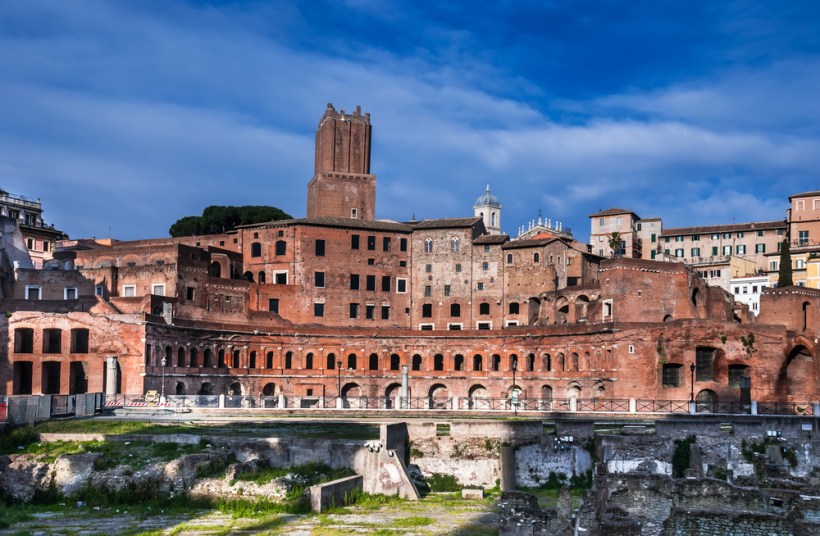
Rome, Italy. Trajan Markets, built in 2nd century AD by Apollodorus of Damascus in the time of Emperor Trajan

The following descriptions of Jews contrasted with Christians in the Roman Empire inspire my thoughts today:

“Rome respected Judaism because the religion was ancient and enduring. Jews had survived opposition for over a thousand years and, in spite of that opposition, had spread throughout the Roman Empire and beyond.… Roman authorities did not require Jews to venerate the gods (say, through sacrificial offerings in local temples) or to serve in the military, and Romans viewed and used at least some local synagogues as civic centers, which implies that Judaism served the larger Roman public, however modestly. Jews were far more integrated into Roman society than it might at first appear.

“…. Jews worshiped one God, Yahweh, to whom they were exclusively devoted; followed a rigorous set of ethical and religious practices; and refused to participate in pagan rituals and festivals. They observed a way of life that set them culturally apart. The Jewish rite of circumcision kept Romans who were attracted to Judaism from wholesale conversion. Jewish kosher laws required that Jews shop in their own stores, their dress codes made them noticeable, and their commitment to marry only fellow Jews prevented them from assimilating into Roman culture.”


“Christians appeared to live like everyone else. They spoke the local language, lived in local neighborhoods, wore local styles of clothing, ate local food, shopped in local markets, and followed local customs. ‘For Christians cannot be distinguished from the rest of the human race by country or language or custom. They do not live in cities of their own; they do not use a peculiar form of speech; they do not follow an eccentric manner of life.’ At a surface level Christians appeared to blend in to Roman society quite seamlessly.

“Yet they were different, too, embodying not simply a different religion but a different—and new—way of life. ‘They live in their own countries, but only as aliens. They have a share in everything as citizens, and endure everything as foreigners. Every foreign land is their fatherland, and yet for them every fatherland is a foreign land.’ They functioned as if they were a nation within a nation, culturally assimilated yet distinct at the same time. ‘Yet, although they live in Greek and barbarian cities alike, as each man’s lot has been cast, and follow the customs of the country in clothing and food and other matters of daily living, at the same time they give proof of the remarkable and admittedly extraordinary constitution of their own commonwealth.’”[1]

This is the fascinating description of Christians from an anonymous letter writer in the Second Century to Diognetus, a Roman official, which the writer of the book from which the excerpt is taken compares to the Roman view of the Jews in the same time period. The comparison inspires a number of thoughts that are worth exploring.

Continue reading “21st Century Reflections on 2nd Century Description of Christians”

The Unwitting Encounter that Inspired A Great Christian Novel

Gen. Lew. Wallace, 1827-1905, he was an American lawyer, union general, governor of the New Mexico Territory, politician, and author, vintage line drawing or engraving illustration

John Ingersoll, the son of a Congregationalist pastor who shared a pulpit with the famous American revivalist, Charles Finney, was an agnostic. His father was mistreated by the church, suffering contentious charges for deviating from “Old School Calvinism”, and he left the ministry and the church. His son, John, who was young at the time, was so influenced that he became a lifelong agnostic, preaching as vociferously against faith in God as his father once preached faith in God.

Such was the great, negative influence of the tensions among Christian brothers New England in the early 1800’s. Though he unwittingly sparked one of the great Christian novels in American history, Ingersoll led a life of hostility toward God and religion for which he was well-known.

The schism between Old School Calvinism and New School Calvinism lasted about 20 years beginning in about 1837. That’s it. Only 20 years! (Wikipedia)

The tension pitted conservatives from the “Old School” against upstarts from the “New School”. The Old School adherents stuck close to the “Westminster standards” and didn’t support the “New School revivalism” championed by Presbyterian revivalists, like Finney, and New England Congregationalist theologians like Jonathan Edwards.

For those interested in history, Princeton Theological Seminary was the defender of the Old School, while Yale and Lane Theological Seminary became the champion of the New School. Looking back, it is with some wonder that Princeton was on the conservative side of this controversy, the same Princeton today that produced the great skeptic New Testament scholar, Bart Ehrman.

It is also noteworthy that the “renewed interest in religion” generated by the revivalism of the Second Great Awakening that took place in the early 1800’s inspired the social activism that energized the abolitionist movement. Lyman Beecher, the father of the famous abolitionist, Harriet Beecher Stowe, was a New School Calvinist.

Revivalism and slavery were key issues in this schism. Revivalism divided the Old School and New School; while slavery divided both and eventually brought elements of the Old School and New School back together again into factions that were divided more along geographic lines – north and south – as the country teetered toward civil war.

I am struck that social and theological movements always stretch the wine skins and leave people divided, today no less than in the past. While conservatives entrench, progressives plow new paths. While old, brittle wine skins burst, wasting the contents on the ground, over eager revolutionaries might abandon the wine skins altogether. Either way, the wine (the very point of the wine skin) is often lost in the process.

I am reminded of the “proverb” spoken in Ecclesiastes: “It is good to grasp the one thing and also not let go of the other; for the one who fears God comes forward with both ….” (Ecc. 7:18 NASB)

Throughout history we see God moving among people, emphasizing new things at different times. People react by resisting, holding back and becoming entrenched or embracing the new thing, letting go of the old and eventually tilting off the path in the other direction. Wisdom lies in grasping the new thing God is doing without letting go of the truth firmly established by God in the past. This is the stretch that requires the new wine skins!

But back to the story of John Ingersoll and his unwitting influence on the writer of one of the greatest Christian novels written by an American. Lew Wallace was a Civil War General who commanded Union troops at Shiloh. Ingersoll served under him in that great battle. It was their chance encounter that prompts this article.

Continue reading “The Unwitting Encounter that Inspired A Great Christian Novel”