The First Fruits of Another World


I did a previous blog article on the radical nature of the Gospel Paul preached, a Gospel he received directly from Jesus, that was confirmed by the closest disciples of Jesus. I ended the article by noting that this Gospel was not primarily about cultural and societal change. Jesus didn’t come merely to transform culture and society, as the Zealots of the First Century supposed the Messiah would.

Jesus came preaching the good news of the Kingdom of God, a kingdom into which we can be born again by receiving Jesus, by believing in his name. The paradigm shift begins here and now, in this world, giving us “the right to become children of God, … born, not of blood nor of the will of the flesh nor of the will of man, but of God.” (John 1:12-13)

Though the reality of the kingdom of God begins here and now, the ultimate fruition of that new birth, that adoption as children of God, still awaits us. The Zealots didn’t understand that in the First Century. They wanted to overtake the Roman government by force and establish the reign of the Messiah then and there in the First Century. When Jesus died on the cross, not even the disciples understood what was going on. Paul understood, however, we he said:

“For we know that the whole creation has been groaning together in the pains of childbirth until now. And not only the creation, but we ourselves, who have the firstfruits of the Spirit, groan inwardly as we wait eagerly for adoption as sons, the redemption of our bodies.” (Romans 8:22-23)

Paul expanded on these thoughts in his letter to the Corinthians when he spoke about death coming into the world through the first Adam, while resurrection from the dead came into the world through Jesus (1 Cor. 15:20-28-42-55) First is the perishable, followed by the imperishable. What is perishable doesn’t beget the imperishable. We must be born again (the ultimate paradigm shift), from natural people into spiritual people.

This paradigm shift begins in this natural life when we are born again, but the seed of that new birth is spiritual, imperishable. When the last trumpet” will sound, “the dead will be raised imperishable”. (1 Cor. 15:52) We await in this life the fruition of the ultimate paradigm shift (from the perishable to the imperishable) in which those who have been adopted as children of God are ushered into the kingdom of God with “the whole creation” following behind in the transformation from natural world to an imperishable world where there are no tears, no pain, no sorrow – only the ultimate fulfillment of all that we could possible hope for.

We won’t see the fruition of these things in this life; rather we look forward to the resurrection from the dead and our inheritance of the imperishable life that swallows death up in victory. This is where I left off in the previous blog post: Paul… the Radical Countercultural? Picking it up from there, I want to begin here with second half of the passage quoted from the letter to the Galatians in that first article.

Paul spoke to the Galatians about the”adoption as sons” for all people who believe in Jesus. He alludes to the centuries old Greco-Roman tradition of adoption of men by men – the passing on of inheritance and legacy through the male line, which was the entrenched cultural structure of a long patriarchal society. But then, Paul did the ultimate mic drop when he said:

“For as many of you as were baptized into Christ have put on Christ. There is neither Jew nor Greek, there is neither slave nor free, there is no male and female, for you are all one in Christ Jesus. And if you are Christ’s, then you are Abraham’s offspring, heirs according to promise.” (Gal 3:27-29)

In one sentence, Paul eliminated the disparity between genders. And not only that, the differences between religious, philosophical, cultural, societal and all other things that divide people from each other.

But this was no cultural revolution. The rest of the story is found in the verses that follow in Chapter 2 of the letter to the Galatians.

Continue reading “The First Fruits of Another World”

Paul… the Radical Countercultural?

In one sentence, Paul leveled all the traditions and paradigms that characterized the Greco-Roman world

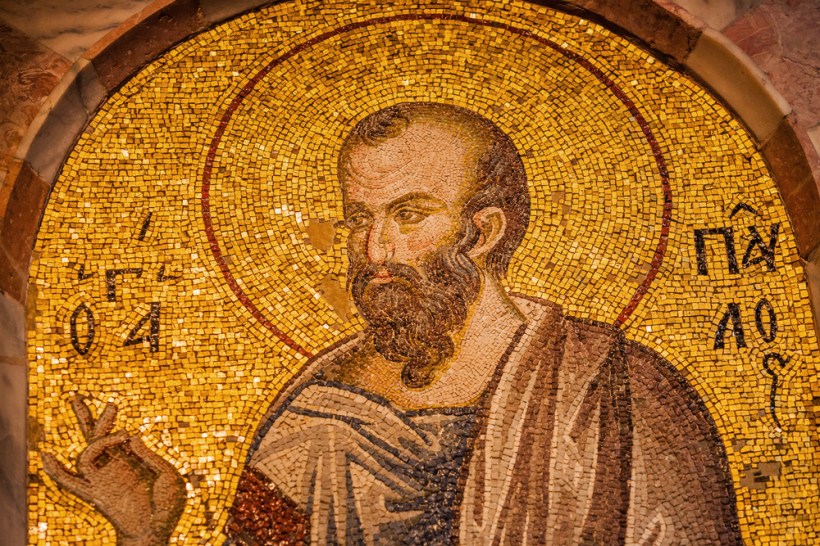
Paul Mosaic at Chora Church in Istanbul

People today don’t give Paul (or Jesus or the Bible) enough credit for “forward thinking”. We like to think that modern man has pulled himself (and herself) up by the bootstraps, a notion that emerges from our modern view of ourselves, of beings that have made ourselves after a long, doggedly determined climb out of the primordial slime.

Paul is often called patriarchal and even misogynist. He is blamed for the “backward thinking” that prevails in some areas of the church. Bronze age ideas and norms, they say, enslave the church in primitive thinking that quashes the rights of more sophisticated modern people.

There are dozens of examples in Scripture that this isn’t true. When we read the Scripture through a modern lens and don’t understand or appreciate the context of the time when it was written, we fail to appreciate the radical nature of Scripture.

I have written on these things many times in the past, but my attention is drawn to one example today. In his letter to the Galatians, Paul wrote:

“[I]n Christ Jesus you are all sons of God, through faith. For as many of you as were baptized into Christ have put on Christ. There is neither Jew nor Greek, there is neither slave nor free, there is no male and female, for you are all one in Christ Jesus. And if you are Christ’s, then you are Abraham’s offspring, heirs according to promise.

“I mean that the heir, as long as he is a child, is no different from a slave, though he is the owner of everything, but he is under guardians and managers until the date set by his father. In the same way we also, when we were children, were enslaved to the elementary principles of the world. But when the fullness of time had come, God sent forth his Son, born of woman, born under the law, to redeem those who were under the law, so that we might receive adoption as sons And because you are sons, God has sent the Spirit of his Son into our hearts, crying, ‘Abba! Father!’ So you are no longer a slave, but a son, and if a son, then an heir through God.” (Galatians 3:26-4:7)

Let’s unpack this a bit, and I think you will see what I am talking about. First, we need to consider the context of the time in which this letter was written. Then we need to look closely at what Paul is saying.

Continue reading “Paul… the Radical Countercultural?”

The Danger of Getting What We Want

We often choose earthly treasures that we can’t keep over eternal treasures that we can’t lose.


Tim Keller paraphrased and quoted a columnist back in the 1980’s who knew quite a few celebrities personally. According to Keller, the columnist said:

“I knew them when they were working behind the counter the cosmetic counter at Macy’s, and I knew them when they were bouncers at the village clubs, and all that, and then they became famous, and they became movie stars, and then they became more unhappy then they were before.

“That giant thing they were striving for, that ‘fame thing’ that was going to make everything OK, that was going to make their lives bearable, that was going to provide them personal fulfillment and with ‘ha ha happiness’, it had happened and nothing changed. They were still them. The disillusionment turned them howling and insufferable.

“If God really wants to play a rotten practical joke on us, He grants your deepest wish and then giggles merrily as you suddenly realize you want to kill yourself.”

This is quite the candid, though skeptical, observation. It’s as if the columnist wanted the celebrities to find a slice of heaven in their stars because that would mean the same heaven was possible for the columnist.

But, alas, no. It is a cruel joke. The thing we want to be our nirvana turns out to lack the substance we want it to have. If the celebrities that everyone yearns to be have been “there” and found it wanting, what hope is there for the rest of us?!

What, then is the answer? We yearn for Eden, but the things we desperately believe will take us there leave us disappointed and wanting. We believe in the pursuit of happiness, but the happiness we seek alludes us – even as we reach to close our hands around it.

The columnist impliedly blamed God for the joke, but Scripture tells us the human condition is no joke. The real problem with the human condition is that God made us for Himself. Thus, nothing else will satisfy us.

The desire for more is the thing that causes us to seek, but what we really seek is Him. When we follow after other things, instead of Him, we find them empty. Thus, when we turn to God and find that He is our fulfillment, we know that we have found what we were looking for.

I write this on the heels of an article in which I reflected on celebrity Christianity. More accurately, celebrities who have recently become Christians. In the article, I also reflected on “celebrity” Christians, people who were thrust into the Christian limelight at an early age, before a firm foundation of spiritual growth and relationship with God was established.

And I wonder how those celebrities turning to Christianity will fair in the future. They are used to the warm (and sometimes harsh) light of public celebrity. That is where they live, but what they need is the nutrient rich soil of God’s word, prayer, relationship to God, fellowship and all the things God must do in us in the dark recesses of our hearts, well out of the light of public life.

Like the rich young ruler who was searching, but found it too difficult to leave behind all his wealth to which he had become accustomed, celebrity, fame, and fortune may be difficult to give up. Even though it doesn’t satisfy the deepest longings of the soul, it is still everything most people think we want, and we can be stubborn in seeking what we want.

Riches, and celebrity, and comfort, and recognition become a trap. We are lured in. Our own desires propel us hard in the direction of the sunlight. We strain our whole lives with all our effort. All our thoughts, hopes, and dreams carry us along, and the things we gain along the way, even if they turn to dust in our hands, are difficult to give up…. If it was all we wanted.

Continue reading “The Danger of Getting What We Want”

Celebrity Christianity

LOS ANGELES, CA. November 9, 2016: Actor Brad Pitt at a special fan screening for “Allied” at the Regency Village Theatre, Westwood.

Following on the heels of public “deconstruction” stories (like Joshua Harris and Marty Sampson) and the suicide of a well-known pastor, Jarrid Wilson, come the stories about newfound faith in God by public figures like Kanye West, Demi Lovato and now Brad Pitt. I feel like we need to be careful here.

Our faith shouldn’t rise or fall on the stories of public figures. The human tendency to follow and be interested in people we admire (or even idolize) is strong. A little perspective should be maintained, though.

God is no respecter of persons.

Though we put stock in what other people do or say, people are not the standard. God, alone, is the standard, and we should be careful to focus on Him. As big and bold as a person might seem, he or she is as finite as we are, flawed by sin and limited by our individual perspectives, influenced by any number of factors, many of which we may not completely appreciate (or even be aware).

One writer surmises that our reactions to celebrities becoming Christians (or renouncing Christianity) says more about us than them.

We live in a celebrity culture in which fame equals validation and significance. When we hear news about a celebrity conversion, we usually don’t picture the lone individual standing before almighty God—stripped of all earthly trinkets and worldly success—on the same level as you and me and everyone else. We still see them in their celebrity form, as the avatar created by their promotional machine. And once someone professes faith, we tend to slip into the same worldly assessment of their significance.

This leads us to put too much emphasis (and faith) in the celebrity who becomes Christian, and that is dangerous for our faith – and theirs. We are quick to hold them up as examples and leaders, but faith, redemption, sanctification and growth in the knowledge and grace of God is a process. It takes time.

Joshua Harris wrote a book, Kiss Dating Goodbye, that catapulted him into the Christian limelight at the age of 21. Marty Sampson, the once Christian songwriter, became a worship leader for the megachurch Hillsong at the age of 20. Talent and fickle fame are not substitutes for depth and strength of character and faith.

We need to be careful not too put too much emphasis in the newfound faith of celebrities. We should not expect them to become overnight spiritual leaders. Neither should we be overly skeptical. They need room to grow and mature in Christ, like anyone else, and I fear that celebrity is not fertile soil for Christian growth.

Think of the rich young ruler.

Jesus described the way to follow him. It looks like taking up a cross. It involves learning the value of being last and adopting a servant of all perspective. Paul warns us that no one should think more highly of himself than he ought. Neither should we think too highly of others – for their sakes and ours.

Our rush to establish a celebrity as a leader in matters of faith does injustice to both the celebrity and also the church, requiring a sped-up sanctification process on behalf of the celebrity (because they’re already seen as a leader) and setting the church up for letdown when the movie star disappoints.

With said, I celebrate the newfound faith of any person, celebrity or commoner, like me. Let us pray for them and keep our eyes fixed on Jesus, the author and perfecter of their faith and ours.

Christians On Social Media


Peter said, “but in your hearts honor Christ the Lord as holy, always being prepared to make a defense [apologia; apologetics] to anyone who asks you for a reason for the hope that is in you; yet do it with gentleness and respect.” (1 Peter 3:15)

This is the tenor and main point of the article, CHRISTIANS ARGUING WITH CHRISTIANS ON SOCIAL MEDIA: A REAL INTEREST IN THE SALVATION OF THE LOST?…. I encourage you to read it. I put it here so people would read it, and so I would be reminded of it and read it again myself.

It’s far too easy to say things on social media that we wouldn’t think of saying face to face in conversation with someone. If we don’t respond to people with gentleness and respect, as Peter urges us, we are not responding in love. We might as well not respond at all.

We live in a reactionary world like never before, exasperated by social media that gives us the instant gratification of an immediate response for every thought that crosses our minds. Don’t do it!

Social media is designed for instant gratification. The algorithms are purposely designed to evoke an immediate response. Social media marketing is aimed at stirring up your emotions to get you to respond, good or bad (they don’t care). Our knee-jerk reactions, especially to contentious comments and posts, are often unkind, judgmental, harsh or worse.

We need to be more self controlled than that. We need to be more self-sacrificial, resisting that desire for immediate gratification for the good of the Gospel. We can pick up our crosses and follow Jesus in this social media age by dying to that desire for the instant response.

We need to be salt and light. Salt accentuates the taste of food, but it does that subtly. Too much salt overwhelms and destroys the flavor of the food. Just the right amount accents and brings out the flavor. People are much more apt to take notice of what we say and take it to heart if we say it with gentleness and respect, as Peter admonishes us.

Light illuminates. Too often we demonstrate heat without a great deal of light. It isn’t our job to convict people of their sin or even to convince them of the rightness of our positions. The Holy Spirit is well-equipped to do the convicting in peoples’ hearts. We just need to be faithful to speak the truth, but we need to do it in love – always in love.

God’s word does not go out and come back void, but our idea of how people should respond and what it means that God’s word does not come back void may not be accurate. We may want every post to be a mic-drop moment, but God doesn’t always work that way.

When Isaiah was given the commission to speak God’s word to the people, he was told they wouldn’t listen. It wasn’t Isaiah’s responsibility to make sure they listened. It was his responsibility simply to speak and to let God do His work. If nobody listened, still Isaiah was being faithful in what God called him to do.

Are we always speaking God’s word? We are finite beings. We might not always have it right. We should have the humility to realize that.

Our love for other people, on the other hand, is always “true”. How we treat people will always shine through and have an impact. Our greatest apologetic is the love of God. Love covers a multitude of sins.

“If I speak in the tongues of men and of angels, but have not love, I am a noisy gong or a clanging cymbal. And if I have prophetic powers, and understand all mysteries and all knowledge, and if I have all faith, so as to remove mountains, but have not love, I am nothing. If I give away all I have, and if I deliver up my body to be burned, but have not love, I gain nothing.” 1 Corinthians 13:1-3