The Alex Pretti Shooting: It’s Black and White

The black and white narratives could not be more divergent


I am reeling in sadness today, and I realize my sadness is multi-layered. The shooting and death of Alex Pretti on the cold streets of Minneapolis yesterday is tragic, regardless of the narrative anyone believes about it. The narratives we believe also expose the polarization in the United States of America and, more specifically, the dark and tragic reality of the polarization in the body of Christ in this country.

Yesterday, as I read how believers from other countries are responding to the killing of Alex Pretti by ICE agents in Minnesota, I was struck by how united they were in their narrative of what happened – unlike believers in our country at the moment.

The narratives we are telling are wildly divergent, despite many videos from different angles. The narratives people began to tell immediately after live coverage was shared to a watching world diverged as dramatically as black and white, and people have planted Christian flags on both sides.

The President and the Department of Justice issued public judgments while the crime tape was still being stretched out to mark the area for investigation. Alex Pretti is a domestic terrorist, they said. He had a gun and intended to commit mass murder. He was at fault for opposing the efforts of ICE to carry out their duties. It was a tragedy that he he is dead but it was ultimately his fault for being there, getting in the way, and carrying a gun (which is ironic in itself).

At the same time, people immediately accusing ICE agents of cold-blooded murder while the blood still oozed out of Pretti’s lifeless body in the frigid street. Alex Pretti was an ICU nurse, they said. He was a great guy who cared for people. He had a conceal license protected by the 2nd Amendment. He stepped in to help a woman, and his hands were not on his gun. ICE, the President, and the DOJ are at fault for unjustly, mercilessly, and wantonly killing him for expressing his First Amendment rights.

I realize that people rush to judgment on these things because of their biases, including me. We have all seen the same videos, and we have reached opposite conclusions in keeping with our own beliefs and narratives. If you disagree with me on everything else, I hope you have the integrity and honesty to admit this much.

Christians who focus on Romans 13, law and order, the culture war, and support the President and governing authorities come down on the side of the administration’s narrative about what happened. Christians focused on the Biblical theme of justice for the poor and needy, not oppressing the foreigner, loving your neighbor, and caring for the least, come down on the side of the opposite narrative.

The facts are the same. We all saw the same videos. They differences lie in the the way we view the world and the basic assumptions that inform our worldviews.

But, how can that be? Shouldn’t Christians be unified in Christ? Don’t we all believe that Jesus is God, the second person of the Trinity, the Word of God through whom all things were made who gave up his life on the cross to save sinners from their sin and death and rose again to give us hope for our own salvation? Why aren’t we all unified in our “biases” over this incident?

As Christians, we have sung, “They will know us by our love.” We have read the words of Jesus, who said, “The world will know us by the love we have for one another.” We have read that “God so loved the world that he gave his only begotten Son, that whosoever believeth in him should not perish, but have everlasting life..” We follow a crucified savior who gave up his life because he loved us. We have all received by faith the righteousness extended to us by the grace of God, not because we earned it, but despite the fact that we didn’t.

Yet, we are divided by the narratives we have embraced as we watch the same videos and reach exactly opposite conclusions.

This troubles me, and it should trouble you if you are also a believer. Not necessarily because I think I am right or you think I am wrong about the narrative, but because it reveals that Christians, who claim to have a special hold on truth given by divine revelation from God with the guidance of the Holy Spirit, are no different than anyone else in the world. Our unity in Christ doesn’t seem to matter. It doesn’t even seem to exist.

Continue reading “The Alex Pretti Shooting: It’s Black and White”
Do Our Past Actions Impact Our Present Choices?

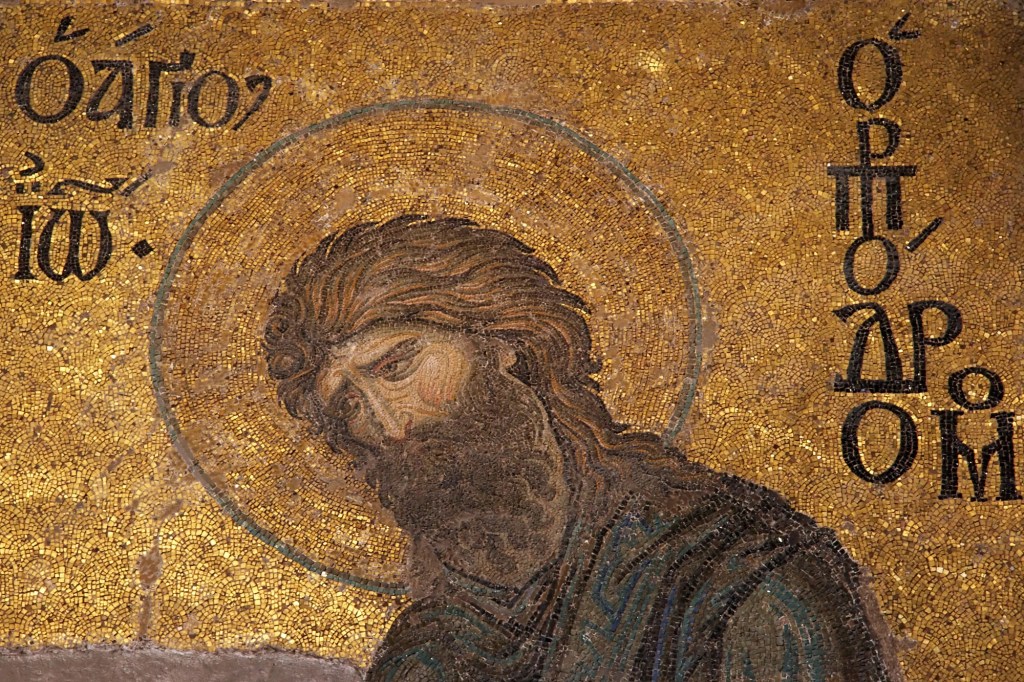
‭”[T]he Pharisees and the experts in religious law rejected God’s purpose for themselves, because they had not been baptized by John.”

My thoughts today might seem a little obscure, but let me set the stage first.  Imagine the scene when two followers of John the Baptist were sent to ask Jesus a question. News of what Jesus was doing had traveled far and wide. People even reported that Jesus brought a dead man to life!

This is the backstory. Jesus happened upon a funeral procession. (Luke 7:11-17) The dead man being carried to his final destination was the only child his mother had, and she was a widow. Jesus was filled with compassion, ands he did the unbelievable. Jesus brought that dead man back from death!

This man and his mother were locals. They lived in a nearby town. They were talking, and it wasn’t just them. People saw it, and they were talking about it also. A crowd had witnessed the whole spectacle.

News about Jesus spread throughout Judea and the surrounding country, so that people were coming to Jesus from all around. John the Baptist heard about these things also, and he sent two of his followers to ask, “Are you the one who is to come, or should we expect someone else?”

(Luke 7:20) (As an aside, Luke does not tell us why John did not come himself, but we know from Mathew that John was in prison. (Matthew 14:1-12)

The “one” John the Baptist wondered about is the Messiah who had long been expected. John and his ancestors kin had been reading about the Messiah in the prophets for centuries. The time seemed right. Many had come recently, claiming to be him, but they were killed, and their following faded. Still, expectation was in the air.

John was imprisoned because he was open and blunt with criticism of Herod the Tetrarch, the local governor, who married his brother’s wife. Herod imprisoned John to silence him.

John was equally straightforward and to the point with the question he sent his followers to ask, “Are you the one?”

John the Baptist’s followers arrived on the scene as Jesus was curing people with diseases, sicknesses and evil spirits, healing people and even giving sight to the blind. When they asked him whether he is the one, or whether there is someone yet to come, Jesus said

“Go back and report to John what you have seen and heard: The blind receive sight, the lame walk, those who have leprosy are cleansed, the deaf hear, the dead are raised, and the good news is proclaimed to the poor. Blessed is anyone who does not stumble on account of me.”

Luke 7:22-23

These words were familiar to John. They come from the book of Isaiah, one of those the prophets that foretold the Messiah to come (see Isaiah 35:5 and 61:1). The Messiah was predicted to be the cornerstone of a new order, but the prophets also warned that he would be rejected, and he would be a stumbling block for many. (See here)

The Pharisees and religious leaders also would have known exactly what Jesus alluded to in his response to John’s followers, though they didn’t even ask the question, and they probably were not privy to the answer. For them, Jesus was a stumbling block. The way Luke describes their response is what prompts me to write today.

Continue reading “Do Our Past Actions Impact Our Present Choices?”

Focusing on Following Jesus in a Chaotic World

God continues to work out His purpose in history.


There is so much angst in the world today. First the corona virus and now the explosion of racial tensions. The political and worldview polarization we we have experienced in recent years have been magnified as political machines ramp up for another presidential election. It even threatens to pull the church apart.

I have recently written about black lives matter and white privilege from a biblical perspective, in an attempt to redeem those phrases from a biblical point of view.  I realize that those terms are loaded. The Black Lives Matter organization has a specific message and worldview that runs contrary to biblical principles at various points, but I tried to find the kernels of truth in those phrases through a biblical lens.

We run a risk in the church of getting off the narrow path of following Jesus by aligning ourselves too closely with a particular political platform, secular philosophy or other way of viewing the world that is not gospel focused. We also run a risk of falling off the narrow path the other way, by  reacting in opposition to everything a particular political platform, philosophy or worldview stands, just because some of it (or even most of it) is contrary to “off”.

Truth is truth, and truth is objective. No one person or particular view is apt to be absolutely true, because we are flawed beings with limited perspective. The likelihood of one person, one church, one theology being absolutely true in every detail is not likely.

At the same time, truth is truth. It is objective, and people can see it. That means that even people who may not acknowledge the truth of the gospel may, nevertheless, accurately see some aspect of the truth.

It’s like science, the facts and evidence must be interpreted. We are all looking at the same facts and evidence, but we do not all interpret it the same way. Still, the facts and evidence are the same. We continually discover new facts and evidence that alters our interpretations of the facts and evidence we previously knew, and we sometimes discover that what we thought we knew is not accurate.

God, of course, never changes. He is the same yesterday, today and forever. Our perspective, knowledge and understanding, however, is finite and limited, and that requires we adopt a posture of humility in our understanding.

God’s Word doesn’t change, but our perspective of it changes. Think of the radical change of perspective Jesus introduced to the descendants of Abraham! God became man, came to His own people, and they didn’t even recognize Him!

Continue reading “Focusing on Following Jesus in a Chaotic World”

On the Near-Death Experience of an Atheist and Speculation on Its Effect

Whatever our experiences, our beliefs often win out. Our beliefs are not always divorced from what we want to be true, though they may be (by the same token) disconnected from reality. 


The subject of near-death experiences is a deep rabbit hole I have come to find out. I have listened to a number of testimonies recently of people who have had near-death experiences. Trying to make some sense of them led me to look up what Gary Habermas has to say about them. Habermas has been involved in the research of near-death experiences (NDEs) for a couple of decades.

This blog piece follows a summary of what Habermas says about NDEs. (See Habermas on Near-Death Experiences) I am picking up here where I left off about the near-death experience of the famous atheist, Sir Alfred Jules (AJ) Ayer, that is self-described in the article, What I Saw When I was Dead. This piece explores beyond the suggestions Habermas makes (that NDEs may be influenced by worldview) and gets behind the public persona of Ayer after his NDE.

To the extent that Ayer is “arguably the most influential 20th century rationalist after Bertrand Russel“, his encounter with a seemingly irrational near-death experience is interesting indeed.

Continue reading “On the Near-Death Experience of an Atheist and Speculation on Its Effect”

Reflections on Gauging the Light and the Dark

Though we have the greatest intellectual and cognitive faculties of any other creature in the world (that we know), we are limited in our knowledge and ability to understand.

Depositphotos Image ID: 80301160 Copyright: SergeyNivens

I’ve heard the following Chinese parable a couple of times. It’s on my mind today:

An old farmer who had an old horse for tilling his fields. One day the horse escaped through the fence. When the farmer’s neighbors sympathized with the old man over his bad luck, the farmer replied, “Is it bad luck? Good luck? I don’t know?”

A week later the horse returned with a herd of wild horses from the hills. This time the neighbors congratulated the farmer on his good luck. His reply was, “Is it bad luck? Good luck? I don’t know?”

The next day, when the farmer’s son attempted to tame one of the wild horses, he fell off its back and broke his leg. The neighbors came around again and commiserated with the old farmer about his very bad luck, but the farmer’s reaction was, “Is it bad luck? Good luck? I don’t know?”

Some weeks later the army marched into the village and conscripted every able-bodied youth they found there. When they saw the farmer’s son with his broken leg they let him off. Now was that good luck? Or was it bad luck?

We like to jump to conclusions, and we have a tendency to jump to those conclusions pretty quickly. We do this even with ultimate, worldview positions. We have a tendency to want to measure everything by the tools that are convenient and familiar to us, but sometimes we need to be willing to venture off from the light of our comfortable positions into the darkness of unfamiliarity to gain a bigger perspective.

Continue reading “Reflections on Gauging the Light and the Dark”