Ten Quick Responses to Difficult Questions on Faith with the Help of John Lennox

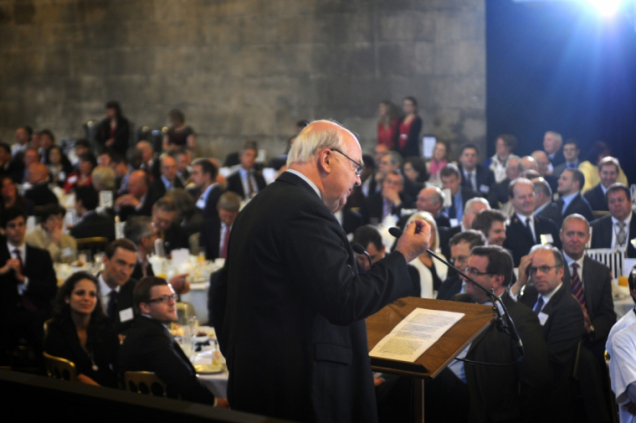
john-lennox-houses-of-parliament


The ten statements and responses suggested below are inspired by a presentation by John Lennox, the famous mathematician, philosopher and Christian theist. Neither the statements nor the responses are comprehensive in the least, but they offer a quick look into the richly rational world of faith through a theistic (and Christian) lens. At the same time, they expose the shallowness of many atheistic objections to the idea of God.

                1)   Christians are really just atheists regarding Zeus and other gods. True atheists go one god further and reject the Christian god.

Statements like these reveal a willful ignorance. The Christian God (as with Allah of Islam and Yahweh of Judaism, for instance) is an exclusive claim: there are no other gods. That Christians, Muslims and Jews cannot all be correct in their understanding of that exclusive God does not negate the possibility that such a God exists. Continue reading “Ten Quick Responses to Difficult Questions on Faith with the Help of John Lennox”

What of Rupert Sheldrake?

Brooke Elkstrom Lake Sunset 2


This piece is a bit afield for me. I am embedding a “banned TED Talk” given by Rupert Sheldrake, a Cambridge, Harvard educated, scientist and bane of the scientific community. What of Rupert Sheldrake?

He is not a Christian, though he reportedly says the Our Father every day. Dr. Sheldrake “evolved” from a biochemist and cell biologist to a plant physiologist and eventually to a researcher in the field of parapsychology.[5] He is known for his “morphic resonance” concept.[6] He is the darling of New Age adherents, not Christians. He is also labeled a “heretic” by his scientific fellows.

So why would I include a piece on Rupert Sheldrake in a Christian-orientated blog site? Continue reading “What of Rupert Sheldrake?”

Are Reason & Faith in God Contradictory Terms?

Looking for a Sunset

I began taking notes on a series of hard questions posed to Tim Keller by some heavy hitting interviewers that is posted to the Veritas Forum. I thought I would take my notes and create a series of quick answers to these hard questions, but I got sidetracked by the first question: Aren’t faith and reason contradictory terms?

The question took me back to college when I first began to wrestle with this question.

Implied in that question is an assumption that the only rational conclusion of reason is disbelief in God. Reason is defined by Merriam Webster as “the power of the mind to think and understand in a logical way.” Faith is defined as the “strong belief or trust in someone or something.”

Note that faith is not defined in relation to evidence or reason, and this common definition of faith is not antithetical to evidence of reason either.

Reason (logic) depends on a premise, and premises are often tautological. Many premises are susceptible of proof, but many are not. The premise that the natural world is the totality of all reality is a premise many believe to be true, but it is not susceptible of proof (at least not scientific proof, unless one believes that science, which is limited to the study of the natural world is capable of proving that nothing other than the natural world exists though it is limited to the study of the natural world).

Continue reading “Are Reason & Faith in God Contradictory Terms?”

Connecting to Our Theological Hardwiring

Children come by the inward conviction of God naturally; adults have a harder time with it.

Julia4 at Hershey

Jesus instructed His disciples to let the children come to Him, and he instructed His disciples to become like children to enter the Kingdom of God.

“Faith comes naturally and normally for children. Certain assumptions about the world and its creator seem to arise intuitively at an early age. For example, children tend to believe in spiritual beings without any trouble, and they distinguish between fairy tales and God in sophisticated ways. They believe the world was made for a purpose and by something greater than human beings. Essentially we have the beginnings of theology in some way hardwired.” (A statement from an article in Christianity Today, The Great Congruence of Science and Faith.)

Faith and science hardly seem to be a place of congruence in popular opinion and even less congruent with that popular opinion is a statement about theology hardwired in children. Or is it? Charles Darwin once commented that he could not trust his “inward conviction… that the Universe is not the result of chance”. (The Darwin Project, UK) Darwin recognized the “hard wiring”, but he rejected it on the basis of evolutionary principles. (See also Random Thoughts on Evolution)

Children come by this inward conviction naturally; adults have a harder time with it. Modern thinkers might say that other things are hardwired into people, such as sexual tendencies and gender identity. The Bible recognizes that we are born into sin, which is why we need to be born again. There is something in the way a child approaches the world, however, that is productive toward faith.

I am reminded of the words of Jesus, “Let the little children come to me, and do not hinder them, for the kingdom of God belongs to such as these.’” (Luke 18:16) The context in which He spoke those words is as important as the words themselves. People were bringing small children to Jesus for him to pray for them, but the disciples attempted to keep them away from the important things Jesus was doing. Instead of continuing with whatever he was doing, Jesus stopped and welcomed the children. Then he said something even more important:

“‘Truly I tell you, anyone who will not receive the kingdom of God like a little child will never enter it.’” (Luke 18:17)

God does not want us to lose that “theological hard wiring”. We have in us a tendency toward sin as well as a tendency toward faith. Paul would say that truth is written on our hearts so we are without excuse, regardless of the intellectual gyrations we use to quash that hard-wired tendency to believe in God.

As we get older, we become more self-sufficient and more self-important. We become more dependent on ourselves, and we have a hard time allowing anyone or anything to dictate to us. We blaze our own trails. We chart our own courses. We separate from our parents, and we separate from God. We lose the wonder of childhood. We become jaded, hardened and tend toward the sinful tendencies if we are not careful.

Disillusioned Politician


Is it any wonder that we need to be born again to see the kingdom of heaven? We need a different approach than what we would naturally take as we get older. We need to become like a child to approach God, stripped of the self-reliance that we strive to attain as adults.

Faith opens the eyes of the believer up to the wonder of God in the world. The congruence of faith and science and reason and the reality in which we live is natural and normal, but we live in a fallen world that is tending away from God, tending toward destruction and decay. Faith takes us in a different direction.

At the end of the day, what is more reliable about our ability to reason over that inward conviction? Both reside in finite human frailty. One will take us to the gate of heaven; the other will take us no further than the grave. One is not more prone to error than the other. Or is it?

Without faith we will not see the kingdom of heaven. If we will not receive what God has provided for us like a child, we cannot grasp it at all. The congruence of faith and truth is found in God who can only be worshiped in spirit and truth. Spirit requires that we let go of our own conceptions that are limited by our finite experience and knowledge and ability to reason and open up to what God would reveal to us.

To approach the world like children, as God instructs us, is to remain open to correction and change of direction as God would guide us. In fact, in the same context in which Jesus said we must be born again, Jesus added:

“‘You should not be surprised at my saying, ‘You must be born again.’ The wind blows wherever it pleases. You hear its sound, but you cannot tell where it comes from or where it is going. So it is with everyone born of the Spirit.’” (John 3:7-8)

If we are to be born again, born of God, was must be open to the influence of God, to the direction of God. We must be sensitive to the wind, the breath of God, His Holy Spirit. Like a child, we may not always be happy or understand the direction that we are going, but a child would not think to go in any direction apart from God in whom and on whom we are utterly dependent. We need to plug into the hard-wiring God built into us that is connected to Him and walk away from any sinful tendencies we might have.

Reprinted from NavigatingByFaith